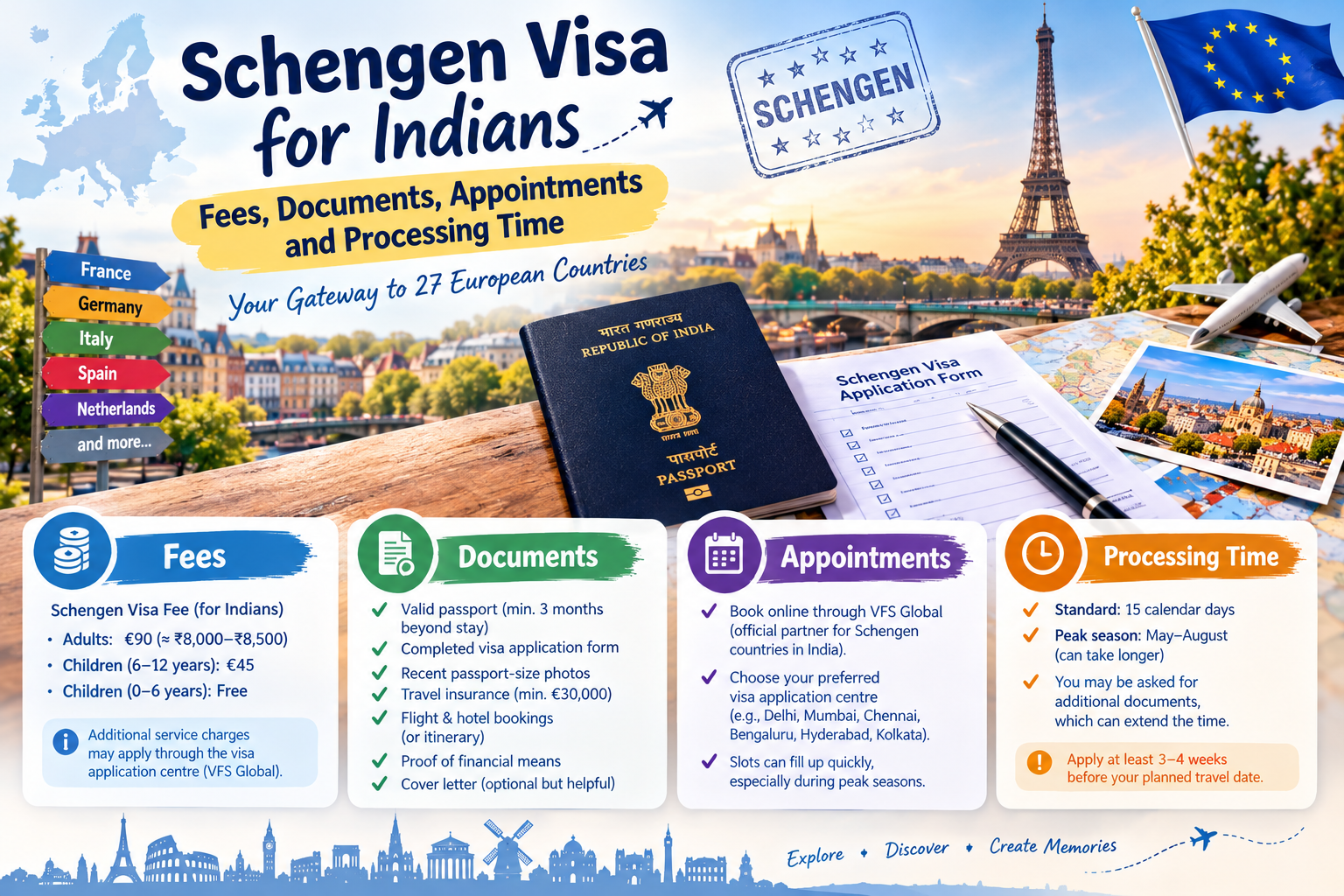
Schengen Visa for Indians: Fees, Documents, Appointments and Processing Time
Want to customize this package?
Share your dates and travellers. This enquiry is free. Small changes to a standard itinerary—such as a date change or an extra day—can be discussed with our team.
If you are planning a Europe tour from India, the Schengen visa is the one document that matters most. A single Schengen short-stay visa lets you visit 29 European countries, including France, Switzerland, Italy, Germany, the Netherlands, Spain and the Nordic countries, for up to 90 days. This guide explains, step by step, how Indian passport holders apply: which embassy to choose, the documents you need, the fees, how long it takes and how to avoid the most common reasons for rejection.
We help hundreds of travellers with their Europe visa every year, so the advice below is practical as well as accurate. Rules do change, so always check the latest checklist on the embassy or VFS Global website before you apply.
What is the Schengen visa?
The Schengen area is a group of 29 European countries that have removed passport checks at their shared borders. For travellers from India, this means one visa covers the whole area: you enter through one country and move freely between the others by road, rail or air. The tourist visa is called a Type C short-stay visa and allows stays of up to 90 days in any 180-day period.
The Schengen countries are Austria, Belgium, Bulgaria, Croatia, the Czech Republic, Denmark, Estonia, Finland, France, Germany, Greece, Hungary, Iceland, Italy, Latvia, Liechtenstein, Lithuania, Luxembourg, Malta, the Netherlands, Norway, Poland, Portugal, Romania, Slovakia, Slovenia, Spain, Sweden and Switzerland. The United Kingdom and Ireland are not part of Schengen, so a tour that includes London needs a separate UK visa.
Which country's embassy should you apply to?
You must apply to the country that is your main destination, meaning the one where you spend the most nights. If you spend an equal number of nights in two or more countries, apply to the country you enter first. On a group tour, your itinerary decides this. For example, on our Paris and Switzerland tour you spend three nights in France and four in Switzerland, so you apply to Switzerland; on a Paris, Amsterdam and Switzerland tour with three nights in each of Paris and Switzerland, you apply to France if you land in Paris.
Many travellers search for which Schengen country gives a visa easily. In practice every Schengen country applies the same rules, and choosing an embassy that does not match your itinerary is itself a reason for refusal. Apply to the right country with a strong file instead.
Schengen visa documents checklist for Indians
- Passport issued within the last 10 years, valid for at least 3 months after you leave the Schengen area, with two blank pages. Include copies of old passports with previous visas.
- Visa application form, filled in online and signed.
- Two recent photographs, 35 x 45 mm, white background, matte finish.
- Cover letter explaining the purpose of the trip, the dates, who is travelling and who is paying.
- Tour confirmation or day-by-day itinerary with hotel bookings. When you book a group tour with us, we provide this on our letterhead.
- Flight reservation showing entry to and exit from the Schengen area.
- Travel medical insurance valid for all Schengen countries, with cover of at least €30,000, for the whole trip.
- Bank statements for the last 3–6 months, stamped by the bank, showing regular income and enough balance for the trip.
- Income tax returns (ITR acknowledgements) for the last 2–3 years.
- Proof of employment: salaried travellers give a leave letter from the employer and recent salary slips; business owners give company registration, GST certificate and company bank statements; retired travellers give pension proof.
- For children: birth certificate, and a no-objection letter from a parent who is not travelling.
Each embassy publishes its own checklist, and some ask for extra papers, so download the latest list from the VFS Global website for your embassy and city.
Schengen visa fees for Indians
| Applicant | Visa fee |
|---|---|
| Adults (12 years and above) | €90 |
| Children 6–11 years | €45 |
| Children under 6 | Free |
The fee is paid in rupees at the exchange rate set by the embassy, together with a VFS Global service charge and any optional services such as courier or a premium lounge. The visa fee is not refunded if the application is refused.
How to book a Schengen visa appointment
Most Schengen embassies in India use VFS Global (some use BLS International or TLScontact) to collect applications in cities such as Delhi, Mumbai, Bengaluru, Chennai, Kolkata, Hyderabad, Pune, Ahmedabad, Chandigarh, Jaipur and Kochi. Register on the centre's website, fill in the form, pay the fee and choose a slot. At the appointment you submit your documents and give biometrics (fingerprints and a photo).
From April to July and before Christmas, appointments in Delhi and Mumbai can be booked out for weeks. Start looking as soon as your tour is confirmed. If you gave fingerprints for a Schengen visa in the last 59 months, some embassies may not need them again.
Schengen visa processing time
The standard processing time is 15 calendar days from the appointment. It can be extended to 30 or, in rare cases, 45 days if the embassy needs more documents. You can apply up to six months before travel and no later than 15 days before. Our advice: apply six to eight weeks before departure in the off-season, and two to three months before for summer and December trips.
The 90/180 rule and multiple-entry visas
On any day, count back 180 days: you may not have spent more than 90 of them in the Schengen area. A typical 7 to 15-night tour is well within the limit. Indian travellers with a good travel history can receive longer, multiple-entry visas: under the EU's cascade rules for Indian nationals, people who have used previous Schengen visas lawfully may be given visas valid for two years, then five years. From October 2025 the EU's Entry/Exit System also records your fingerprints and photo at the border on your first entry, so allow a little extra time at immigration.
Common reasons for refusal, and how to avoid them
- Weak finances: large deposits just before applying look suspicious. Keep a steady balance and show regular income.
- Unclear purpose: a vague or changing itinerary. A confirmed group tour with fixed hotels is the strongest proof.
- Doubts about returning to India: show your job, business, property or family ties.
- Wrong embassy: applying to a country that is not your main destination.
- Insufficient insurance: cover below €30,000 or not valid for the whole trip.
If your visa is refused, the letter states the reason. You can appeal or apply again with a stronger file; most refusals are fixed by addressing the stated reason.
Schengen visa for children, senior citizens and business owners
Children need their own application, a birth certificate and, if one parent is not travelling, a notarised consent letter from that parent. Children under 12 do not give fingerprints. Senior citizens should show pension statements, property or investment proof and a letter from children who are sponsoring the trip, if any; insurance for travellers over 70 costs more, so buy it early. Business owners and self-employed travellers should add company registration, GST returns, company bank statements and a letter on the company letterhead explaining who will manage the business while they travel. Students need a bonafide certificate and leave letter from the college, and parents' financial documents.
How Dreamland Vacations helps
When you book a Europe group tour with us, our visa desk prepares your cover letter and tour confirmation, checks your documents against the embassy's checklist, and helps you book the appointment. We also arrange travel insurance that meets the Schengen rules. Browse our Europe tour packages or read how to plan a Europe trip from India.
Europe tours we can help you with





Frequently asked questions
How much is the Schengen visa fee for Indians?
€90 for adults, €45 for children aged 6 to 11, and free for children under 6, plus the VFS service charge.
How long does a Schengen visa take for Indians?
Usually 15 calendar days from the appointment, sometimes up to 45 days. Apply six to eight weeks before travel, earlier for summer and December.
Which Schengen country gives a visa easily?
All Schengen countries follow the same rules. Apply to the country where you spend the most nights; choosing a different country to get an 'easy' visa can lead to refusal.
Can I visit Switzerland on a Schengen visa?
Yes. Switzerland, Liechtenstein, Norway and Iceland are part of the Schengen area even though they are not in the European Union.
Do I need a Schengen visa for London?
No. The UK is not in the Schengen area and needs a separate UK visitor visa.
Is travel insurance mandatory for the Schengen visa?
Yes. You need travel medical insurance valid in all Schengen countries with cover of at least €30,000 for the whole trip.
How early can I apply for a Schengen visa?
Up to six months before your trip, and no later than 15 days before.
Plan your Europe trip
Book your Europe tour with us and our visa desk will guide you through the Schengen application.
Get a free quote