Europe Christmas & New Year Tour – Paris, Switzerland & Italy, 10 Nights / 11 Days
Standard Package

Europe Christmas & New Year Tour – Paris, Switzerland & Italy, 10 Nights / 11 Days

Spend Christmas in Paris and New Year's Eve in Venice on this 10 nights / 11 days group tour departing 24 December 2026, covering Paris, Switzerland,…

⌖ Europe ✦ Family & senior friendly planning
Package snapshot
DestinationEurope
Travel styleStandard Package
From ₹257,143 per person (twin sharing), land only, GST extra

Price updated 10 Nov 2026, 6:00 AM IST at today's exchange rate. Vendor payments are in foreign currency, so the final amount is fixed at our selling exchange rate on the date of full payment. GST 5% and TCS 2% extra at checkout.

Your holiday

Europe Christmas & New Year Tour – Paris, Switzerland & Italy, 10 Nights / 11 Days: overview

Christmas in Paris, snow in the Alps, New Year in Venice

This holiday gives you the three Europes that most Indian travellers dream about, at the most magical time of year. You land in Paris on Christmas Eve and spend Christmas Day at the Eiffel Tower and Versailles. You stand in the snow at the Top of Europe in Switzerland. Then on New Year's Eve you glide through the canals of Venice in a gondola, and begin the New Year in Florence, Pisa and Rome.

In Paris: a guided city tour, the top level of the Eiffel Tower, Versailles, a Seine cruise and a full day at Disneyland® Paris. In Switzerland: Geneva, Jungfraujoch – the Top of Europe, Mt. Titlis, a Lake Lucerne cruise and the Rhine Falls. In Austria: the Swarovski Crystal Worlds and Innsbruck. And in Italy: Venice with a gondola ride, a guided walk in Florence, the Leaning Tower of Pisa, and Rome with St. Peter's Basilica.

A professional tour manager travels with the group throughout, you stay in superior 4-star hotels, and Indian lunches and dinners with Jain, vegetarian and non-vegetarian options are included, along with two gala dinners, for Christmas and New Year's Eve. If you want Italy as well as Paris and the Alps, this Italy, Paris and Switzerland tour package is the one: an Italy tour package from India and a Paris and Switzerland holiday in a single trip. See all our Europe tour packages.

Good to know

Package typeStandard Package
Planning supportSmall changes by enquiry
Best forFamilies, couples & seniors
Book now – pay 30%
Trip highlights
✦ 24 Dec · Arrive in Paris | Christmas Eve in the City of Light
✦ 25 Dec · Paris city tour, Eiffel Tower top level, Versailles and Seine cruise | Christmas Day in Paris
✦ 26 Dec · Full day at Disneyland® Paris | A day of magic for all ages
✦ 27 Dec · Paris to Geneva | Into the mountains
✦ 28 Dec · Jungfraujoch – Top of Europe and Interlaken | Standing on top of Europe
✦ 29 Dec · Mt. Titlis, Lucerne and Lake Lucerne cruise | Snow, a storybook town and a lake
Day-wise plan

Europe itinerary: day by day

Day 1
24 Dec · Arrive in Paris | Christmas Eve in the City of Light

24 Dec · Arrive in Paris | Christmas Eve in the City of Light

⌖ Paris 🍽 Meals: Dinner

Imagine stepping off a long flight and into Paris on Christmas Eve. That's how this holiday begins: eleven days that take you from the City of Light through the snowy Swiss Alps and the Austrian Tyrol to the canals of Venice, the art of Florence and the ancient wonders of Rome. Your Dreamland Vacations representative meets you in the arrivals hall at Paris Charles de Gaulle, and from the moment you step onto the coach, everything is taken care of. The plans, the tickets, the hotels and the meals are arranged; all you need to do is look out of the window and enjoy.

The drive into Paris on Christmas Eve has a special atmosphere. The motorways are quieter than usual, because many Parisians have already left the city to spend the holidays with family in the countryside, while those who stay are busy with last-minute preparations. As the coach nears the centre, the familiar Paris appears: honey-coloured stone buildings, wrought-iron balconies, café terraces with wicker chairs, and church towers rising over the rooftops. Everywhere there are signs of Christmas: wreaths on doors, small fir trees for sale on street corners, and lights twinkling in apartment windows.

Christmas in France has its own traditions, many of them quite different from those you may know. French children believe in Père Noël, Father Christmas, who comes on Christmas Eve, and traditionally they leave their shoes by the fireplace or under the tree for him to fill with gifts. Many French homes set up a crèche, a nativity scene with small painted clay figures called santons, a tradition that comes from Provence in the south of France. Here, the figures don't just include the holy family and the shepherds but whole villages: bakers, fishermen, washerwomen and farmers, all heading to the stable. In the south of France, families even finish their Christmas Eve feast with thirteen desserts, representing Jesus and the twelve apostles.

Paris is also a city of great churches, and on Christmas Eve they come alive. Notre-Dame Cathedral, which reopened in December 2024 after five years of restoration following the fire of 2019, once again holds its Christmas services, and its bells ring out over the island where Paris began. At the beautiful church of La Madeleine, built like a Greek temple with towering columns, and in churches across the city, people gather for evening and midnight masses, filling the cold night air with music. Even if you only pass them from the coach, it's moving to see the doors open and the candlelight glowing inside.

Once you reach your hotel and check in, take time to rest. After an overnight flight, a hot shower and a short nap work wonders, and you'll want your energy tonight. If you'd like some fresh air, take a gentle walk around the neighbourhood. Notice the small shops: the boulangerie with its golden loaves, the pâtisserie with its rows of perfect pastries in the window, the fromagerie with dozens of cheeses, and the florist with bunches of winter flowers. On Christmas Eve, many of these shops close early so their owners can celebrate with their families, so enjoy them while they're open.

Darkness falls around five o'clock, and Paris lights up for the night. The Champs-Élysées has been decorated for Christmas for decades, with hundreds of trees along the avenue wrapped in lights, and the grand avenues of the fashion district, like Avenue Montaigne, glitter with their own elegant decorations. In the distance, you may catch sight of the Eiffel Tower lit up in gold, and on the hour, sparkling with thousands of flashing lights.

Tonight is the highlight of your first day: the group's Christmas Eve gala dinner. In France, Christmas Eve is the most important evening of the year, when families sit down to the réveillon, a long, joyful feast that can last until midnight. You'll celebrate your own réveillon with your fellow travellers: a beautifully set table, a special festive menu with Jain, vegetarian and non-vegetarian options, and a warm, celebratory atmosphere. It's the perfect way to meet the people you'll be travelling with for the next eleven days, and many friendships begin around this table. Your tour manager will also share the plan for tomorrow and a few tips for exploring Paris.

When you return to your hotel, tired but happy, remember where you are: in Paris, on Christmas Eve, at the very start of a journey across Europe. Sleep well. Tomorrow is Christmas Day.

Included today: group arrival transfer from Paris CDG (for flights landing 8 am–2 pm), Christmas Eve gala dinner.

Good to know: hotel check-in is usually mid-afternoon. Paris is around 2–7°C in late December, so keep a warm jacket, scarf and gloves in your hand luggage. Some attractions close or change their hours over Christmas, so the order of sightseeing may be switched between days; you still see everything included.
Day 2
25 Dec · Paris city tour, Eiffel Tower top level, Versailles and Seine cruise | Christmas Day in Paris

25 Dec · Paris city tour, Eiffel Tower top level, Versailles and Seine cruise | Christmas Day in Paris

⌖ Paris 🍽 Meals: Breakfast, Lunch, Dinner

Joyeux Noël! It's Christmas Day, and Paris is yours. On Christmas morning the city is at its most peaceful: the streets are quiet, most shops are closed, families are at home opening their presents, and the great monuments stand calm in the soft winter light. It's a rare chance to see Paris without its usual rush.

Your local guide joins the coach after breakfast, and the city tour begins in some of the most elegant corners of Paris. At Place Vendôme, an octagonal square of matching 17th-century facades, the windows of the world's top jewellers sparkle around a tall bronze column. The famous Ritz hotel stands on one side, and at number 12 the composer Frédéric Chopin spent his last days in 1849. A few streets away, the Opéra Garnier is a wedding cake of marble, gold and statues. Its grand auditorium is lit by an enormous chandelier weighing several tonnes, and in 1896, part of its counterweight fell into the audience, one of the real events that inspired the story of The Phantom of the Opera.

The tour continues past the Musée d'Orsay, a former railway station that now holds the world's finest collection of Impressionist art, and on to Place de la Concorde. Originally named after King Louis XV, the square was renamed after the Revolution, during which it became the site of the guillotine; today it's home to a gleaming 3,000-year-old Egyptian obelisk from Luxor, topped with gold. From here, the Champs-Élysées sweeps up towards the Arc de Triomphe, its trees glittering with Christmas lights. Twelve avenues meet at the arch like the points of a star, and the traffic circling it, with no lanes at all, is a spectacle of its own. Then you cross the river by Pont Alexandre III, decorated with golden winged statues and Art Nouveau lamps, and pass Les Invalides, which Louis XIV built as a hospital and home for wounded soldiers. Beneath its shining gold dome lies the tomb of Napoleon.

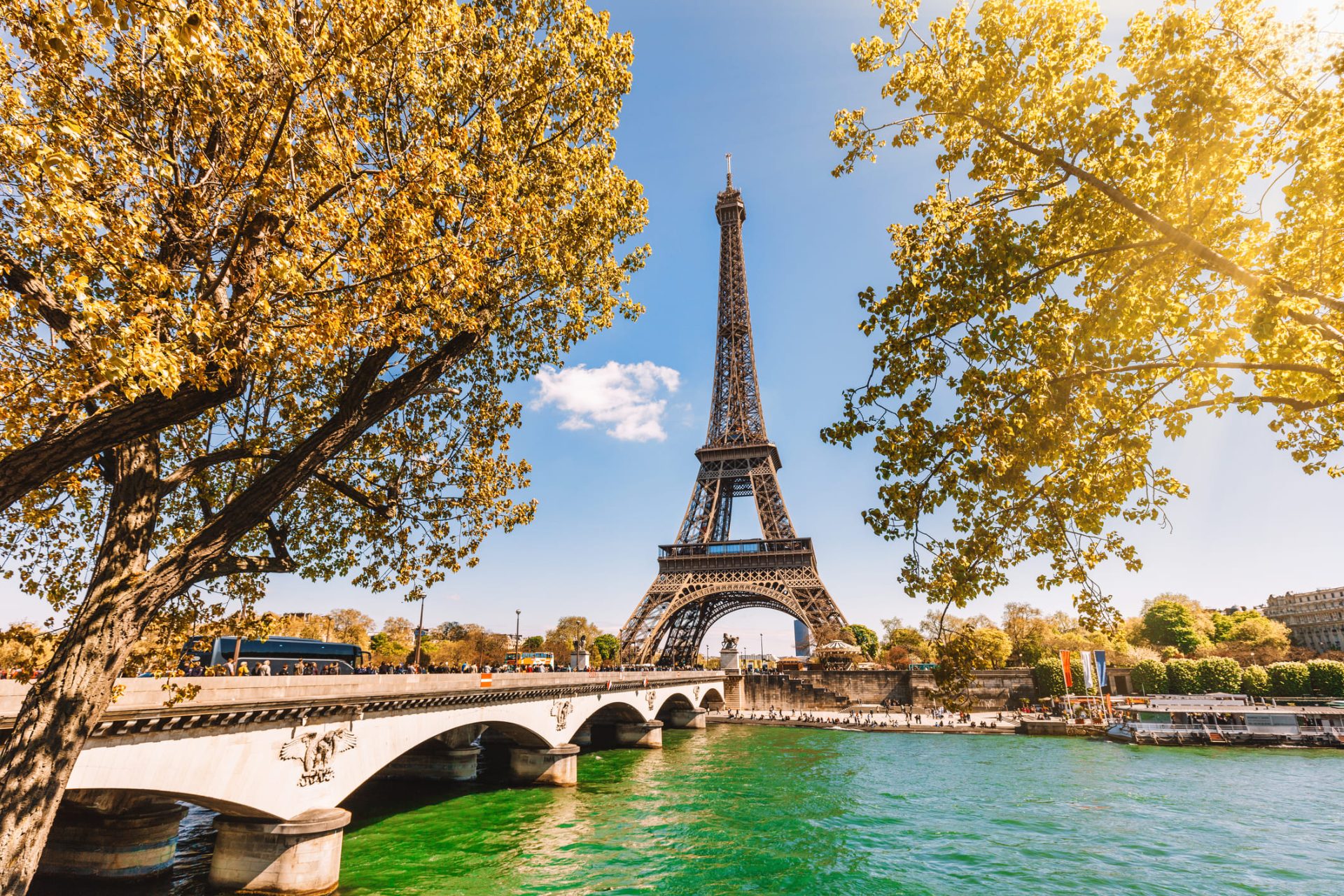
Then it's time for the Eiffel Tower. Standing at its foot and looking straight up through the iron lattice is an experience in itself. When it was built for the 1889 World's Fair, many of Paris's leading artists signed a letter protesting against this "useless and monstrous" tower. It was supposed to be dismantled after twenty years, but it was saved because it proved so useful as a giant radio antenna. Gustave Eiffel was a brilliant engineer: he also designed the iron framework hidden inside the Statue of Liberty in New York. Today the tower is repainted by hand every few years, using around 60 tonnes of paint.

The lifts carry you up through the tower to the top level, 276 metres above the city. Up here, the wind is crisp and the view is unforgettable. Paris spreads out in every direction: the river, the bridges, the parks, the golden dome of Les Invalides and the white domes of Sacré-Cœur on the hill of Montmartre. On a clear winter day you can see far beyond the city. Take a moment to stop, look and simply take it in: you're standing on top of the Eiffel Tower on Christmas Day.

The programme also includes a guided visit to the Palace of Versailles, the most magnificent royal palace in Europe. Louis XIV, the Sun King, who ruled France for 72 years, the longest reign of any European monarch, turned a hunting lodge into a palace with around 2,000 windows, hundreds of rooms and gardens that stretch to the horizon. Inside, you walk through state rooms dedicated to the gods of ancient Rome, each more lavish than the last, before entering the Hall of Mirrors. Out in the grounds, far from the palace, Queen Marie Antoinette built herself a little make-believe village, with thatched cottages and a farm, where she could escape the strict rules of court life. Because Versailles is closed on Christmas Day, your tour manager will arrange this visit on another day of your stay in Paris.

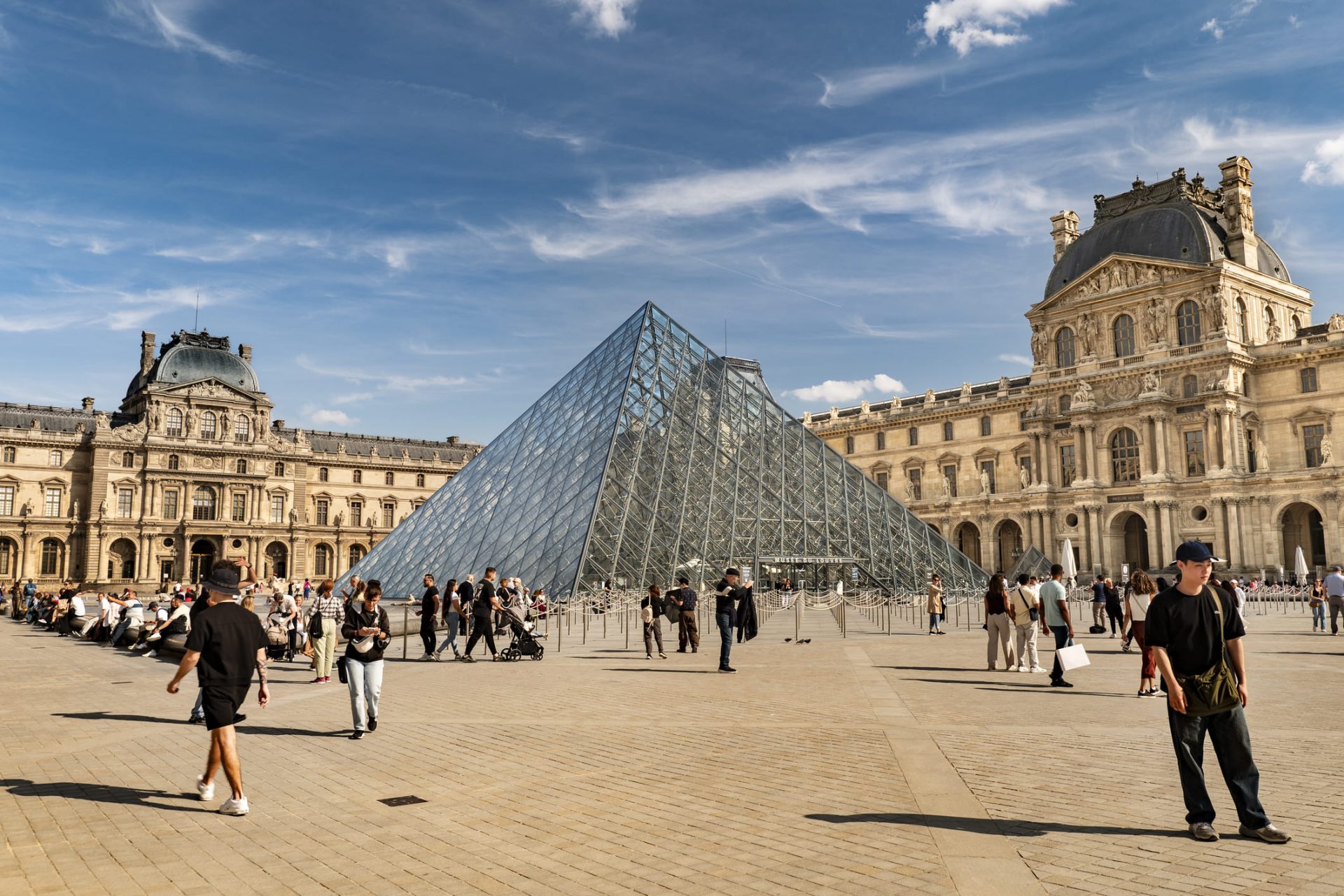
As evening falls, you board a boat for a cruise along the Seine. The river is the best place to see how Paris grew, monument by monument, along its banks. You glide past the Conciergerie, a medieval palace that became a prison during the Revolution, where Marie Antoinette spent her final weeks. Then come the illuminated towers of Notre-Dame, the Louvre, and the Musée d'Orsay with its great station clocks. Near the end of the cruise, look out for a small copy of the Statue of Liberty on a narrow island in the river, a reminder of the friendship between France and America. And then, as you turn back, the Eiffel Tower appears ahead, glowing gold against the night sky.

In the evening the group gathers for Christmas dinner, a warm end to a Christmas Day you'll always remember.

Included today: guided Paris city tour, Eiffel Tower top level, guided Versailles Palace tour (on another day in Paris), River Seine cruise, breakfast, lunch, dinner.

Good to know: because of Christmas, some places may be closed on certain days (the Palace of Versailles, for example, is closed on 25 December), so activities may be switched between days. You still see everything included. If the Eiffel Tower top level is closed, the group visits the 2nd level instead.
Day 3
26 Dec · Full day at Disneyland® Paris | A day of magic for all ages

26 Dec · Full day at Disneyland® Paris | A day of magic for all ages

⌖ Paris 🍽 Meals: Breakfast, Packed Lunch, Dinner

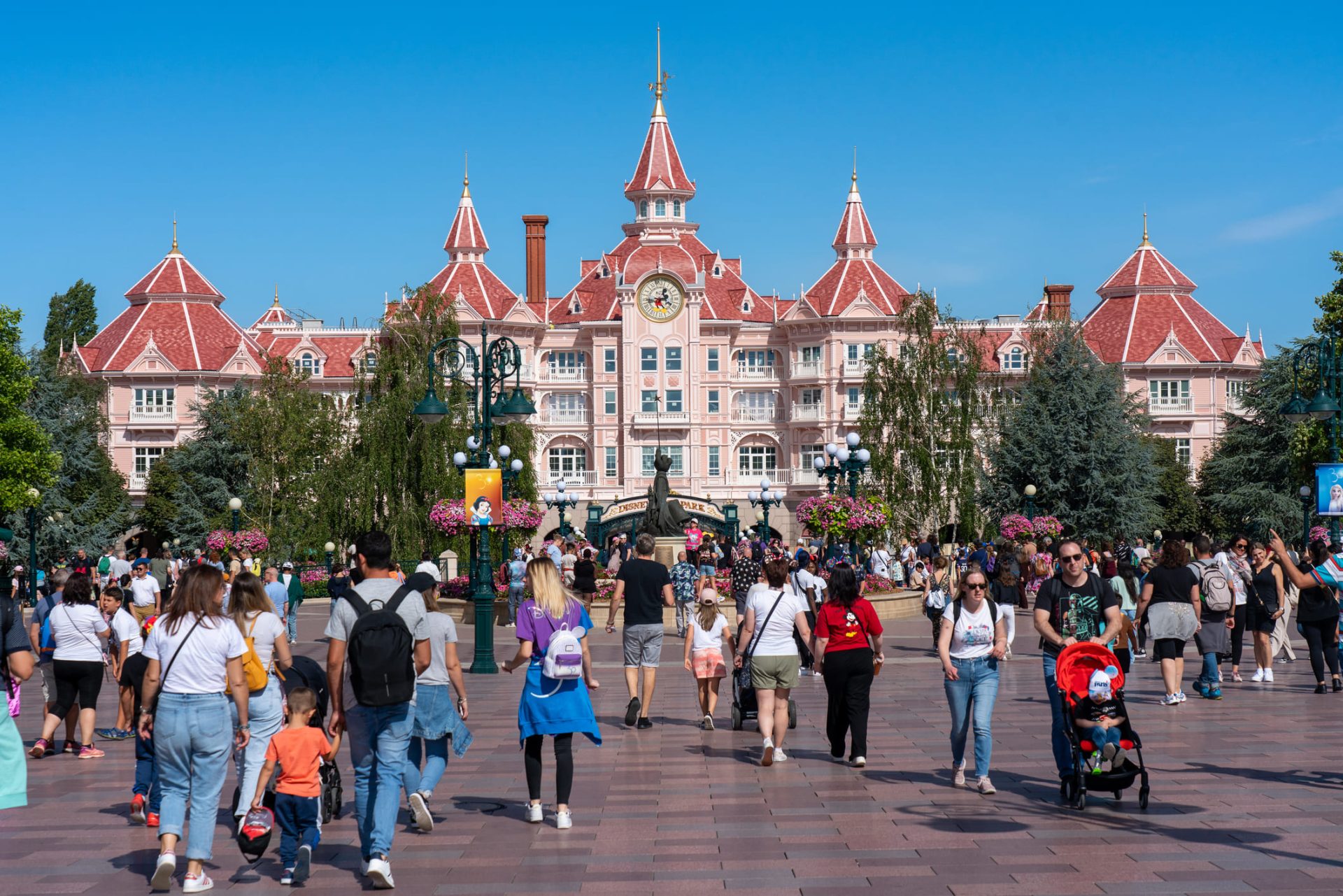
Today belongs to the child in everyone. After Christmas, the magic continues at Disneyland® Paris, still dressed in its full holiday finery. The coach leaves Paris after breakfast and drives about forty minutes east, through the countryside of the Île-de-France, to Marne-la-Vallée. Watch the faces on the coach when the pink and blue turrets of the castle first appear above the trees.

Disneyland® Paris opened in 1992 and is the most visited theme park in Europe. Walt Disney himself had French roots: his family name came from the town of Isigny in Normandy, so in a way, Disney has come home. The resort has two parks, and your ticket gives you a full day in one of them. Your tour manager will help you choose. For families with younger children, and anyone who wants the classic fairy-tale experience, Disneyland® Park is the favourite. For older children and movie lovers, the second park brings famous films to life, with rides like the Ratatouille adventure, where you shrink to the size of Remy the rat and scurry through a Parisian restaurant kitchen, and Crush's Coaster, a spinning ride through the ocean world of Finding Nemo.

Entering Disneyland® Park, you pass beneath the pink Disneyland Hotel and step onto Main Street, U.S.A., an old-fashioned American town with ice-cream parlours, sweet shops and a horse-drawn tram. In the days after Christmas, it's still dressed for the season: garlands draped across the shopfronts, a towering Christmas tree in Town Square, and Christmas carols floating in the air. At the end of the street stands Sleeping Beauty Castle, the heart of the park. Climb up inside to see the stained-glass windows and tapestries telling the story of Princess Aurora, and don't miss the dragon's lair beneath it, where a huge dragon lies sleeping in the dark, ready to wake with a roar.

Disneyland® Paris also has attractions you won't find in any other Disney park. In Frontierland, Phantom Manor is a spooky Victorian mansion with its own ghost story, set in the Wild West mining town of Thunder Mesa. Nearby, Big Thunder Mountain, the runaway mine train, races around an island in the middle of a lake, and it even dives into a tunnel beneath the water. In Fantasyland, Alice's Curious Labyrinth is a maze of hedges where the Queen of Hearts shouts "Off with their heads!" and the Cheshire Cat grins from the bushes. It ends at the Queen's castle, with views across the whole land.

There are gentle rides for the little ones too: the flying elephants of Dumbo, the carousel of Lancelot, and Peter Pan's Flight, a magical journey over the rooftops of London by moonlight, which is one of the most popular rides in the park, so go early. Thrill-seekers can head to Discoveryland for Star Wars Hyperspace Mountain, or to Adventureland for the twists and loops of the Indiana Jones ride. And everyone should take the Pirates of the Caribbean boat ride, with its cannon fire, singing pirates and treasure caves.

During the Christmas season, Mickey, Minnie and the gang appear in their festive outfits, and the Christmas parade winds its way along Main Street with floats, dancers and music. The finale is Santa Claus himself, waving from his sleigh. Character meet-and-greets are hugely popular, so if your children have a favourite princess or hero, check the app to see where and when they're appearing.

Your packed lunch means you can eat when and where you like, without losing time in queues. In winter, the warm snack stands come into their own: grab a hot chocolate or a cup of coffee to warm your hands between rides. As the light fades in the late afternoon, the castle begins to glow, the Christmas lights twinkle along Main Street, and the whole park takes on an enchanted feel. If there's an evening show at the castle tonight, with music, projections and fireworks lighting up the sky, find a spot early on Main Street: it's the perfect, magical end to the day.

On the way back, the coach will be quiet: children fast asleep, holding new soft toys, and parents scrolling through the day's photos with a smile. Dinner is waiting back in Paris, and over it, everyone will argue happily about the best ride of the day.

Disneyland® Paris is more than the two parks. Next to the gates is Disney Village, an entertainment street of restaurants, shops and cinemas, and around the lake beyond it stand the resort's themed hotels, styled after New York, the Wild West, New England and Cape Cod. The whole resort is about the size of a small town, and after dark, with the lights reflected in the lake, it looks like a film set. If the group has a little time before the coach returns to Paris, Disney Village is a lively place to pick up a last souvenir.

Included today: full-day Disneyland® Paris tickets (one park), coach transfers, breakfast, packed lunch, dinner.

Good to know: wear comfortable shoes and warm layers. Download the Disneyland® Paris app to check ride waiting times and show schedules, and keep your phone charged. Parades, shows and opening hours are set by the park and may change on the day.

Day 4
27 Dec · Paris to Geneva | Into the mountains

27 Dec · Paris to Geneva | Into the mountains

⌖ Geneva 🍽 Meals: Breakfast, Packed Lunch, Dinner

Today you say goodbye to Paris and travel south-east towards the mountains. It's a long day on the road, but it's also one of the most scenic, as France slowly changes around you from city to farmland to forest, and finally to the first ridges of the Alps. Settle into your seat, keep your camera nearby, and enjoy watching Europe go by.

The coach leaves Paris after breakfast and heads south on the motorway. Soon the suburbs give way to the open countryside of central France, with wide fields, small stone villages and church spires rising above the trees. After a while you pass through Burgundy, one of the most famous wine regions in the world, where vineyards stretch across the gentle hillsides in neat rows, bare and silvery in winter. Burgundy is also home to the city of Dijon, whose name is known around the world for its mustard. The region was once an independent duchy whose dukes were richer than many kings, and its villages are full of old abbeys, castles and half-timbered houses.

As the afternoon goes on, the landscape becomes hillier and greener, and you climb into the Jura mountains, a range of forested ridges along the border between France and Switzerland. This is a land of dairy farms and cheese-making, known for its nutty Comté cheese, and of watchmakers, who have worked in these valleys for centuries. Your packed lunch keeps you going on the road, with comfort stops along the way to stretch your legs.

Then you cross the border into Switzerland, the second country of your tour, and arrive in Geneva. Geneva sits at the tip of Lake Geneva, one of the largest lakes in Western Europe, where the River Rhône flows out on its way to the Mediterranean. It's a French-speaking city, but a very international one: around 40 percent of its residents come from other countries, and it's home to dozens of international organisations. On a clear day, look to the south: the snowy summit of Mont Blanc, the highest mountain in Western Europe, can be seen rising in the distance.

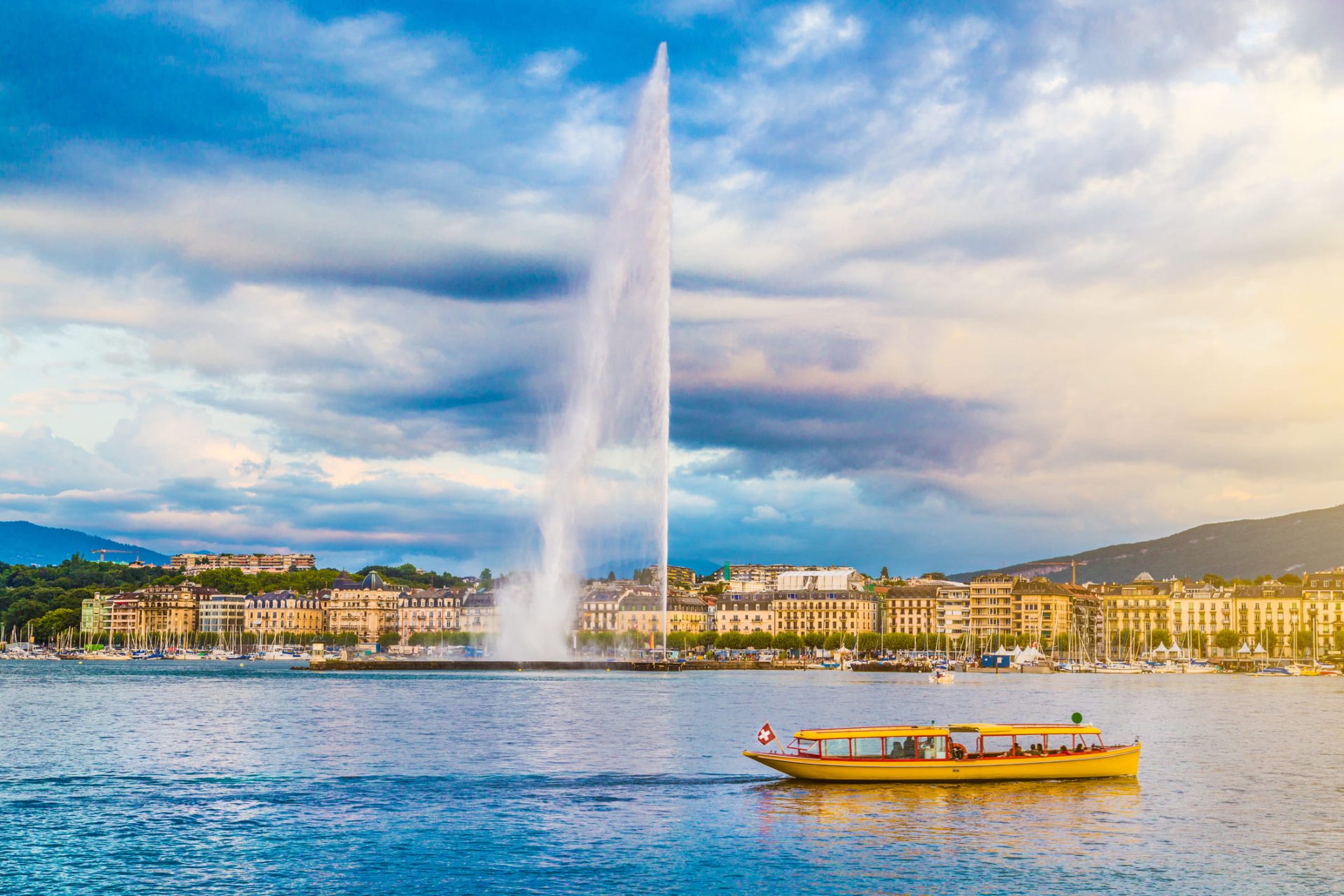
Your orientation tour starts at the lake, where the Jet d'Eau shoots a column of water 140 metres into the air, about as high as a 45-storey building. It began in 1886 as a simple safety valve for a hydraulic power station, releasing excess water pressure in the evenings. People loved it so much that the city turned it into a permanent fountain, and today it's the symbol of Geneva. On a sunny day, watch for a rainbow in the spray.

Geneva is often called the capital of peace. The Red Cross was founded here in 1863 by a Geneva businessman, Henri Dunant, after he witnessed the suffering of wounded soldiers on a battlefield in Italy. Today the city is home to the European headquarters of the United Nations, in the grand Palais des Nations, where a long row of flags from member countries lines the approach. Opposite stands one of Geneva's most powerful sights: the Broken Chair, a giant wooden chair 12 metres high with one leg shattered, a monument calling for an end to landmines and cluster bombs. Just outside the city is CERN, the world's largest particle physics laboratory, where in 1989 a British scientist, Tim Berners-Lee, invented the World Wide Web, which means the internet you use every day was born here.

In the English Garden by the lake, you'll see Geneva's famous Flower Clock, a working clock made of thousands of plants, a tribute to the city's long tradition of watchmaking. Some of the most prestigious Swiss watch brands were founded in Geneva, and the elegant shops along the lakefront display watches worth more than a house. Even if you're only window-shopping, it's fascinating to see.

If there's a little time before dinner, take a stroll along the lakeside promenade. Swans glide on the grey-blue water, the mountains rise beyond the lake, and the lights of the city start to reflect on the surface as evening falls. Then it's time to check in to your hotel and sit down to dinner with the group. Tomorrow is the day many of you have been waiting for since you first booked: Jungfraujoch, the Top of Europe.

One of Geneva's most surprising winter sights is on the lake itself. At the Bains des Pâquis, an old public bathing area on a jetty in the lake, some locals swim in the icy water all through the winter, then warm up in the sauna. In winter the bathing area's small café is also known for serving cheese fondue, and on a cold evening, Genevans gather here to eat it with a view of the Jet d'Eau and the city lights. It's a very local scene, and a reminder that the people of Geneva love their lake in every season.

Included today: coach Paris to Geneva, Geneva orientation tour, breakfast, packed lunch, dinner.

Good to know: the drive takes most of the day, with comfort stops on the way. Keep a warm layer, snacks and water in your hand luggage on the coach.

Day 5
28 Dec · Jungfraujoch – Top of Europe and Interlaken | Standing on top of Europe

28 Dec · Jungfraujoch – Top of Europe and Interlaken | Standing on top of Europe

⌖ Central Switzerland 🍽 Meals: Breakfast, Lunch, Dinner

This is the day of the trip. Today you leave Geneva and travel into the heart of the Swiss Alps to Jungfraujoch, the Top of Europe, where you'll stand among glaciers and snow-covered peaks at nearly 3,500 metres. After an early breakfast, wrap up warmly and board the coach, because the scenery begins almost as soon as you leave the city.

The road follows the shore of Lake Geneva and then climbs above it, past the Lavaux vineyards, where terraces of vines step steeply down the hillsides to the water. Monks first built these terraces almost a thousand years ago, and today they're a UNESCO World Heritage Site. On a clear morning, the lake shines below you with the French Alps rising on the far shore. Then the coach turns inland, across the rolling green countryside of western Switzerland, past Bern, and into the mountains of the Bernese Oberland. As you approach Interlaken, the valleys narrow, the peaks grow higher and whiter, and you'll feel the excitement building.

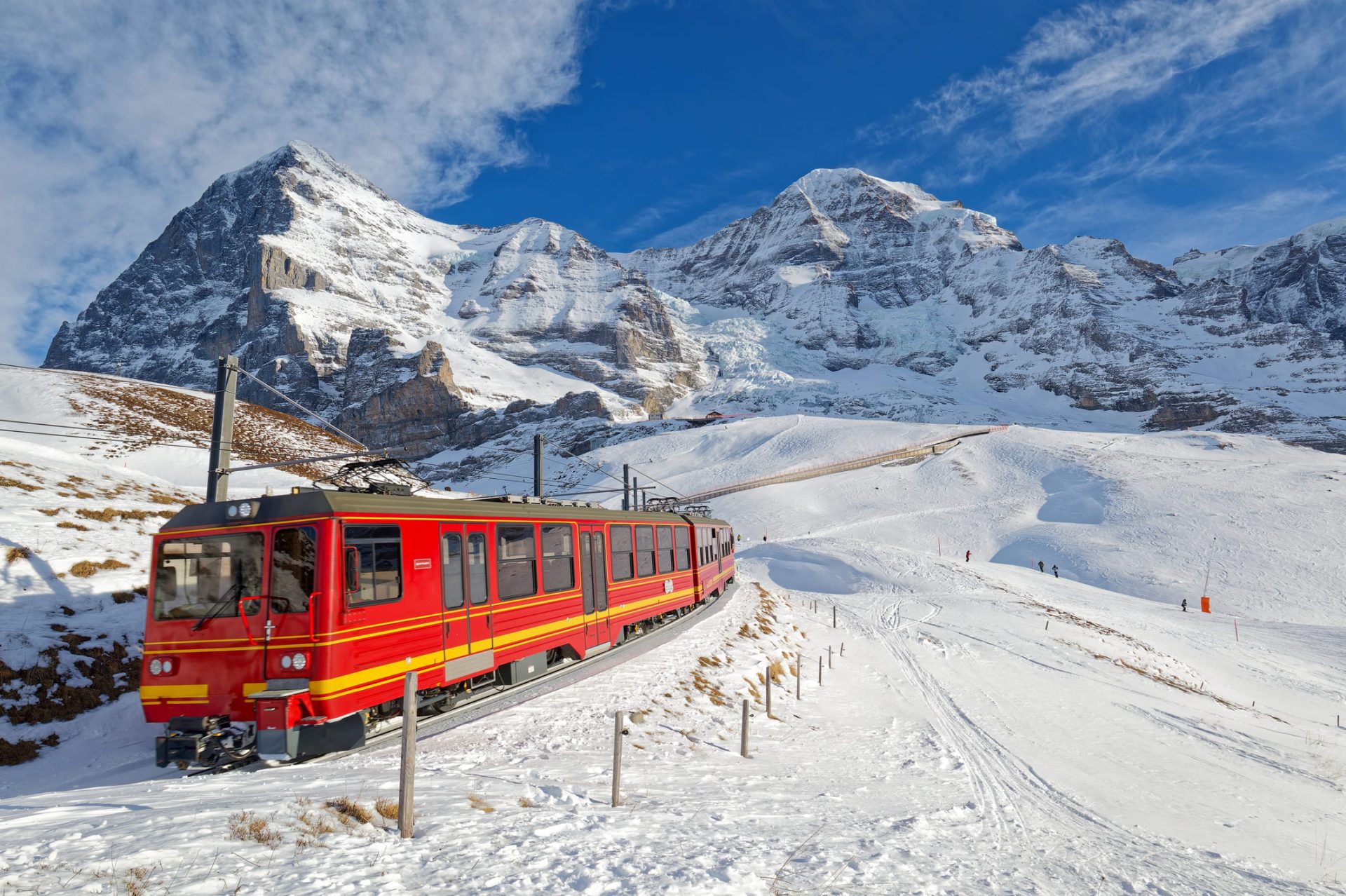
At the Grindelwald Terminal, below the famous village of Grindelwald, you board the Eiger Express gondola. In about fifteen minutes, it lifts you up the mountainside, past snowy fir forests and alongside the vast dark north face of the Eiger. From there, the Jungfrau Railway takes you on, climbing inside the mountain itself.

The story of this railway is a remarkable one. In 1893, a Swiss industrialist named Adolf Guyer-Zeller was hiking in the mountains when he had the idea of building a railway to the summit of the Jungfrau. Many people thought he was mad. The work took sixteen years: hundreds of labourers, many of them from Italy, blasted a tunnel through solid rock at high altitude, often in bitter cold and dangerous conditions. The line finally opened to Jungfraujoch in 1912. It never reached the actual summit, but it became one of the great engineering achievements of its time, and it still amazes everyone who rides it today.

When you step off the train at Jungfraujoch, Europe's highest railway station at 3,454 metres, you'll feel the altitude. The air holds less oxygen up here, so walk slowly, take deep breaths and drink some water. It's also a good moment to know a curious fact: at this height, water boils at only about 88°C instead of 100°C, which is why a cup of tea up here never feels quite as hot.

A lift takes you to the Sphinx, a building perched on a rocky peak above the station. As well as a viewing terrace, it houses one of the highest scientific research stations in Europe, where scientists have studied the atmosphere, the climate and the stars since the 1930s. Step out onto the terrace, and the view is one you'll never forget. Below you lies the Great Aletsch Glacier, the largest glacier in the Alps, a vast river of ice holding billions of tonnes of frozen water, flowing slowly south between the peaks. On a clear day, the panorama stretches across range after range of snowy summits, and the light on the snow is so bright you'll need your sunglasses.

Inside the mountain, walk through the Ice Palace, a maze of corridors and halls carved by hand into the glacier, with glittering ice sculptures and walls of blue-white ice. Then head out onto the snow plateau. Here, surrounded by peaks, you can stand on the glacier itself, feel the snow crunch under your shoes and wave a Swiss flag for the perfect photograph. For many travellers, this is the moment they'll remember most from all of Europe.

In the afternoon, after lunch, you descend by train and gondola and drive to Interlaken. Interlaken has welcomed travellers since the 19th century, when wealthy English tourists came here to admire the Jungfrau, and its main street, the Höheweg, still has the grand hotels of that era. From the open green meadow in the centre of town, you can look up at the Jungfrau, where you stood just a few hours ago. There's time to stroll along the main street, browse the shops for Swiss watches, chocolates and souvenirs, and perhaps have a hot chocolate in a café.

In the evening you continue to your hotel in Central Switzerland, tired, happy and still amazed. Over dinner, you'll find yourself scrolling through your photos again and again: yes, you really were at the Top of Europe today.

Included today: coach Geneva to Interlaken, Jungfraujoch – Top of Europe excursion with the Eiger Express and Jungfrau Railway, Ice Palace, Sphinx terrace, Interlaken, breakfast, lunch, dinner.

Good to know: it's very cold at the top in December, often well below zero, so wear thermal layers, a warm jacket, gloves, a hat and sunglasses, and use sunscreen, as the snow reflects strong sunlight. Travellers with heart or breathing conditions should check with their doctor before going to high altitude.

Day 6
29 Dec · Mt. Titlis, Lucerne and Lake Lucerne cruise | Snow, a storybook town and a lake

29 Dec · Mt. Titlis, Lucerne and Lake Lucerne cruise | Snow, a storybook town and a lake

⌖ Central Switzerland 🍽 Meals: Breakfast, Lunch, Dinner

Today brings together the best of Central Switzerland: a glacier summit in the morning, a storybook lakeside town in the afternoon, and a peaceful cruise on one of the most beautiful lakes in the Alps. After breakfast, the coach drives into the valley of Engelberg, where Mt. Titlis rises at the end of the valley, its glacier shining above the village.

Titlis is the highest viewpoint in Central Switzerland, and it has drawn adventurers for centuries: it was first climbed in 1744. Today, getting up is much easier, though still thrilling. The journey up is made in stages, first by gondola over snowy pine forests and a frozen mountain lake, then by cable car, and finally on the Rotair, the world's first revolving cable car. As the Rotair climbs the last steep stretch, its floor slowly turns a full 360 degrees, so you see everything: the cliffs, the crevasses of the glacier below, and the snowy peaks all around.

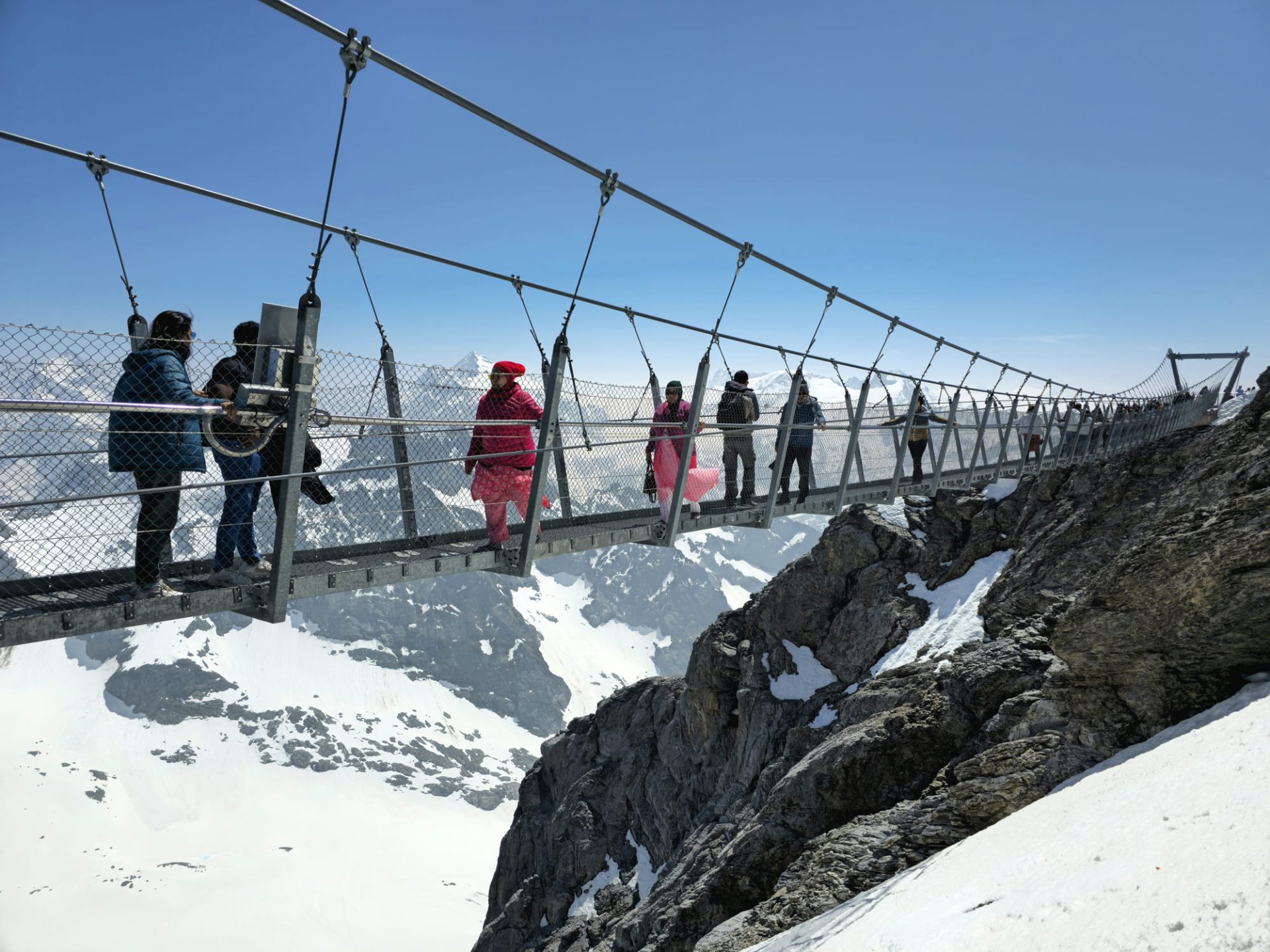
At 3,020 metres, the top station opens onto a glittering world of snow and ice. If you're brave, walk the Titlis Cliff Walk, the highest suspension bridge in Europe, which hangs along the cliff face with a sheer drop of around 500 metres beneath you. Halfway across, stop, hold the railing and look down, then out at the mountains: it's a moment of pure adrenaline. Then explore the Glacier Cave, a passage cut deep into the ice, where the walls glow in shades of blue and the air is still and cold. Back outside, there's snow to play in and photos to take. If conditions allow, ride the Ice Flyer, an open chairlift that floats just above the glacier and its crevasses.

After coming down from the mountain, you drive to Lucerne, one of the most loved towns in Switzerland. Many famous people have fallen for it. Queen Victoria stayed here in 1868 and travelled into the surrounding mountains, and the composer Richard Wagner lived for several years in a villa on the lakeshore, where he wrote some of his greatest music. Lucerne's charm lies in the way the old town, the river, the lake and the mountains all come together in one view.

Your orientation tour takes you through the car-free old town, with its cobbled squares and houses painted with colourful scenes and decorations, some of them centuries old. You'll walk across the Chapel Bridge, the covered wooden bridge from the 1300s that is Lucerne's symbol, with its stone Water Tower standing in the river, and visit the Lion Monument, a great dying lion carved into a rock face, honouring the Swiss Guards who fell in Paris in 1792. On the lakefront you'll see the modern Culture and Convention Centre, designed by the French architect Jean Nouvel, with a vast flat roof that seems to float over the water. It's a striking contrast with the medieval town just across the river. Then there's free time to shop: Lucerne is one of the best places in Switzerland for watches, Swiss Army knives, chocolate and cuckoo clocks.

Later in the afternoon, you board a boat for a cruise on Lake Lucerne. The lake has an unusual shape: its arms stretch out in different directions between the mountains, and around each corner a new view appears. Steep slopes rise straight from the water, dotted with villages, churches and grand old hotels. The lake has a long boating tradition and one of Europe's finest fleets of historic paddle steamers. From the deck, look for Mt. Pilatus, whose jagged peak, according to legend, was once home to dragons, and Mt. Rigi, known as the "Queen of the Mountains", where Europe's first mountain railway opened in 1871. In winter the lake is calm and silvery, with snow on the peaks reflected in the still water, and the light fades slowly into shades of pink and blue. Stand on deck for a while if you can bear the cold: the silence, the fresh air and the mountains all around are pure Switzerland.

In the evening you return to your hotel for dinner. Tomorrow you leave Switzerland and head for the Austrian Alps.

The shores of Lake Lucerne are the historic heartland of Switzerland. One of the founding cantons, Schwyz, on the eastern side of the lake, even gave its name to the whole country and its flag: the red square with the white cross. Schwyz is also the home of the Swiss Army knife. In 1884 a cutler named Karl Elsener opened a workshop in the village of Ibach, and in 1891 he began supplying knives to the Swiss army. His company, Victorinox, still makes the famous red knives there today. If you buy one in Lucerne, you're taking home a piece of local history.

Included today: Mt. Titlis with the Rotair, Cliff Walk and Glacier Cave, Lucerne orientation tour, Lake Lucerne cruise, breakfast, lunch, dinner.

Good to know: it's very cold at the top of Titlis, so wear warm layers, gloves and sunglasses. The Ice Flyer and other activities at the top depend on the weather, and the lake cruise schedule may change in winter.

Day 7
30 Dec · Rhine Falls, Swarovski Crystal Worlds and Innsbruck | A waterfall, a crystal wonderland and the Tyrol

30 Dec · Rhine Falls, Swarovski Crystal Worlds and Innsbruck | A waterfall, a crystal wonderland and the Tyrol

⌖ Innsbruck / Seefeld 🍽 Meals: Breakfast, Lunch, Dinner

Today you travel from a thundering Swiss waterfall to a crystal wonderland and on into the snowy Austrian Tyrol. It's a day of contrasts: the raw power of nature in the morning, sparkling artistry in the afternoon, and an imperial mountain city as the light fades.

Your first stop is the Rhine Falls in northern Switzerland, just outside the old town of Schaffhausen. Schaffhausen itself is a jewel, with streets of painted houses decorated with elegant bay windows, and above the town, a round medieval fortress called the Munot, which looks down over the river. A few kilometres downstream, the River Rhine, having passed through Lake Constance, suddenly reaches a band of hard rock and plunges over it in the largest waterfall in Europe. Walk down to the viewing platforms and you'll be right beside it: a wall of foaming white water, a deep, steady roar that fills your ears, and a cold mist that drifts over everything. On very cold winter mornings, the spray can freeze onto the trees and rocks along the banks, turning them into delicate sculptures of ice. Look up at the cliff above the falls and you'll see Laufen Castle, which has watched over the falls for around a thousand years.

From the Rhine Falls, the coach heads east through the valleys and mountains of eastern Switzerland and into Austria, the third country of your tour. Austria's west is the Tyrol, a land of high mountains, green valleys, onion-domed churches and wooden farmhouses with balconies piled high with snow in winter. The Tyroleans are proud of their traditions, from yodelling and folk music to hearty mountain food.

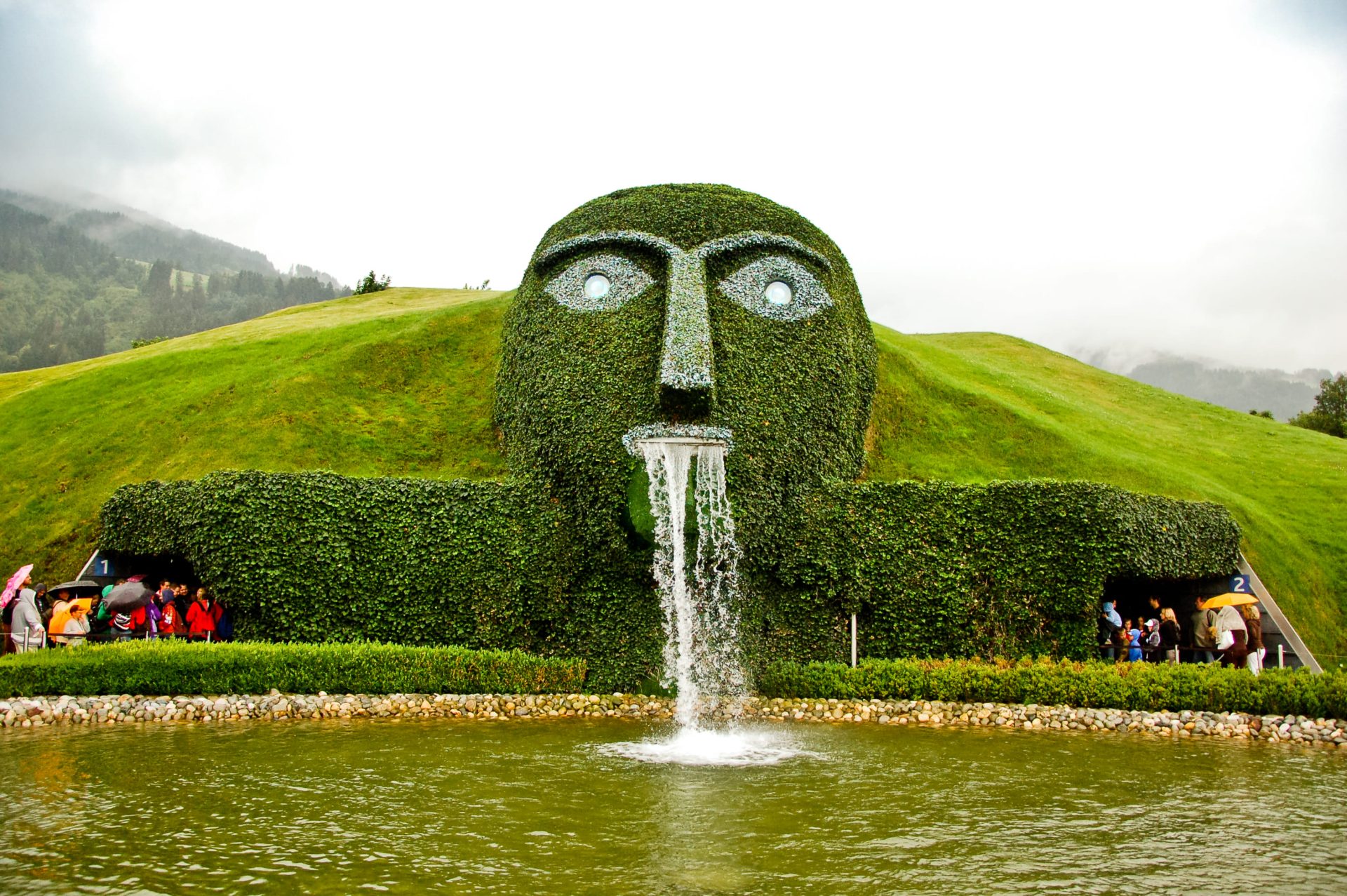
In the afternoon you reach Wattens, a small town in the Inn valley, and the Swarovski Crystal Worlds. It was created in 1995 to celebrate the 100th anniversary of Swarovski, the crystal company founded here by Daniel Swarovski. The entrance is unforgettable: a giant's head rises from a grassy hillside, its eyes glittering with green crystals, and a waterfall pours from its mouth into a pool. Inside the giant's head, a series of Chambers of Wonder takes you on a journey through light and art. Each room was created by a different artist and is completely different from the last. In one, you step inside a vast dome lined with mirrors that make you feel as if you're standing inside a crystal. In another, crystals sparkle like snow falling from the sky. In the gardens outside, the Crystal Cloud floats above a dark mirror pool, made of hundreds of thousands of hand-mounted crystals that glitter like a sky full of stars. Then there's the Swarovski store, the largest in the world, full of jewellery, figurines and Christmas decorations to take home.

A short drive brings you to Innsbruck, the capital of the Tyrol, set in a valley with high mountains rising almost straight up from the edge of the city. Innsbruck was once one of the favourite cities of the Habsburg emperors, who ruled a huge empire from Vienna, and you'll see their legacy in its palaces and churches. Your orientation tour takes you through the old town, with its narrow lanes and tall, pastel-coloured houses. You'll see the Golden Roof, a balcony topped with gleaming gilded tiles, built for Emperor Maximilian I around 1500, and next to it the Helbling House, covered in elaborate white stucco decoration that looks like icing on a cake. The city tower, built in the 15th century as a watchtower, rises above the rooftops. Nearby stands the Imperial Palace, the Hofburg, and the Court Church, which holds the magnificent tomb of Emperor Maximilian, guarded by 28 larger-than-life bronze statues of his ancestors and heroes.

The Tyrol is also famous for its food, perfect after a cold day. Look out for Kaiserschmarrn, a fluffy, torn-up pancake dusted with icing sugar and served with plum or apple sauce, named after the Austrian emperor; or a warm slice of apple strudel. Even a cup of hot chocolate tastes better here, with the mountains glowing pink in the last light of the day.

In the evening the coach takes you to your hotel in the Tyrolean Alps for the night. Step outside after dinner: the mountain air is pure and cold, snow covers the rooftops, and the night is silent. Tomorrow is New Year's Eve, and you'll spend it in Venice.

If you hear a familiar Christmas carol in the Tyrol this evening, there's a reason. "Silent Night", sung around the world every Christmas, was written in Austria. It was first performed on Christmas Eve 1818 in the small village of Oberndorf, near Salzburg, and it was Tyrolean folk singers, travelling families from the Ziller valley, who carried it across Europe and even to America. So when you hear it played in an Austrian church or inn over the holidays, you're hearing it in its home.

Included today: Rhine Falls, Swarovski Crystal Worlds entry, Innsbruck orientation tour, breakfast, lunch, dinner.

Good to know: the Rhine Falls boat ride usually pauses over Christmas and New Year, so you see the falls from the viewing platforms. Today has long coach journeys, so keep snacks and water with you.

Day 8
31 Dec · Venice – private boat to St. Mark's Square and gondola ride | New Year's Eve on the canals

31 Dec · Venice – private boat to St. Mark's Square and gondola ride | New Year's Eve on the canals

⌖ Padova / Ferrara 🍽 Meals: Breakfast, Lunch, Dinner

It's the last day of the year, and you spend it in Venice, the most romantic city in the world. After breakfast the coach crosses the Alps by the Brenner Pass into Italy, the fourth country of your tour, and descends through the valleys of South Tyrol, where Italian and German are spoken side by side, to the plains of the Veneto. By late morning, you reach the edge of the Venetian lagoon.

Here you leave the coach and board a private boat, and there's no better way to arrive. As the boat speeds across the lagoon, Venice appears ahead: a skyline of domes, bell towers and palaces that seems to rise straight out of the water. For a thousand years, Venice was an independent republic, the Serenissima, or "Most Serene", and one of the richest and most powerful cities on earth. Its merchants traded silk, spices and glass between Europe and the East, and its ships ruled the Mediterranean. Marco Polo, the Venetian merchant whose travels took him to China, set out from here. The wealth of those centuries is written in every palace and church you'll see today.

The boat brings you to St. Mark's Square, the heart of Venice. At one end stands St. Mark's Basilica, its five domes and golden mosaics glowing even on a grey winter day, and beside it rises the tall brick Bell Tower. Arcades of shops and historic cafés line the square, and at the waterfront stands the Doge's Palace, the pink and white palace of the rulers of Venice. A short walk along the waterfront brings you to the Bridge of Sighs, the little enclosed white bridge that once led prisoners from the palace's courtrooms to the prison cells.

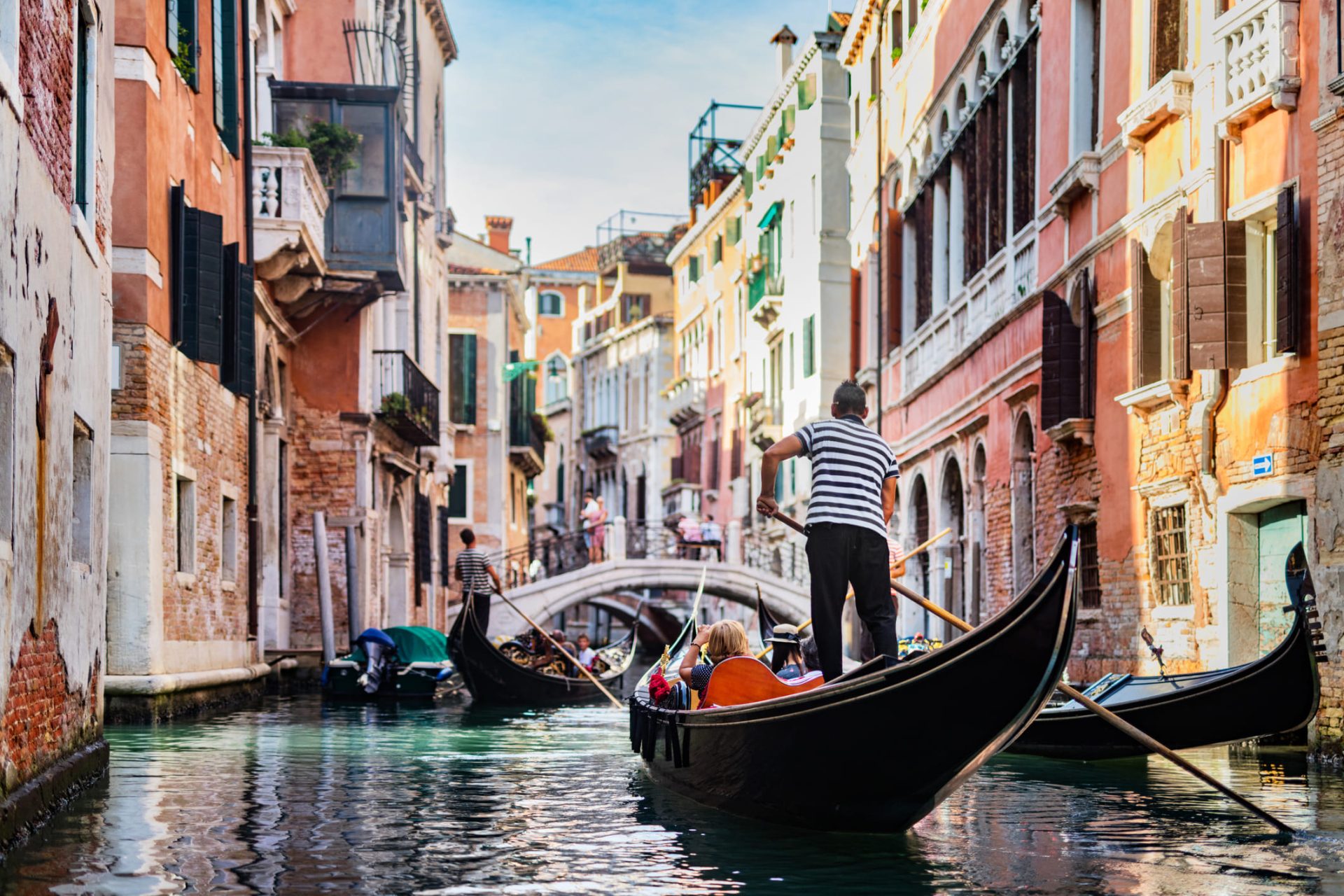
Then comes one of the moments of the trip: a gondola ride. You step down into the gondola, settle into the cushioned seats, and the gondolier pushes off with a single smooth stroke of his oar. Gondolas are true works of craftsmanship: each one is about 11 metres long, built by hand from hundreds of pieces of different woods, and slightly asymmetrical, with one side longer than the other, so that the gondolier can steer in a straight line while rowing on only one side. They have been painted black for centuries. Only a few hundred gondoliers are licensed in Venice, and the skill is often passed down through families.

As you glide away from the busy waterfront into the narrow side canals, the noise of the city falls away. All you can hear is the gentle splash of the oar and the gondolier's call of warning as he approaches a blind corner. Old palaces rise straight from the water on either side, their walls weathered into soft shades of red, ochre and pink, with green water lapping at the doorsteps and wooden poles striped like candy where boats once tied up. You pass under small stone bridges, catching glimpses of hidden courtyards, window boxes and washing strung between houses. It's the Venice of paintings and films, and it's even more beautiful in real life.

After the gondola ride, there's free time to explore. Wander towards the Rialto Bridge, the great stone bridge over the Grand Canal, completed in 1591, lined with shops and crowded with visitors taking photographs of the canal below. The Grand Canal winds through the city in a huge S-shape for nearly four kilometres, lined with some 170 palaces, and it's the main street of Venice, busy with water buses, delivery boats and gondolas. Stop for a hot chocolate or a coffee, and try a slice of pandoro or panettone, the sweet cakes Italians eat over Christmas and New Year; pandoro, the golden star-shaped cake, comes from nearby Verona. The hills north of Venice are also the home of prosecco, the sparkling wine that Italians use to toast the New Year.

In the late afternoon, the boat carries you back across the lagoon as the sun sets, and the coach drives to your hotel in the Padova / Ferrara area. Padova is an ancient university city, home to the great basilica of St. Anthony, and Ferrara is a Renaissance city still encircled by its old walls. Tonight, though, there's only one thing on everyone's mind.

It's New Year's Eve, and the group celebrates in style at the New Year's Eve gala dinner. Dress up, enjoy a festive menu with Jain, vegetarian and non-vegetarian options, and share stories of the past week with the friends you've made. As midnight approaches, the excitement builds, glasses are raised, and the countdown begins. Across Italy, fireworks light up the sky, church bells ring, and you welcome the New Year together, a world away from home and in one of the most beautiful countries on earth. Happy New Year!

Included today: coach to Venice via the Brenner Pass, private boat across the lagoon to St. Mark's Square, gondola ride, New Year's Eve gala dinner, breakfast, lunch.

Good to know: in winter Venice sometimes has acqua alta, high tides that briefly flood parts of the city; raised walkways are put out and the water usually recedes within a few hours. Wear waterproof shoes, and keep a close eye on bags and phones in crowded places.

Day 9
1 Jan · Florence guided walking tour and Leaning Tower of Pisa | New Year's Day in Tuscany

1 Jan · Florence guided walking tour and Leaning Tower of Pisa | New Year's Day in Tuscany

⌖ Tuscany 🍽 Meals: Breakfast, Lunch, Dinner

Happy New Year! You begin the year in Tuscany, in two of the most beautiful and famous cities in Italy. After a late, relaxed breakfast (you've earned it after last night's celebrations), the coach drives south across the plains and over the Apennine mountains into Tuscany, a region of rolling hills, cypress trees, olive groves and medieval towns. On New Year's Day, the roads are quiet and the countryside is calm, the perfect gentle start to 2027.

Your first stop is Florence, the cradle of the Renaissance. Around 600 years ago, this city was the centre of an explosion of art, science and ideas that changed the world. Rich banking families, above all the Medici, paid artists and architects to fill Florence with masterpieces. Leonardo da Vinci, Michelangelo, Botticelli and Galileo all lived and worked here, and the poet Dante wrote in the local Florentine dialect, which became the basis of the Italian language spoken today. Walking through Florence, you're walking through the birthplace of much of Western art.

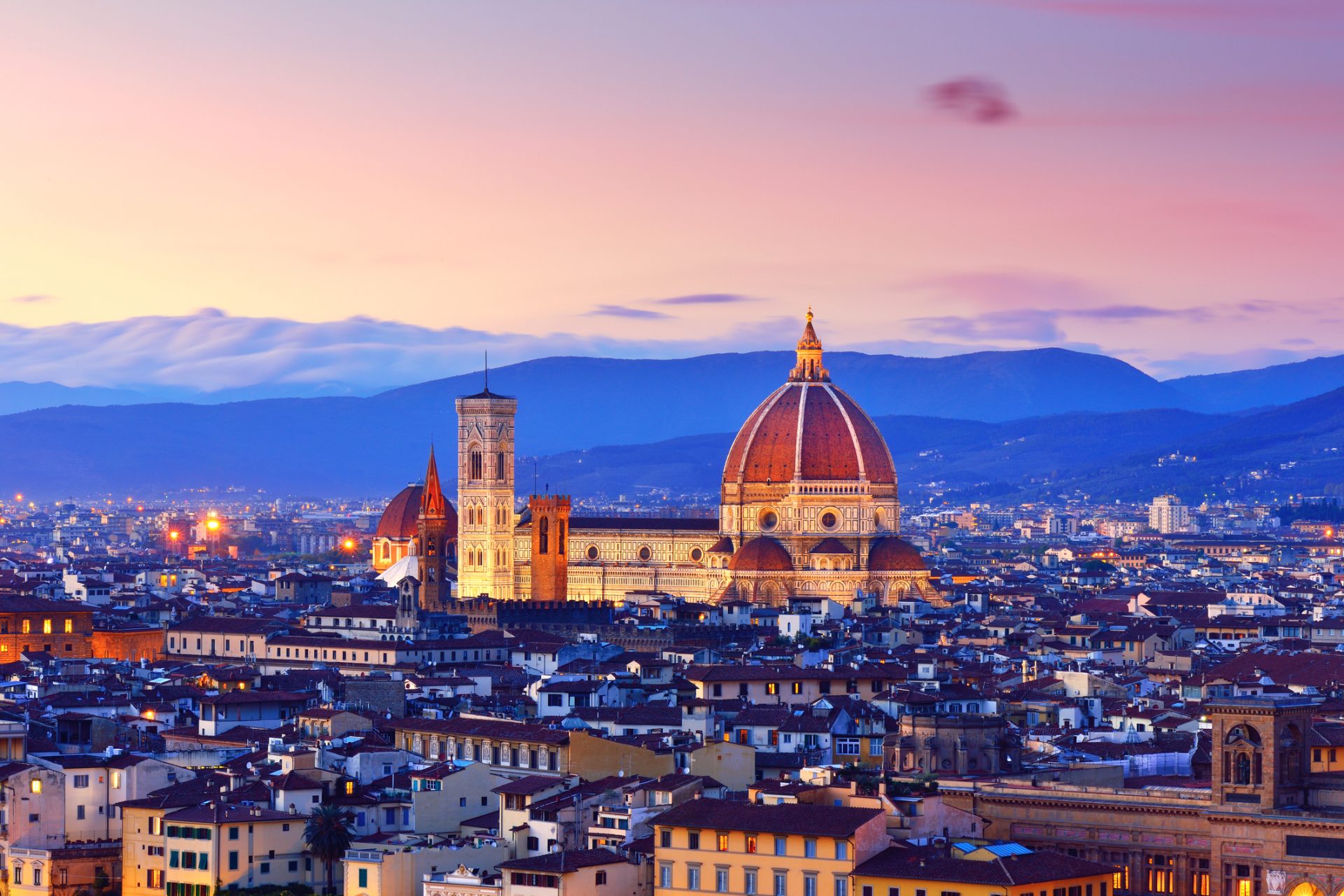
Your English-speaking local guide leads you through the historic centre, which is a UNESCO World Heritage Site. You begin at the Duomo, Florence's cathedral, and it stops you in your tracks. Its walls are covered in white, green and pink marble in geometric patterns, and above it rises the great red-tiled dome designed by Filippo Brunelleschi and completed in 1436. Nobody at the time knew how to build a dome so large, and Brunelleschi solved the problem with brilliant new techniques, laying the bricks in a clever herringbone pattern so that the dome could support itself as it rose. Nearly six centuries later, it's still the largest brick dome ever built. Beside the cathedral stands Giotto's Campanile, the elegant marble bell tower, and opposite, the octagonal Baptistery. Its eastern doors, covered in gilded bronze panels showing scenes from the Bible, were so beautiful that Michelangelo is said to have called them the Gates of Paradise.

The walk continues to Piazza della Signoria, Florence's great public square, which has been the centre of the city's political life for 700 years. Here stands the Palazzo Vecchio, the fortress-like town hall with its tall tower, and in front of it, a copy of Michelangelo's David, the most famous statue in the world. The original, carved from a single block of marble when Michelangelo was in his twenties, is now protected in a museum nearby. Beside the palace, the Loggia dei Lanzi is an open-air gallery of Renaissance statues, including Cellini's bronze Perseus holding up the head of Medusa.

Then you reach the River Arno and the Ponte Vecchio, Florence's oldest bridge, with little houses and shops built along both sides. Butchers and tanners once worked here, until in 1593 the Grand Duke, tired of the smell, ordered them out and replaced them with goldsmiths and jewellers, who are still there today, their windows glittering with gold. Above the shops runs a hidden passageway, built so the Medici family could walk between their palaces without mixing with the crowds. During the Second World War, the Ponte Vecchio was the only bridge in Florence that the retreating German army didn't destroy.

In the afternoon you drive west to Pisa, home of one of the most famous buildings in the world. The Leaning Tower stands in the Square of Miracles, a wide green lawn where the brilliant white marble cathedral, the round Baptistery and the bell tower stand together like jewels on a cloth. Construction of the tower began in 1173, and it started to lean during the building, when the soft, wet ground beneath one side began to sink. The builders tried to correct it by making the upper floors slightly curved, but the tower kept tilting. By the late 20th century, engineers feared it might fall, so between 1990 and 2001 they carefully removed soil from beneath the higher side, reducing the lean by about 40 centimetres and making it safe for centuries to come. Galileo was born in Pisa, and a famous story says he dropped balls from the tower to prove that objects of different weights fall at the same speed.

Of course, you'll want the classic photo: standing on the lawn and "holding up" or "pushing over" the tower with your hands. It's silly, everyone does it, and it's great fun. There's also time to admire the cathedral's facade and pick up souvenirs from the stalls nearby.

In the evening you check in to your hotel in Tuscany and sit down to dinner with the group. It's been a wonderful first day of the year.

Included today: guided Florence walking tour, Leaning Tower of Pisa photo stop, breakfast, lunch, dinner.

Good to know: 1 January is a public holiday in Italy, so many shops, museums and restaurants are closed or open shorter hours. The walking tour is outdoors, so wear comfortable shoes and a warm jacket.

Day 10
2 Jan · Rome and Vatican City – St. Peter's Basilica, Colosseum and Trevi Fountain | The Eternal City

2 Jan · Rome and Vatican City – St. Peter's Basilica, Colosseum and Trevi Fountain | The Eternal City

⌖ Rome 🍽 Meals: Breakfast, Lunch, Dinner

Your last full day is in Rome, the Eternal City, capital of an empire, centre of the Catholic world and a living museum of almost 3,000 years of history. After breakfast in Tuscany, the coach drives south through the countryside of Tuscany and Umbria, past hill towns and vineyards, and by late morning you reach Rome.

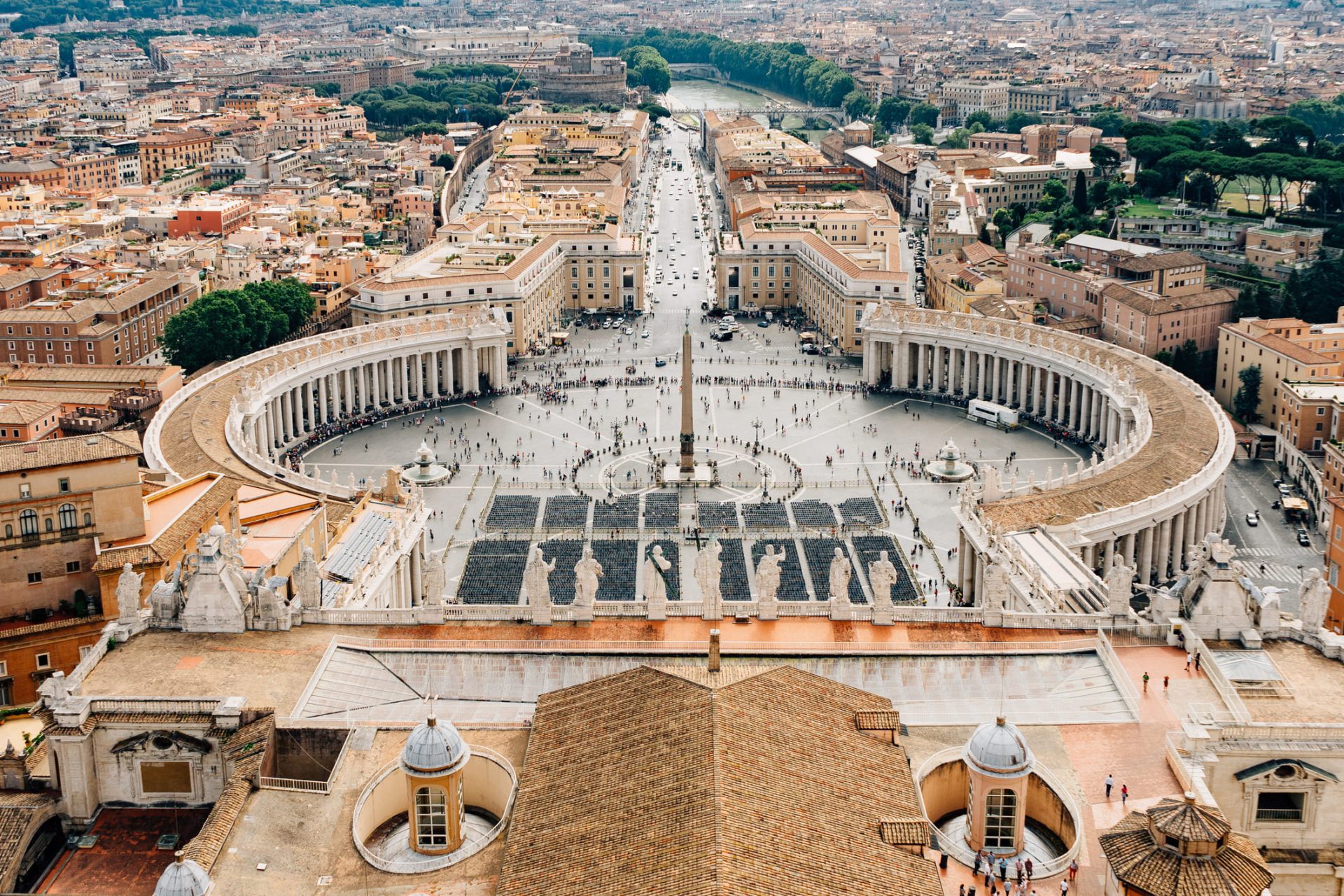
Your day begins in Vatican City, a country of its own inside Rome, ruled by the Pope. As you walk into St. Peter's Square, Bernini's great colonnades wrap around you, and at the far end rises the facade of St. Peter's Basilica, with Michelangelo's dome soaring above it. Over the Christmas season, the square holds a giant Christmas tree and a large nativity scene, and pilgrims from all over the world gather here.

Inside the basilica, you'll understand why it's considered one of the greatest buildings ever made. Its size is hard to grasp: the inside is so vast that the statues of saints high on the walls are several metres tall, yet they look life-size from the floor. Michelangelo took charge of the building when he was 71 years old and designed the dome, though he didn't live to see it finished. Walk along the central aisle and you'll pass the Holy Door, which is opened only during special Jubilee years, and in a quiet chapel near the entrance, Michelangelo's Pietà. Further in, look for the bronze statue of St. Peter seated on his throne: one of his feet has been worn smooth and thin by the touch and kisses of pilgrims over the centuries. Above the main altar, Bernini's bronze canopy rises nearly 30 metres on four twisted columns, directly over the place where St. Peter is believed to be buried.

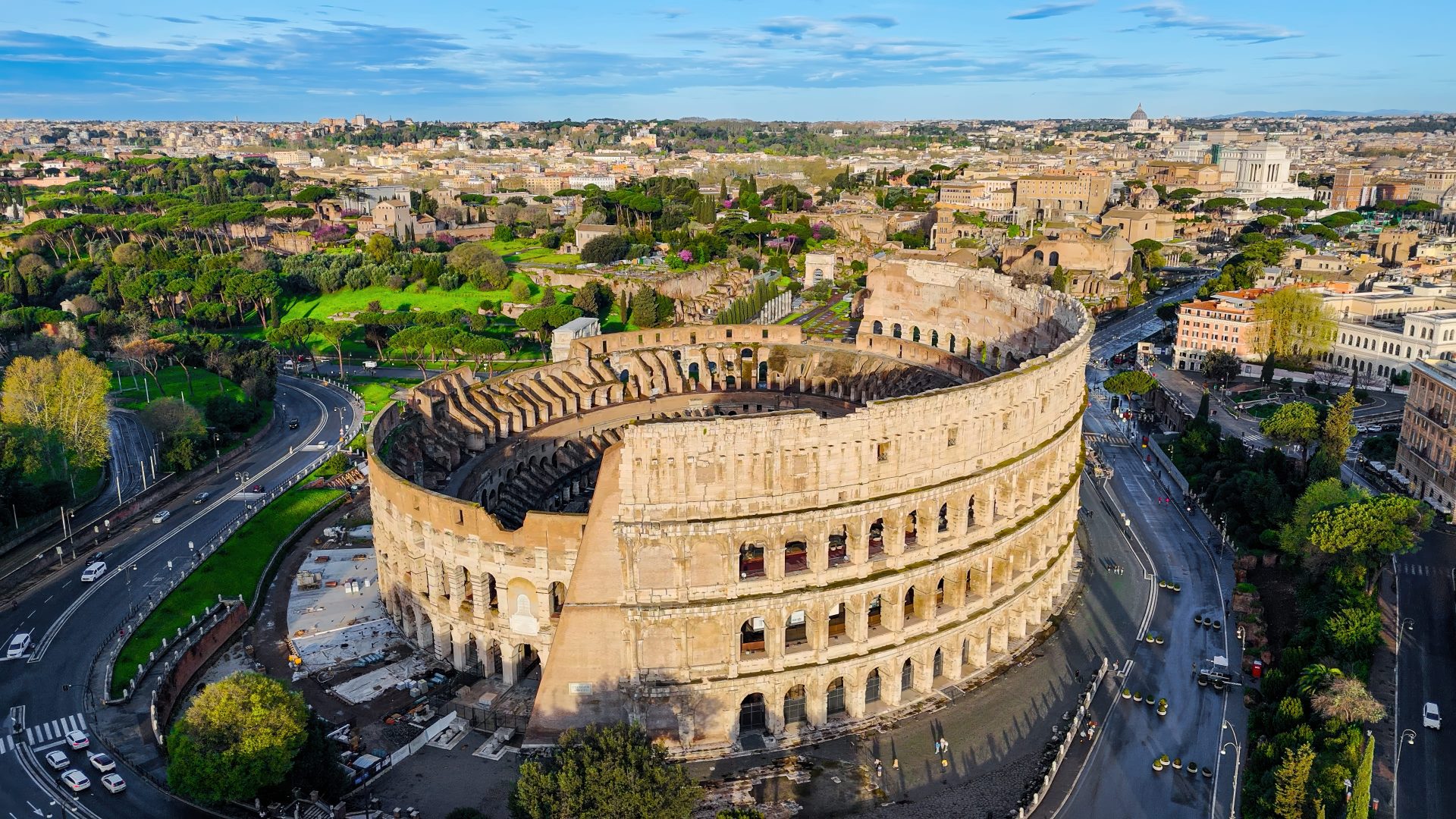
After lunch you head into ancient Rome and the Colosseum. Its real name is the Flavian Amphitheatre, after the family of emperors who built it; the name Colosseum probably came from a giant bronze statue, the Colossus of Nero, that once stood nearby. When it opened in AD 80, the games lasted 100 days. Up to 50,000 Romans packed the stands to watch gladiators, wild animals and dramatic hunts, and sailors from the Roman navy stretched a huge canvas awning over the top to shade the crowds from the sun. Beneath the arena floor was a maze of tunnels and lifts, where animals and fighters waited before being raised into the arena. Standing before its great curved walls of arches, you can almost hear the roar of the crowd.

The day ends at the Trevi Fountain, the largest and most famous fountain in Rome. Its name probably comes from tre vie, the "three roads" that once met here. The water that feeds it still arrives through the Aqua Virgo, an aqueduct built in 19 BC. According to legend, it was named after a young girl who showed thirsty Roman soldiers where to find the spring. The fountain, designed by Nicola Salvi, became world-famous in 1960, when the actress Anita Ekberg waded into it in Federico Fellini's film La Dolce Vita. Turn your back to the fountain, throw a coin over your left shoulder with your right hand, and, as the tradition goes, you're sure to return to Rome.

If there's a little free time, treat yourself to a real Italian gelato, or a slice of pizza al taglio, Roman pizza sold by the slice from long rectangular trays. Then the group gathers for a farewell dinner, full of stories and laughter, as you look back over eleven days together: Christmas in Paris, snow in the Alps, crystals in Austria, New Year's Eve in Venice and New Year's Day in Tuscany, and now Rome.

As you walk between the sights, notice the small details of Roman life. On almost every street corner you'll see a nasone, a "big nose", a small cast-iron drinking fountain with a curved spout, from which fresh, cold water runs day and night. There are around 2,500 of them in the city, and Romans block the end of the spout with a finger so that the water shoots up from a little hole on top, making a perfect drinking fountain. Look down, too, and you'll see the letters SPQR on manhole covers, bins and buildings. They stand for "the Senate and People of Rome", the motto of the ancient Roman republic, and the city still uses them today.

Roman food is simple and delicious. Cacio e pepe, pasta tossed with pecorino cheese and plenty of black pepper, is a Roman classic and perfect for vegetarians. Supplì, fried rice balls with a gooey heart of mozzarella, are the city's favourite street snack. And Romans take their coffee standing at the counter of a bar, chatting with the barista, for a few minutes of pleasure in the middle of a busy day.

Included today: coach Tuscany to Rome, St. Peter's Basilica, Colosseum, Trevi Fountain, breakfast, lunch, dinner.

Good to know: shoulders and knees must be covered inside St. Peter's Basilica, and bags are security-checked at the entrance. Opening hours at the Vatican can change for religious events, so the order of today's visits may change.

Day 11
3 Jan · Departure from Rome | Home with three Europes behind you

3 Jan · Departure from Rome | Home with three Europes behind you

⌖ Rome 🍽 Meals: Breakfast

Your European holiday comes to an end today, and you'll fly home with three Europes in your heart: Christmas in Paris, the snowy Alps of Switzerland and Austria, and the art, history and New Year celebrations of Italy.

Enjoy a slow breakfast this morning. Rome in early January still has a holiday feel. The Christmas decorations are up, nativity scenes stand in churches and squares, and Italian families are getting ready for one more celebration: Epiphany on 6 January. In Italian tradition, this is when La Befana arrives, a kindly old witch who flies on her broomstick on the night of 5 January, bringing sweets to good children and lumps of coal to naughty ones. Many cities hold markets for the Befana, selling toys, sweets and Christmas treats, and the most famous one fills Piazza Navona in Rome. You'll see little Befana dolls on her broomstick in shop windows everywhere, and they make a charming souvenir.

As you finish your coffee, take a moment to think back over the last eleven days. You arrived in Paris on Christmas Eve and celebrated with a gala dinner. You spent Christmas Day at the top of the Eiffel Tower and on the Seine, and the next day at Disneyland®. You crossed France to Geneva, stood in the snow at Jungfraujoch, the Top of Europe, rode the revolving cable car on Mt. Titlis, and cruised on Lake Lucerne. You felt the spray of the Rhine Falls, wandered through the Swarovski Crystal Worlds and explored Innsbruck. You glided through Venice in a gondola on New Year's Eve and welcomed the New Year at the gala dinner. Then Florence and Pisa on New Year's Day, and finally Rome. That's a journey most people only dream about.

Before you check out, pack carefully. Wrap fragile items, such as Swarovski crystal, Murano glass and Italian ceramics, in clothes and put them in the middle of your suitcase. Knives and liquids over 100 ml go in your checked baggage. Keep your passport, tickets, medicines, a phone charger and a warm layer in your hand luggage. If you made purchases with tax-free forms, keep the forms, receipts and goods together, as they may need to be checked at the airport.

Then the coach takes you to Rome Fiumicino airport, about 30 kilometres from the city near the coast. As you leave Rome behind, look out for the tall umbrella pines that line the roads, with their slender trunks and flat green crowns, one of the classic sights of the Roman countryside, and the last glimpse of Italy from the road.

On the way, take a moment to thank your tour manager and coach driver, who have guided you through four countries and the Vatican, through holiday crowds, mountain roads and long days, always making sure everything ran smoothly. It means a lot to them. Swap contact details with the friends you've made; the group chat will soon be full of photos.

At the airport, there's time for a last espresso or cappuccino, and for a final bit of shopping: Italian chocolates, coffee, olive oil or a box of panettone make wonderful gifts for those waiting at home. Then it's time to board.

As the plane climbs over the blue Mediterranean and turns towards India, you'll be carrying memories you'll treasure for a lifetime. And remember the coin you tossed into the Trevi Fountain yesterday: according to the legend, you'll be back.

If you have a few spare minutes before the coach leaves, step outside and take in an ordinary Roman morning. Shopkeepers roll up their shutters, neighbours greet each other with a cheerful "Buongiorno!", and someone always seems to be carrying a tray of coffees across the street. Italians have a phrase for the art of enjoying life slowly, il dolce far niente, "the sweetness of doing nothing", and a last quiet moment in a Roman square is the perfect place to practise it.

Rome has a soft spot for cats, too. In the middle of the busy city centre, at Largo di Torre Argentina, lie the sunken ruins of four Roman temples, close to the spot where Julius Caesar was assassinated in 44 BC. Today the ruins are home to a colony of stray cats, looked after by volunteers. Romans are proud of them, and they're one of the city's quirkiest sights.

On the way to the airport, the coach passes stretches of the Aurelian Walls, the great brick walls built around Rome in the 3rd century to protect the city from invaders, and then follows the River Tiber towards the sea. Close to Fiumicino are the ruins of Ostia Antica, ancient Rome's harbour, where grain ships from Egypt once unloaded their cargo to feed a million people. Even your final kilometres in Italy pass through two thousand years of history.

Included today: breakfast, group departure transfer to Rome Fiumicino airport.

Good to know: book a flight that leaves at least 3 hours after the group transfer reaches the airport; we'll confirm the transfer time when you book.

Hotel confirmation

Hotel names will be provided after booking, subject to availability and confirmation. We do not hold hotel confirmations before booking.

Inclusions

Accommodation

10 nights in superior 4-star hotels:

  • 3 nights Paris – B&B / Millennium CDG or similar
  • 1 night Geneva – Everness / Mövenpick or similar
  • 2 nights Central Switzerland – La Maison / Radisson or similar
  • 1 night Innsbruck / Seefeld – Alpenkönig / Hocheder or similar
  • 1 night Padova / Ferrara – Four Points by Sheraton / Blue Dream or similar
  • 1 night Tuscany – Park / Le Fonti or similar
  • 1 night Rome – SHG / Selene / Simon or similar

Meals

  • Daily continental buffet breakfast
  • 9 Indian lunches (Jain / vegetarian / non-vegetarian), packed on the Disneyland and Geneva drive days
  • 10 Indian dinners (Jain / vegetarian / non-vegetarian)
  • 500 ml mineral water bottle per person daily

Sightseeing and entrances

  • Guided Paris city tour
  • Eiffel Tower top (3rd) level
  • Guided tour of Versailles Palace
  • River Seine cruise
  • Full day at Disneyland® Paris
  • Geneva orientation tour and Jet d'Eau
  • Jungfraujoch – Top of Europe and Interlaken
  • Mt. Titlis with the Rotair revolving cable car and Cliff Walk
  • Lucerne orientation tour and Lake Lucerne cruise
  • Rhine Falls
  • Swarovski Crystal Worlds, Wattens
  • Innsbruck – Golden Roof and Maria-Theresien-Strasse
  • Venice – private boat to St. Mark's Square and gondola ride
  • Guided walking tour of Florence
  • Leaning Tower of Pisa photo stop
  • Rome – Colosseum and Trevi Fountain
  • St. Peter's Basilica, Vatican City

Services

  • Services of a professional tour manager throughout the tour
  • Air-conditioned coach for all transfers and sightseeing
  • Tips for coach drivers
  • Free group airport transfer on arrival at Paris (CDG) for flights landing between 8 am and 2 pm, and on departure to Rome (FCO) with drop by 11 am (see booking terms)
  • Christmas and new year's eve gala dinners included

Exclusions

  • Flights to Paris and back from Rome (we can quote these separately)
  • Schengen visa fee, passport and overseas travel insurance
  • 5% GST and 2% TCS on the tour cost (TCS is credited to your PAN and can be claimed in your income tax return)
  • Private airport transfers for flights outside the group transfer timings
  • Porterage, laundry, alcohol, mini-bar, phone calls and other personal expenses
  • Meals other than those listed; menus are pre-set
  • Sightseeing, entrance fees or guides not mentioned in the itinerary
  • Any increase in local taxes, entrance fees or fuel costs, and surcharges on some departure dates
  • Anything not listed under inclusions

Important Terms

Starts: Paris (CDG)   Ends: Rome (FCO)

Booking and payment

  • At booking: 30% of the tour cost per person, with clear copies of the passport and PAN card of every traveller.
  • 30 days before departure: the full balance.
  • Booking within 30 days of departure: 30% to book, and the balance as soon as your booking is confirmed.

Price and taxes

  • Prices are per person on twin sharing. Children below 12 years on the whole tour pay child rates; a third person in a triple room usually gets a rollaway bed in a standard-size room.
  • The tour cost is set in euros. The final rupee amount is fixed at the exchange rate on the date of your final payment.
  • Indian passport holders paying in rupees pay 5% GST and 2% TCS on the tour cost. Foreign passport holders and NRIs, please ask us, as different tax rules apply.

Airport transfers

  • Free group transfers run only for flights landing at Paris (CDG) between 8 am and 2 pm. You may wait up to 2–3 hours in the arrival hall for other guests.
  • On the last day the coach drops the group at Rome (FCO) by 11 am, which can be up to 6 hours before your flight.
  • If these timings don't suit your flights, we can book a private transfer at extra cost. No refund is given for an unused group transfer.

On tour

  • Passports must be valid for at least 6 months after your return date, with two blank pages.
  • Please carry one check-in bag and one hand bag per person; luggage space on the coach is limited.
  • The order of days may change, or the tour may run in reverse, on some dates. All listed sightseeing is still covered unless an attraction is closed, in which case an alternative is arranged.
  • If the Eiffel Tower queue is very long, the group may visit Montparnasse Tower for the city view instead.
  • On some dates your group may join another group, and a local representative may assist instead of the tour manager for the first part of the tour.
  • Tours run subject to government rules. Changes caused by weather, strikes or other events beyond our control, and any extra costs from them, are payable by the traveller.

Cancellation charges

When you cancelCancellation charge
From booking until 36 days before departure₹30,000 per person
35 to 29 days before departure₹60,000 per person
28 to 15 days before departure50% of the tour cost
14 to 8 days before departure75% of the tour cost
7 days or less before departure, or no-show100% of the tour cost
  • Visa refusal: if your visa is refused and you cancel more than 45 days before departure, the charge is ₹12,000 per person instead of the above, and the rest of your payment is refunded. Please send us the refusal letter. Within 45 days of departure the table above applies.
  • Please send cancellations in writing by email or WhatsApp. The date we receive it decides the charge.
  • No refund is given for unused services, missed sightseeing or leaving the tour early.
  • Refunds are paid to the account the payment came from, within 30 days of cancellation. GST and TCS are adjusted as per Government of India rules.

Christmas and New Year on this tour

The group arrives in Paris on Christmas Eve and spends Christmas in the festive French capital. After the snowy Swiss Alps, the tour reaches Venice on 31 December, with a gondola ride before the New Year's Eve gala dinner, and starts 2027 in Florence and Rome. Two gala dinners, for Christmas and New Year's Eve, are included.

Some attractions keep holiday hours on 25 December and 1 January, so the order of days may be adjusted. Everything listed is still covered.

Europe Christmas & New Year Tour – Paris, Switzerland & Italy, 10 Nights / 11 Days FAQs

When does this tour depart?
It departs on 24 December 2026 and returns on 3 January 2027 (10 nights / 11 days). The tour starts at Paris Charles de Gaulle airport and ends at Rome Fiumicino airport.
Where will we be on Christmas and New Year's Eve?
Christmas is in Paris, and on New Year's Eve the group is in Venice, staying overnight in the Padova / Ferrara area.
Are gala dinners included?
Yes. Two gala dinners are included, for Christmas and New Year's Eve.
Are flights included?
No, this is a land package starting in Paris and ending in Rome. Our team can quote flights from Delhi or your city separately.
Is Jain or vegetarian food available?
Yes. Lunches and dinners are Indian meals with Jain, vegetarian and non-vegetarian options.
Is Jungfraujoch included?
Yes, Jungfraujoch – Top of Europe is included, as are Mt. Titlis, the Lake Lucerne cruise and the Venice gondola ride.
What is the weather like in late December?
Expect cold, short days. Paris and Amsterdam are usually around 2–8°C, Swiss towns around freezing, and the mountain tops at Jungfraujoch and Titlis well below zero with snow. Pack thermals, a warm coat, gloves, a cap and shoes with good grip. Venice, Florence and Rome are milder, usually around 5–13°C.
Which Italian cities does this tour cover?
Venice with a gondola ride, Florence with a guided walking tour, a photo stop at the Leaning Tower of Pisa, and Rome with the Vatican and the Colosseum (outside).
How much does an Italy and Switzerland trip cost from India?
It depends on the departure, room type and number of travellers; flights are extra. Send us an enquiry for an exact quote.
Gallery

Europe photos: Europe Christmas & New Year Tour – Paris, Switzerland & Italy, 10 Nights / 11 Days

Plan your Europe holiday with Dreamland Vacations

Share your dates, travellers and comfort preference. Our team will guide you with the next best step.

Book now – pay 30%
Continue to booking
Itinerary Book now – pay 30%
WhatsApp