Europe New Year Tour – 8 Countries, 9 Nights / 10 Days
Standard Package

Europe New Year Tour – 8 Countries, 9 Nights / 10 Days

Travel from Paris to Rome across eight countries over Christmas and New Year on this 9 nights / 10 days group tour departing 23 December 2026, with C…

⌖ Europe ✦ Family & senior friendly planning
Package snapshot
DestinationEurope
Travel styleStandard Package
From ₹208,095 per person (twin sharing), land only, GST extra

Price updated 10 Nov 2026, 6:00 AM IST at today's exchange rate. Vendor payments are in foreign currency, so the final amount is fixed at our selling exchange rate on the date of full payment. GST 5% and TCS 2% extra at checkout.

Your holiday

Europe New Year Tour – 8 Countries, 9 Nights / 10 Days: overview

Christmas Eve in Paris, New Year's Eve in Rome

This Europe group tour from India is for people who want to see as much of Europe as possible, at the best value. You spend Christmas Eve in Paris and Christmas Day in Brussels, roll through the Netherlands, Germany, Switzerland and the Austrian Alps, ride a boat across the lagoon into Venice, and ring in the New Year in Rome, with a coin tossed into the Trevi Fountain so that, as the legend says, you'll come back.

In ten days you see eight countries: Paris with the Eiffel Tower, Versailles and a Seine cruise; Brussels; Madurodam and an Amsterdam canal cruise; Heidelberg and the Black Forest; the Rhine Falls, Lucerne and Mt. Titlis; Innsbruck in the Tyrol; Venice; and Rome with St. Peter's Basilica and the Colosseum. Jungfraujoch is optional, which keeps this Europe 10 days tour package our best-value way to cover the continent.

A professional tour manager travels with the group throughout, you stay in 3 and 4-star hotels, and Indian lunches and dinners with Jain, vegetarian and non-vegetarian options are included, along with two gala dinners, for Christmas and New Year's Eve. Compare it with our other Europe tour packages.

Good to know

Package typeStandard Package
Planning supportSmall changes by enquiry
Best forFamilies, couples & seniors
Book now – pay 30%
Trip highlights
✦ 23 Dec · Arrive in Paris | Your European holiday begins
✦ 24 Dec · Eiffel Tower, Seine cruise, Versailles and Paris orientation tour | Christmas Eve in Paris
✦ 25 Dec · Brussels – Grand Place and Manneken Pis | Christmas Day in Belgium
✦ 26 Dec · Madurodam and Amsterdam canal cruise | Holland in miniature and in real life
✦ 27 Dec · Heidelberg, Black Forest and Rhine Falls | Romantic Germany and a thundering waterfall
✦ 28 Dec · Free day or optional Jungfraujoch; Lucerne | Your Swiss day, your way
Day-wise plan

Europe itinerary: day by day

Day 1
23 Dec · Arrive in Paris | Your European holiday begins

23 Dec · Arrive in Paris | Your European holiday begins

⌖ Paris 🍽 Meals: Dinner

Ten days, eight countries, Christmas Eve in Paris and New Year's Eve in Rome: your great European holiday begins the moment you land at Paris Charles de Gaulle. As you walk out into the arrivals hall, your Dreamland Vacations representative is there to greet you and lead you to the coach. Take a deep breath of the cold December air. For the next ten days, you don't need to worry about trains, tickets, directions or where to eat. Your tour manager handles all of that, and your only job is to enjoy Europe.

The drive into Paris takes about an hour, depending on traffic, and it's your first chance to get a feel for the city. Paris is divided by the River Seine into two halves. The Right Bank, to the north, is the Paris of grand avenues, department stores, the Louvre and the Champs-Élysées. The Left Bank, to the south, has always been the Paris of students, artists and writers, with the old university quarter, bookshops and famous cafés. Between them, on a small island in the river called the Île de la Cité, is where Paris began more than 2,000 years ago, when a Celtic tribe called the Parisii settled there. The city takes its name from them.

You'll notice that Paris feels both grand and intimate at the same time. Wide boulevards open onto monuments and squares, but just around the corner are narrow streets of small shops, bakeries, florists and cafés with chairs set out on the pavement, even in winter, under glowing heaters. Look out for the entrances to the Paris Métro, the city's underground railway, which opened in 1900. Some of the original station entrances are still in use, with curling green iron frames shaped like plant stems, designed in the Art Nouveau style, and they've become symbols of Paris themselves.

You arrive on 23 December, the day before Christmas Eve, and Paris is buzzing with festive energy. Families are doing their final Christmas shopping, carrying bags of presents and bunches of flowers. Food shops and markets are busy as Parisians buy what they need for the Christmas Eve feast, the most important meal of the French year: oysters, smoked salmon, fine cheeses, chocolates and pastries. Shop windows are decorated in silver, gold and red, the trees along the avenues are wrapped in lights, and Christmas music spills out of doorways. It's a wonderful moment to arrive, when the whole city is in a cheerful, expectant mood.

Paris is also a city of cafés, and they're part of its history. On the Left Bank, cafés like Les Deux Magots and Café de Flore were once the meeting places of writers, philosophers and painters; Ernest Hemingway, Pablo Picasso and Jean-Paul Sartre were among the regulars. Today Parisians still treat the café as an extension of their living room: a place to read, chat with a friend or simply sit and watch the world go by over a single coffee. Nobody will hurry you, and that's the point.

Once you reach your hotel and check in, the rest of the day is yours. If you've had a long overnight flight, rest and take it easy, as tomorrow is a full day of sightseeing. If you have energy to spare, take a short walk near the hotel, find a bakery and buy a warm croissant or a pain au chocolat, or simply stand at a corner and take in the sounds of Paris: the clink of cups in a café, a scooter buzzing past, a snatch of French conversation.

Darkness comes early in late December, before five in the afternoon, and as it falls, the Christmas lights come on across the city. Even from the coach or your hotel window, it's a magical sight, and a hint of what you'll see tomorrow evening, when your tour takes you through the illuminated heart of Paris.

In the evening the group meets for dinner at an Indian restaurant. It's a warm and familiar way to end your travel day, with Jain, vegetarian and non-vegetarian options and the comfort of home-style food after the journey. Around the table, you'll meet the people you'll share the next ten days with. Your tour manager will explain how the tour works: breakfast and departure times, how to find your coach, and how to keep your belongings safe in busy places. Then it's back to the hotel for a good night's rest before Christmas Eve in Paris.

Included today: group arrival transfer from Paris CDG (for flights landing 8 am–2 pm), dinner at an Indian restaurant.

Good to know: hotel check-in is usually mid-afternoon. Paris is around 2–7°C in late December, so keep a warm jacket, scarf and gloves in your hand luggage. Some attractions close or change their hours over Christmas, so the order of sightseeing may be switched between days; you still see everything included.
Day 2
24 Dec · Eiffel Tower, Seine cruise, Versailles and Paris orientation tour | Christmas Eve in Paris

24 Dec · Eiffel Tower, Seine cruise, Versailles and Paris orientation tour | Christmas Eve in Paris

⌖ Paris 🍽 Meals: Breakfast, Lunch, Dinner

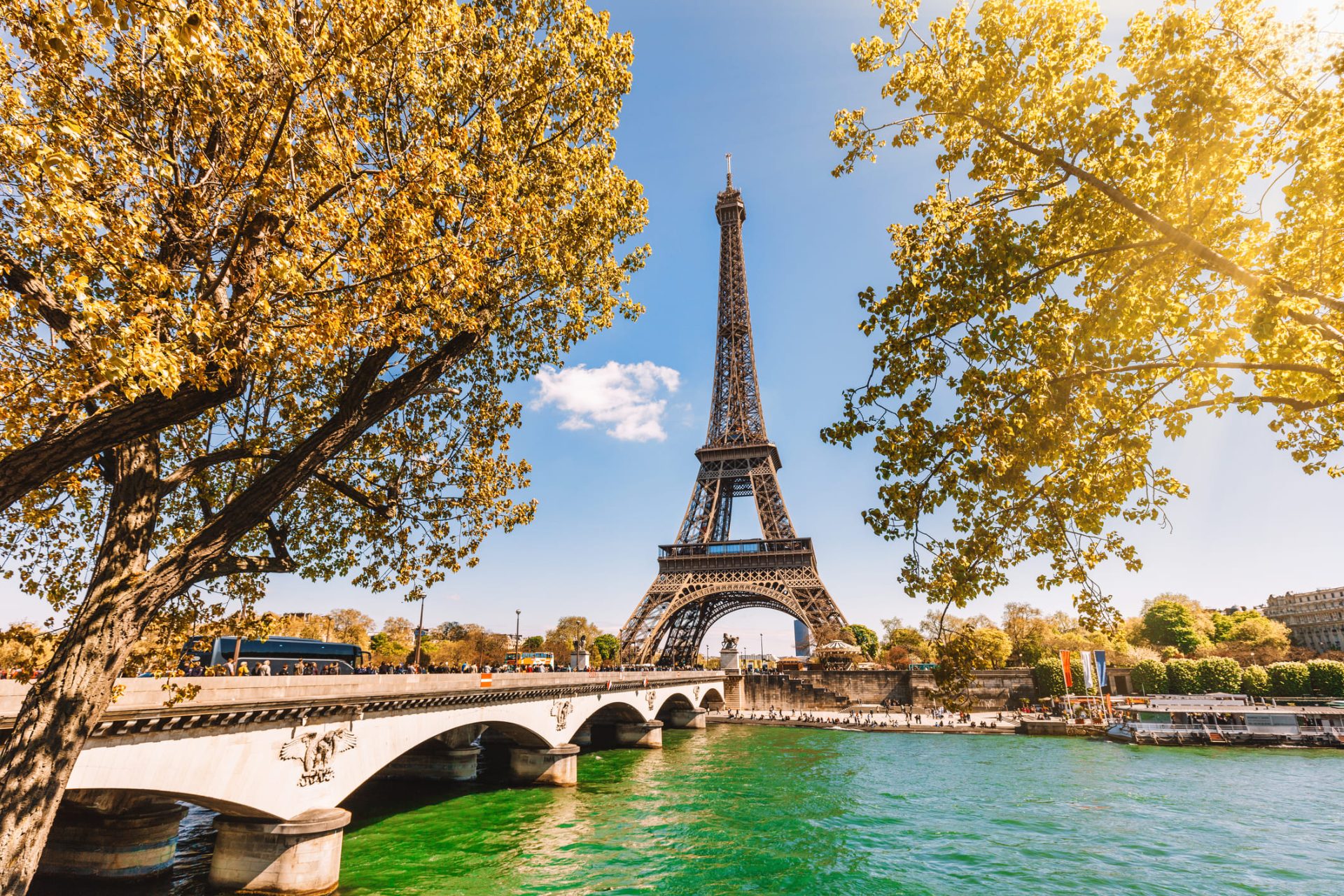
It's Christmas Eve, and you're spending it in Paris. After breakfast the coach takes you to the Champ de Mars, the long park that stretches out beneath the Eiffel Tower, and there it stands, rising 330 metres above you. Photos never prepare you for the size of it. Its four great iron legs spread wide across the ground, and the latticework climbs and narrows until it seems to touch the winter sky.

The Eiffel Tower was built for the World's Fair of 1889, to celebrate the 100th anniversary of the French Revolution. Gustave Eiffel's company built it in just over two years, and for forty years it was the tallest structure in the world. Eiffel was so proud of it that he kept a small private apartment near the top, where he received guests, including the inventor Thomas Edison. Here's a curious fact: the tower actually changes height with the weather. In summer heat, the iron expands, and the top can rise by around 15 centimetres.

The lift carries you to the second level, 115 metres above the ground. It's high enough to see the whole city spread out like a map, and low enough to make out the details: the dome of Les Invalides glinting gold, the long gardens of the Champ de Mars below, the river curving away under its bridges, and the white basilica of Sacré-Cœur shining on its hill at Montmartre. Many people find this level gives the best views of all. Walk all the way round the platform, find each landmark, and take your time with the photos.

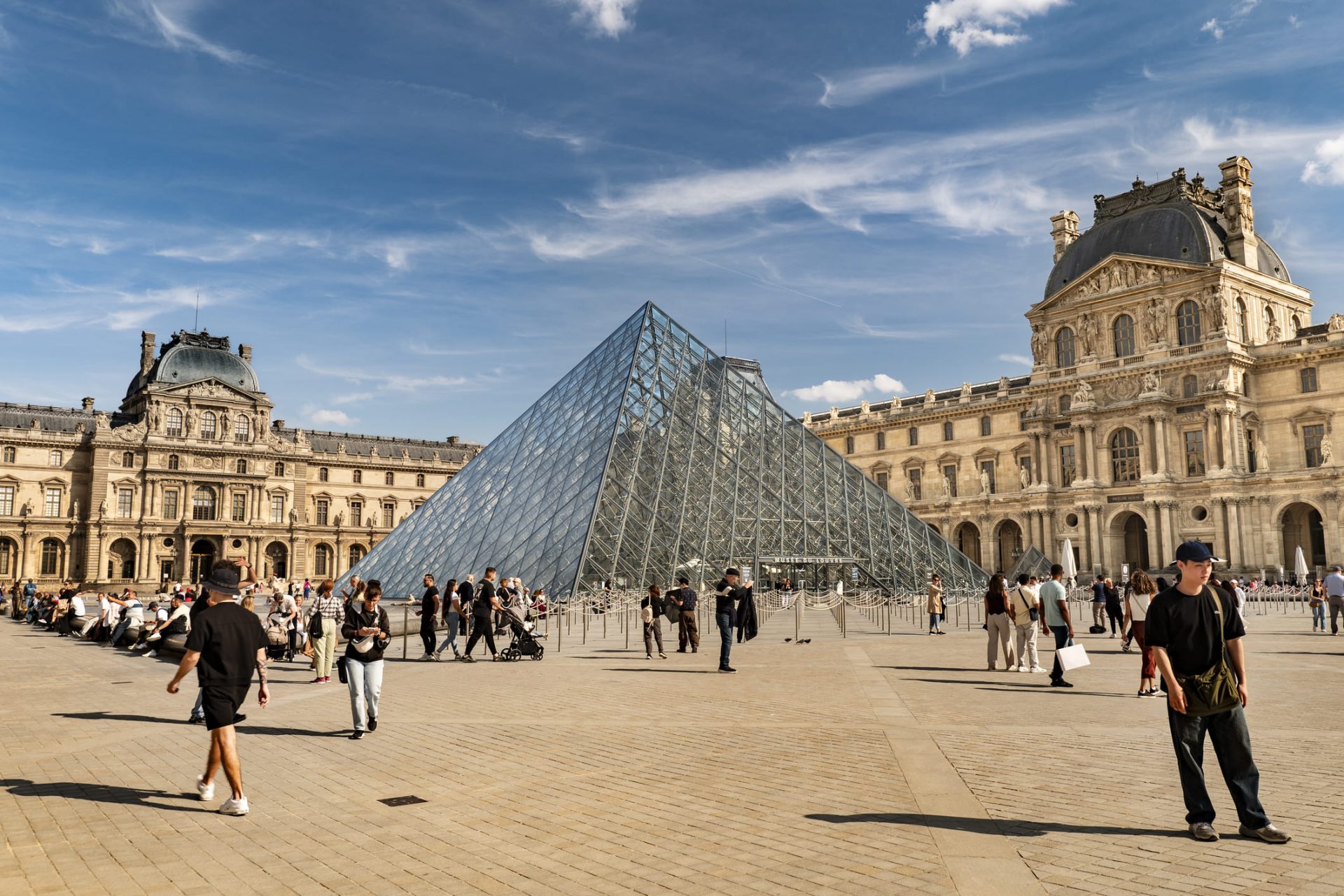
From the tower you head down to the river for a cruise on the Seine. The riverbanks of Paris are so beautiful that UNESCO has listed them as a World Heritage Site. Your boat slides along the water past grand buildings and under bridge after bridge: the city has 37 of them. One of the most famous is the Pont Neuf, whose name means "new bridge", though it's actually the oldest standing bridge in Paris, completed in 1607. Along the stone embankments, you'll see the bouquinistes, booksellers who have sold old books, prints and postcards from green wooden boxes fixed to the river walls for hundreds of years. The boat glides past the Île de la Cité, the birthplace of Paris, where the twin towers of Notre-Dame rise above the river, beautifully restored after the fire of 2019. Then you pass the long, majestic facade of the Louvre, once the palace of French kings and now the most visited museum in the world, home of the Mona Lisa.

After lunch the coach drives to Versailles, about twenty kilometres southwest of Paris. This was the home of the French kings and the centre of French power for more than a century, from Louis XIV to the Revolution. Louis XIV, the Sun King, wanted a palace that would show all of Europe how powerful France was, and he succeeded. The estate covers about 800 hectares, with formal gardens designed by André Le Nôtre stretching away in perfect lines of hedges, fountains, statues and canals.

Your guided visit takes you through the palace's richest rooms. In the Royal Chapel, white marble and gold soar towards a painted ceiling. In the King's Bedchamber, at the very centre of the palace, the king's day began with a public ceremony: courtiers gathered to watch him wake and dress, and being allowed to hand the king his shirt was a great honour. The Queen's Bedchamber has its own stories: royal babies were born here in front of crowds of courtiers, so that nobody could doubt the child's identity. And in October 1789, as an angry crowd stormed the palace, Queen Marie Antoinette escaped from this very room through a small hidden door in the wall. Then you walk into the Hall of Mirrors, the most famous room in the palace, glittering with crystal chandeliers and gold, where the great ceremonies of the royal court were held.

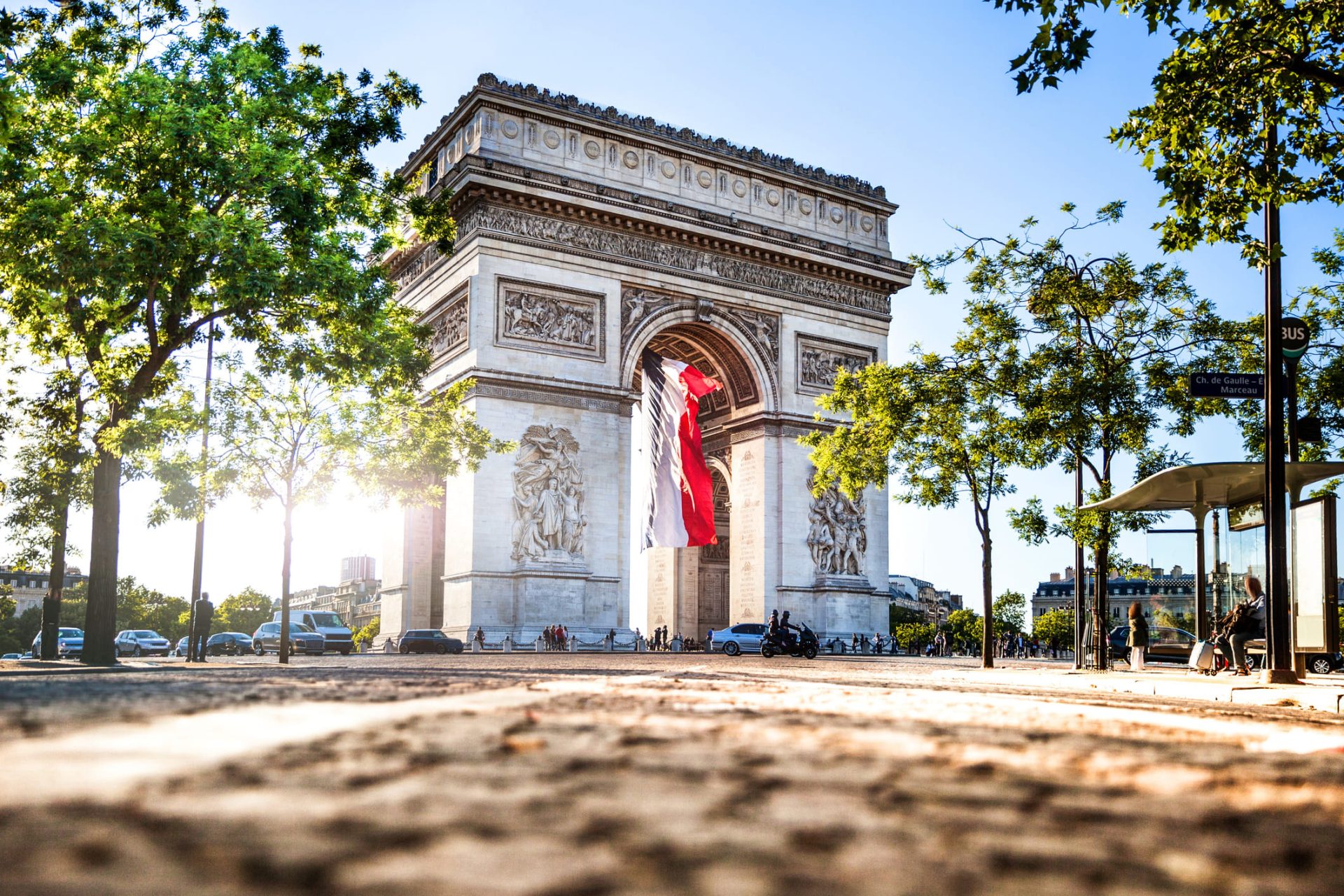
As darkness falls, you return to Paris for an orientation tour of the city, all lit up for Christmas Eve. Place Vendôme glows with the windows of its famous jewellers. The Opéra Garnier is lit in gold. At the Place de la Concorde, the ancient Egyptian obelisk stands floodlit among the fountains, and the Champs-Élysées stretches away towards the Arc de Triomphe, its trees wrapped in lights. You pass the golden dome of Les Invalides, where Napoleon is buried. It's the Paris of picture books, and on Christmas Eve, it feels like the whole city is celebrating.

The day ends with the group's Christmas Eve gala dinner. Across France, families are sitting down to their réveillon, the long Christmas Eve feast, and you're doing the same with your new travelling family: a festive table, a special menu with Jain, vegetarian and non-vegetarian options, and plenty of laughter. It's a Christmas Eve to remember.

Included today: Eiffel Tower 2nd level, River Seine cruise, guided Versailles Palace tour, Paris orientation tour, breakfast, lunch, Christmas Eve gala dinner.

Good to know: because of Christmas, some places may be closed or have shorter hours, so activities may be switched between days; you still see everything included. Expect a lot of walking today, so wear comfortable shoes.
Day 3
25 Dec · Brussels – Grand Place and Manneken Pis | Christmas Day in Belgium

25 Dec · Brussels – Grand Place and Manneken Pis | Christmas Day in Belgium

⌖ Netherlands 🍽 Meals: Breakfast, Lunch, Dinner

Merry Christmas! You wake up on Christmas morning in Paris, and by lunchtime you'll be in a different country. After a relaxed breakfast, the coach heads north out of the city, and the roads are wonderfully quiet: on Christmas Day most of France is at home with family. The motorway runs through the gently rolling farmland of northern France, past villages gathered around their church spires, and in about three and a half to four hours, you cross the border into Belgium, the third country of your tour.

Belgium is a small country with a big personality. It has three official languages, Dutch, French and German, and in Brussels you'll see street signs written in both French and Dutch. Brussels itself is the home of the European Union and NATO, so it's one of the most international cities in Europe. Belgium is also famous for three things that make visitors very happy: chocolate, waffles and fries. Belgians will tell you, with great conviction, that the "French" fry was actually invented here, and that the proper way to eat fries is from a paper cone, with a dollop of mayonnaise.

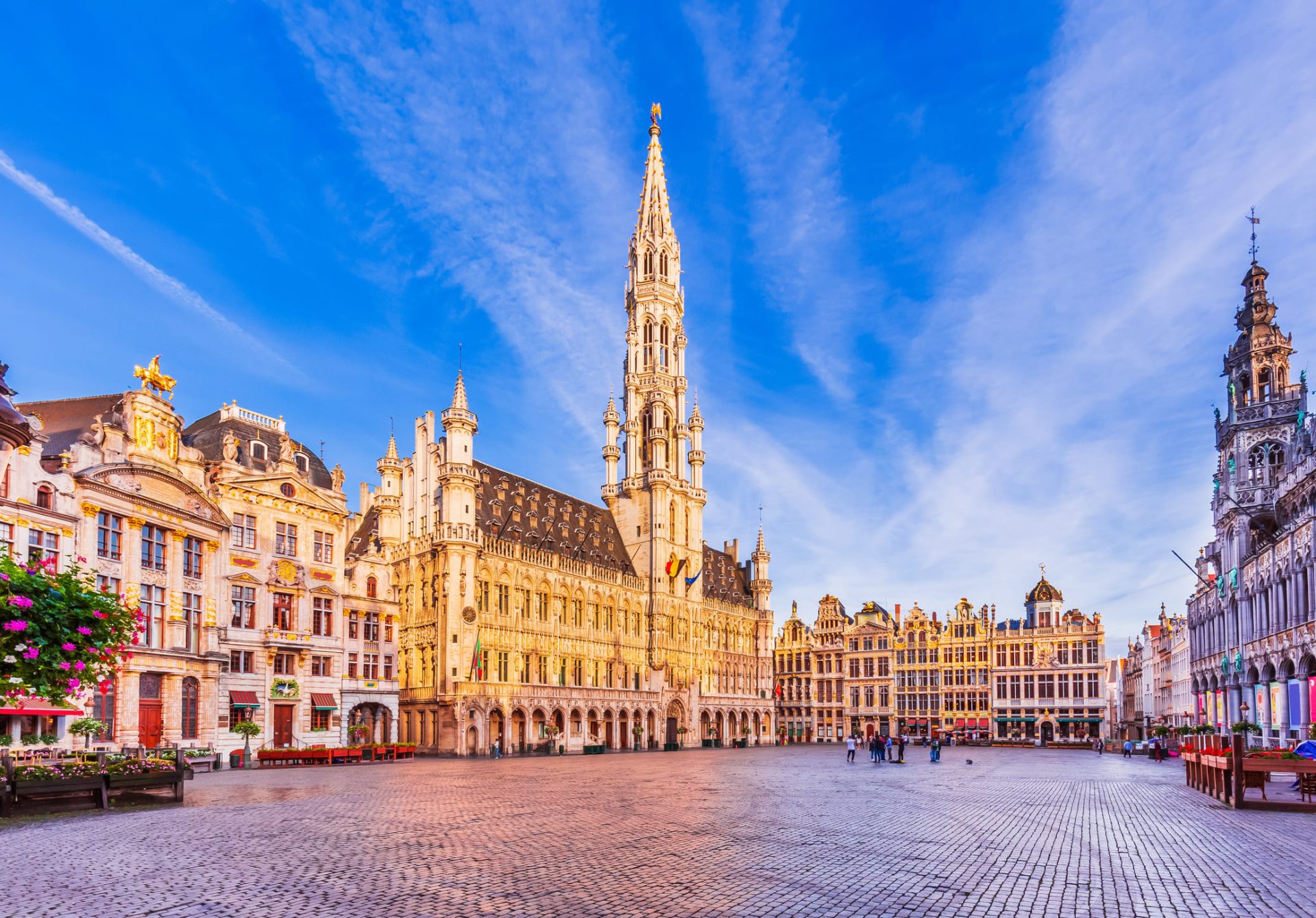
Your walk begins in the heart of the old city, and all paths lead to the Grand Place. Coming in through one of the narrow side streets, you suddenly step into the square, and it's like opening a jewellery box. Tall, narrow guild houses stand shoulder to shoulder, each one decorated from top to bottom with carved stone, statues and gold leaf that catches even the pale winter sun. On one side rises the Gothic Town Hall, whose lacy stone tower soars about 96 metres into the sky. Look closely and you'll notice that the building is not quite symmetrical: the tower isn't exactly in the middle, and the two wings are different. A local legend says the architect was so upset when he noticed that he threw himself from the tower, but that's only a story, and historians say the building was simply built in stages. Opposite stands the King's House, a richly decorated Gothic building that today houses the Brussels City Museum.

At Christmas, the Grand Place is the city's festive centre, with a giant Christmas tree in the middle of the square. Families stroll through in their warmest coats, children ride on their parents' shoulders, and the smell of hot waffles and mulled drinks floats from the nearby streets. Stand in the middle of the square for a moment and turn slowly in a full circle: it's one of the finest views in Europe.

From the square, a short walk takes you to Brussels's best-known little resident, the Manneken Pis. He is a small bronze statue of a boy relieving himself into a fountain, and he has stood on this street corner, in one form or another, since the 17th century. Locals love his cheeky spirit, which sums up their own sense of humour. The bronze boy on the corner is a copy; the precious original is kept in the City Museum on the Grand Place. On special days he is dressed in costumes from his enormous wardrobe, so keep an eye out to see whether he's wearing something festive for Christmas.

Brussels has another claim to fame that surprises many visitors: it's the capital of the comic strip. Hergé, the creator of Tintin, was born here, and the Smurfs also came from Belgium. As you walk around the centre, look up at the walls: you may spot huge comic-strip murals painted on the sides of buildings, featuring famous Belgian cartoon characters. Close to the Grand Place, you can also stroll through the Royal Galleries of Saint-Hubert, an elegant glass-roofed shopping arcade opened in 1847, one of the oldest of its kind in Europe, lined with chocolate shops, cafés and bookshops. Even on Christmas Day, its arches and glass roof make a lovely place to walk and admire the window displays.

After lunch you say goodbye to Brussels and drive north into the Netherlands, your fourth country of the tour. The landscape becomes even flatter, with wide skies, canals and fields stretching to the horizon, and on a clear day you may spot your first windmills. As evening falls, you reach your hotel in the Netherlands, where dinner is waiting. Christmas Day in three countries' worth of memories: breakfast in Paris, a walk through Brussels and dinner in Holland.

Included today: coach Paris to Brussels and on to the Netherlands, Brussels walking tour with the Grand Place and Manneken Pis, breakfast, lunch, dinner.

Good to know: because of Christmas, many shops and some sights may be closed or have shorter hours on 25 December, so activities may be switched between days; you still see everything included. Today has long coach journeys, so keep snacks, water and a neck pillow handy.
Day 4
26 Dec · Madurodam and Amsterdam canal cruise | Holland in miniature and in real life

26 Dec · Madurodam and Amsterdam canal cruise | Holland in miniature and in real life

⌖ Germany 🍽 Meals: Breakfast, Lunch, Dinner

Today you see Holland twice: first as a whole country shrunk to the size of a park, then as the real thing from a boat on Amsterdam's canals. After breakfast the coach takes you to The Hague, the city where the Dutch government sits and where the King has his working palace. It's also known around the world as the home of the International Court of Justice in the Peace Palace. On the edge of the city lies Madurodam, the Netherlands in miniature.

Madurodam opened in 1952, and its story is a moving one. It's named after George Maduro, a young Dutch law student from the Caribbean island of Curaçao who fought bravely in the Dutch resistance during the Second World War and died in a concentration camp in 1945. After the war, his parents gave the money to build the park in his memory, and it has delighted visitors ever since.

Walking into Madurodam, you suddenly become a giant. All around you, at a scale of 1 to 25, are the Netherlands' most famous buildings and landscapes, built in loving detail. You step over canals lined with Amsterdam's narrow houses, pass the grand Rijksmuseum, and stand beside the medieval Binnenhof, where the Dutch parliament has met for centuries. Windmills turn their sails, tiny trains run along their tracks, ships sail into the giant Port of Rotterdam, one of the busiest harbours in the world, and planes taxi along the runways of a miniature Schiphol airport. Cheese markets, tulip fields, dykes and drawbridges are all here. Many of the models move, and pressing buttons makes things happen, so children (and quite a few grown-ups) rush from one to the next. It's the perfect introduction to the Netherlands, and a fun way to understand how this small country lives with water.

From The Hague the coach drives about an hour to Amsterdam, the Dutch capital. The city's name tells you how it began: in the 13th century, fishermen built a dam on the River Amstel, and the settlement that grew up around it became "Amstel-dam". Because the ground here is soft, wet peat, almost every old building in Amsterdam stands on long wooden poles driven deep into the mud. The Royal Palace on Dam Square alone stands on 13,659 of them, a number every Amsterdam schoolchild learns. So as you walk around, remember that much of this city is, in a sense, a forest standing upside down.

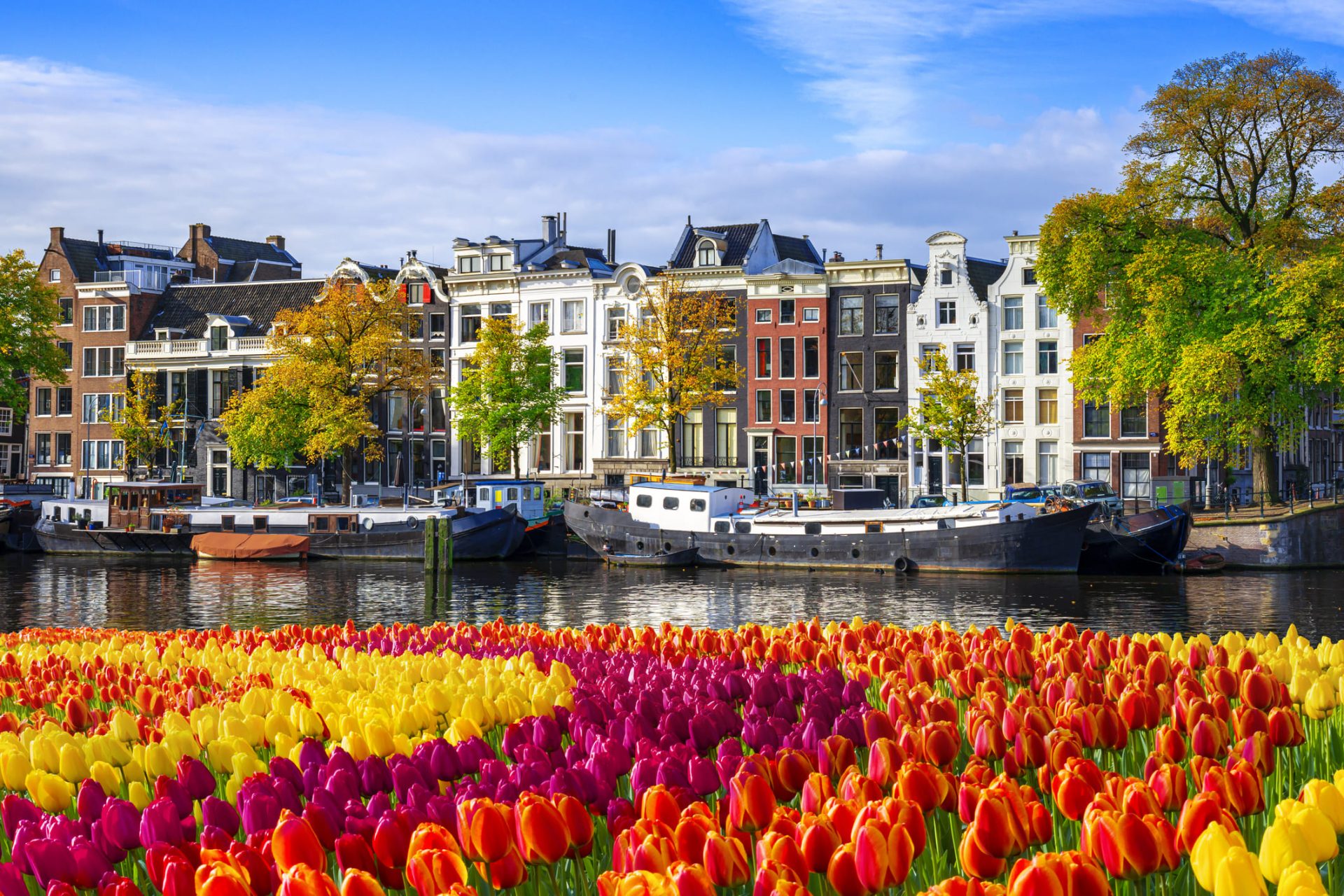
The best way to see Amsterdam is from the water, and your canal cruise sets off through the heart of the city. Amsterdam has more canals than Venice and well over a thousand bridges, and as the boat glides along, the city unfolds like a film. Tall, narrow houses lean gently against each other along the banks, their gabled tops shaped like steps, bells and triangles, and their big windows giving glimpses of cosy rooms with plants and bookshelves. Houseboats line the canals, some of them simple barges and others charming floating homes with flower pots and bicycles on deck; around 2,500 of them are moored in the city.

Your guide's commentary brings the city to life. You'll pass the Skinny Bridge over the Amstel, a white wooden drawbridge that's lit up beautifully after dark. On some canals you can look down a line of arched bridges, one behind the other, a classic Amsterdam view. You'll pass close to Amsterdam Central Station, a grand red-brick building from 1889, designed by the same architect as the Rijksmuseum and built on three artificial islands in the harbour. In winter, Amsterdam's canals take on a special atmosphere: mist on the water, bare trees reflected in the still surface, and lights glowing in the windows early in the afternoon. During the winter season the city also hosts a festival of light art, with installations along the canals, so if it's on during your visit, keep your camera ready.

If there's a little free time after the cruise, wander along a canal, watch the endless stream of bicycles (the city has more of them than people), and pop into a shop for Dutch cheese or a tin of stroopwafels to take home.

In the afternoon you leave the Netherlands behind and drive east into Germany, the fifth country of your tour. The flat Dutch landscape gives way to rolling hills and forests as you join the German autobahn. By evening you reach your hotel in the Frankfurt area, where dinner is waiting after a day of two very different Hollands.

Included today: Madurodam entry, Amsterdam canal cruise, breakfast, lunch, dinner.

Good to know: 26 December is a public holiday in the Netherlands and Germany, so some shops may be closed or open shorter hours. It can be cold and windy by the water, so wear a warm jacket, hat and gloves.

Day 5
27 Dec · Heidelberg, Black Forest and Rhine Falls | Romantic Germany and a thundering waterfall

27 Dec · Heidelberg, Black Forest and Rhine Falls | Romantic Germany and a thundering waterfall

⌖ Central Switzerland 🍽 Meals: Breakfast, Lunch, Dinner

Today the road takes you from one of Germany's most romantic towns, through the dark woods of the Black Forest and over the border into Switzerland, where the mighty Rhine tumbles over a wall of rock. It's a day of changing scenery, so try to get a window seat.

The first stop is Heidelberg, about an hour south of Frankfurt, set where the River Neckar leaves the hills and flows out onto the plain. Heidelberg is famous across Germany as the town of students, poets and romance. Its university, founded in 1386, is the oldest in the country, and about one in five people living in the town today is a student. Unlike many German cities, Heidelberg came through the Second World War with little damage, so its old town of red sandstone and baroque buildings looks much as it did centuries ago.

Above the town, on a wooded hillside, stand the red ruins of Heidelberg Castle, half-palace and half-fortress, with broken towers and empty Renaissance windows looking out over the river. Wars and a lightning strike left it in ruins centuries ago, and instead of rebuilding it, Heidelberg let it become one of the most romantic sights in Germany. On a misty December morning, with frost on the roofs below, it looks like something from a fairy tale.

Your walk takes you through the Old Town to the Market Square and the Church of the Holy Spirit, whose tall tower dominates the skyline. Facing the church is the Knight's House, built in 1592, with a richly carved stone facade: it was one of the few buildings to survive a great fire in 1693. Nearby is one of the town's quirkiest sights, the Student Prison. Until 1914 the university had the right to punish its own students, and those caught drinking, brawling or playing pranks were locked up here for a few days. The prisoners covered the walls and ceilings with drawings, poems and graffiti, which can still be seen today. Across the river, a hillside path called the Philosophers' Walk climbs through the trees, and from it, the view back over the river, the Old Bridge, the roofs of the Old Town and the castle is one of the most famous in Germany.

From Heidelberg the coach drives south into the Black Forest, the largest forested mountain range in Germany, stretching some 160 kilometres along the Rhine valley. Its name comes from the dense fir and spruce forests that cover its hills, so thick that from a distance they look almost black. This is also where the great River Danube begins its long journey across Europe to the Black Sea. In winter the forest is magical: snow on the treetops, smoke curling from the chimneys of wooden farmhouses, and quiet valleys where the only sound is a stream running under the ice.

The Black Forest is famous for its traditions. In a few villages, women still wear a traditional hat called the Bollenhut on festive days, a straw hat topped with large woollen pompoms: red pompoms for unmarried women and black for married women. You'll see its image on postcards, chocolates and souvenirs all over the region. The region is also known for Black Forest ham, smoked slowly over fir wood, and of course for the cake that bears its name.

But most of all, the Black Forest is the home of the cuckoo clock. At a traditional clock workshop, you see a demonstration of how these clocks are made and how they work. There are two classic styles: the "hunter" style, carved with deer heads, rabbits and oak leaves, and the "chalet" style, shaped like a little Black Forest house with dancers, water wheels or woodcutters that move when the clock strikes. Some clocks need winding every day, while others run for eight days. Genuine Black Forest clocks come with a certificate of authenticity, so if you're buying one, ask for it.

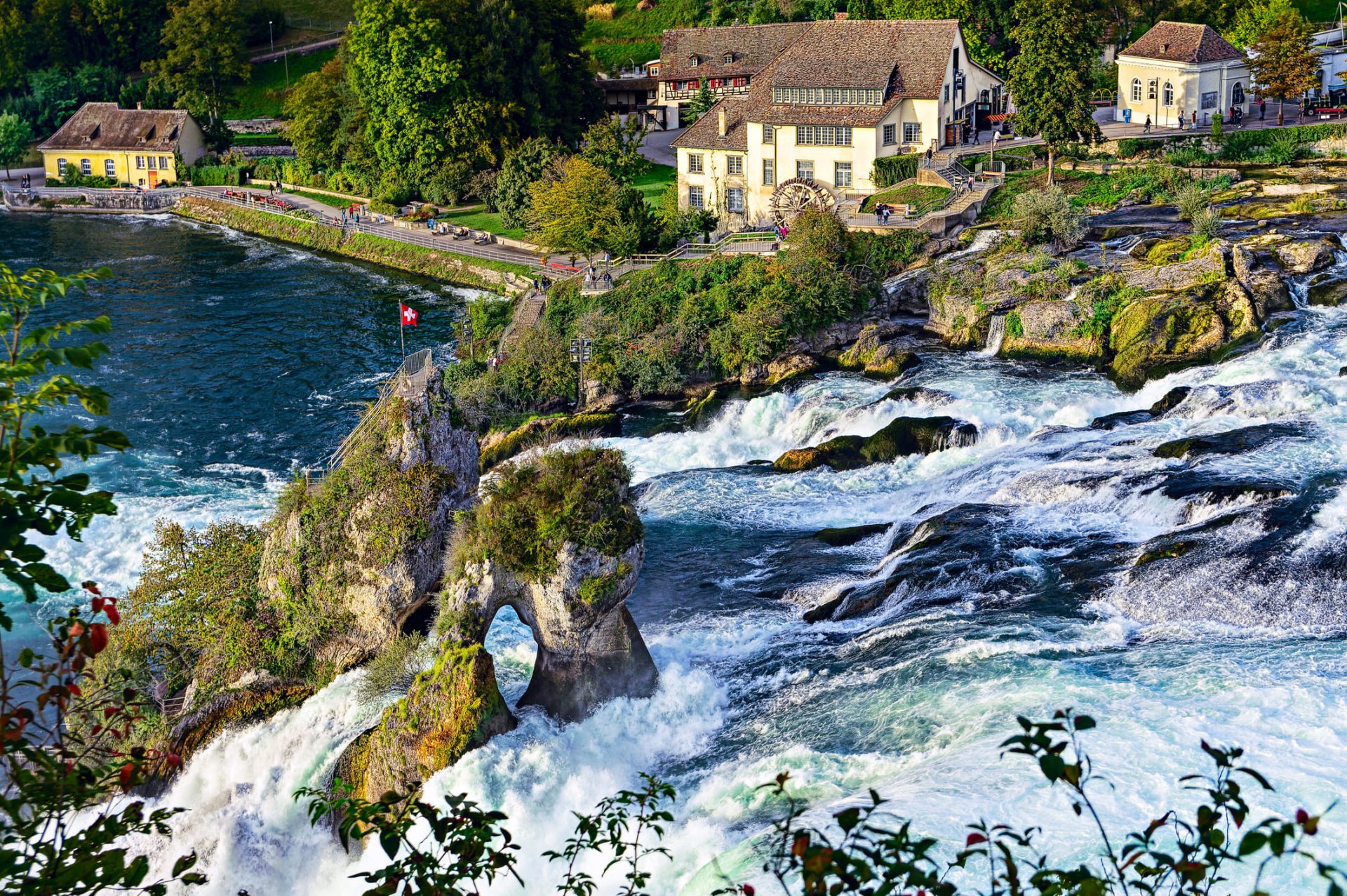
In the afternoon you cross the border into Switzerland and stop at the Rhine Falls near Schaffhausen. The River Rhine starts as a stream high in the Swiss Alps and flows more than 1,200 kilometres to the North Sea, and here it makes its most dramatic leap. The river widens, races towards the edge and pours over a broad ledge of rock in a thunder of white water and spray. The great English painter J.M.W. Turner painted it, and once you stand on the viewing platforms with the roar in your ears, you'll see why artists have been drawn here for centuries. Even in winter, when the flow is gentler than in summer, the power of the water is unforgettable.

In the evening you drive into Central Switzerland and check in to your hotel for the next two nights. Dinner is waiting, and with it the excitement of being in Switzerland at last.

Included today: Heidelberg Old Town, Black Forest cuckoo clock demonstration, Rhine Falls, breakfast, lunch, dinner.

Good to know: the boat ride at the Rhine Falls usually pauses over Christmas and New Year, so you see the falls from the viewing platforms. Pavements can be icy in winter, so wear shoes with a good grip.

Day 6
28 Dec · Free day or optional Jungfraujoch; Lucerne | Your Swiss day, your way

28 Dec · Free day or optional Jungfraujoch; Lucerne | Your Swiss day, your way

⌖ Central Switzerland 🍽 Meals: Breakfast, Lunch, Dinner

You wake up in Switzerland, and the view from your window may be the first thing you photograph today: snow-covered hills, dark pine forests, wooden chalets with smoke rising from their chimneys, and perhaps a glimpse of a frozen lake. Today is your Swiss day, and you can shape it as you like. The morning is free, and you can relax at your own pace or join the optional excursion to Jungfraujoch, the Top of Europe. In the afternoon, the whole group comes together in Lucerne.

If you choose to stay relaxed, enjoy a slow breakfast and take a walk in the fresh mountain air. Swiss villages are spotlessly clean and peaceful, and simply wandering around, watching locals go about their day, buying bread at the bakery or chatting at the post office, gives you a feel for everyday Swiss life. It's also a good chance to rest your legs after a busy week.

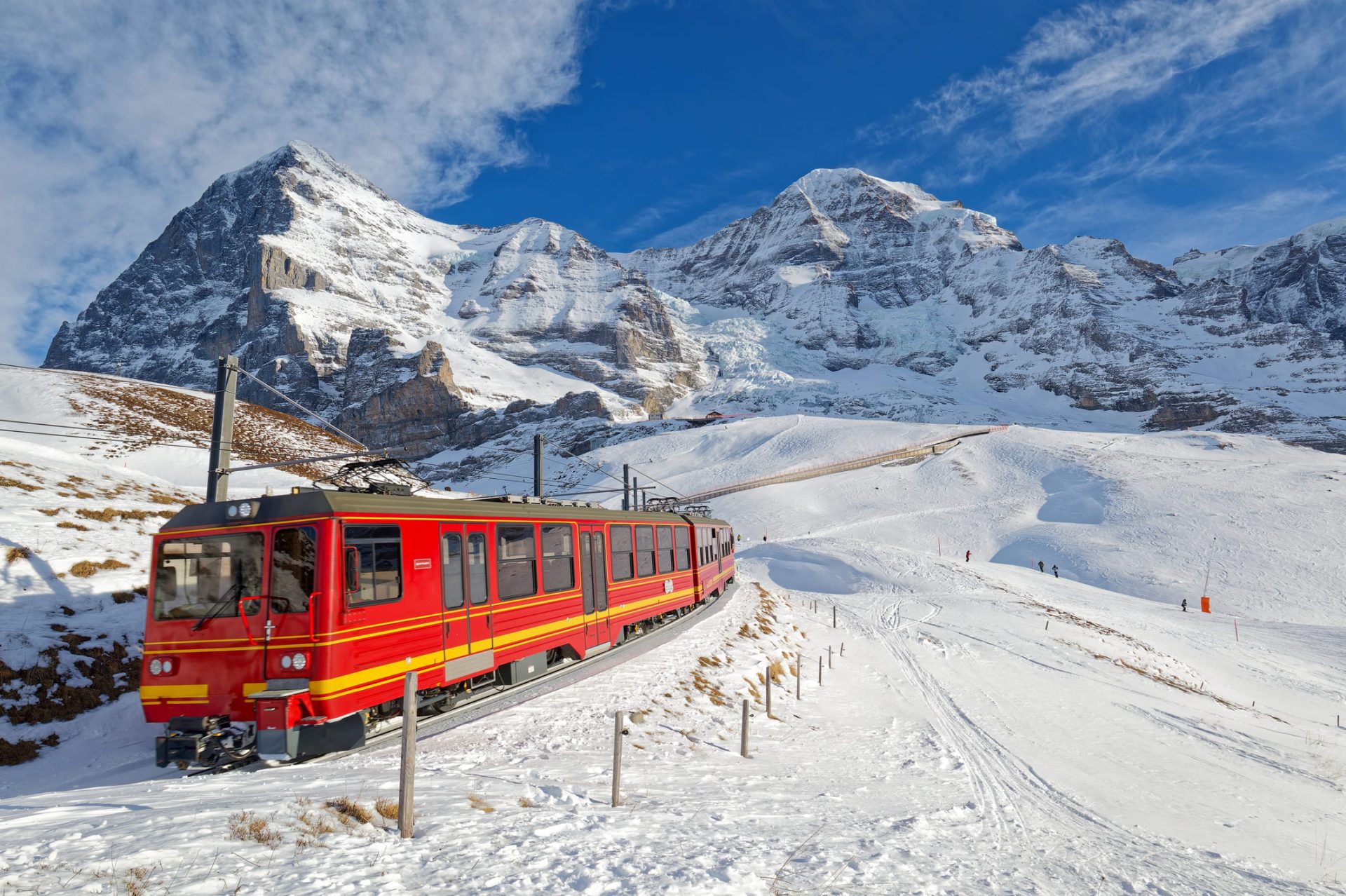
For most first-time visitors, though, the optional Jungfraujoch excursion is the highlight of the whole trip. The journey takes you into the Bernese Oberland, one of the most dramatic mountain regions in the Alps, where three great peaks stand side by side: the Eiger, the Mönch and the Jungfrau, whose names mean the Ogre, the Monk and the Maiden. Local people like to say that the monk stands between the ogre and the maiden to protect her. On the way, you pass through deep valleys where waterfalls pour off sheer cliffs, and mountain villages where the only way in is by train or cable car.

The final climb is made on the Jungfrau Railway, which runs for most of its length through a tunnel inside the mountains, bored through solid rock more than a century ago. It brings you to Jungfraujoch, at 3,454 metres the highest railway station in Europe. Here you step into a frozen world. Walk through the Ice Palace, a series of tunnels carved deep inside the glacier, with sculptures made of ice. Take the lift to the Sphinx observation terrace and look out over the Aletsch Glacier, the longest in the Alps, curving away for about 20 kilometres between snow-white peaks. Step out onto the snow plateau and feel the crunch of the snow under your boots and the bright sunlight on your face. For many travellers from India, it's the first time they've stood in deep snow, and the excitement is wonderful to see.

In the afternoon, everyone meets in Lucerne for a guided orientation tour. Lucerne lies at the edge of Lake Lucerne, which the Swiss call the Lake of the Four Forest Cantons. Its shores are where Switzerland itself was born. According to tradition, in 1291 representatives of three mountain communities met in a meadow on the lakeshore called the Rütli and swore an oath to defend each other, the beginning of the Swiss Confederation. This is also the land of the legendary hero William Tell, who, so the story goes, was forced to shoot an apple from his own son's head with a crossbow.

Lucerne's old town is a delight to explore. You walk across the river on the Chapel Bridge, Lucerne's famous covered wooden bridge from the 1300s, with flower boxes along its sides and old paintings under its roof. A little further downstream is a second wooden bridge, the Spreuer Bridge, from 1408, whose paintings show the Dance of Death, a medieval reminder that life is short. Above the old town, the Musegg Wall stretches along the hill with nine towers. One of them, the Zyt Tower, has the oldest clock in Lucerne, and by ancient privilege, it's allowed to strike the hour one minute before every other clock in town.

You'll also visit the Lion Monument, a great dying lion carved into a sandstone cliff. It honours the Swiss Guards who died protecting the French royal family in Paris in 1792. The sad, noble expression on the lion's face moves almost everyone who sees it.

Then there's free time for shopping. Lucerne is one of the best places in Switzerland to buy watches, Swiss Army knives, chocolates and souvenirs, and the shops along the river are full of Christmas cheer. As the light fades, the old town's lanterns come on and the bridges are lit up, reflecting in the dark water. In the evening you return to the hotel for dinner with the group, and if you went to Jungfraujoch, you'll have plenty of snow photos to share.

Included today: Lucerne orientation tour with Chapel Bridge and Lion Monument, breakfast, lunch, dinner.

Good to know: the Jungfraujoch excursion is optional and costs extra; book it with us in advance, as places on the train are limited in the holiday season. If you go, wear thermal layers, gloves, a hat and sunglasses: it is well below freezing at the top.

Day 7
29 Dec · Mt. Titlis, Swarovski and Innsbruck | Glaciers, crystal and the Austrian Alps

29 Dec · Mt. Titlis, Swarovski and Innsbruck | Glaciers, crystal and the Austrian Alps

⌖ Innsbruck / Seefeld 🍽 Meals: Breakfast, Lunch, Dinner

Today you go from a Swiss glacier to the heart of the Austrian Alps, with snow and sparkle all the way. After breakfast, the coach takes you into the narrow green valley of Engelberg, a mountain village that grew up around a Benedictine monastery founded nine centuries ago. The monks still live and pray there, and the monastery even has its own small cheese dairy. Above the village, filling the end of the valley, rises Mt. Titlis, its summit crowned by a glacier that shines white even on a grey day.

The journey up the mountain is a series of rides, each more exciting than the last. Small gondolas carry you first over snowy fir forests to Trübsee, a mountain lake that in winter lies frozen and silent under a thick blanket of snow, surrounded by peaks. From there a larger cable car climbs to Stand station, and then you step into the Rotair, the world's first revolving cable car. As it climbs the final steep rock face, the whole floor of the cabin turns slowly, so that everyone on board gets the full panorama: the glacier with its deep blue crevasses beneath you, jagged peaks all around, and the valley you came from shrinking to a thin line far below.

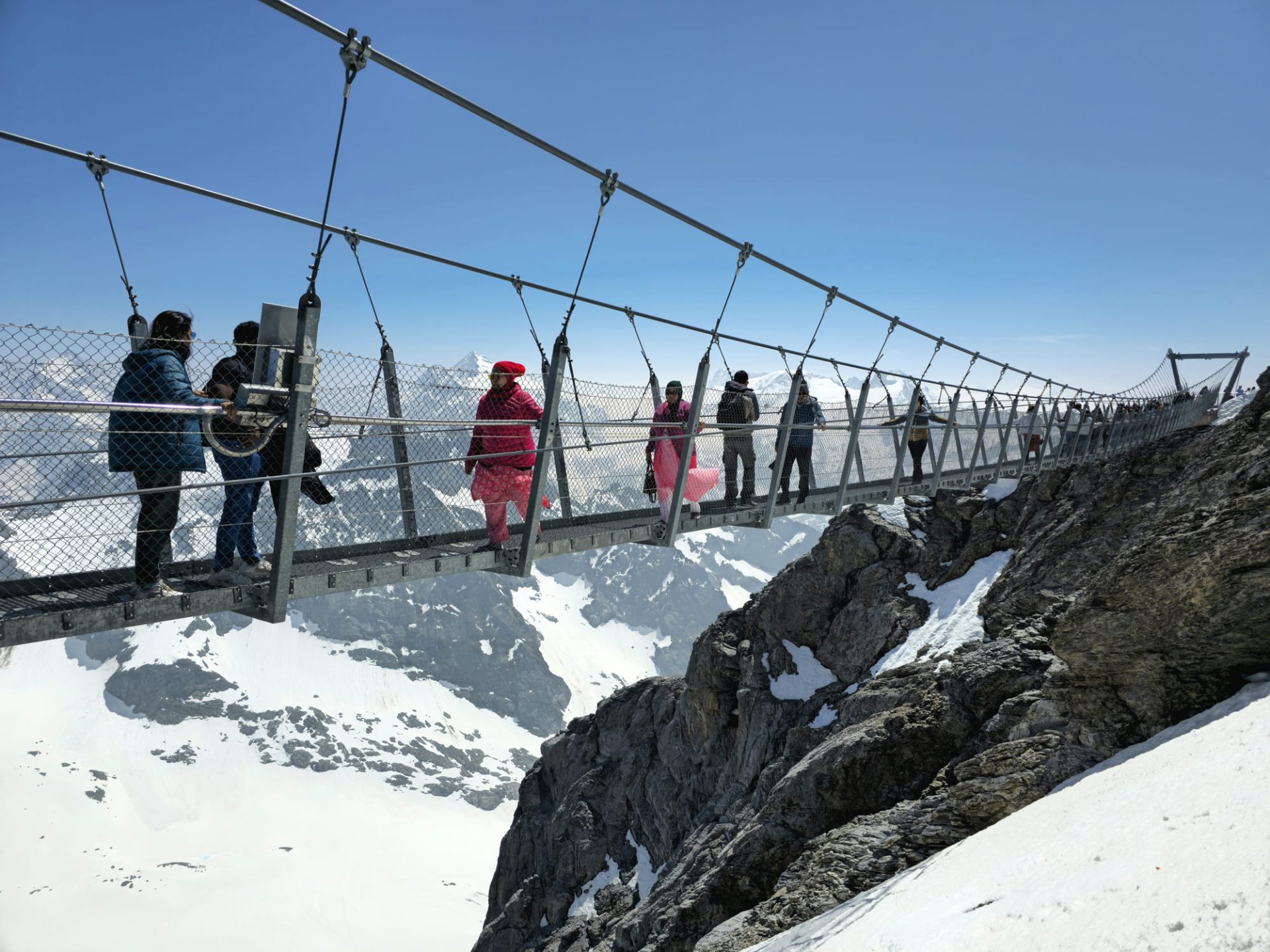
At the top station, at 3,020 metres, you step out into a world of white. The adventurous head straight for the Titlis Cliff Walk, a narrow suspension bridge strung along the cliff face, about 100 metres long, with the ground some 500 metres below. It's the highest suspension bridge in Europe, and walking across it, with the wind in your face and the mountains all around, is a real thrill. Inside the mountain, a passage leads into the Glacier Cave, a tunnel carved through the ice, glowing blue and cold, where you can see the layers of snow that built up over many years. Then there's time to go out onto the snow, build a snowman, throw snowballs and take photos against the endless white peaks.

After lunch you leave Switzerland and drive east, through the mountains and along valleys of snowy villages, into Austria, the sixth country of your tour. Your destination is Innsbruck, the capital of the Tyrol. The name means "bridge over the Inn", after the river that flows through the city. Innsbruck is one of the most beautifully placed cities in Europe: the great wall of the Nordkette mountains rises almost straight up behind the rooftops, so that wherever you are in the old town, you look up at snow-covered peaks. It's a true winter-sports city and has hosted the Winter Olympics twice, in 1964 and 1976.

Your orientation tour takes you to the old town, with its pastel-coloured houses, arcades and painted facades. The most famous sight is the Golden Roof, a richly decorated balcony with a roof made of more than 2,600 gilded copper tiles, built around 1500 for Emperor Maximilian I. From here, the emperor and his court watched tournaments, dances and festivals in the square below. Then you stroll along Maria-Theresien-Strasse, Innsbruck's grand main street, named after the Empress Maria Theresa, with St. Anne's Column standing in the middle and the mountains rising beyond. In the festive season, the old town is still decorated with lights and garlands, and the smell of roasted chestnuts and warm spices often fills the air.

Innsbruck is also home to one of the world's most famous crystal brands. Swarovski was founded in 1895 in the Tyrol, in the town of Wattens near Innsbruck, by Daniel Swarovski, who invented a machine that could cut crystal with incredible precision. Today its sparkling crystal is worn and collected around the world. At the Swarovski crystal shop, you can admire glittering jewellery, figurines and Christmas ornaments, and pick up a gift that will remind you of the Alps every time it catches the light.

As evening falls, the coach climbs up from the Inn valley to Seefeld, an alpine village on a high, sunny plateau surrounded by mountains. Seefeld is famous for cross-country skiing, and it hosted the Nordic events of the Innsbruck Winter Olympics. In winter, it's a picture-postcard village: snow-covered chalets with carved wooden balconies, horse-drawn sleighs with jingling bells, a pretty parish church and fields of snow glowing under the streetlamps. Step outside after dinner, breathe in the cold, pure mountain air and look up: the stars are bright up here. Tomorrow you cross into Italy.

Tyrolean winter evenings are made for warming up. In the village inns, wooden-panelled rooms called Stuben glow with candlelight, and tiled stoves fill them with heat. Tyroleans love their hearty mountain food after a day in the snow: cheese dumplings in broth, spinach dumplings with melted butter and parmesan, and Käsespätzle, little egg noodles baked with mountain cheese and crispy onions. Many of these dishes are vegetarian, so they're well worth trying if you get the chance.

Included today: Mt. Titlis with the Rotair, Cliff Walk and Glacier Cave, Swarovski crystal shop, Innsbruck orientation tour, overnight in Seefeld, breakfast, lunch, dinner.

Good to know: it's very cold at the top of Titlis and in Seefeld at night, so wear thermal layers, gloves and a hat. Activities on Titlis depend on the weather.

Day 8
30 Dec · Venice – private boat to St. Mark's Square | Arriving by water

30 Dec · Venice – private boat to St. Mark's Square | Arriving by water

⌖ Padova 🍽 Meals: Breakfast, Lunch, Dinner

Today you cross the Alps into Italy and arrive in Venice by water, the way travellers have arrived for a thousand years. After breakfast in Seefeld, the coach heads south through the Tyrol and climbs to the Brenner Pass, one of the oldest routes across the Alps. Roman legions, medieval emperors and merchants all crossed the mountains here. At the top of the pass, you leave Austria behind and enter Italy, the seventh country of your tour.

As the road winds down the other side, you'll notice the change. The signs become Italian, church towers take on a different shape, and the valleys open up into vineyards and orchards. In this region, called South Tyrol, many people still speak German, and towns have names in both languages. Gradually the mountains fall away behind you, and you reach the wide, flat plains of the Veneto, the region of Venice.

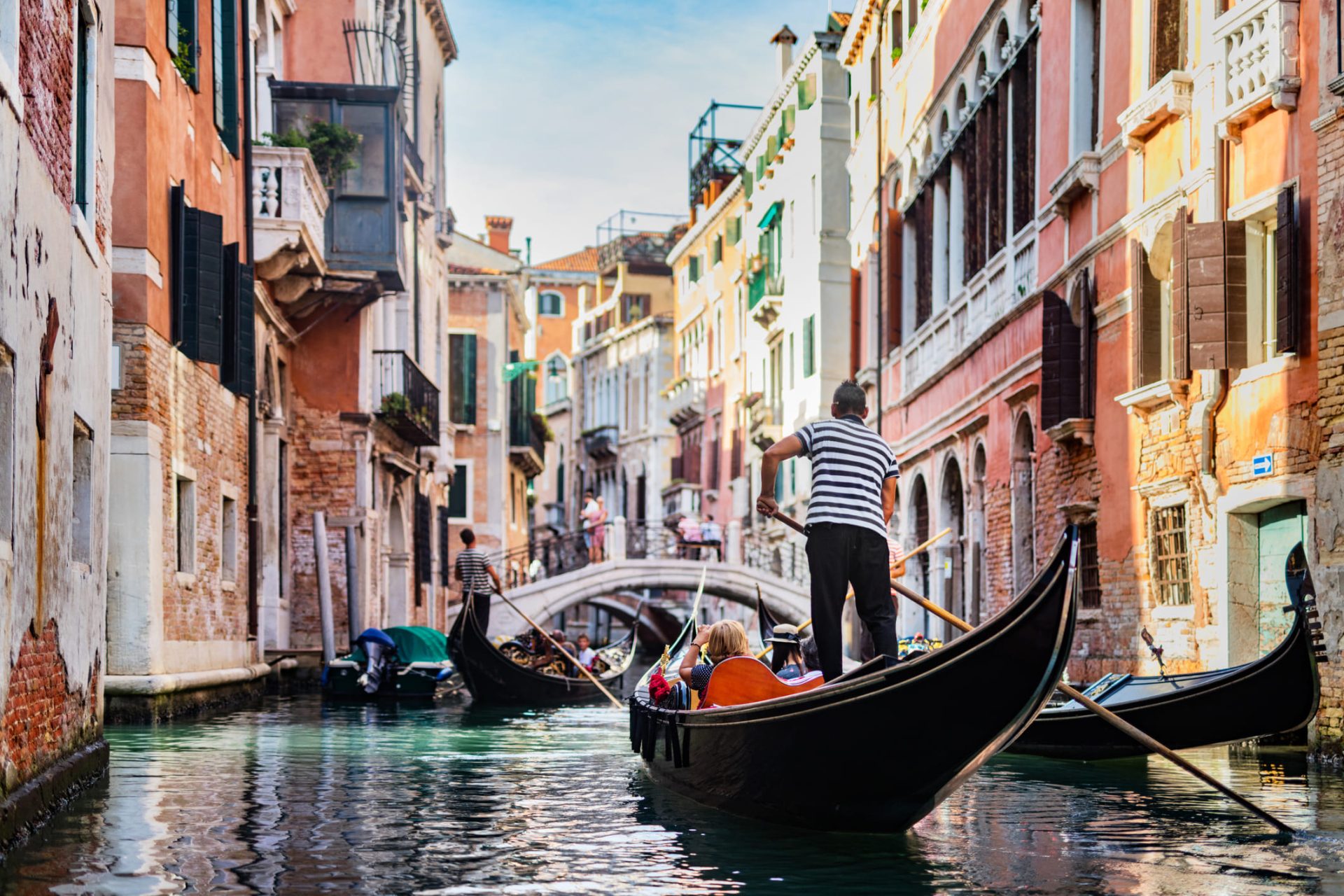
The coach stops at the edge of the lagoon, and here you board a private boat. As it pulls away from the shore and heads out across the open water, the excitement on board is clear. Venice begins as a faint line on the horizon, and then slowly the domes, bell towers and palaces rise out of the water, as if the whole city were floating. In a way, it is. Venice is built on around 118 small islands in a shallow lagoon, connected by about 400 bridges. Its first inhabitants came here more than 1,500 years ago to escape invaders on the mainland, and they built their homes on millions of wooden poles driven deep into the mud. Over the centuries, this unlikely city became one of the richest and most powerful in the world, a republic of merchants and sailors that traded with the East and ruled the seas for a thousand years.

Your boat glides past the island of San Giorgio Maggiore and the elegant facade of the Doge's Palace, and pulls in near St. Mark's Square. Napoleon is said to have called it "the drawing room of Europe", and it's easy to see why. Long arcades frame three sides of the square, and at the far end stands St. Mark's Basilica, glowing with golden mosaics and crowned with five great domes. It was built to hold the remains of St. Mark, which, according to legend, two Venetian merchants smuggled out of Alexandria in Egypt in 828, hidden under a load of pork so that the guards wouldn't check the cargo. Above the main door stand four bronze horses, copies of the ancient originals that are now kept inside.

Beside the basilica rises the Bell Tower, nearly 99 metres tall. Amazingly, the original tower collapsed suddenly in 1902; the Venetians rebuilt it exactly as it was, "where it was and as it was", and it reopened ten years later. Across the square stands the Clock Tower, with a blue and gold clock face showing the signs of the zodiac, and on its roof two bronze figures, known as the Moors, have struck the hours on a great bell for over five hundred years.

From the square you walk to the waterfront to see the Doge's Palace, the pink and white Gothic palace where the rulers of Venice lived and governed. Behind it, a small white stone bridge crosses a narrow canal: the Bridge of Sighs. It once linked the palace's courtrooms to the prisons, and legend says prisoners sighed as they caught their last glimpse of Venice through its small stone windows on the way to their cells. The famous adventurer Casanova was imprisoned here, and in 1756 he made a daring escape across the roofs of the palace.

Then there's time to explore on your own. Venice is a city made for getting a little lost. Wander away from the crowds into the narrow lanes, called calli, where washing hangs between houses, gondolas glide along quiet canals and small bridges lead to hidden squares. Look in the shop windows for the colourful glass made on the nearby island of Murano, and the elaborate masks worn during the famous Venice Carnival. Stop for a hot chocolate or a gelato, even in winter, at a café by a canal.

In the late afternoon, the boat takes you back across the lagoon as the sun sets behind the city, turning the water gold and pink. The coach then drives to your hotel near Padova, an old university city where the astronomer Galileo once taught. Over dinner, you'll find everyone talking about the same thing: there is simply nowhere else on earth like Venice.

Included today: coach Seefeld to Venice via the Brenner Pass, private boat across the lagoon to St. Mark's Square, Venice orientation walk, breakfast, lunch, dinner.

Good to know: in winter, Venice sometimes has acqua alta, high tides that briefly flood parts of the city, including St. Mark's Square. If it happens, raised walkways are put out and the water usually recedes within a few hours. Wear waterproof shoes, and beware of pickpockets in crowded areas.

Day 9
31 Dec · Rome and Vatican City – St. Peter's Basilica, Colosseum and Trevi Fountain | New Year's Eve in the Eternal City

31 Dec · Rome and Vatican City – St. Peter's Basilica, Colosseum and Trevi Fountain | New Year's Eve in the Eternal City

⌖ Rome 🍽 Meals: Breakfast, Lunch, Dinner

The last day of the year, and you spend it in the Eternal City. After an early breakfast, the coach drives south from Padova through the heart of Italy, past the hills of Tuscany and Umbria, with medieval hill towns perched on their summits and rows of cypress trees lining the farm roads. By late morning you reach Rome, a city that has been lived in for nearly 3,000 years. According to legend, it was founded in 753 BC by Romulus, who, with his twin brother Remus, had been raised by a she-wolf. From here, the Romans built an empire that stretched from Britain to the Middle East, and you'll see its traces everywhere: in the roads, the ruins, the languages of Europe and even the calendar we use today.

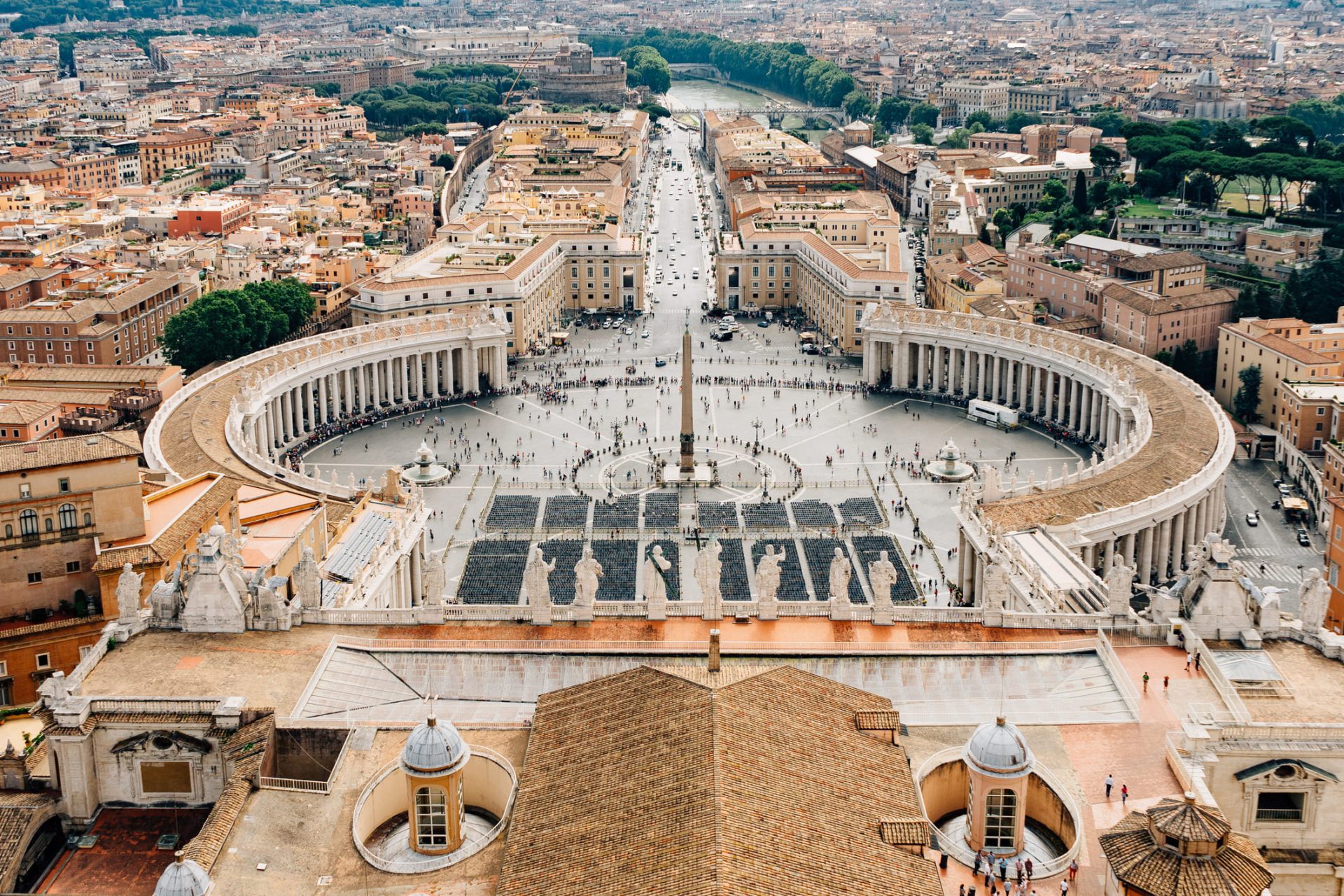
Your first stop is Vatican City, the world's smallest country. It covers less than half a square kilometre, entirely surrounded by Rome, yet it's the spiritual home of more than a billion Catholics and the residence of the Pope. You enter through St. Peter's Square, designed by the sculptor Gian Lorenzo Bernini in the 17th century. Two great curved colonnades, with nearly three hundred columns, reach out around the square like a pair of arms embracing everyone who arrives. In the centre stands an Egyptian obelisk brought to Rome by the Roman emperors, and during the Christmas season, a giant Christmas tree and a large nativity scene stand in the square.

Then you step inside St. Peter's Basilica, one of the largest churches in the world. It took 120 years to build, from 1506 to 1626, and the greatest artists of the Renaissance worked on it. The scale is overwhelming: the floor seems to go on forever, and sunlight pours down through the windows of the vast dome, designed by Michelangelo, which rises more than 130 metres above the floor. Just inside the entrance, behind protective glass, is Michelangelo's Pietà, a marble statue of Mary holding the body of Jesus, carved when the artist was only in his early twenties. It's so tender and lifelike that visitors often stand silently before it. In the centre of the basilica, Bernini's huge bronze canopy, held up by four twisting columns, stands over the high altar, above the place where St. Peter is believed to be buried. Look out, too, for the Swiss Guards in their colourful striped uniforms: they've protected the Pope since 1506, a nice link to the Switzerland you've just left.

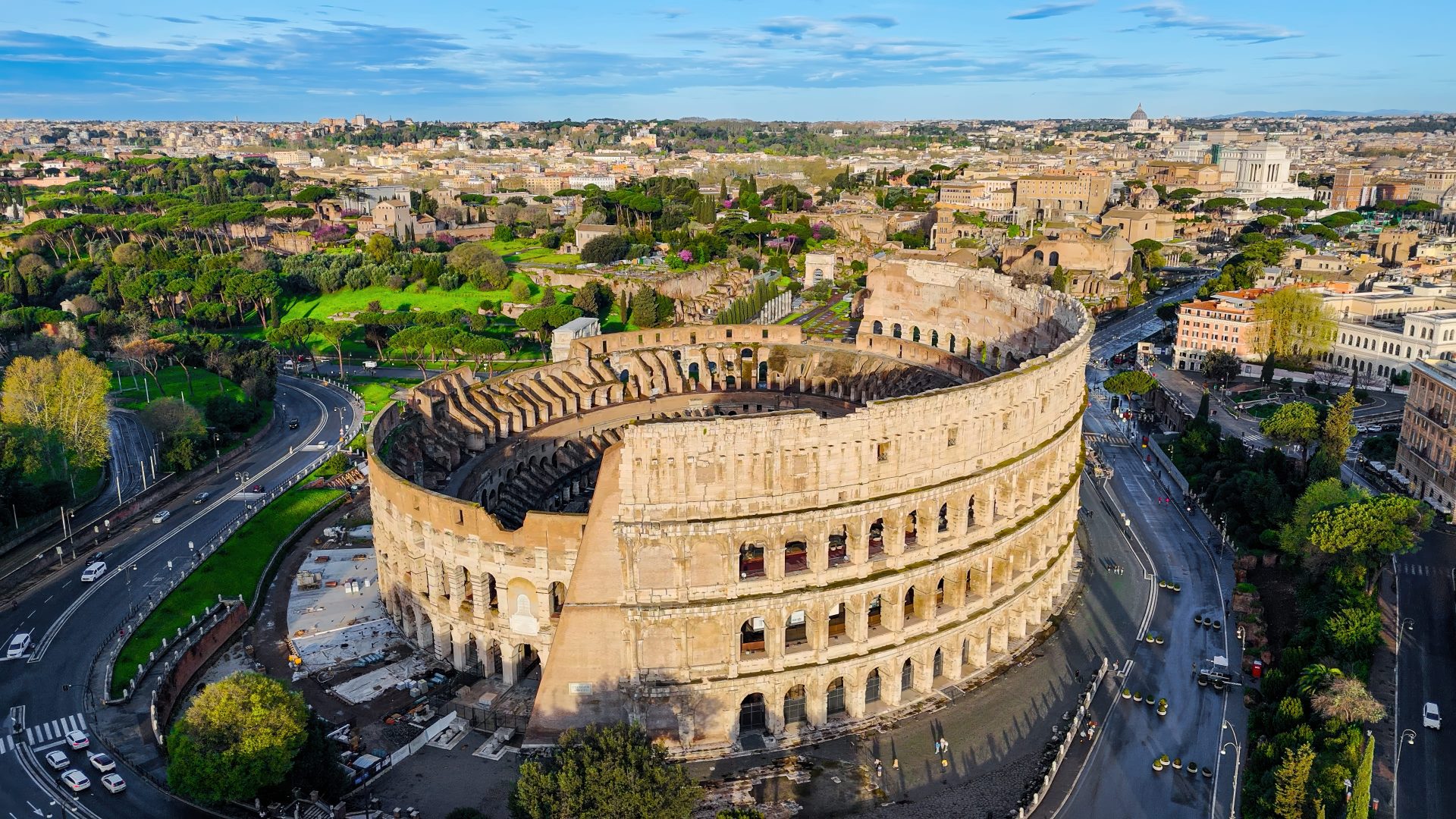
After lunch, your orientation tour takes you through the heart of ancient Rome. You'll pass the Piazza Venezia and the huge white Victor Emmanuel II Monument, which Romans nickname "the wedding cake" or "the typewriter" because of its shape. Then the Colosseum rises in front of you, and it's even bigger than you imagined. Opened in AD 80, it could hold around 50,000 spectators, who came to watch gladiators fight each other and wild animals in spectacular, often brutal shows. Nearly 2,000 years later, it remains the symbol of Rome and one of the wonders of the world. You stop here for photos against its great arches, with the ruins of the Roman Forum, once the centre of Roman political life, close by.

The afternoon ends at the Trevi Fountain, hidden in a small square among narrow streets. You hear it before you see it, the sound of rushing water echoing off the buildings, and then it appears: a huge baroque masterpiece of white marble, with the sea god Oceanus riding a shell-shaped chariot pulled by sea horses, and the water tumbling over carved rocks into a turquoise pool. It was completed in 1762, and it's fed by an aqueduct that has carried water to Rome since ancient times. Tradition says that if you toss a coin over your left shoulder with your right hand, you'll return to Rome one day. So many people do it that thousands of euros are collected from the fountain every day and given to charity.

Tonight is New Year's Eve, and Romans celebrate it with joy and plenty of traditions. Many families eat lentils at midnight, because the little round lentils look like coins and are believed to bring money in the new year, and some Romans wear something red for good luck. Across the city, fireworks light up the sky over the domes and rooftops at midnight. You celebrate with the group at the New Year's Eve gala dinner: a festive meal, music, laughter and toasts to the year ahead with the friends you've made over the past nine days. When the clock strikes twelve, you'll be welcoming the New Year in one of the most beautiful and historic cities on earth.

Included today: coach Padova to Rome, St. Peter's Basilica, Rome orientation tour, Colosseum photo stop, Trevi Fountain, New Year's Eve gala dinner, breakfast, lunch.

Good to know: shoulders and knees must be covered inside St. Peter's Basilica, and bags are security-checked at the entrance. On 31 December, the basilica's opening hours may be shortened for religious services, so the order of today's visits may change. Today starts early because of the long drive to Rome.

Day 10
1 Jan · Departure from Rome | Start the New Year with eight countries behind you

1 Jan · Departure from Rome | Start the New Year with eight countries behind you

⌖ Rome 🍽 Meals: Breakfast

Happy New Year! You wake up on the first morning of 2027 in Rome, and the city feels completely different from last night. After the fireworks and celebrations, Rome sleeps late on New Year's Day. The streets are hushed, the shops are closed, and the only sounds may be church bells ringing across the rooftops and a few early risers walking their dogs. In St. Peter's Basilica, the Pope traditionally celebrates a special Mass on New Year's Day, which the Catholic Church marks as the World Day of Peace. It's a peaceful, gentle start to the year, and a lovely moment to pause before the journey home.

Take your time over breakfast. If last night's celebrations went on late, you'll be glad of a strong Italian coffee. Italians take their coffee seriously: a short, strong espresso, drunk standing at a bar in a couple of sips, is the national habit, and cappuccino is traditionally only drunk in the morning. Sip yours slowly and look back on the past ten days.

It's quite a list. You arrived in Paris as the city prepared for Christmas, stood on the Eiffel Tower and cruised along the Seine, walked through the royal rooms of Versailles, and celebrated Christmas Eve with a gala dinner. You spent Christmas Day in the golden Grand Place of Brussels, saw all of Holland in miniature at Madurodam and then the real thing from a boat on Amsterdam's canals. You walked the cobbled streets of Heidelberg, heard the cuckoo clocks of the Black Forest, and stood beside the roaring Rhine Falls. You explored Lucerne, perhaps stood in the snow at the Top of Europe, rode a revolving cable car up Mt. Titlis, and admired the Golden Roof of Innsbruck. You crossed the Alps into Italy, sailed into Venice by private boat, stood beneath Michelangelo's dome in St. Peter's, and welcomed the New Year in Rome. Eight countries, two celebrations and memories enough for a lifetime.

Before you check out, take a few minutes to pack carefully. Wrap fragile souvenirs, such as Murano glass, Swarovski crystal or a cuckoo clock, in soft clothes and place them in the middle of your suitcase. Put any knives and liquids over 100 ml in your checked baggage, and keep your passport, tickets, medicines and a warm layer in your hand luggage. If you shopped in a store that offered tax-free shopping, keep the forms and receipts together with the goods, as you may need to have them checked at the airport before you check in.

Then the coach takes you to Rome Fiumicino, the city's main international airport, about 30 kilometres from the centre near the coast. It's officially named after Leonardo da Vinci, the great Italian artist and inventor who sketched designs for flying machines more than 500 years ago. On the way, you may catch a last glimpse of Roman pine trees, with their tall bare trunks and wide umbrella-shaped tops, one of the most typical sights of the Roman countryside.

This is the moment to say a heartfelt goodbye to your tour manager and coach driver, who have taken you safely across eight countries, through snow, holiday crowds and early mornings. A word of thanks means a great deal to them. Exchange numbers with the friends you've made, and promise to share photos. Many of our travellers stay in touch for years, and some even travel together again.

At the airport, once you're through check-in and security, there's time for a final Italian treat. Pick up a box of Italian chocolates, a bottle of olive oil or some Italian coffee for home, or simply enjoy a last cappuccino or a slice of pizza. Then it's time to board.

As your plane climbs over the Mediterranean coast and turns towards home, you'll be carrying something more valuable than any souvenir: the memory of a Christmas and New Year spent across Europe with the people you love. And if the legend of the Trevi Fountain is true, your coin is already making sure you'll be back.

As the coach heads towards the coast, look out for signs to Ostia Antica, close to the airport. This was ancient Rome's harbour city, where ships unloaded grain, oil and wine from all over the Mediterranean to feed the capital. Today its ruins are so well preserved that you can walk along Roman streets past bakeries, warehouses, apartment blocks and a theatre. It's a reminder, even on the way to the airport, that in Rome history is never far away.

One last thought before you fly. The Romans have a phrase, "Roma, non basta una vita", which means "Rome: one lifetime is not enough." After your time in the Eternal City, you'll know exactly what they mean, and you'll already be wondering what you'll see when your coin from the Trevi Fountain brings you back.

Included today: breakfast, group departure transfer to Rome Fiumicino airport.

Good to know: 1 January is a public holiday in Italy, and most shops in Rome are closed. Book a flight that leaves at least 3 hours after the group transfer reaches the airport; we'll confirm the transfer time when you book.

Hotel confirmation

Hotel names will be provided after booking, subject to availability and confirmation. We do not hold hotel confirmations before booking.

Inclusions

Accommodation

9 nights in 3 and 4-star hotels:

  • 2 nights Paris – B&B / Ace or similar
  • 1 night Netherlands – Amrath / Holiday Inn Express or similar
  • 1 night Germany – Elaya / Intercity or similar
  • 2 nights Central Switzerland – Dormero / Du Parc or similar
  • 1 night Innsbruck / Seefeld – Hotel Olympia or similar
  • 1 night Padova / Ferrara – Blue Dream / B&B or similar
  • 1 night Rome – B&B / Pineta or similar

Meals

  • Daily continental buffet breakfast
  • 8 Indian lunches (Jain / vegetarian / non-vegetarian)
  • 9 Indian dinners (Jain / vegetarian / non-vegetarian)

Sightseeing and entrances

  • Paris orientation tour
  • Eiffel Tower 2nd level
  • Guided tour of Versailles Palace
  • River Seine cruise
  • Brussels Grand Place and Manneken Pis
  • Madurodam miniature park
  • Amsterdam canal cruise
  • Heidelberg Old Town
  • Black Forest cuckoo clock demonstration
  • Rhine Falls
  • Lucerne orientation tour
  • Mt. Titlis with the Rotair revolving cable car and Cliff Walk
  • Swarovski crystal shop and Innsbruck orientation tour
  • Venice – private boat to St. Mark's Square
  • Rome orientation tour, Colosseum photo stop and Trevi Fountain
  • St. Peter's Basilica, Vatican City

Services

  • Services of a professional tour manager throughout the tour
  • Air-conditioned coach for all transfers and sightseeing
  • Tips for coach drivers
  • Free group airport transfer on arrival at Paris (CDG) for flights landing between 8 am and 2 pm, and on departure to Rome (FCO) with drop by 11 am (see booking terms)
  • Christmas and new year's eve gala dinners included
  • A free day in Switzerland, with an optional Jungfraujoch, Interlaken and Lucerne excursion at extra cost (see exclusions)

Exclusions

  • Flights to Paris and back from Rome (we can quote these separately)
  • Schengen visa fee, passport and overseas travel insurance
  • 5% GST and 2% TCS on the tour cost (TCS is credited to your PAN and can be claimed in your income tax return)
  • Optional Jungfraujoch excursion with Interlaken and Lucerne orientation tour: EUR 216 per adult, plus GST and TCS. Please book it with your tour
  • Private airport transfers for flights outside the group transfer timings
  • Porterage, laundry, alcohol, mini-bar, phone calls and other personal expenses
  • Meals other than those listed; menus are pre-set
  • Sightseeing, entrance fees or guides not mentioned in the itinerary
  • Any increase in local taxes, entrance fees or fuel costs, and surcharges on some departure dates
  • Anything not listed under inclusions

Important Terms

Starts: Paris (CDG)   Ends: Rome (FCO)

Booking and payment

  • At booking: 30% of the tour cost per person, with clear copies of the passport and PAN card of every traveller.
  • 30 days before departure: the full balance.
  • Booking within 30 days of departure: 30% to book, and the balance as soon as your booking is confirmed.

Price and taxes

  • Prices are per person on twin sharing. Children below 12 years on the whole tour pay child rates; a third person in a triple room usually gets a rollaway bed in a standard-size room.
  • The tour cost is set in euros. The final rupee amount is fixed at the exchange rate on the date of your final payment.
  • Indian passport holders paying in rupees pay 5% GST and 2% TCS on the tour cost. Foreign passport holders and NRIs, please ask us, as different tax rules apply.

Airport transfers

  • Free group transfers run only for flights landing at Paris (CDG) between 8 am and 2 pm. You may wait up to 2–3 hours in the arrival hall for other guests.
  • On the last day the coach drops the group at Rome (FCO) by 11 am, which can be up to 6 hours before your flight.
  • If these timings don't suit your flights, we can book a private transfer at extra cost. No refund is given for an unused group transfer.

On tour

  • Passports must be valid for at least 6 months after your return date, with two blank pages.
  • Please carry one check-in bag and one hand bag per person; luggage space on the coach is limited.
  • The order of days may change, or the tour may run in reverse, on some dates. All listed sightseeing is still covered unless an attraction is closed, in which case an alternative is arranged.
  • If the Eiffel Tower queue is very long, the group may visit Montparnasse Tower for the city view instead.
  • On some dates your group may join another group, and a local representative may assist instead of the tour manager for the first part of the tour.
  • Tours run subject to government rules. Changes caused by weather, strikes or other events beyond our control, and any extra costs from them, are payable by the traveller.

Cancellation charges

When you cancelCancellation charge
From booking until 36 days before departure₹30,000 per person
35 to 29 days before departure₹60,000 per person
28 to 15 days before departure50% of the tour cost
14 to 8 days before departure75% of the tour cost
7 days or less before departure, or no-show100% of the tour cost
  • Visa refusal: if your visa is refused and you cancel more than 45 days before departure, the charge is ₹12,000 per person instead of the above, and the rest of your payment is refunded. Please send us the refusal letter. Within 45 days of departure the table above applies.
  • Please send cancellations in writing by email or WhatsApp. The date we receive it decides the charge.
  • No refund is given for unused services, missed sightseeing or leaving the tour early.
  • Refunds are paid to the account the payment came from, within 30 days of cancellation. GST and TCS are adjusted as per Government of India rules.

Christmas and New Year on this tour

The group is in Paris on Christmas Eve and spends the following days travelling through festive Brussels, Amsterdam and the snowy Alps. The tour reaches Rome on 31 December, so you welcome the New Year in the Eternal City. Two gala dinners, for Christmas and New Year's Eve, are included.

Some attractions keep holiday hours on 25 December and 1 January, so the order of days may be adjusted. Everything listed is still covered.

Europe New Year Tour – 8 Countries, 9 Nights / 10 Days FAQs

When does this tour depart?
It departs on 23 December 2026 and returns on 1 January 2027 (9 nights / 10 days). The tour starts at Paris Charles de Gaulle airport and ends at Rome Fiumicino airport.
Where will we be on New Year's Eve?
In Rome. On 31 December the group visits St. Peter's Basilica, the Colosseum and the Trevi Fountain and stays overnight in Rome.
Are gala dinners included?
Yes. Two gala dinners are included, for Christmas and New Year's Eve.
Is Jungfraujoch included?
No. Day 6 is a free day in Switzerland, with Jungfraujoch available as an optional excursion at extra cost. Mt. Titlis is included.
Are flights included?
No, this is a land package starting in Paris and ending in Rome. Our team can quote flights from Delhi or your city separately.
Is Jain or vegetarian food available?
Yes. Lunches and dinners are Indian meals with Jain, vegetarian and non-vegetarian options.
What is the weather like in late December?
Expect cold, short days. Paris and Amsterdam are usually around 2–8°C, Swiss towns around freezing, and the mountain tops at Jungfraujoch and Titlis well below zero with snow. Pack thermals, a warm coat, gloves, a cap and shoes with good grip. Venice and Rome are milder, usually around 5–13°C.
Does this tour include Germany?
Yes. You visit Heidelberg's old town and drive through the Black Forest, with a stop for the famous cuckoo clocks, before entering Switzerland.
Is 10 days enough for Europe?
Ten days is enough to see eight countries at a steady pace on a guided tour. For more time in each place, look at our 11 and 13-day tours.
Gallery

Europe photos: Europe New Year Tour – 8 Countries, 9 Nights / 10 Days

Plan your Europe holiday with Dreamland Vacations

Share your dates, travellers and comfort preference. Our team will guide you with the next best step.

Book now – pay 30%
Continue to booking
Itinerary Book now – pay 30%
WhatsApp