Kerala & Kanyakumari Tour – 7 Days
Standard Package

Kerala & Kanyakumari Tour – 7 Days

Munnar, Thekkady, an Alleppey houseboat, Kanyakumari's sunrise and Kovalam beach. 7 days from Kochi to Trivandrum.

⌖ Kerala, India ✦ Family & senior friendly planning
Package snapshot
DestinationKerala
Travel styleStandard Package

Want to customize this package?

Share your dates and travellers. This enquiry is free. Small changes to a standard itinerary—such as a date change or an extra day—can be discussed with our team.

We’ll send verification codes to your WhatsApp number and email. Indian numbers can be entered without +91; for other countries, include the country code.
Verification required before submitting.
Your holiday

Kerala & Kanyakumari Tour – 7 Days: overview

From the tea hills of Kerala to the tip of India

Imagine standing on the shore at the southern tip of India as the sun rises out of the sea, where the Arabian Sea, the Bay of Bengal and the Indian Ocean meet, and pilgrims fall silent as the sky turns gold behind the Vivekananda Rock Memorial. This Kerala and Kanyakumari tour takes you from the misty tea hills of the Western Ghats all the way down to that unforgettable sunrise, and on to the beaches of Kovalam.

You begin with two nights in Munnar, with waterfalls and a spice garden on the drive up, Eravikulam National Park and its Nilgiri tahr, the Tea Museum and the lakes along the Mattupetty road. Then you take a boat ride on Periyar Lake in Thekkady and spend a night on a private houseboat in the Alleppey backwaters. From there, a long, fascinating drive through Kollam and Thiruvananthapuram brings you into Tamil Nadu and to Kanyakumari for sunset. Next morning, you take the ferry to the Vivekananda Rock Memorial and the Thiruvalluvar statue, visit the Kumari Amman Temple and the Gandhi Mandapam, and drive to Kovalam for an evening on Lighthouse Beach. On the last day, you see the Padmanabhaswamy Temple, Kuthiramalika Palace and the Napier Museum in Thiruvananthapuram before your flight.

It's 7 days, starting in Kochi and ending in Trivandrum, so you never retrace your steps, with a private car and driver throughout.

Compare all our Kerala tour packages, discover more Kerala tourist places, or read our Kerala itinerary guide.

From Ashok's travels

I first travelled through Kerala in the 1990s, by train to Kochi and bus to Kanyakumari, and I keep going back. It is even greener than Goa. Give Kochi a full day, walk the Munnar tea gardens, try a Kerala massage in Thekkady, and don't miss a night on a houseboat in Alappuzha.

Ashok Saini, Founder, Dreamland Vacations

Good to know

Package typeStandard Package
Planning supportSmall changes by enquiry
Best forFamilies, couples & seniors
Get a free quote
Trip highlights
✦ Kochi to Munnar – Climbing into the Ghats
✦ Munnar – Tea Hills and Mountain Goats
✦ Munnar to Thekkady – Periyar Wildlife
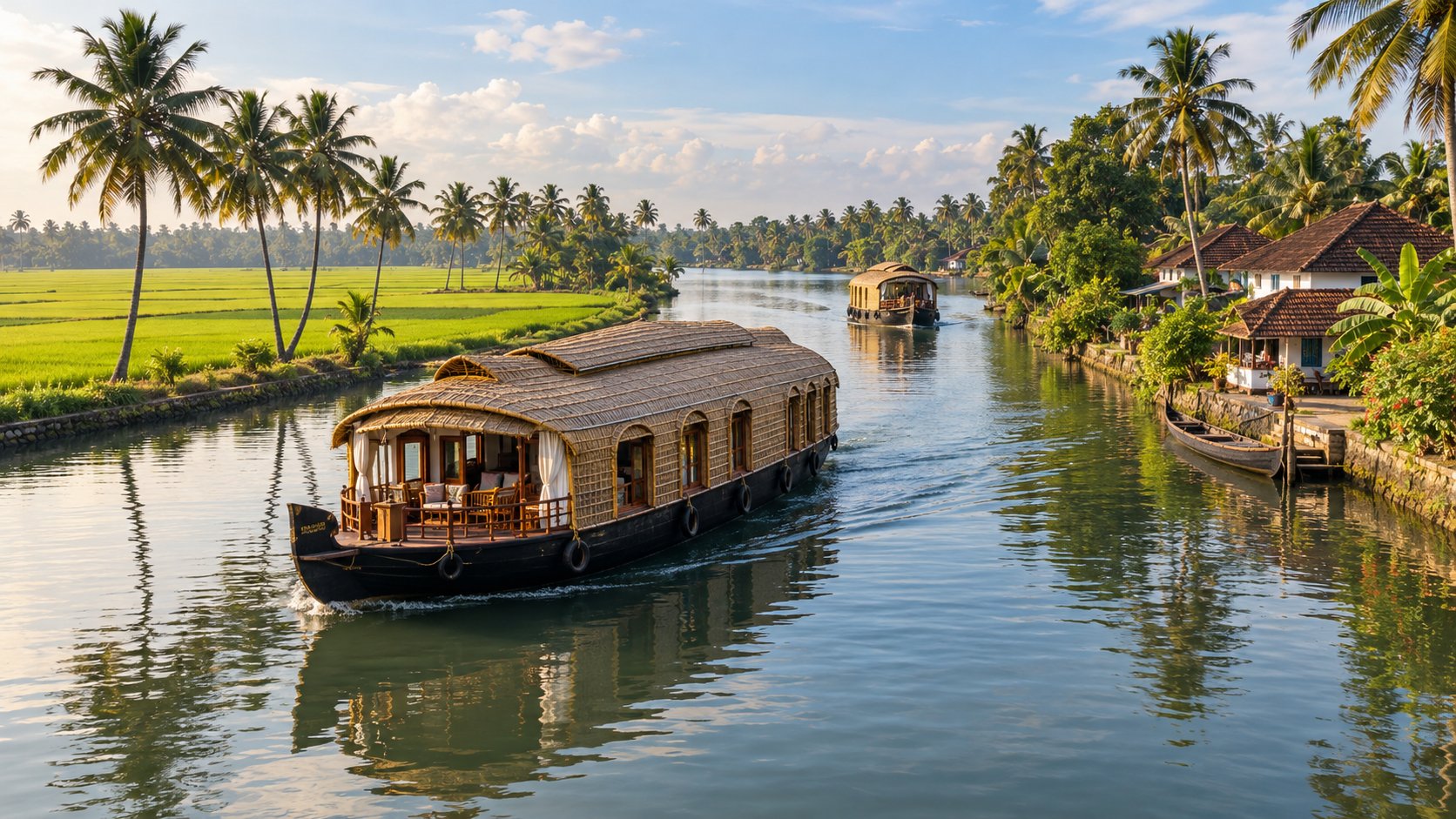
✦ Thekkady to Alleppey – Houseboat on the Backwaters
✦ Alleppey to Kanyakumari – South to the Tip of India
✦ Kanyakumari to Kovalam – Sunrise and the Sea
Day-wise plan

Kerala itinerary: day by day

Day 1
Kochi to Munnar – Climbing into the Ghats

Kochi to Munnar – Climbing into the Ghats

⌖ Munnar

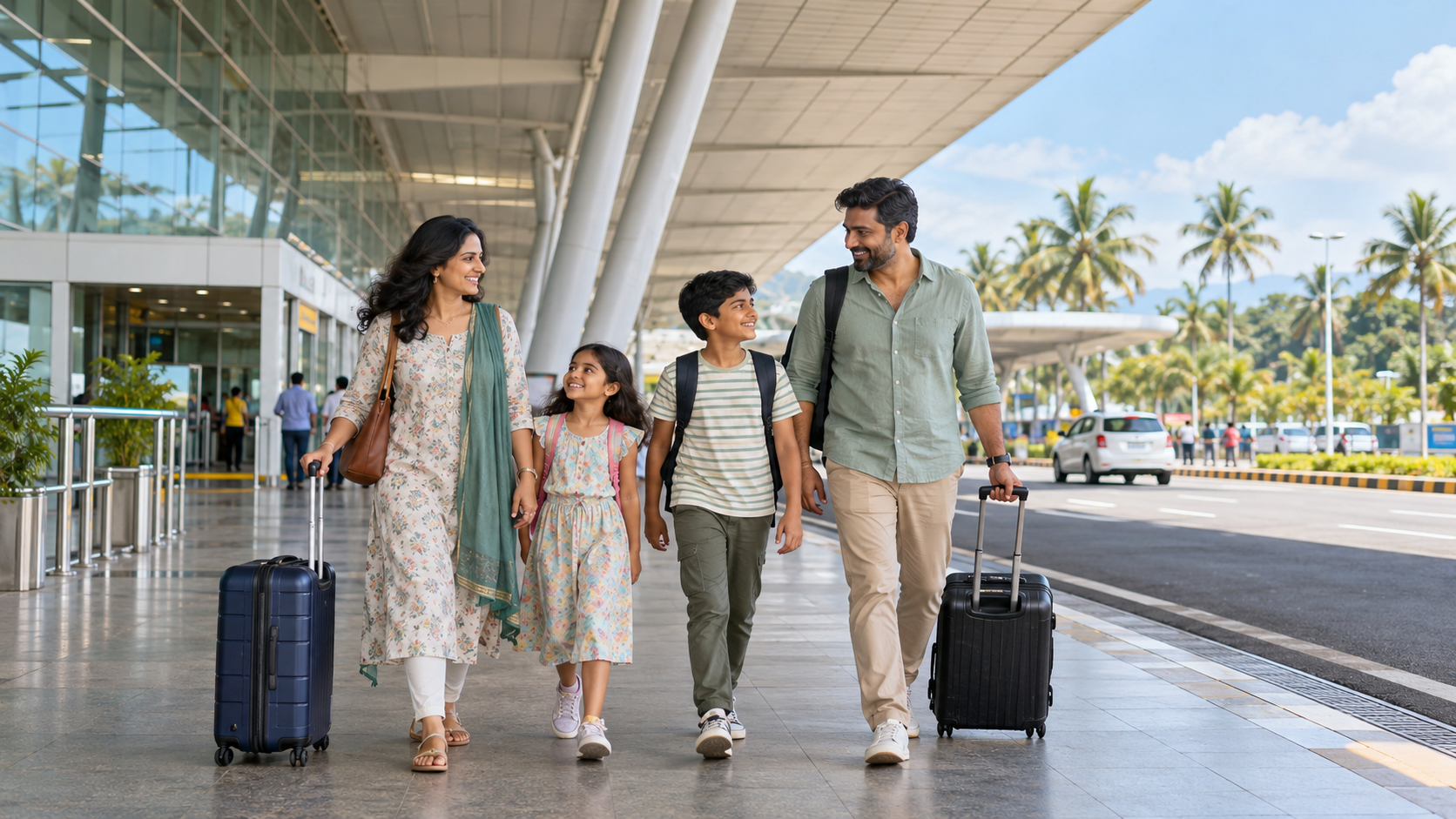
Your driver meets you at Kochi airport or Ernakulam railway station, ready for a week that will take you from the misty mountains of the Western Ghats all the way down to the southern tip of India, where three seas meet. Load your bags into the car and settle in for the first leg of the journey: a drive of about four hours east into the hills to Munnar.

For the first hour or so, the road crosses the flat, green farmland behind the coast. This is Kerala at its most everyday: coconut palms leaning over red-tiled houses, small paddy fields, roadside stalls selling bananas in great green and yellow bunches, schoolchildren in neat uniforms, and churches, temples and mosques sharing the same few hundred metres of road. Around Kothamangalam, the land begins to rise, and rubber plantations close in on both sides, with their tall, slender trees planted in long, shady rows. At Neriamangalam, you cross the Periyar River on an old stone arch bridge, and from here the climb begins in earnest.

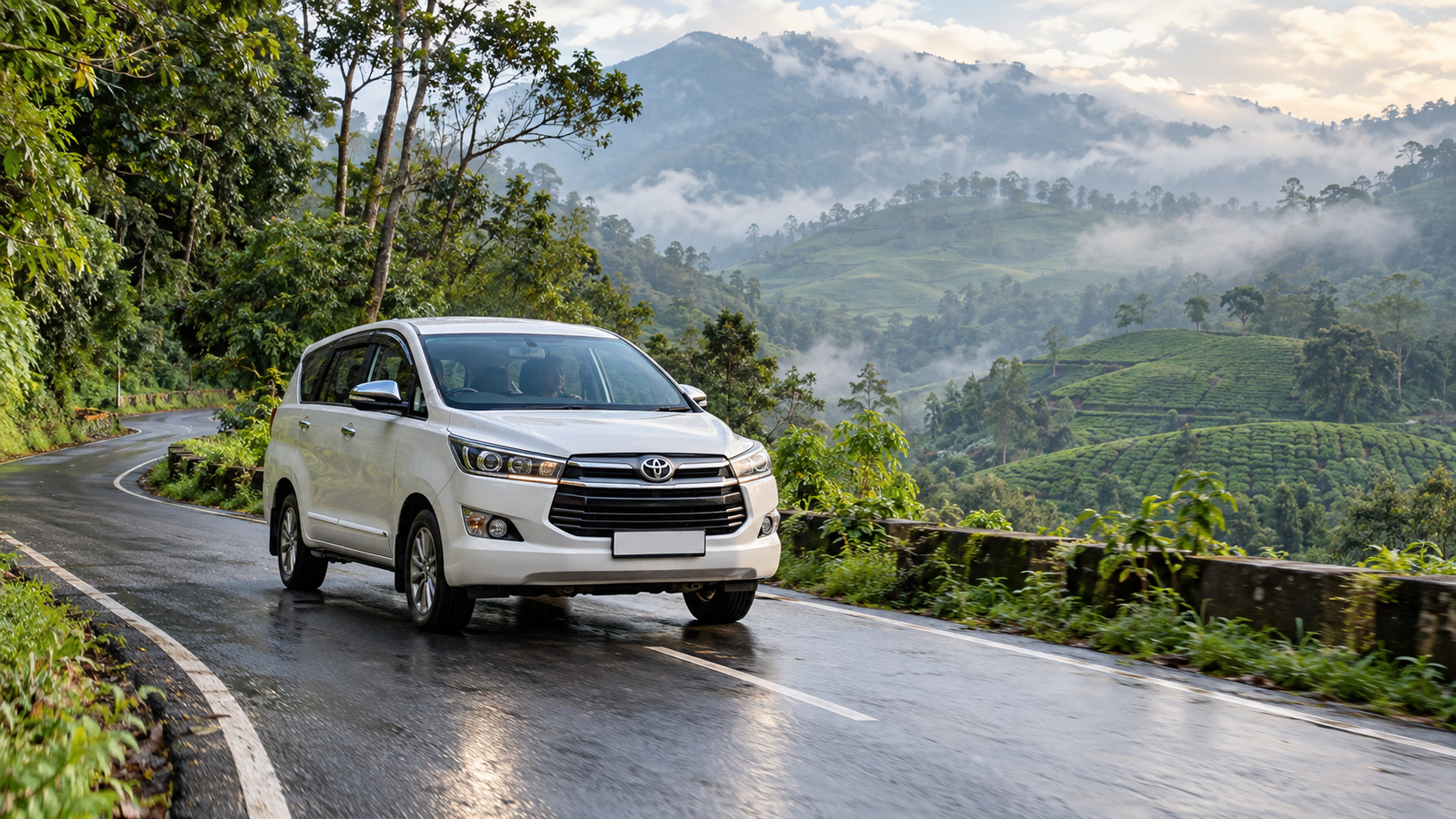
The road twists and turns up through thick forest and spice country, with sharp hairpin bends and sudden views back down over the plains. Ask your driver to stop at the waterfalls along the way. Cheeyappara falls down a long, rocky slope in a series of steps right beside the road, and Valara, a little further on, drops into a deep forested valley. In the weeks after the monsoon, both are thundering torrents; in the dry season, they become gentler, lacy streams, but the setting is always lovely. Monkeys often wait hopefully on the parapets, so keep your snacks out of sight.

Next, stop at one of the spice plantations near Adimali or Pallivasal. A guide will walk you through the garden and show you how Kerala's famous spices grow: pepper vines climbing up tall trees, cardamom plants with their pods hidden at the base of the stems, cinnamon trees whose bark is peeled and rolled, cloves, nutmeg with its bright red mace, vanilla orchids, cocoa pods and coffee. Rub a leaf of allspice between your fingers and smell it, taste a fresh peppercorn, and hear how these spices brought Roman, Arab, Chinese, Portuguese, Dutch and British traders to the Malabar Coast. There's usually a small shop where you can buy spices fresh from the garden.

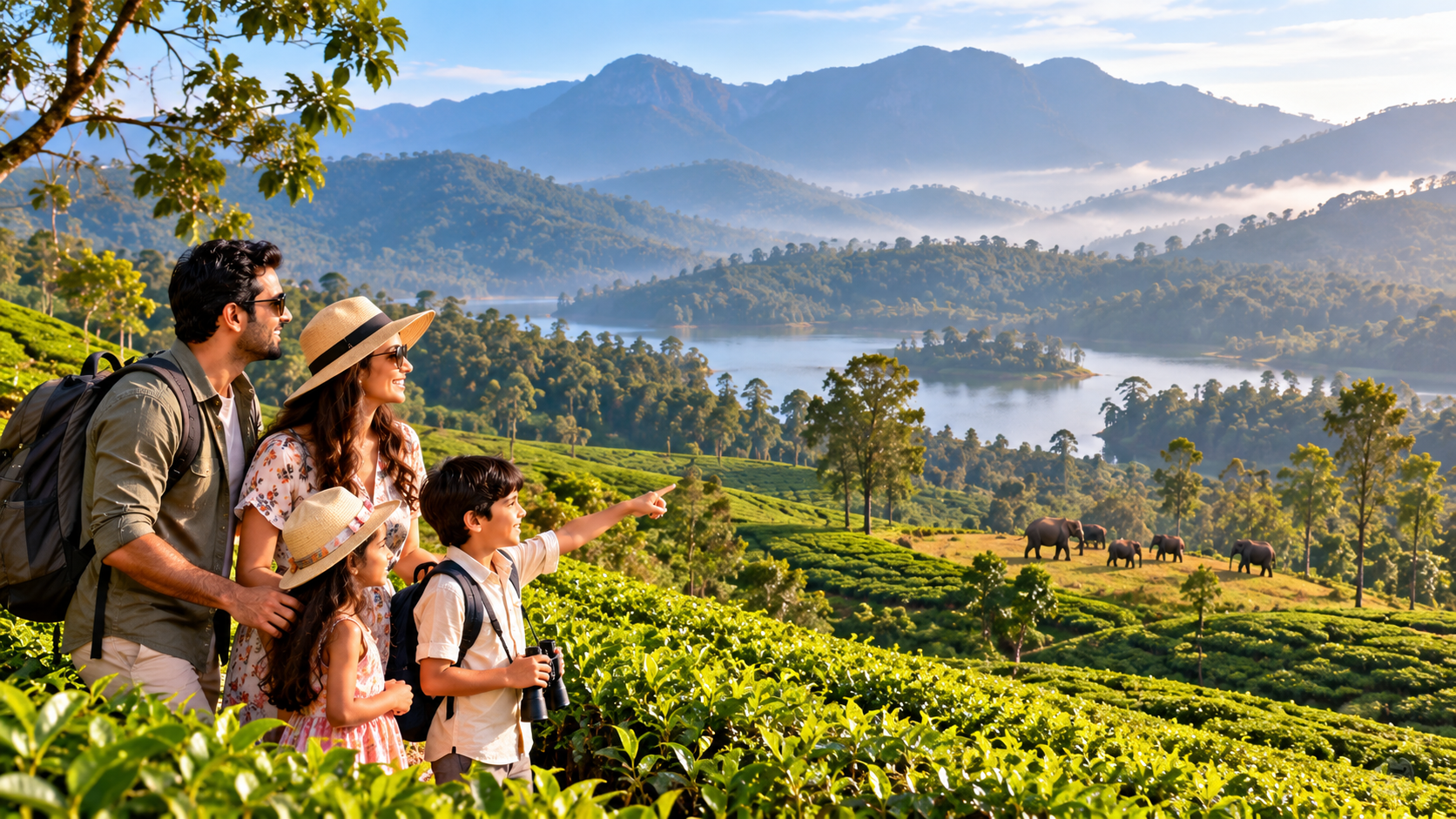
The last stretch of road climbs into Munnar's tea country, and it's a sight you won't forget. The hills are covered from top to bottom with tea bushes, clipped into neat rows that follow the contours of the slopes like the lines of a fingerprint. Silver oak and eucalyptus trees rise above them, giving shade, and here and there, a white tea factory or a cluster of workers' homes sits in a fold of the hills. Mist drifts over the higher ridges, and the air smells of damp earth and eucalyptus.

Check in to your hotel by mid-afternoon. Munnar sits at about 1,600 metres, where three rivers, the Muthirappuzha, Nallathanni and Kundala, meet, and the cool air is a welcome change after the warmth of the coast. Spend the rest of the afternoon resting, or take a short walk into town to explore the small market, where stalls sell tea, cardamom, homemade chocolates, fruit and vegetables grown in the hills.

In the evening, as the temperature drops, put on a light jacket and enjoy a hot cup of Munnar tea on your balcony or terrace, watching the mist settle over the valleys and the lights of the estate villages come on one by one. Dinner is at your hotel or one of the restaurants in town, many of which serve Kerala specialities such as appam with vegetable or chicken stew, fish moilee, a mild curry with coconut milk, and the rich, spicy dishes of the hill country, along with North Indian and Chinese food.

Munnar's climate makes it a pleasure to visit through most of the year. From September to May, the days are mild and sunny and the evenings cool, while December and January can be properly cold at night, with frost on the higher estates. The monsoon months from June to August bring heavy rain and mist, and the hills turn a vivid green. Whenever you visit, bring a warm layer, comfortable walking shoes and a light raincoat or umbrella. Sleep well: tomorrow you'll be up early to meet the mountain goats.

Included today: pick-up at Kochi airport or railway station, private car to Munnar with stops at the waterfalls and a spice garden, hotel in Munnar.

Good to know: drive about 4 hours, plus stops. The hill road has many bends; if you're prone to motion sickness, sit in front and take something before you set off. Breakfast on arrival day and lunch on the way aren't included.
Day 2
Munnar – Tea Hills and Mountain Goats

Munnar – Tea Hills and Mountain Goats

⌖ Munnar 🍽 Meals: Breakfast

Today is all about Munnar, and the best way to begin is early. After breakfast, drive to Eravikulam National Park, about half an hour from town, and join the queue at the entrance before it opens at 9 AM. From the gate, a forest department bus carries you up a narrow road through the tea gardens to the start of the walking trail at Rajamala.

Eravikulam protects a high, rolling plateau of grassland and shola forest, the patches of evergreen woodland that grow in the sheltered folds of the hills. It's the stronghold of the Nilgiri tahr, a sure-footed mountain goat found only in the Western Ghats. Once hunted close to extinction, the tahr have made a remarkable recovery here, and these days they're so used to visitors that they graze calmly beside the path. The males are dark and stocky with a pale saddle; the females and young are lighter and smaller, and in spring, you may see kids leaping about the rocks. Above the trail rises Anamudi, at about 2,695 metres the highest mountain in India south of the Himalayas.

Walk at your own pace along the paved path, stopping to take in the views. On a clear morning, the valleys fall away beneath you in shades of green, the tea estates far below look like a soft carpet and the mist curls along the ridges. Wild flowers grow among the grasses, and if you're lucky, you'll see a Nilgiri pipit or a black-and-orange flycatcher among the trees. Every twelve years, the hillsides here turn blue-violet when the Neelakurinji shrub blooms all at once, a spectacle that draws visitors from all over India.

Before you leave the park, browse the small information centre near the trailhead, which has displays about the tahr, the shola forests and the Neelakurinji, and pick up a snack or a hot drink from the forest department's café. Then take the bus back down to the gate, where your driver will be waiting.

Have lunch in Munnar town before or after the Tea Museum. Most restaurants serve simple, freshly cooked Kerala meals: rice with sambar, rasam and several vegetable dishes, or porotta with a spicy curry, and the tea, of course, is always fresh. If you'd like to see the estates more closely, ask your driver to stop at one of the viewpoints on the Mattupetty road, where you can walk a little way along the paths between the tea bushes and meet the tea pickers at work.

In the afternoon, visit the Tea Museum in Munnar, where old machines, photographs and documents tell the story of how British planters turned these forested hills into one of the great tea regions of the world in the late 19th century. Watch how fresh leaves are withered, rolled, fermented and dried, then sip a cup of the finished tea.

Munnar's tea story is a fascinating one. In the late 19th century, British planters leased these hills, then known as the Kanan Devan Hills, from the Raja of Poonjar, cleared the forests and planted tea, coffee and cinchona. Gradually, tea took over, factories were built, and a light railway and ropeways carried the tea down to the plains. In the 20th century, the estates passed to the Tata group, and since 2005, most of them have been run by Kannan Devan Hills Plantations, a company in which the workers themselves hold a large share, one of the largest employee-owned plantation companies in India.

Then follow the scenic road towards Mattupetty, one of the prettiest drives in Munnar, winding past tea estates, eucalyptus groves and grassy meadows. Stop at Mattupetty Dam, with its long reservoir set between the hills, and at Echo Point, where your voice rings back from the far side of the lake. At Kundala Lake, hire a pedal boat or a shikara for a slow, peaceful turn on the water among the eucalyptus-covered hills.

As the afternoon light softens, drive back towards town. If the weather is clear, stop at Pothamedu viewpoint, a few kilometres from Munnar, for a sweeping view over the tea, coffee and cardamom plantations and the valleys below, especially lovely in the late afternoon light. Back at your hotel, spend a quiet evening by the fire or on your balcony, listening to the sounds of the hills: the wind in the eucalyptus, the birds settling for the night, and perhaps the distant hum of a tea factory working late during the picking season.

It's a day of fresh air, wide views and the gentle rhythm of the hills, and a perfect introduction to the Western Ghats.

Included today: Munnar sightseeing by private car, breakfast.

Good to know: Eravikulam usually closes for the tahr's calving season for a few weeks, typically from February into April; park fees and boating are paid locally. The Tea Museum is closed on Mondays. See our Munnar tour packages for more.

Day 3
Munnar to Thekkady – Periyar Wildlife

Munnar to Thekkady – Periyar Wildlife

⌖ Thekkady 🍽 Meals: Breakfast

After breakfast, say goodbye to the tea hills and drive south for about three to four hours to Thekkady, on the edge of the Periyar Tiger Reserve. The road follows the spine of the Cardamom Hills through some of the richest spice-growing country in India, with cardamom growing beneath the forest canopy, pepper vines on the trees and coffee bushes on the slopes. You'll pass tea estates, small towns and long stretches of forest, and here and there, the road opens up to wide views over the ranges.

Thekkady and the neighbouring town of Kumily sit right on the border with Tamil Nadu, and the town has a busy, friendly feel, with spice shops, small restaurants and handicraft stores. Check in to your hotel, many of which are set in gardens or among the trees.

Kumily is a good place to buy spices, as many of them are grown in the hills around the town. Walk along the main street, where shops are piled high with sacks and jars of green cardamom, black pepper, cloves, cinnamon, nutmeg, star anise and dried ginger, along with packets of tea and coffee, homemade chocolates, vanilla pods and Ayurvedic oils and soaps. The shopkeepers are happy to explain the different grades and let you taste and smell before you buy. The town also has a number of shops selling handicrafts, including carvings in sandalwood and rosewood, brass lamps and colourful textiles.

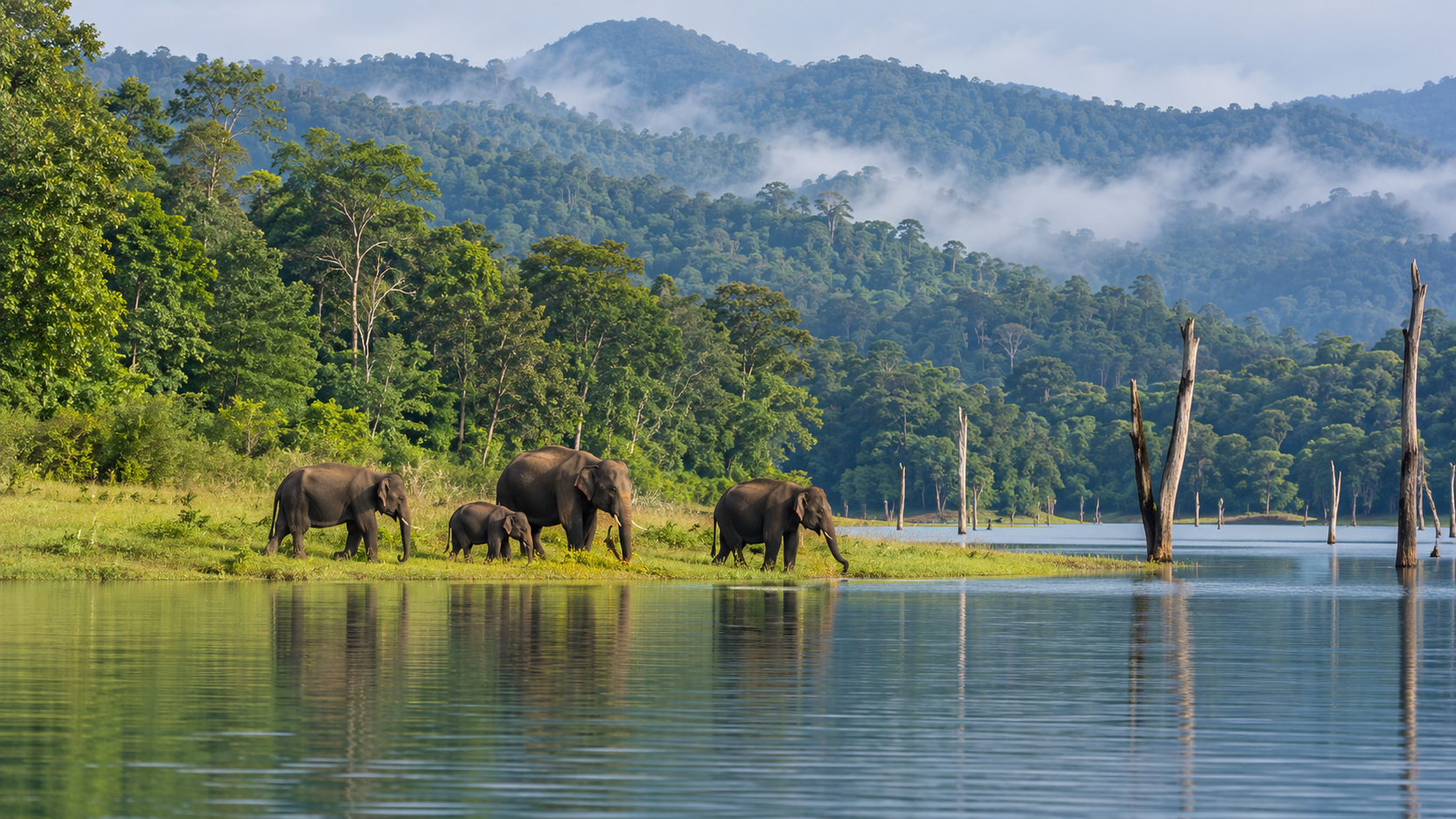
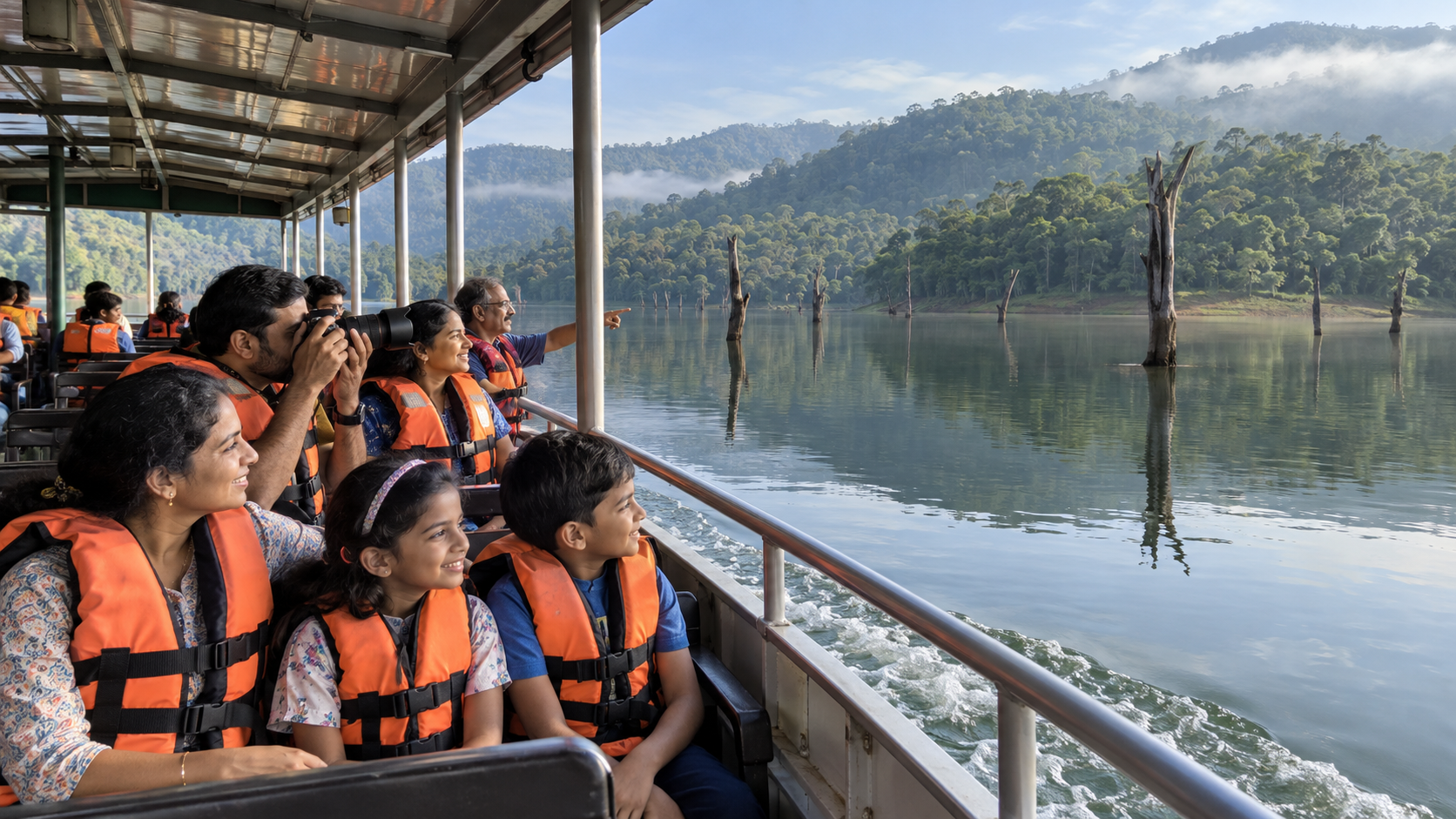
In the afternoon, take the boat ride on Periyar Lake. The lake was formed in 1895, when the Mullaperiyar Dam was built across the Periyar River, flooding the valley, and the trunks of drowned trees still stand in the water, their branches used as perches by cormorants and darters. As the boat glides through the reserve, watch the forested shores for wildlife: elephants coming down to the water to drink and bathe, gaur, the massive Indian bison, grazing in the clearings, sambar deer, wild boar, and otters playing at the water's edge. Overhead, you may see hornbills, kingfishers and fish eagles.

The Mullaperiyar Dam that created the lake was built by Colonel John Pennycuick, a British army engineer, who is said to have sold some of his own property in England to finish it when funds ran out. The dam diverts water from the Periyar River through a tunnel in the mountains to the dry plains of Tamil Nadu, where Pennycuick is still remembered with gratitude by farmers, many of whom name their children after him.

The boat rides are run several times a day, starting early in the morning, and the first and last trips are usually best for wildlife, when animals are most active and the light is soft and golden. Tickets can sell out quickly in the busy season, so it's worth booking ahead or reaching the boat landing early. Wildlife sightings are never guaranteed, but elephants are often seen, especially in the dry months from February to May, when they come down to the lake for water. Bring binoculars, and keep your voice low.

In the evening, enjoy a cultural show in Kumily. Choose between Kathakali, Kerala's classical dance-drama, with its elaborate green-and-red make-up, enormous skirts and headdresses, and its stories from the Mahabharata and Ramayana told through gestures and expressions, or Kalaripayattu, the ancient martial art of Kerala, performed with flying kicks, sticks, swords and shields in a sunken arena lit by oil lamps. Arrive early for the Kathakali shows to watch the performers put on their make-up, a process that takes hours.

If you'd like to explore more of the reserve, the forest department runs a range of guided activities, including nature walks, bamboo rafting, and longer treks through the forest, led by trained guides from local communities. These need to be booked in advance, so let us know if you're interested. After the show, return to your hotel for dinner and a quiet night, with the sounds of the forest all around.

Thekkady's weather is pleasant through most of the year, cooler than the coast but warmer than Munnar, with daytime temperatures usually between 18 and 30°C. Bring a light jacket for the evening and the early morning boat ride, comfortable shoes, a hat, sunscreen and insect repellent, and wear clothes in muted greens and browns if you plan to walk in the forest, as bright colours can disturb the animals and make them harder to spot.

Tomorrow, you'll leave the hills behind for the backwaters, so make the most of the cool, fresh forest air tonight, and enjoy a good night's rest before your houseboat adventure on the backwaters of Alleppey.

Included today: private car from Munnar to Thekkady, hotel in Thekkady, breakfast.

Good to know: drive 3–4 hours. The boat ride and cultural shows are optional and paid locally. More ideas in our guide to Thekkady tourist places.

Day 4
Thekkady to Alleppey – Houseboat on the Backwaters

Thekkady to Alleppey – Houseboat on the Backwaters

⌖ Alleppey 🍽 Meals: Breakfast, Lunch, Dinner

Enjoy an early breakfast at your hotel, with the birds calling from the forest around you, and set off by about 8 AM for the drive of about four hours down to Alleppey, so that you reach your houseboat around noon. The road leaves Kumily and climbs gently through tea estates around Vandiperiyar and Peermade, where the air is still cool and the hills are dotted with pine and grassland, before plunging down through dense forest in a series of tight bends. Below Kuttikkanam, the views open up over the plains, and the temperature rises steadily as the road drops through rubber plantations to the lowlands.

Beyond Kottayam, the land flattens completely, and you enter Kuttanad, the heart of the backwaters. This is one of the most unusual farming landscapes in the world: a vast patchwork of paddy fields lying below sea level, reclaimed from the lakes generations ago and protected by mud dykes topped with coconut palms. Canals run beside the road, and the rice fields stretch away flat and shining to the horizon, with herons and egrets wading among the green shoots.

At the jetty, your crew will be waiting to welcome you aboard. A kettuvallam, the traditional Kerala houseboat, was originally a cargo barge, built from planks of jackwood tied together with coir rope, without a single nail, and used to carry rice, spices and coconuts along the backwaters to the ports. Today, these boats have been beautifully converted into floating homes, with arched roofs of woven bamboo and palm thatch, polished wooden interiors, bedrooms with attached bathrooms, a lounge, and an open deck at the front with comfortable chairs. Your crew, usually a captain, a cook and a deckhand, will greet you with a fresh tender coconut and show you around.

Then the boat pulls away from the jetty and out onto the open water. Most cruises start on the wide waters of Vembanad Lake, the longest lake in India, where the breeze is cool and the horizon is lined with palms. Lunch is served on board around 1 PM, freshly prepared by the cook in the boat's small kitchen: red Kerala rice, a fish curry or karimeen fry, vegetable thoran, sambar, pappadam and pickle, followed by fresh fruit. Vegetarian food is always available, so just let us know your preferences in advance.

In the afternoon, the boat leaves the open lake and winds through narrower channels, and this is where the backwaters come alive. Life here is lived on and beside the water. Houses with tiled roofs sit on narrow strips of land between the canals and the paddy fields, their steps leading down to the water, where women wash clothes and pots and children splash and swim. Small canoes carry everything from coconuts and firewood to schoolchildren and the post. You'll pass churches with white facades, small temples, toddy shops, village ferries and the occasional floating grocery shop. Some routes pass near Champakulam, whose St Mary's Church is one of the oldest churches in Kerala.

The birdlife is wonderful too. Look out for kingfishers of several kinds, from the tiny, jewel-like common kingfisher to the large white-throated and pied kingfishers, as well as cormorants, darters, egrets, herons, Brahminy kites and, in the winter months, migratory ducks. If you'd like fresh seafood for dinner, the crew can stop at a fishermen's landing to buy prawns, crab or fish, which the cook will prepare for you at a small extra cost.

In the late afternoon, tea and snacks are served on deck, often banana fritters or spicy vadas. The boat moors for the night at about 5:30 PM, as local rules require, at a quiet spot by the bank, so fishermen can set their nets safely after dark. As the sun goes down, the sky over the water turns gold, then orange and pink, and the palms become black silhouettes against the glow. Lamps come on in the village houses, and you'll hear evening prayers from a temple or church, the croak of frogs and the splash of fish jumping in the dark water.

Dinner is served on board: rice, chapati, a curry of chicken or fish, vegetables and dessert. Afterwards, sit out on the deck and enjoy the stillness of the night, with the stars overhead and the gentle lapping of the water against the hull. The bedroom air conditioning runs on the boat's generator through the night, usually from about 9 PM to 6 AM, and in the morning, you'll wake to the sounds of village life on the water.

It's a night many travellers remember for the rest of their lives.

Included today: private car from Thekkady to Alleppey, private houseboat with lunch, dinner and breakfast on board, breakfast at the hotel.

Good to know: drive about 4 hours. Bedrooms are air-conditioned at night. Compare boats on our Alleppey houseboat packages page.

Day 5
Alleppey to Kanyakumari – South to the Tip of India

Alleppey to Kanyakumari – South to the Tip of India

⌖ Kanyakumari 🍽 Meals: Breakfast

Wake early on the houseboat and step out onto the deck. In the first light, the backwaters are at their most beautiful: mist lies low over the water, fishermen are already out in their narrow canoes, flocks of ducks are herded along the banks, and the first ferries chug past with villagers heading to work and school. Breakfast is served on board, perhaps fluffy appam with vegetable stew or puttu with kadala curry, with hot tea or coffee, as the boat cruises slowly back to the jetty. Leave the boat by about 9 AM, where your driver will be waiting.

Today is the longest drive of the trip, about eight to nine hours with stops, as you travel the length of southern Kerala and cross into Tamil Nadu to reach Kanyakumari, the southernmost point of mainland India. It's a long day in the car, but the road is full of interest, and it's a wonderful way to see how the landscape, language and culture change as you travel south.

The road heads south along the coast, past the old temple town of Ambalappuzha, whose Sri Krishna Temple is famous across Kerala for its palpayasam, a sweet rice pudding made with milk and offered to the deity. Beyond Kayamkulam, you reach Kollam, once known as Quilon, one of the oldest ports on the Malabar Coast. For centuries, ships from China, Arabia, Persia and Rome called here for pepper and other spices, and Marco Polo wrote about it in the 13th century. Today, Kollam is the centre of India's cashew industry, and it sits beside Ashtamudi Lake, a beautiful, many-armed lake fringed with palms and Chinese fishing nets, which is the southern gateway to the backwaters.

Stop for lunch along the way, perhaps a Kerala thali or fresh fish curry at one of the restaurants on the highway, and stretch your legs. If you leave the houseboat early and you'd like a short detour, the red cliffs of Varkala, which rise dramatically above a long golden beach, are not far from the highway, and the clifftop path is lined with cafés and small shops.

Continue south to Thiruvananthapuram, also known as Trivandrum, Kerala's capital, and then past Neyyattinkara towards the border with Tamil Nadu. You'll come back to Trivandrum on your last day, so today, you'll skirt the city and keep going. As you cross into Tamil Nadu, you'll notice the change straight away. The signboards switch from the rounded letters of Malayalam to Tamil script, the temples have tall, ornate gopurams, or gateway towers, covered with brightly painted figures, and women in colourful saris wear strings of jasmine in their hair. The land becomes drier and more open, with tall palmyra palms standing over the rice fields and the last bare, rocky hills of the Western Ghats rising sharply to the east, where the great mountain chain comes to an end. Just to the north, at the Aralvaimozhi pass, lies one of India's largest wind farms, with hundreds of turbines catching the strong winds that funnel through the gap in the hills.

Pass through Nagercoil, the district's main town, and arrive in Kanyakumari in the late afternoon. Kanyakumari is the meeting point of three seas, where the Arabian Sea, the Bay of Bengal and the Indian Ocean come together, and it's one of the most sacred places in India. Pilgrims come from all over the country to bathe at the Triveni Sangamam, the confluence of the three seas, and to pray at the temple of Devi Kanya Kumari, the virgin goddess after whom the town is named. According to legend, the goddess waited here to marry Shiva, but the wedding never took place, and she remains here, guarding the southern tip of India.

Check in to your hotel and head down to the shore for the sunset. Kanyakumari is one of the very few places in India where you can watch the sun both rise and set over the sea, and every evening, crowds gather at the sunset point on the western side of town to watch the sun sink into the Arabian Sea. The sky turns orange, pink and purple, and the waves crash against the rocks below. On the full moon in April or May, known as Chitra Pournami, you may even see the sun setting and the moon rising at the same time.

After sunset, take a stroll through the town's busy streets, lined with stalls selling seashells, colourful sand from the beaches, souvenirs, snacks and religious items. For dinner, try South Indian food: crisp dosas, idli and vada with chutney and sambar, a Tamil-style meal served on a banana leaf, or fresh fish fried with chilli and spices. Get an early night: tomorrow begins with the sunrise.

Included today: breakfast on the houseboat, private car from Alleppey to Kanyakumari, hotel in Kanyakumari.

Good to know: drive about 8–9 hours with stops. Lunch is at your own cost.

Day 6
Kanyakumari to Kovalam – Sunrise and the Sea

Kanyakumari to Kovalam – Sunrise and the Sea

⌖ Kovalam 🍽 Meals: Breakfast

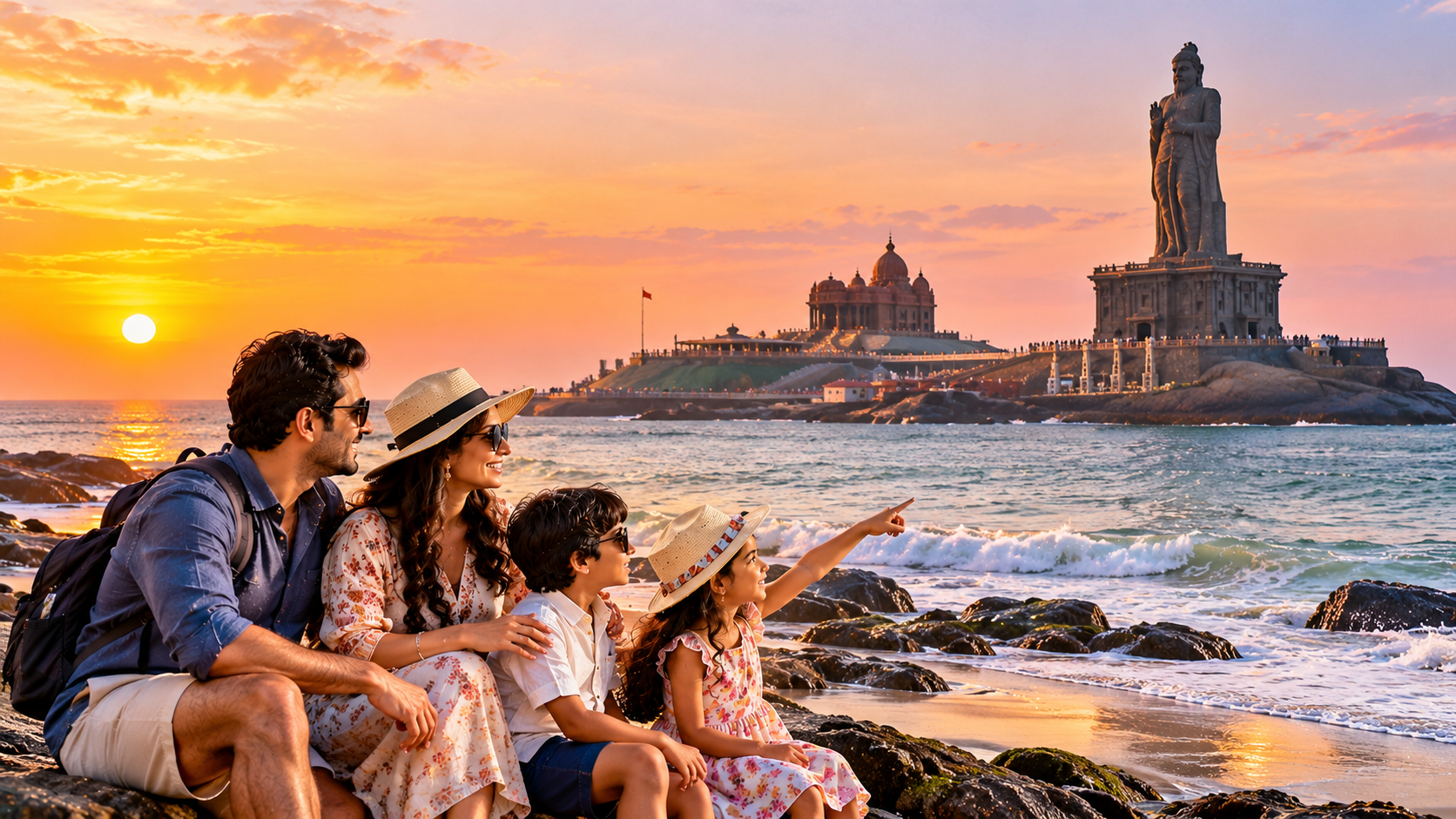
Set your alarm early, around 5:30 AM, and head down to the shore to watch the sunrise over the Bay of Bengal, the moment many visitors come to Kanyakumari for. Crowds of pilgrims and travellers gather on the beach and the rocks, and as the sky lightens from grey to pink to gold, a hush falls over them, and the sun rises out of the sea behind the silhouettes of the Vivekananda Rock Memorial and the Thiruvalluvar statue. Many hotels in Kanyakumari have rooftop terraces or sea-facing rooms where you can watch it in comfort too. The best views come between October and March, when the skies are usually clear.

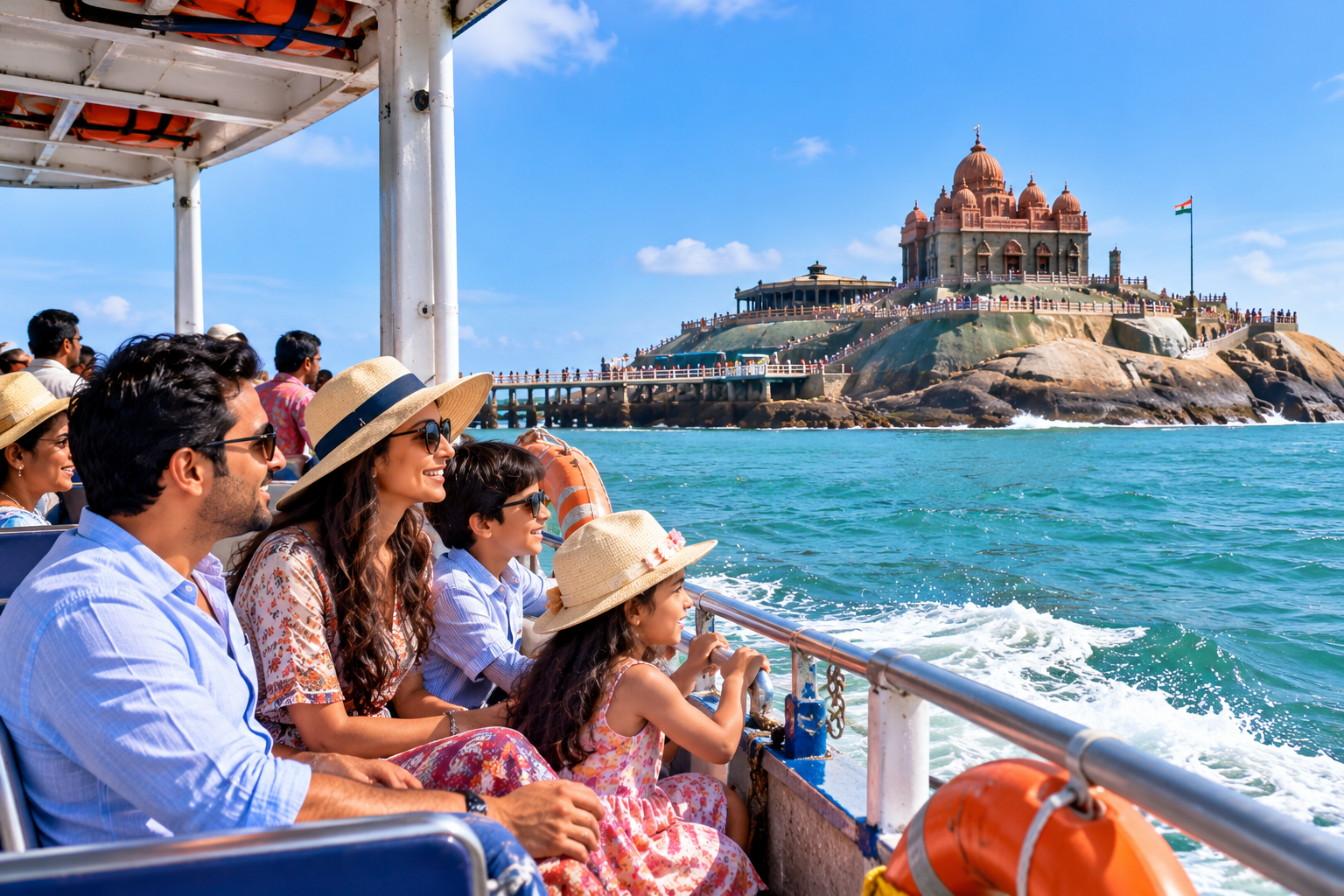
After breakfast, take the ferry to the Vivekananda Rock Memorial, about 500 metres offshore. The ferries are run by the Poompuhar Shipping Corporation and leave every few minutes from about 8 AM. Queues build quickly through the morning, especially on weekends and holidays, so go early. Everyone on board wears a life jacket, and the short crossing gives you a lovely view back to the town and the temple on the shore.

In December 1892, the young monk Swami Vivekananda, who had travelled the length of India on foot, swam out to this rock and meditated here for three days. It was here, it's said, that he resolved to dedicate his life to the service of India and its people, and the following year, he travelled to Chicago, where his speech at the Parliament of the World's Religions made him famous around the world. The memorial, built in 1970, combines architectural styles from across India. Inside the main hall is a bronze statue of Vivekananda, and below it, the Dhyana Mandapam, a quiet, dimly lit meditation hall, where you can sit in silence for a few minutes. On the same rock, the Shripada Mandapam marks a spot where, according to legend, the goddess Kanya Kumari stood on one foot in penance, and a mark said to be her footprint can be seen on the rock.

On the neighbouring rock stands the Thiruvalluvar statue, a 133-foot stone figure of the Tamil poet and philosopher Thiruvalluvar, author of the Thirukkural, a classic work on ethics, love and statecraft written around two thousand years ago. Its height represents the 133 chapters of the Thirukkural, and the statue was unveiled in 2000. In December 2024, a glass-floored bridge was opened between the two rocks, so you can now walk across from the memorial to the statue, with the sea swirling beneath your feet.

Back on the mainland, visit the Kumari Amman Temple, dedicated to the goddess Kanya Kumari, near the shore. The temple is thought to be more than three thousand years old, and its goddess is famous for her diamond nose ring, which, according to legend, sparkled so brightly that sailors mistook it for a lighthouse, and the temple's eastern gate, facing the sea, is kept closed for that reason. Men must remove their shirts before entering, and the inner sanctum can be crowded. Nearby, the Gandhi Mandapam marks the spot where an urn holding some of Mahatma Gandhi's ashes was kept before they were immersed in the sea in 1948. The building was designed so that each year on 2 October, Gandhi's birthday, the midday sun shines through a hole in the roof onto the spot where the urn was placed.

Late in the morning, drive about two hours along the coast to Kovalam. If you'd like to break the journey, two remarkable places lie along the way. At Suchindram, the Thanumalayan Temple is dedicated to Brahma, Vishnu and Shiva together, and is known for its musical stone pillars, which ring with different notes when struck, and its huge statue of Hanuman. At Padmanabhapuram, a short detour from the highway, Padmanabhapuram Palace was the seat of the rulers of Travancore until the late 18th century, and it's one of the finest examples of traditional Kerala wooden architecture, with intricate carvings, polished black floors, painted murals and cool, shady courtyards. The palace is closed on Mondays.

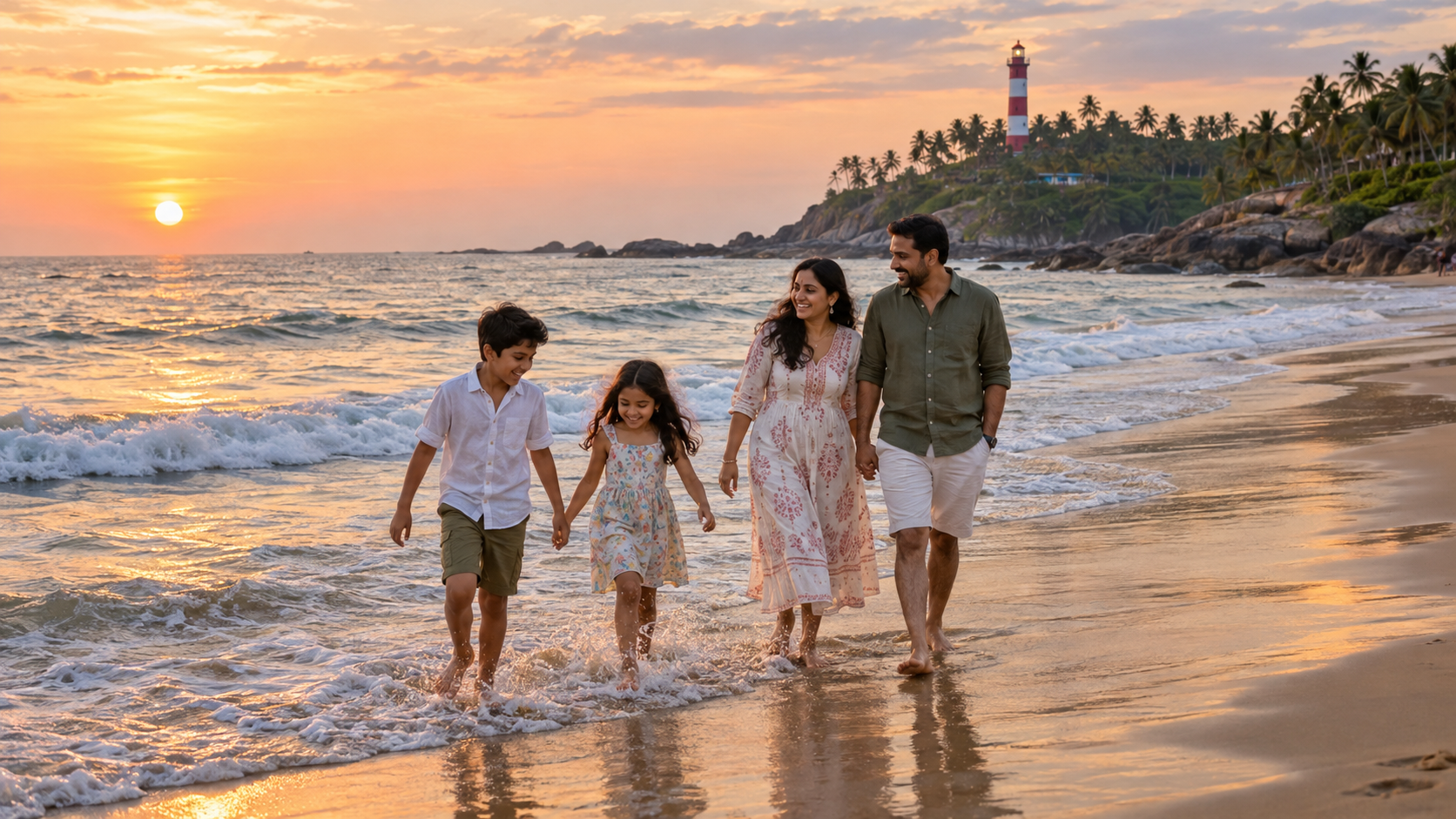
Arrive in Kovalam in the afternoon and check in to your hotel. Kovalam is Kerala's most famous beach resort, a series of three crescent-shaped beaches separated by rocky headlands, lined with palms, hotels, cafés and shops. The southernmost and most popular is Lighthouse Beach, named for the red-and-white striped lighthouse on the Kurumkal hill at its southern end. Climb the steps to the top of the lighthouse for sweeping views of the coast and the beaches, the fishing boats drawn up on the sand and the palm-covered hills stretching inland. Then spend the evening on the beach, swimming or relaxing on a sun lounger, with the waves rolling in.

As the sun sets over the Arabian Sea, the cafés along the promenade light up, and the fishermen bring in their catch. Choose your own fish, prawns, crab or lobster from the display at one of the beach restaurants and have it grilled or cooked Kerala-style with coconut and spices. Kovalam is also known for Ayurveda, and many hotels and centres offer massages and treatments, a perfect way to relax after the long journey. Swim only in the areas marked by the lifeguards' flags, as the currents can be strong, especially during the monsoon.

Included today: private car from Kanyakumari to Kovalam, hotel in Kovalam, breakfast.

Good to know: drive about 2 hours. The ferry runs from early morning; tickets are paid locally.

Day 7
Kovalam to Trivandrum – Departure

Kovalam to Trivandrum – Departure

⌖ Trivandrum 🍽 Meals: Breakfast

Begin your last day in Kerala with a walk along the beach in the cool of the early morning, when the sand is quiet and the fishermen are hauling in their nets. Many of them use the traditional shore seine, a long net pulled in from the beach by a team of men, chanting in rhythm as they haul. Join them for a few minutes if you like; they're usually happy to have extra hands. Then return to your hotel for a leisurely breakfast and pack your bags.

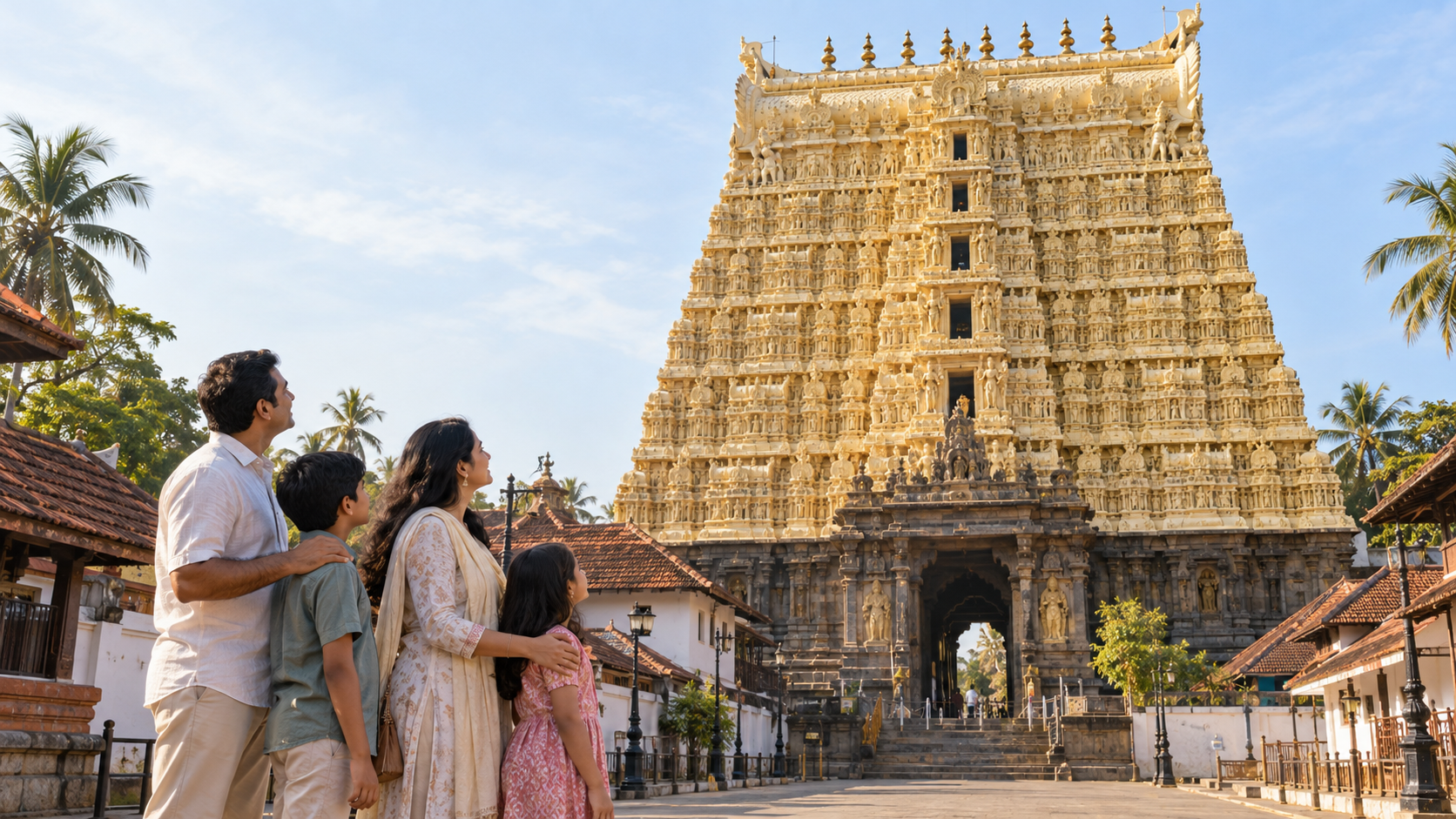
Drive about 30 to 45 minutes to Thiruvananthapuram, Kerala's capital, a green, relaxed city spread over low hills, with grand old buildings from the days of the Maharajas of Travancore, wide avenues, busy markets and plenty of trees. The city takes its name from Anantha, the serpent on which Vishnu reclines, and its most important landmark is the Sree Padmanabhaswamy Temple, in the heart of the old fort area.

The temple is one of the most important Vishnu temples in India, and its tall gopuram, built in the Dravidian style, rises seven storeys above the temple tank. Inside, Vishnu is shown reclining on the coiled serpent Anantha, in the form of Padmanabha, and the great idol is so long that it's seen through three doors: the face, the navel, from which a lotus bearing Brahma rises, and the feet. In 1750, Maharaja Marthanda Varma dedicated his entire kingdom to the deity, and the rulers of Travancore governed as Padmanabhadasa, servants of the Lord. In 2011, the opening of vaults beneath the temple revealed a treasure of gold, jewels and coins, making it one of the wealthiest temples in the world. Entry is for Hindus only, and the dress code is strict: men wear a mundu or dhoti and no shirt, and women wear a saree or a long skirt with a blouse. Mundus can be hired at the entrance. Phones and cameras aren't allowed inside.

Next door, visit the Kuthiramalika Palace, also known as Puthen Malika, built in the 1840s by Maharaja Swathi Thirunal, a gifted poet and composer of classical music. The palace takes its name, which means the mansion of horses, from the 122 horses carved into the wooden brackets that support its roof. Part of the palace is now a museum, with Kathakali figures, portraits of the royal family, weapons, musical instruments, crystal thrones gifted by the Dutch and the British, and beautiful old furniture. Its rooms look out over the temple tank and the gopuram of the Padmanabhaswamy Temple. The palace is closed on Mondays.

Then drive a few minutes to the Napier Museum, set in leafy grounds in the north of the city. Built in 1880 and named after Lord Napier, then Governor of Madras, the museum's building is a work of art in itself, with its red and black brickwork, pointed gables, and blend of Kerala, Indian and European styles. Inside, you'll find a fine collection of bronze sculptures, old ornaments, carved wooden temple chariots and ivory carvings. In the same grounds, the Sree Chitra Art Gallery displays paintings by Raja Ravi Varma, the celebrated 19th-century painter from Kerala whose portraits of gods, goddesses and Indian women became famous across the country, along with works by Nicholas Roerich and others. The museum is closed on Mondays and on Wednesday mornings, and the zoo next door is a pleasant place for a stroll.

If you have time, visit Chalai Bazaar, the city's oldest market, for spices, flowers, brass lamps and handloom textiles, or pick up a Kerala kasavu saree or mundu from one of the handloom shops in the city. Then your driver drops you at Trivandrum International Airport, just a few kilometres from the city centre, or at Thiruvananthapuram Central railway station.

Your week has taken you from the tea gardens and wildlife of the Western Ghats to the peaceful backwaters, and from the southern tip of India, where three seas meet, to the golden beaches of Kovalam and the temples and palaces of Kerala's capital, a journey full of variety, colour and warmth that we hope you'll remember for a long time.

Book a flight that leaves at least three hours after you reach the airport, and allow extra time on weekday evenings, when the city's traffic can be heavy. Our team will stay in touch until you're home safely. Thank you for travelling with us, and we hope to welcome you back to Kerala again soon.

Whatever time your flight leaves, the airport is close, so you can make the most of your last hours in Kerala without rushing.

Included today: private car from Kovalam to Trivandrum with sightseeing, drop at Trivandrum airport or railway station, breakfast.

Good to know: drive to Thiruvananthapuram 30–45 minutes. Padmanabhaswamy Temple entry is for Hindus only, with a strict dress code. Kuthiramalika Palace and the Napier Museum are closed on Mondays; the museum is also closed on Wednesday mornings.

Hotel confirmation

Hotel names will be provided after booking, subject to availability and confirmation. We do not hold hotel confirmations before booking.

Inclusions

  1. 5 nights in hotels or resorts of your chosen category (2 in Munnar, 1 in Thekkady, 1 in Kanyakumari, 1 in Kovalam), with daily breakfast
  2. 1 night on a private houseboat, with lunch, dinner and breakfast on board
  3. A private sedan, SUV or tempo traveller with an English- or Hindi-speaking driver for all 7 days, including fuel, tolls, parking, driver allowance and the Tamil Nadu interstate permit
  4. Pickup at Kochi airport or railway station and drop at Trivandrum airport or railway station
  5. All sightseeing and transfers listed in the itinerary

Exclusions

Not included: flights or trains, entry tickets (Eravikulam National Park, Tea Museum, Periyar boating, Vivekananda Rock ferry, Trivandrum museums), cultural shows, meals other than breakfast and houseboat meals, and personal expenses.

Important Terms

These terms apply to every Kerala tour package booked with Dreamland Vacations LLP ("we", "us"). By paying the advance, you ("the guest") accept them on behalf of everyone named in the booking.

1. Quotes and availability

1.1 Quotes are valid for 3 days and are subject to availability until the booking is confirmed. Hotel and houseboat prices change often, especially for December and January travel.

1.2 Hotels named in a quote are our first choice. If one is unavailable when you book, we'll offer a hotel of the same category and tell you before confirming.

2. Booking and payment

2.1 Once we confirm availability, pay 30% of the total package cost to confirm your booking. Your booking is confirmed only when we have received this payment and sent you a written confirmation with hotel names.

2.2 Full payment is due 30 days before your travel date. If it is not received by then, we may treat the booking as cancelled by you, and the charges in section 4 apply.

2.3 For bookings made within 30 days of the travel date, pay 30% to book, and the balance as soon as your booking is confirmed.

2.4 We accept payment by bank transfer, UPI or our online payment link, with no extra charge for paying online.

3. Prices

3.1 Prices are per person, based on two adults sharing a room, unless the quote says otherwise. GST is charged extra at the rate applicable on the invoice date.

3.2 Child rates apply to children aged 5 to 11 sharing their parents' room. Children under 5 travel free without an extra bed, subject to hotel policy.

3.3 Hotels add compulsory gala-dinner charges for 24 and 31 December. These are not included unless the quote says so and are payable at the time of booking.

3.4 Once confirmed, the package price is fixed, except for changes in government taxes, park fees or fuel surcharges imposed after booking.


Cancellation by you

4.1 Cancellations must be sent by email to info@dreamlandvacations.com. The charges below are counted from the day we receive your email, in Indian time.

4.2 Bookings for travel between 20 December and 5 January, and any hotel, resort or houseboat we have told you is non-refundable, cannot be refunded once confirmed, whatever the cancellation date.

4.3 Flights and train tickets booked through us follow the airline's or railway's own cancellation rules, plus our service fee of Rs 500 per ticket.

4.4 GST already paid is not refundable.

4.5 We recommend travel insurance that covers cancellation, as these charges apply whatever the reason for cancelling, including illness.

5. Changes by you

5.1 One change of travel dates is free if requested 31 or more days before the original arrival date, provided the new dates are within the same season and the hotels are available. You pay any difference in price.

5.2 Date changes requested within 30 days of arrival are treated as a cancellation and a new booking.

5.3 Other changes, such as upgrading a hotel, adding a night or adding a houseboat, are possible at any time, subject to availability and the price difference.

5.4 Changing the name of a traveller is free up to 7 days before arrival.

6. Refunds

6.1 Refunds are made to the original payment method within 21 working days of the cancellation, after deducting the charges in section 4.

6.2 There is no refund for any service you don't use once the tour has started, including meals, sightseeing, a missed houseboat check-in or leaving early. If you leave early, we'll try to cancel later bookings and pass on whatever the hotels or suppliers refund to us.

7. Changes by us

7.1 If we must change a confirmed hotel, we'll replace it with one of the same or a higher category at no extra cost, and tell you as soon as we know.

7.2 If we have to cancel your tour for any reason other than those in section 8, you can choose a full refund of what you have paid or a different tour of equal value.

8. Events beyond our control

8.1 Heavy rain, landslides, floods, strikes and hartals, road closures, government orders, park closures and similar events can disrupt travel in Kerala, especially in the hills during the monsoon.

8.2 If such an event affects your tour, we'll arrange the best available alternative, such as a different route, hotel or sightseeing. Any extra costs are payable by you, and we'll refund only what the hotels and suppliers refund to us for services not used.

8.3 Houseboat cruising may be shortened or stopped in bad weather or under local regulations. Periyar boating and Eravikulam National Park can close without notice. These are not grounds for a refund of the package.

9. Our responsibility

9.1 We arrange hotels, houseboats, transport and sightseeing through independent suppliers. We take care to choose them well, but we are not responsible for loss, injury, damage, delay or illness caused by their acts or omissions, or by you.

9.2 Please look after your own belongings. We're not responsible for lost or stolen items.

9.3 Wildlife sightings, weather and views cannot be guaranteed.

10. Travel notes

10.1 Every guest must carry a valid government photo ID (Aadhaar, passport, driving licence or voter ID). Foreign nationals need a valid passport and Indian visa. Hotels may refuse check-in without ID.

10.2 Hotel check-in is usually 2 pm and check-out 11 am or 12 noon. Early check-in and late check-out depend on availability and may be charged.

10.3 The vehicle is for the itinerary as booked. Drives beyond it, or after 8 pm, may cost extra. Drivers may switch off the air-conditioning on steep hill roads.

10.4 Houseboats moor for the night at a fixed time under local rules. Air-conditioning on Deluxe boats usually runs at night only.

10.5 Behaviour that endangers others or breaks the law may lead to the tour being ended without refund.


Good to Know

  1. Day 5 is a long drive. We leave the houseboat by 8 am and stop for lunch on the way. Keep snacks and anything you need for the day in a small bag.
  2. Vivekananda Rock ferry runs from about 8 am to 4 pm. Queues can be long on weekends and holidays, so go early.
  3. Temple dress codes: at the Kumari Amman Temple men usually remove their shirts before entering. The Sree Padmanabhaswamy Temple in Trivandrum is open only to Hindus, with a strict dress code.
  4. Eravikulam National Park closes for a few weeks each year between February and April for the Nilgiri tahr calving season. On those dates we replace it with Top Station or extra time at the tea estates.
  5. The Tea Museum and Trivandrum's museums are closed on Mondays.

Best Time for This Tour

October to March is the best time, with dry weather in the hills, calm backwaters and the clearest skies for the Kanyakumari sunrise. December and January are the busiest months, so book early. April and May are hot on the coast and in Kanyakumari, and in the monsoon (June to September) the sea is rough, cloud often hides the sunrise and Kovalam is not safe for swimming. See our guide to the best time to visit Kerala.

Make It Your Own

  1. Break the long drive: add a night in Varkala, Kerala's cliff-top beach, between Alleppey and Kanyakumari.
  2. More time on the beach: add a second night in Kovalam, or see our Vagamon, Munnar & Kovalam tour with two beach nights.
  3. A slower pace: take nine days with our Kerala & Kanyakumari grand tour.
  4. Skip the south: our Kerala 7 Days Itinerary stays in the hills and backwaters and returns to Kochi.
  5. On honeymoon? Upgrade the houseboat and the Kovalam hotel. See our Kerala honeymoon packages.

Get a free quote for this tour

Kerala & Kanyakumari Tour – 7 Days FAQs

Is Kanyakumari in Kerala?
No. Kanyakumari is in Tamil Nadu, just across the border at the southern tip of India, about two hours from Trivandrum. It is so close to Kerala that it is often added to Kerala tours.
How long is the drive from Alleppey to Kanyakumari?
About 8 to 9 hours with stops for lunch and breaks. It is the longest drive of the trip, so we leave the houseboat early. If you'd prefer to split it, we can add a night in Varkala on the way.
What is Kanyakumari famous for?
Kanyakumari is the southernmost point of mainland India, where the Arabian Sea, the Bay of Bengal and the Indian Ocean meet. It is famous for its sunrise over the ocean, the Vivekananda Rock Memorial, the Thiruvalluvar Statue and the Kumari Amman Temple.
Why does this tour end in Trivandrum?
Kovalam is about 30 minutes from Trivandrum airport but around five hours from Kochi. Flying home from Trivandrum saves you a long drive on the last day. If you need to fly from Kochi, we can arrange the drive, but plan for an evening flight.
When is the best time to see the sunrise at Kanyakumari?
October to March usually has the clearest skies. In the monsoon months, cloud often hides the sunrise. Check the sunrise time the evening before, as it changes through the year, and arrive at the shore about 20 minutes early.
Is this tour suitable for senior travellers?
Yes, with one long drive to plan for on Day 5. All other drives are four hours or less, and we can add a night in Varkala to split the journey. The Vivekananda Rock ferry involves some steps and queuing, so we go early to avoid the crowds.
Gallery

Kerala photos: Kerala & Kanyakumari Tour – 7 Days

Plan your Kerala holiday with Dreamland Vacations

Share your dates, travellers and comfort preference. Our team will guide you with the next best step.

Get a free quote
Itinerary Get a quote
WhatsApp