Vagamon Tour Package with Munnar, Alleppey & Kovalam – 8 Days
Standard Package

Vagamon Tour Package with Munnar, Alleppey & Kovalam – 8 Days

Munnar, Vagamon, an Alleppey houseboat and resort, and 2 beach nights in Kovalam. 8 days, Kochi to Trivandrum, private car and driver.

⌖ Kerala, India ✦ Family & senior friendly planning
Package snapshot
DestinationKerala
Travel styleStandard Package

Want to customize this package?

Share your dates and travellers. This enquiry is free. Small changes to a standard itinerary—such as a date change or an extra day—can be discussed with our team.

We’ll send verification codes to your WhatsApp number and email. Indian numbers can be entered without +91; for other countries, include the country code.
Verification required before submitting.
Your holiday

Vagamon Tour Package with Munnar, Alleppey & Kovalam – 8 Days: overview

Two hill stations, the backwaters and the beach

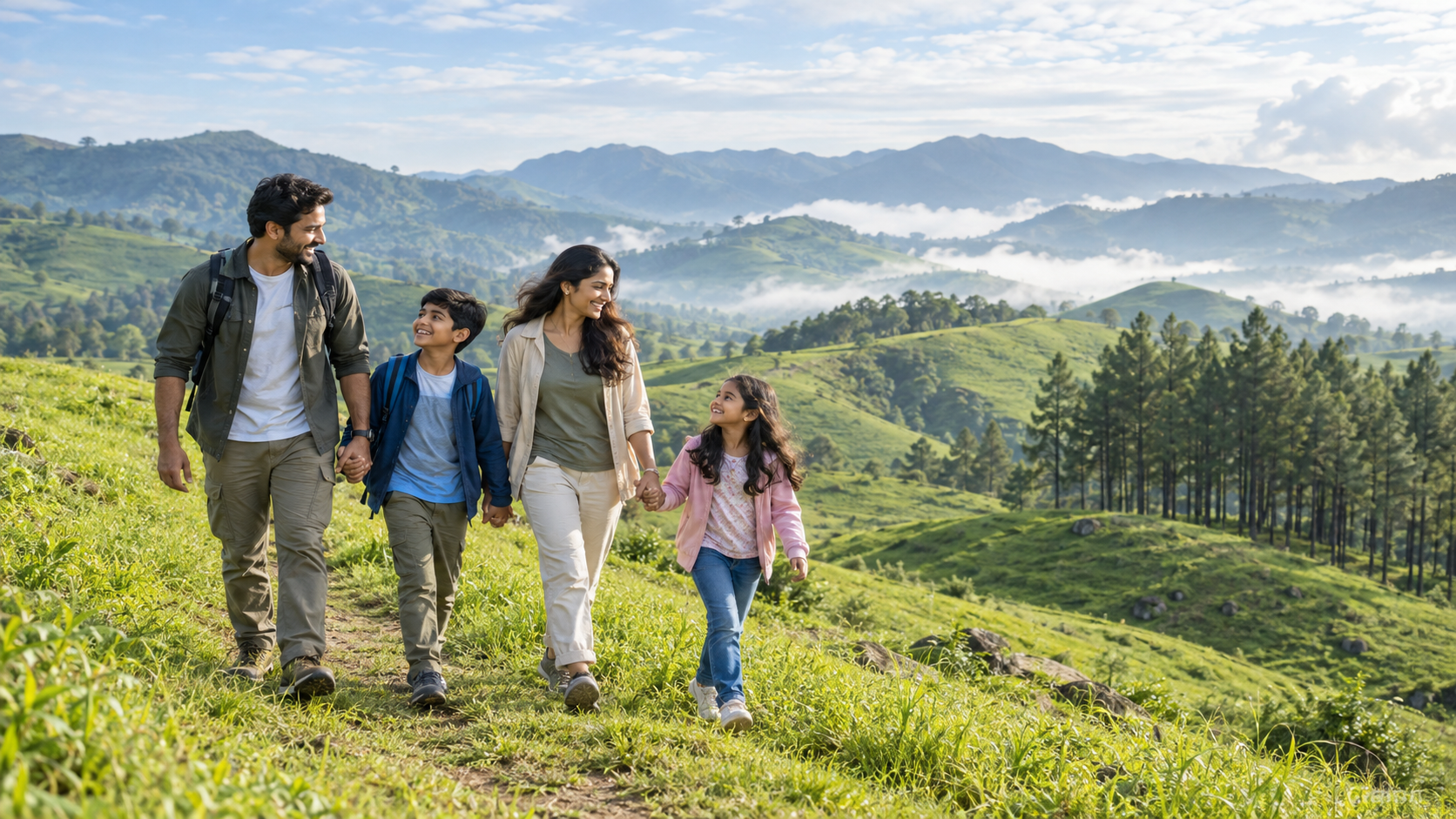
Picture yourself walking through a quiet pine forest in Vagamon, sunlight slanting between the tall trunks, then climbing a grassy hill to watch the mist roll across the valleys below. A few days later, you're drifting through the Alleppey backwaters on a private houseboat, and by the end of the week, you're watching the sun sink into the Arabian Sea from the lighthouse at Kovalam. This Vagamon tour package brings together two very different hill stations, the backwaters and the beach in eight days.

You begin with two nights among Munnar's tea estates, with waterfalls and a spice garden on the drive up, Eravikulam National Park and its Nilgiri tahr, the Tea Museum and the lakes of Mattupetty and Kundala. Then you spend a night in Vagamon, Kerala's quiet hill station of open meadows, pine forest and three hills of three faiths. From there, you drop down to Alleppey for a night on your own houseboat and a slow day at a lakeside resort, with time for Ayurveda or a canoe ride through the village canals. Finally, you have two nights by the sea in Kovalam, with a day to choose between the beach and the temples, palaces and museums of Trivandrum.

You travel from Kochi to Trivandrum without retracing your steps, with a private car and driver throughout. It's a lovely choice for couples and anyone who wants the quieter side of Kerala.

Compare all our Kerala tour packages, explore our Munnar tour packages, or see our Kerala honeymoon packages.

From Ashok's travels

I first travelled through Kerala in the 1990s, by train to Kochi and bus to Kanyakumari, and I keep going back. It is even greener than Goa. Give Kochi a full day, walk the Munnar tea gardens, try a Kerala massage in Thekkady, and don't miss a night on a houseboat in Alappuzha.

Ashok Saini, Founder, Dreamland Vacations

Good to know

Package typeStandard Package
Planning supportSmall changes by enquiry
Best forFamilies, couples & seniors
Get a free quote
Trip highlights
✦ Kochi to Munnar – Up into the Western Ghats
✦ Munnar – Eravikulam, Tea and Lakes
✦ Munnar to Vagamon – Meadows, Pines and Three Hills
✦ Vagamon to Alleppey – Your Houseboat Cruise
✦ Alleppey – A Slow Day by the Lake
✦ Alleppey to Kovalam – To the Beach
Day-wise plan

Kerala itinerary: day by day

Day 1
Kochi to Munnar – Up into the Western Ghats

Kochi to Munnar – Up into the Western Ghats

⌖ Munnar

Welcome to Kerala. Your driver meets you at Kochi airport or Ernakulam railway station, helps you with your bags, and you set off east towards the hills on a journey of about four hours that takes you from the warm, green coast to the cool tea country of Munnar. Over the next eight days, you'll see two very different hill stations, the backwaters and the beach, and this first drive is a wonderful introduction to the variety of Kerala's landscapes.

The first part of the journey crosses the busy plains east of Kochi, through Aluva and Perumbavoor and past fields of paddy, bananas and tapioca, coconut groves and rubber plantations. Life here moves at a brisk pace: lorries loaded with timber and coconuts, school buses painted in bright colours, cyclists balancing great bunches of bananas, and roadside stalls selling tender coconuts, jackfruit and tea. Past the town of Kothamangalam, the road begins to climb, and the landscape changes. The plantations of rubber give way to thick forest and then to cardamom, which grows in the shade of tall trees, and finally, as you climb higher, to tea.

At Neriamangalam, you cross the Periyar, Kerala's longest river, on a graceful stone bridge with tall arches, built in the 1930s by the rulers of Travancore and still in use today. From here, the road winds steeply up into the Western Ghats in a series of hairpin bends, with the forest closing in on both sides and occasional glimpses back down over the plains.

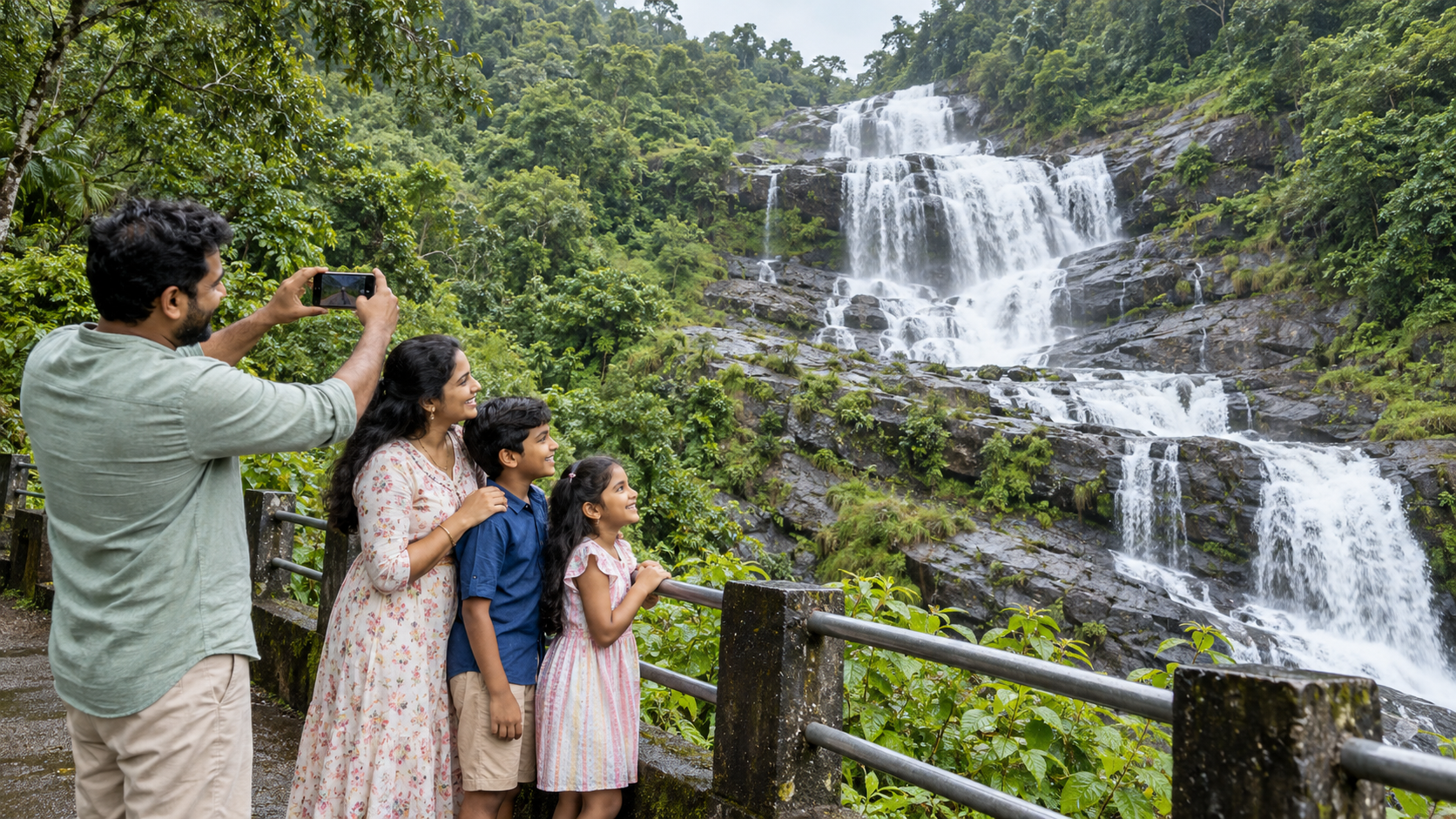
Stop at the Cheeyappara waterfall, where the water tumbles down a rocky hillside in seven tiers right beside the road, and at the Valara falls, a short distance further on, which plunge into a deep, wooded gorge. Both are at their most impressive during and after the monsoon, between June and December, but they're lovely at any time of year. Bonnet macaques often gather by the roadside here, so keep your food out of sight.

Further up, stop at a spice garden, where a local guide will lead you along shaded paths and show you the spices that made Kerala famous: black pepper vines climbing up tall trees, cardamom with its pods hidden at the base of the plant, cinnamon, cloves, nutmeg with its scarlet mace, allspice, vanilla, cocoa and coffee. Crush a leaf between your fingers to release its fragrance, and listen to the stories of the merchants from Rome, Arabia, China, Portugal, Holland and Britain who came to Kerala in search of these spices. The garden shop is a good place to buy fresh spices to take home.

Have lunch on the way at one of the restaurants around Adimali, a busy market town in the hills, where you can try a Kerala meal of rice with fish curry, vegetable thoran and sambar, or flaky porotta with a spicy curry.

As you climb the last stretch to Munnar, the first tea estates appear on the slopes around you, and soon the whole landscape is covered in tea. The bushes are planted in tidy rows that follow the curves of the hills, trimmed to waist height so that the pickers can reach the tender young leaves, and shaded by tall silver oaks. Here and there, a white-walled tea factory sits in a valley, and the neat lines of the workers' homes climb the slopes. The air is cool and fresh, scented with eucalyptus and damp earth, and mist often drifts across the higher ridges.

You reach Munnar in the afternoon, with time to rest and enjoy the cool air. Munnar sits at about 1,600 metres, at the meeting point of three mountain rivers, and it was developed by British planters in the late 19th century as the centre of a great tea-growing region known as the High Ranges. Spend the rest of the afternoon relaxing at your hotel, perhaps with a cup of fresh tea on your balcony, looking out over the hills as the mist rolls in, or take a short walk into town to explore the small market.

In the evening, the temperature drops and the hills grow quiet. Wrap up in a warm layer and enjoy dinner at your hotel, perhaps a Kerala chicken or vegetable stew with soft appam, or a bowl of hot soup. Then get a good night's sleep: tomorrow begins early at Eravikulam, and the cool mountain air makes for deep, restful sleep.

Welcome to the hills.

Over the coming week, you'll see why so many travellers fall in love with Kerala on their very first day in the hills.

Included today: pick-up at Kochi airport or railway station, private car to Munnar with stops at the waterfalls and a spice garden, hotel in Munnar.

Good to know: drive about 4 hours, plus stops. Lunch is at your own cost, and breakfast on arrival day isn't included. Evenings in Munnar can be cool, so keep a warm layer handy.
Day 2
Munnar – Eravikulam, Tea and Lakes

Munnar – Eravikulam, Tea and Lakes

⌖ Munnar 🍽 Meals: Breakfast

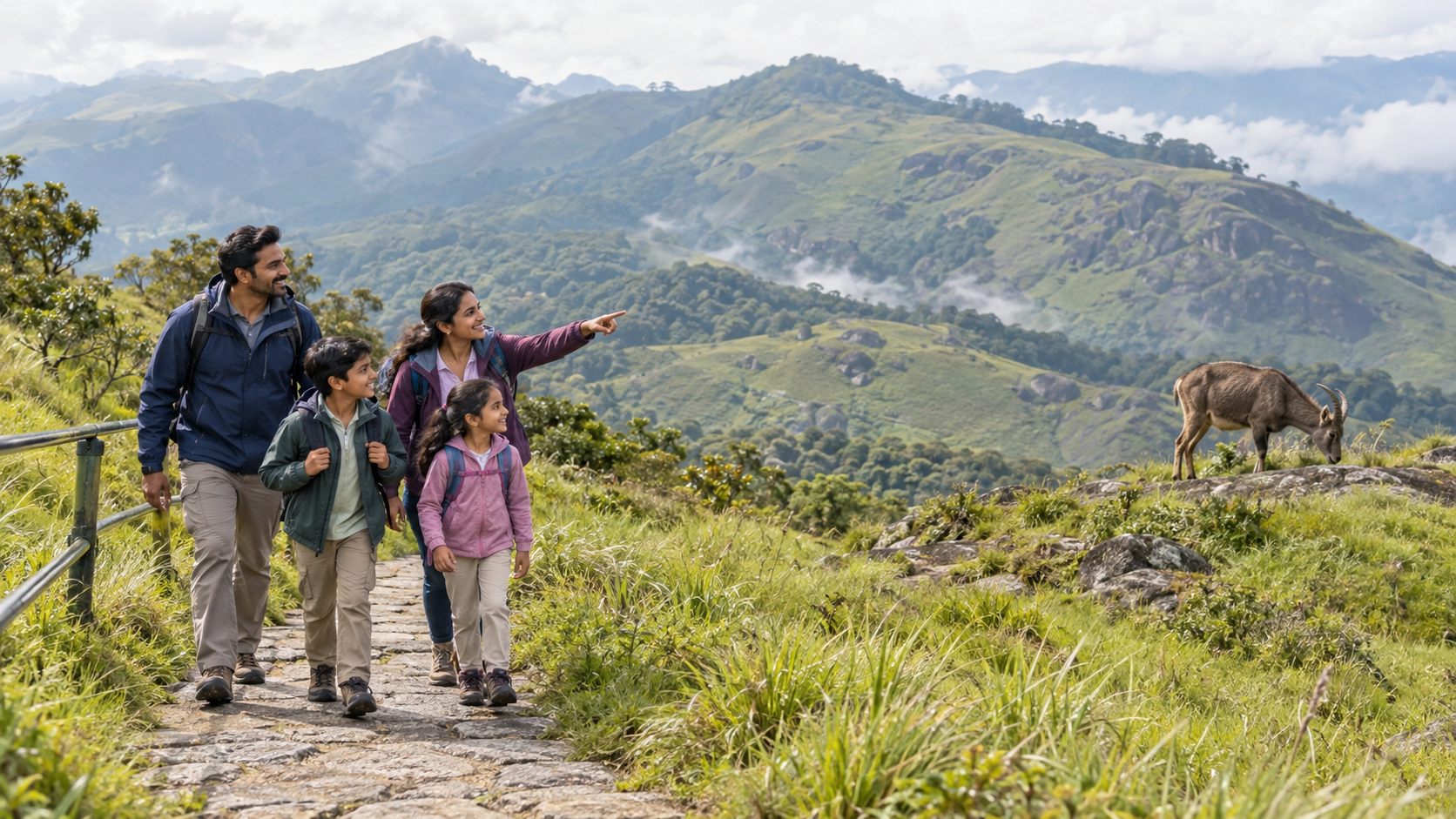
Be at Eravikulam National Park by 9 AM, when the park buses start running up to the grasslands where the rare Nilgiri tahr lives. The park is about 15 kilometres from Munnar, and it's the most popular sight in the area, so arriving early means shorter queues and the best chance of seeing the tahr while the morning is cool. The bus climbs a narrow, winding road through the tea estates to Rajamala, where a paved path leads along the hillside through the park.

The Nilgiri tahr is a stocky, sure-footed wild goat with short, curved horns, found only in the southern Western Ghats. It was once hunted almost to extinction, but under protection, its numbers have recovered, and Eravikulam now holds the largest population in the world. Here, the tahr are so used to people that they graze calmly by the path and stand on the rocks above, unbothered by the visitors below. In spring, from about April, you may see the young ones, born during the calving season, when the park is usually closed for a few weeks.

The landscape is magnificent: a high plateau of rolling grassland and patches of dark green shola forest, with steep cliffs dropping away to the valleys far below. Above you rises Anamudi, the highest peak in South India, at about 2,695 metres. On a clear day, you can see for miles across the hills, and when the mist rolls in, the grasslands become soft and mysterious, the shapes of the tahr appearing and disappearing in the cloud. Look out for wild flowers, butterflies and birds, including the Nilgiri pipit, found only in these hills. Once every twelve years, the slopes here are covered in the blue-violet flowers of the Neelakurinji, a shrub that blooms all at once across the hills.

Afterwards, the Tea Museum walks you through how tea is made, from leaf to cup. Set in an old tea factory, the museum tells the story of Munnar's tea estates through old photographs, documents and machines, from the first plantations of the 1880s to the present day. You'll see how fresh green leaves are withered, rolled, oxidised and dried, and how the finished tea is graded and packed, and you'll end with a tasting of Munnar's bright, brisk tea.

Spend the afternoon on the road to Mattupetty, with viewpoints over the tea estates along the way. The road winds through some of the most beautiful scenery in Munnar, past rolling tea gardens, eucalyptus groves and grassy meadows. Mattupetty Dam holds back a long, calm lake set between green hills, and the area around it is home to a dairy farm founded with Swiss help in the 1960s, where herds of cattle graze on the slopes. Wild elephants sometimes come down to the lake in the evening. At Echo Point, a little further on, shout across the water and hear your voice come back to you from the hills.

Kundala Lake, the last stop, is a peaceful reservoir ringed by eucalyptus and tea, with a graceful arch dam at one end. You can hire a pedal boat or a shikara for a slow turn on the water, or simply walk along the shore. In spring, the cherry trees around the lake bloom pink and white, a charming reminder of the British planters who planted them.

Return to Munnar in the late afternoon, as the light softens and the mist rises over the tea. Spend a relaxed evening at your hotel, or explore the shops in town, which sell tea from the local factories, cardamom, pepper, homemade chocolates, eucalyptus oil and warm shawls.

If you have energy left in the evening, Munnar town is small and easy to explore on foot. The CSI Christ Church, built of grey stone by the British planters in 1910, stands on a hill above the town, and the Mount Carmel Church, built in 1898, was the first Catholic church in the High Ranges. Both are quiet, atmospheric places, especially in the soft light of late afternoon.

For dinner, Munnar's restaurants serve everything from Kerala meals and North Indian curries to Chinese dishes and grilled trout from the hill streams. Wrap up warmly if you eat out, as the nights can be chilly, especially from November to February. Back at your hotel, enjoy the silence of the hills and get a good rest before tomorrow's drive to Vagamon.

Sleep well, with the window open to the cool mountain air.

Tomorrow brings a completely different kind of hill country, the open meadows and pine forests of Vagamon.

Included today: Munnar sightseeing by private car, breakfast.

Good to know: Eravikulam usually closes for a few weeks early in the year for the tahr's calving season; entry tickets and boating are paid locally. The Tea Museum is closed on Mondays. Find more ideas on our Munnar tour packages page.

Day 3
Munnar to Vagamon – Meadows, Pines and Three Hills

Munnar to Vagamon – Meadows, Pines and Three Hills

⌖ Vagamon 🍽 Meals: Breakfast

After breakfast, leave Munnar and drive south for about four hours to Vagamon, the highlight of this Vagamon tour package. The road winds down through the tea estates and spice country of Idukki district, past small hill towns, cardamom plantations and stretches of forest, with views over deep valleys and the folded ranges of the Western Ghats. Depending on the route your driver chooses, you may pass close to the great Idukki arch dam, built in the 1970s between two granite hills, Kuravan and Kurathi, which holds back one of the largest reservoirs in Kerala and feeds one of the state's biggest hydroelectric projects.

Vagamon sits at about 1,100 metres, on the border of Idukki and Kottayam districts, and it feels nothing like Munnar. Instead of rows of tea, you find open, rolling meadows, a planted pine forest where the light filters through tall straight trunks, and quiet tea estates. The hills here are softer and greener, carpeted with short grass and dotted with rocks and small lakes, and the air is cool and fresh even in summer. It's far quieter than Munnar, with few large hotels and little traffic, and it's a wonderful place to slow down, take long walks and enjoy the peace of the hills.

Start with the Vagamon meadows, a series of grassy hills that roll away in every direction, perfect for walking. Climb to the top of one of the hills for wide views over the valleys, with mist drifting across the slopes and the land falling away to the plains in the west. On clear evenings, the sunsets here are spectacular.

Then visit the pine forest, one of the most photographed places in Kerala. The pines were planted decades ago, and today they form a tall, quiet forest on a steep hillside, with a carpet of fallen needles underfoot, the trunks rising straight towards the sky and shafts of sunlight slanting through the branches. Walk down the slope among the trees, listening to the wind in the high branches.

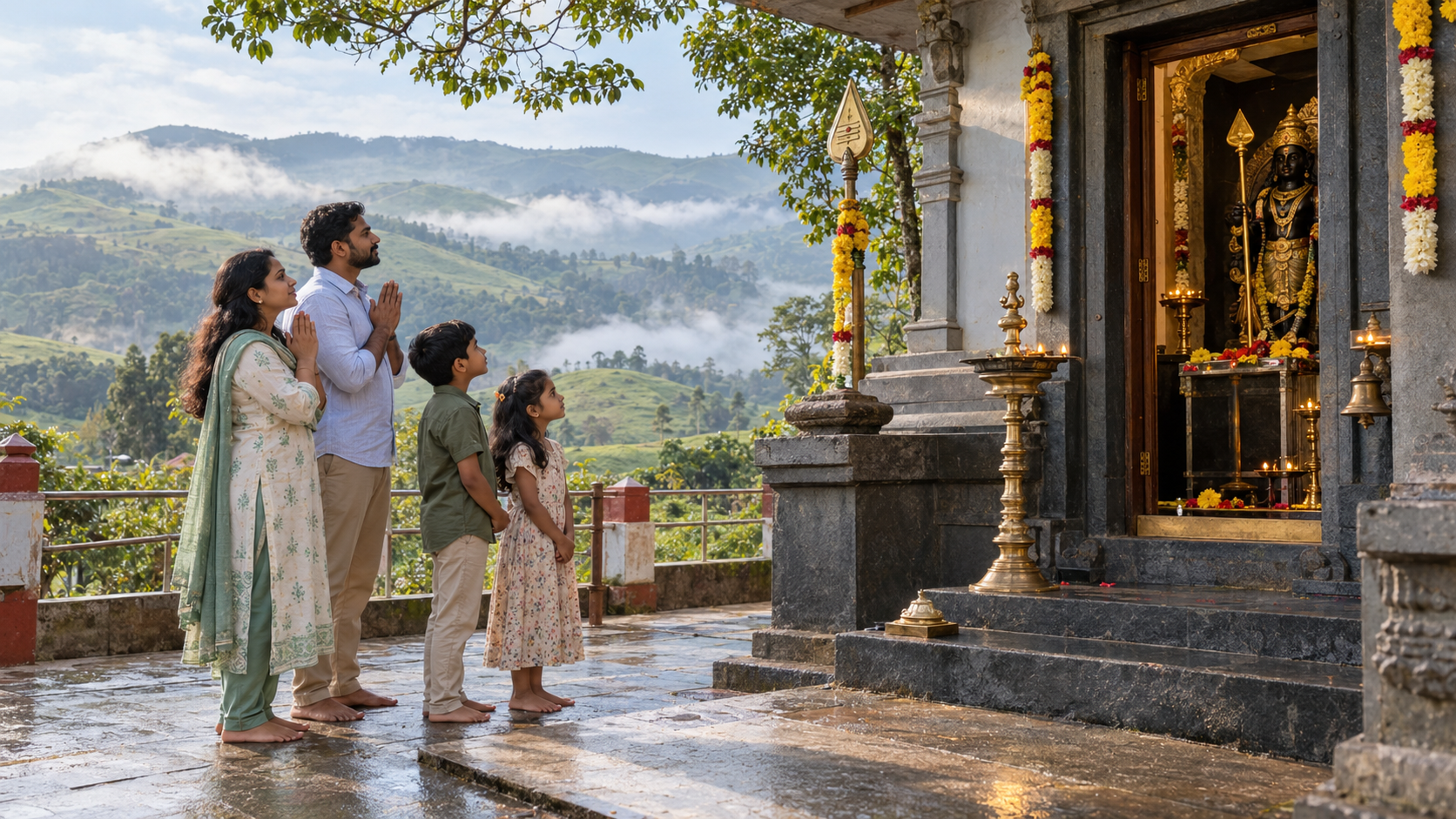
Vagamon is known for three hills of three faiths, a symbol of the harmony between Kerala's communities. Thangal Para is a great rock topped by the shrine of a Sufi saint, Sheikh Fariduddin, who is said to have come here from Afghanistan centuries ago, and it's visited by people of every faith. Murugan Mala is crowned by a temple to Lord Murugan, a popular deity in South India, and Kurisumala, the hill of the cross, is a Christian pilgrimage site, with the stations of the cross leading up to a chapel on the summit. During Holy Week, thousands of pilgrims climb the hill carrying wooden crosses. At the foot of Kurisumala, the Kurisumala Ashram, founded in 1958, is a Christian monastery inspired by Indian traditions, known for its peaceful setting and its dairy farm.

If time allows, visit the orchid garden before sunset, where you can see dozens of varieties of orchids and other flowering plants. Vagamon is also known as one of India's best places for paragliding, thanks to its steady winds and open slopes, and an international paragliding festival is held here in some years. If you'd like to try a tandem flight with a trained pilot, let us know in advance, and we'll check if it's possible on your dates.

Check in to your hotel and spend a quiet evening. Vagamon's hotels are small and relaxed, many of them set among tea gardens or on hillsides with sweeping views, and as night falls, the hills grow silent, the stars come out and the air turns cool enough for a jacket.

Vagamon's weather is pleasant all year, with daytime temperatures of around 10 to 25°C, cooler at night, and mist is common in the afternoons and evenings, especially during the monsoon. It's a place for walking, so bring comfortable shoes with a good grip, a warm layer and a light raincoat or umbrella. The meadows and the pine forest can be slippery after rain, so take care on the steeper slopes.

There's no nightlife in Vagamon, and that's part of its charm. After dinner, step outside and look up: far from the lights of the towns, the stars are bright and close, and the only sounds are the wind in the trees and the occasional call of a night bird. It's the perfect place to unwind before your journey down to the backwaters tomorrow.

Sleep well among the quiet hills of Vagamon.

Whether you spend it walking, praying, photographing or simply sitting on a hilltop watching the clouds, Vagamon is a place that stays with you.

Included today: private car from Munnar to Vagamon, Vagamon sightseeing, hotel in Vagamon, breakfast.

Good to know: drive about 4 hours. Entry tickets to the pine forest, meadows and orchid garden, and paragliding, are paid locally. Mist can roll in quickly in the afternoon, especially in the monsoon.

Day 4
Vagamon to Alleppey – Your Houseboat Cruise

Vagamon to Alleppey – Your Houseboat Cruise

⌖ Alleppey 🍽 Meals: Breakfast, Lunch, Dinner

Leave Vagamon after an early breakfast for the drive of about three hours down to Alleppey, now officially called Alappuzha, in time to board your private houseboat around noon. The road drops steeply from the hills through rubber plantations and small towns such as Erattupetta and Pala, then crosses the plains near Kottayam to the backwaters. You'll feel the air grow warmer and more humid as you descend from the cool hills, and the landscape opens out into the flat green paddy fields of Kuttanad, below the level of the sea, laced with canals and lined with coconut palms.

Life on the backwaters follows the rhythm of the water and the seasons. In the dry months, from about December to April, the farmers plant and harvest their rice on the paddy fields below the level of the lake, protected by dykes, and great flocks of ducks are let loose on the fields after the harvest. During the monsoon, the water rises, the fields flood, and the canals become busy highways, carrying people, goods and animals from village to village. Many of the villages you pass can only be reached by boat, and children travel to school by canoe or ferry every day.

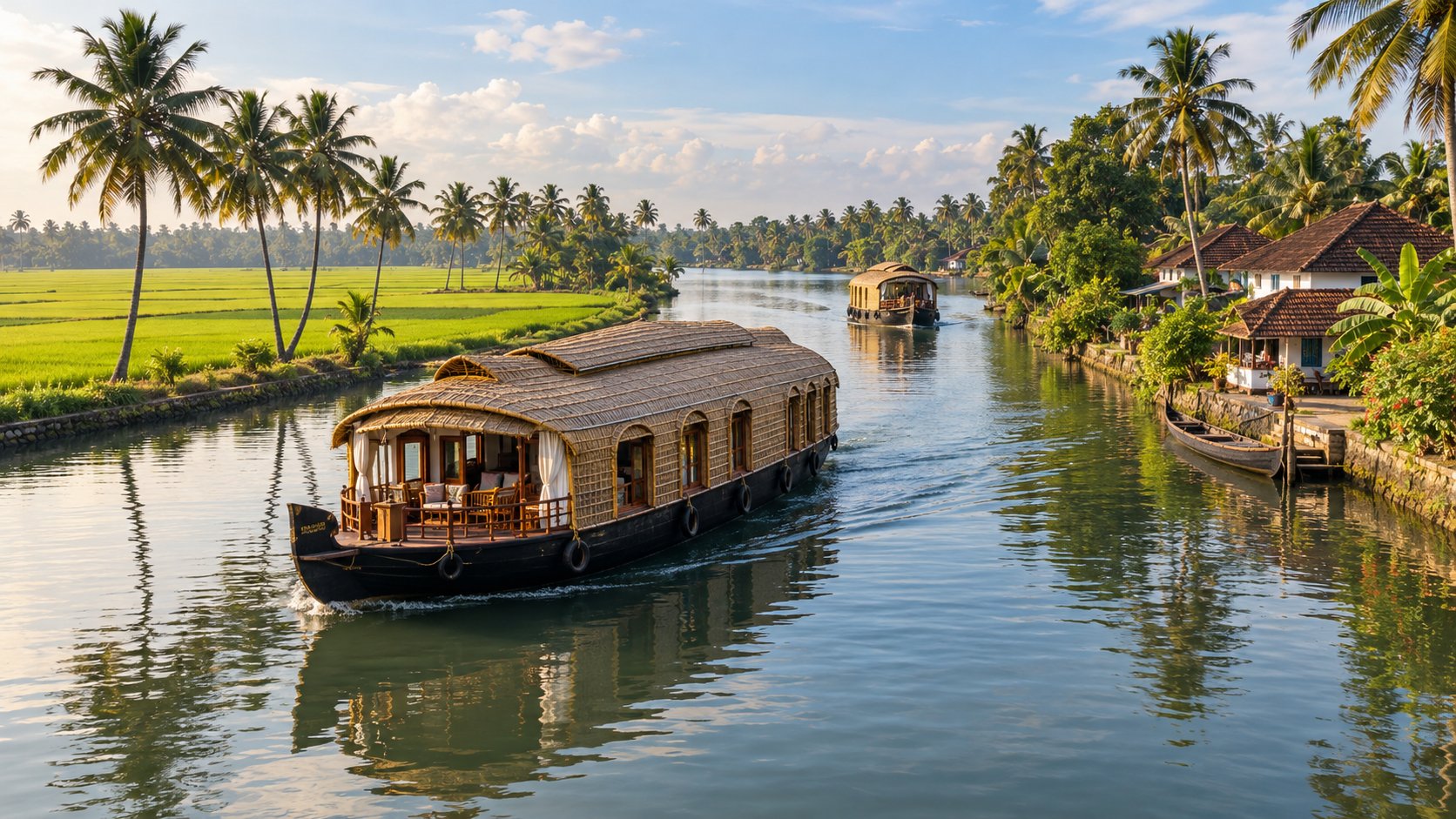
At the jetty, your crew will be waiting to welcome you aboard with a fresh tender coconut. Your kettuvallam is a traditional rice barge, built from planks of jackwood tied together with coir rope, now turned into a comfortable floating home with a curved roof of bamboo and palm thatch, a bedroom with an attached bathroom, a lounge and an open deck. The crew, usually a captain, a cook and a deckhand, will look after you throughout the cruise.

Through the afternoon, you cruise past paddy fields, coconut palms and waterside villages, stopping for a lunch of Kerala dishes cooked on board. Lunch might include Kerala red rice, sambar, avial, a vegetable thoran, a fish curry or fried karimeen, pickles and pappadam, with fresh fruit to finish. Vegetarian meals are always available.

The backwaters are a vast network of lakes, canals and rivers running parallel to the coast, and your cruise will take you across the wide, open waters of Vembanad Lake, the longest lake in India, and then through narrower channels where village life goes on just a few metres from the boat. Sit on the deck and watch the scenes slide past: women washing clothes on stone steps, children paddling small canoes, men fishing with nets and lines, toddy tappers climbing the coconut palms, and great flocks of ducks being herded along the banks. Kingfishers flash blue as they dive for fish, egrets and herons stand in the shallows, and cormorants perch on posts with their wings spread wide to dry.

You'll pass small white churches with tall facades, temples with oil lamps on their steps, village shops, ferry landings and the occasional floating shop selling groceries from a boat. If you'd like seafood for dinner, the crew can stop at a fishermen's landing so you can buy fresh prawns, crab or fish, which the cook will prepare for you at a small extra cost. In the late afternoon, tea and snacks, often banana fritters, are served on deck.

Houseboats on the Alleppey backwaters follow rules set by the local authorities to protect the waterways and the people who live and work on them. Boats must stop sailing and moor for the night by early evening so that fishermen can set their nets safely, and only licensed boats with trained crews can operate. The crews know these waters well, and many grew up in the villages along the banks, so ask them about the fishing, the farming, the festivals and the famous snake-boat races. Their stories make the trip even more special, and a small tip at the end of the cruise is always appreciated.

The boat moors for the night at about 5:30 PM, as local rules require, and the crew serves dinner on deck. As the sun goes down, the sky turns gold and pink over the water, and the palms become black silhouettes against the glow. Lamps come on in the houses along the bank, and the sounds of the evening drift across the water: a temple bell, children's voices, the croak of frogs and the call of night birds. After dinner, sit out under the stars and enjoy the deep peace of the backwaters at night.

It's a night on the water you'll remember long after you're home.

Rest well and let the gentle movement of the water lull you to sleep.

Included today: private car from Vagamon to Alleppey, private houseboat with lunch, dinner and breakfast on board, breakfast at the hotel.

Good to know: drive about 3 hours. Bedrooms are air-conditioned at night, usually from about 9 PM to 6 AM. Compare boat categories on our Alleppey houseboat packages page.

Day 5
Alleppey – A Slow Day by the Lake

Alleppey – A Slow Day by the Lake

⌖ Alleppey 🍽 Meals: Breakfast

Wake to the soft sounds of the backwaters: the splash of paddles, the calls of birds and the distant chug of a ferry. Step out onto the deck to watch the mist lifting from the water as the villages come to life. After a short morning cruise and breakfast on board, perhaps appam with egg curry or puttu with kadala curry, leave the boat by 9 AM and move to a resort on the backwaters.

The day is yours: a swim, an Ayurvedic massage, or a canoe ride through the narrow canals. After the busy days in the hills, it's a chance to rest and enjoy the beauty of the backwaters at your own pace. Alleppey's lakeside resorts are some of the most peaceful places to stay in Kerala, with gardens of palms, hibiscus and bougainvillea running down to the water, swimming pools, hammocks and terraces where you can watch the houseboats glide past.

Kerala is the home of Ayurveda, India's traditional system of medicine, and many of Alleppey's resorts have their own Ayurveda centres. A traditional Abhyangam massage, using warm herbal oils, is a wonderful way to relax, or you could try Shirodhara, in which a stream of warm oil is poured gently over the forehead. Treatments are given by trained therapists, and longer programmes can be arranged if you'd like.

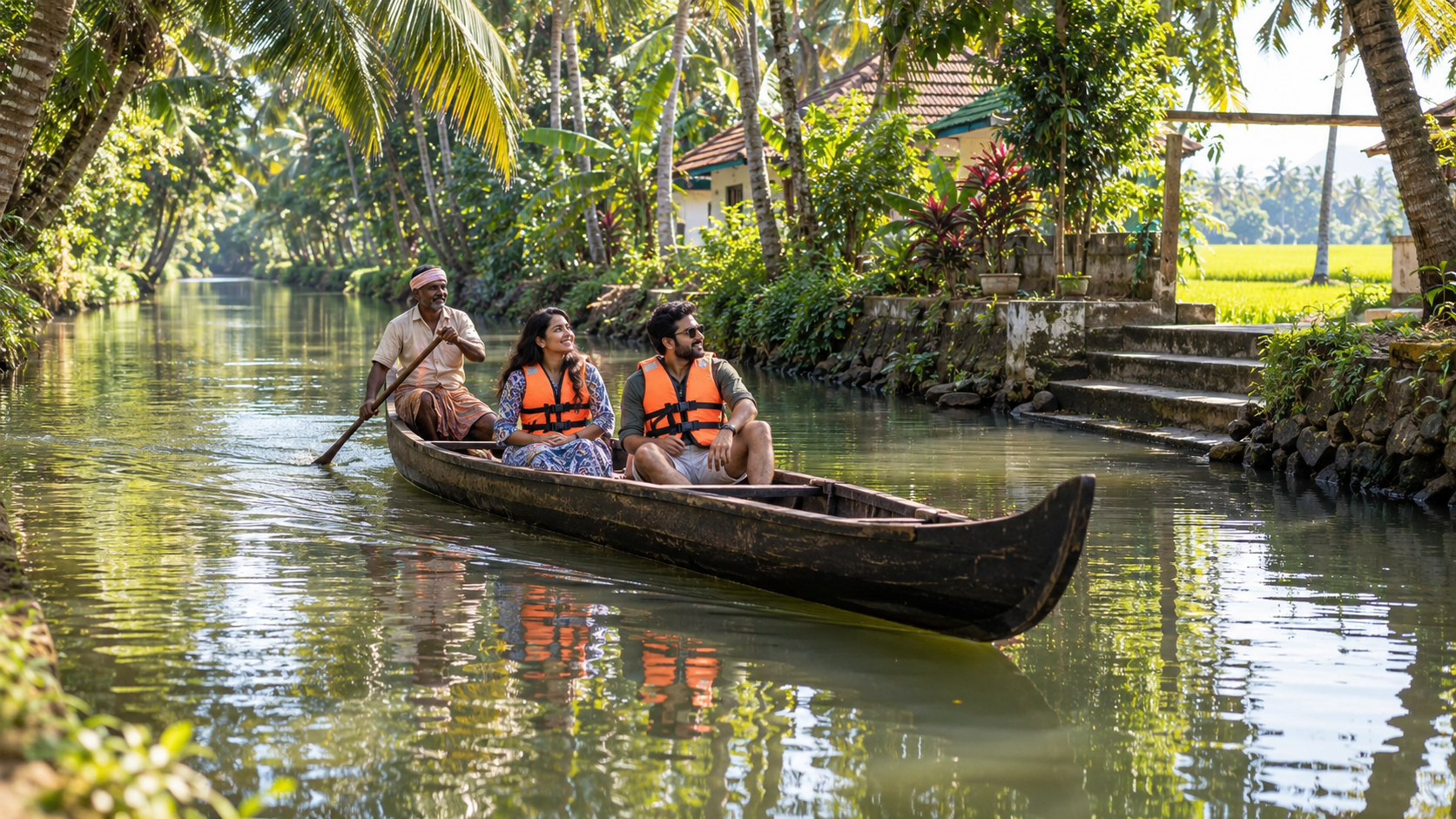
A canoe ride through the narrow canals is one of the best ways to see village life in the backwaters. Small country boats, paddled by local boatmen, can slip into channels too narrow for the houseboats, past homes, paddy fields and small farms, and the quiet of the paddle lets you hear the birds and the sounds of the villages. You'll see coir being made from coconut husks, farmers tending their fields, and families going about their daily lives on the water.

Alleppey is often called the Venice of the East, a name said to have been given by Lord Curzon, the British Viceroy of India, who admired its canals in the early 20th century. Every year, on the second Saturday of August, the town hosts the famous Nehru Trophy Boat Race on Punnamada Lake, when long, sleek snake boats, each rowed by more than a hundred oarsmen, race across the lake to the beat of drums and songs, cheered on by huge crowds lining the shores. If you're here in August, it's an unforgettable sight.

Alleppey is also the centre of Kerala's coir industry, which turns the fibre of coconut husks into rope, mats, carpets and many other products. Coir has been made here for centuries, and in the villages around the backwaters, you can still see women spinning coir yarn by hand, while in the town, small factories weave it into mats and carpets in every colour and pattern. Coir doormats make light, practical souvenirs.

If you'd like to explore further, Alleppey has some fascinating places within easy reach. In Ambalappuzha, about 15 kilometres south, the Sri Krishna Temple is famous for its palpayasam, a sweet rice pudding cooked in milk and offered to the deity every day. At Karumadi, a small black granite statue of the Buddha, known affectionately as Karumadikkuttan, sits beside a canal, believed to be more than a thousand years old. Your driver can take you there in the afternoon, at extra cost.

In the evening, walk on Alleppey Beach and see the old pier. Alleppey was once one of the busiest ports on the Malabar Coast, and the remains of its 19th-century pier still reach out into the sea. The red-and-white striped lighthouse nearby, built in the 1860s, can be climbed for views over the town and the beach. As the sun sets over the Arabian Sea, the beach fills with local families strolling along the sand, and stalls sell roasted peanuts, ice cream and snacks.

For dinner, try some of Alleppey's specialities, such as karimeen pollichathu, pearl spot fish grilled in a banana leaf, a spicy duck roast or prawns in coconut curry, with appam or Kerala rice.

After dinner, sit out by the water and enjoy the peace of the night, with the lamps of the houseboats glowing across the lake and the sounds of frogs and crickets all around. Tomorrow, you'll head south to the beaches of Kovalam, so pack up and get a good night's sleep.

It's the perfect day to do as little or as much as you like, and many travellers say it's the most relaxing day of their whole trip.

Enjoy every slow, sunny minute of it before the next leg of your journey begins.

Included today: morning cruise and breakfast on the houseboat, backwater resort in Alleppey.

Good to know: Ayurvedic treatments and canoe rides are optional and paid locally. The climate in Alleppey is warm and humid, so light cotton clothes, sunscreen and mosquito repellent are useful.

Day 6
Alleppey to Kovalam – To the Beach

Alleppey to Kovalam – To the Beach

⌖ Kovalam 🍽 Meals: Breakfast

Drive south along the coast to Kovalam, near Trivandrum. The journey takes four to five hours, sometimes more with traffic, so we leave after breakfast. The highway runs through a string of busy towns and villages, past coconut groves, churches, temples and markets, with the backwaters and the sea never far away.

The drive south follows National Highway 66, the main coastal road of Kerala, and it gives you a real sense of how densely populated and lively the state is. Towns and villages run into one another, with little open countryside between them, and the road is lined with shops, churches, temples, mosques, schools, markets and colourful houses. Every few kilometres, you'll see a small shrine, a wayside tea shop or a stall selling fresh tender coconuts, and the people are friendly and curious about visitors.

About an hour south of Alleppey, near Kayamkulam, Krishnapuram Palace makes a fascinating stop. Built in the 18th century by Marthanda Varma, the great king of Travancore, it's a fine example of traditional Kerala architecture, with sloping tiled roofs, wooden carvings and cool inner courtyards. Its treasure is the Gajendra Moksham mural, one of the largest murals in Kerala, which shows Vishnu rescuing the elephant king Gajendra from a crocodile, painted in rich natural colours. The palace is closed on Mondays.

Further south, you pass through Kollam, an ancient port that traded with China, Arabia and Rome, and is now the centre of India's cashew industry. Kollam sits on the shores of Ashtamudi Lake, a beautiful lake with eight arms, lined with Chinese fishing nets and coconut palms. Stop for lunch on the way, perhaps at a seafood restaurant in Kollam.

If you'd like a detour, the cliffs of Varkala are just off the highway. Here, red laterite cliffs rise dramatically above a long, golden beach, with a footpath along the top lined with cafés and shops, and freshwater springs flowing from the rock face. The Janardhana Swamy Temple, more than 2,000 years old according to tradition, stands on a hill above the town.

As you approach Trivandrum, you'll notice the city's grand old buildings and leafy avenues, a reminder of its history as the capital of the kingdom of Travancore. You'll come back here tomorrow if you choose the city tour, so today, you skirt the centre and continue to Kovalam, about 16 kilometres south.

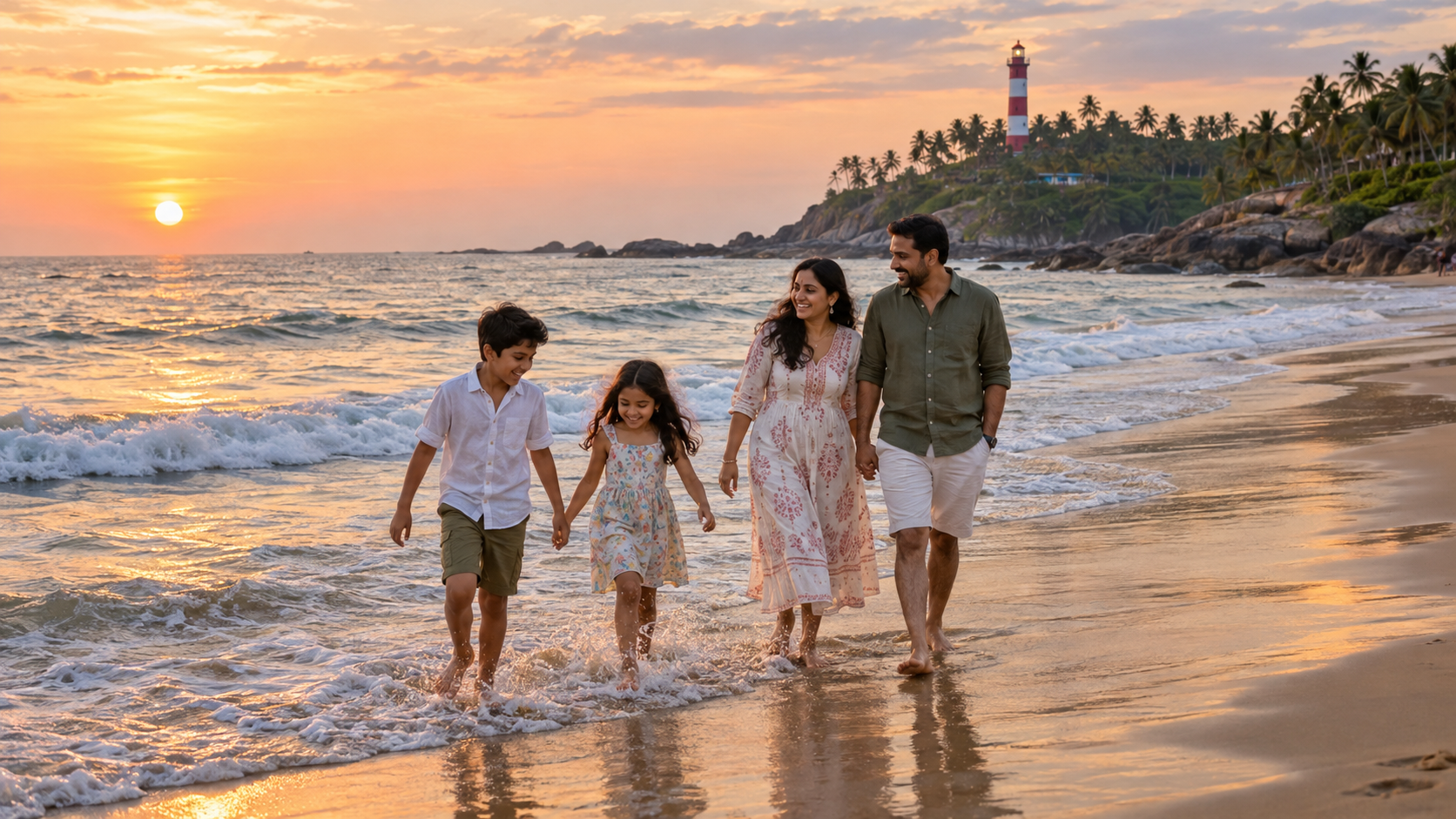
Check in near the beach in the afternoon and spend the evening on the sand: Kovalam's crescent-shaped beaches, Lighthouse Beach and Hawa Beach, are lined with cafés, and the lighthouse gives a fine view at sunset. Kovalam has been one of India's most popular beach resorts since the 1970s, when travellers on the hippie trail discovered its calm, sheltered coves, and today it's a relaxed, friendly place, with palm-shaded promenades, small hotels and restaurants serving fresh seafood.

Kovalam's three beaches each have their own character. Lighthouse Beach, the largest, is the liveliest, with a long promenade of cafés, shops and hotels, while Hawa Beach, just to the north, is smaller and busy with fishermen in the mornings. Samudra Beach, the northernmost, is the quietest, with fewer people and a more local feel. The sea is generally calm in the sheltered coves between October and March, but always swim where the lifeguards are on duty.

Climb the spiral staircase of the red-and-white lighthouse on Kurumkal hill for a magnificent view over the beaches, the fishing boats drawn up on the sand, the rocky headlands and the palm-covered coast stretching away into the distance. Then walk along the beach as the sun sinks into the Arabian Sea.

If you arrive early enough, book an Ayurvedic massage at your hotel to ease away the long drive, or simply sit on your balcony with a cool drink and watch the sea change colour as the evening comes on. Welcome to the beach.

As darkness falls, the beachfront restaurants light up and lay out the day's catch on ice: kingfish, snapper, prawns, lobster, crab and squid. Choose what you'd like and have it grilled with garlic and lime or cooked Kerala-style in coconut and spices, and enjoy your dinner with the sound of the waves.

After dinner, take a last stroll along the beach, with the sound of the waves, the warm breeze off the sea and the beam from the lighthouse sweeping slowly across the dark water. Tomorrow, you can choose between the city and the beach, so decide over dinner which suits you best.

Sleep with the window open and let the sound of the waves carry you off.

Included today: private car from Alleppey to Kovalam, hotel in Kovalam, breakfast.

Good to know: drive 4–5 hours. Entry to Krishnapuram Palace is paid locally. Swim only in the areas marked by lifeguards' flags, as the currents can be strong, especially during the monsoon.

Day 7
Trivandrum Sightseeing or a Beach Day

Trivandrum Sightseeing or a Beach Day

⌖ Kovalam 🍽 Meals: Breakfast

Today is yours to shape. Choose between a full day at the beach and a half-day in Trivandrum, Kerala's capital, about 30 minutes away, and come back to Kovalam in the afternoon either way. Many travellers do a little of both: the city in the cool of the morning, the beach in the afternoon and a seafood dinner by the waves at night. Let your driver know your plans the evening before.

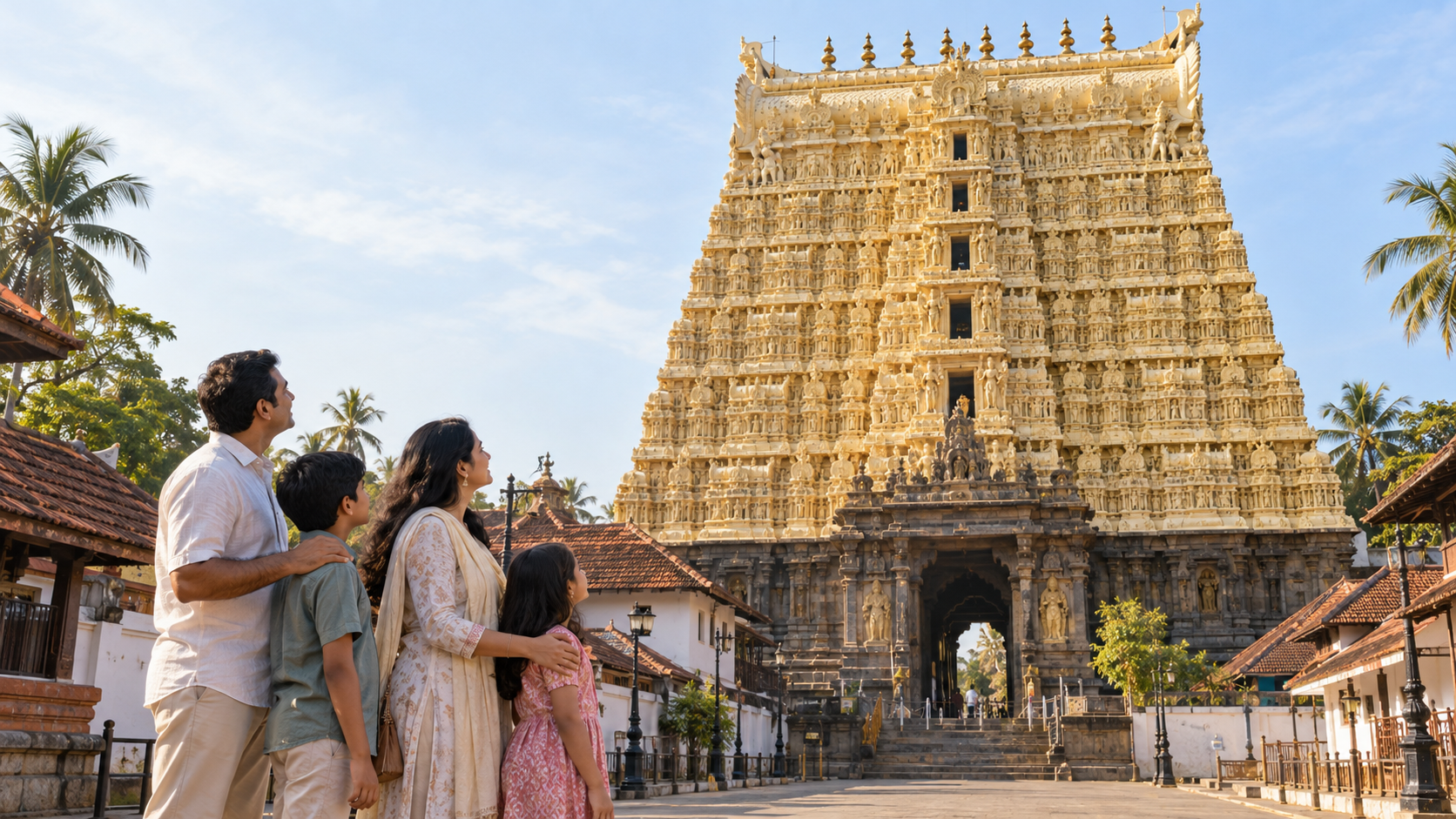
If you choose the city, start early with the Sree Padmanabhaswamy Temple, the spiritual heart of Thiruvananthapuram, whose name means the city of the sacred serpent Anantha. The temple's great gopuram, a seven-tiered tower in the Dravidian style of Tamil Nadu, rises above a large stepped tank in the old fort area, and it's one of the most striking sights in Kerala. Inside, Vishnu reclines on the coils of the serpent Anantha, and the deity is so large that devotees see it through three separate doors. The rulers of Travancore considered themselves servants of Padmanabha, and the kingdom was formally dedicated to him in the 18th century. If you are Hindu, you can join the darshan in the traditional dress the temple requires: for men, a mundu or dhoti and no shirt, and for women, a saree or a long skirt and blouse. Non-Hindus can see the gopuram and the tank from outside, and the streets around the temple, lined with shops selling brass lamps, flowers and sweets, are fascinating to wander.

Right beside the temple, the Kuthiramalika Palace, built in the 1840s by Maharaja Swathi Thirunal, a poet and composer of classical music, is a beautiful example of Travancore architecture, with wooden ceilings, polished floors and carved eaves. Its name, the mansion of horses, comes from the row of 122 wooden horses carved along the brackets under its roof. Part of the palace is a museum, with royal portraits, ivory thrones, weapons, musical instruments and Kathakali figures, and its windows look out over the temple tank. Classical music concerts are held in the courtyard during the Swathi Sangeethotsavam festival each January.

Then visit the Napier Museum, a short drive north, in a leafy park that also holds the city zoo, one of the oldest in India. The museum building, finished in 1880 and named after Lord Napier, the Governor of Madras, is a delightful mix of Kerala, Mughal and European styles, with striped brickwork, pointed gables and carved woodwork. Inside are bronzes, temple carvings, ornaments and a beautifully carved temple chariot. In the same grounds, the Sree Chitra Art Gallery has a superb collection of paintings by Raja Ravi Varma, the 19th-century artist from Kerala who brought Indian gods, goddesses and heroines to life in oil paint, as well as works by Nicholas Roerich and paintings from the Rajput, Mughal and Tanjore schools.

If you choose the beach instead, Kovalam has plenty to fill a lazy day. Start with an early walk along the sand to Samudra Beach, the quieter northern cove, where fishing boats are drawn up on the sand, then spend the morning swimming and sunbathing at Lighthouse Beach or Hawa Beach. Book an Ayurvedic massage at one of Kovalam's many Ayurveda centres, or try a yoga class on the beach.

For a short excursion, the fishing harbour at Vizhinjam, just south of Kovalam, is colourful and busy in the morning, when the boats bring in their catch, and nearby is a small rock-cut cave temple from around the 8th century, with carvings of Shiva. A little further south, Poovar, about half an hour's drive away, is where the Neyyar River meets the sea, and a boat ride through its mangrove-lined backwaters takes you to a golden sand bar between the river and the ocean, a beautiful, peaceful spot.

Come back to Kovalam for a last sunset by the sea. Find a seat at one of the cafés on the promenade, or climb the lighthouse once more, and watch the sun sink into the Arabian Sea as the fishing boats head out for the night, their lights twinkling on the horizon. Then enjoy a last seafood dinner on the beach, choosing from the catch of the day, grilled or cooked Kerala-style with coconut and spices.

Whichever you choose, it's a relaxed day to enjoy the sea, the sun and the gentle pace of life in the south of Kerala, before your journey home tomorrow.

Enjoy your last full day in Kerala to the fullest, and make it exactly the day you want it to be.

Included today: private car for Trivandrum sightseeing (or a free day at the beach), hotel in Kovalam, breakfast.

Good to know: Padmanabhaswamy Temple entry is for Hindus only, with a strict dress code. Kuthiramalika Palace and the Napier Museum are closed on Mondays, and the museum is also closed on Wednesday mornings. Tickets, boat rides and Ayurvedic treatments are paid locally.

Day 8
Departure from Trivandrum

Departure from Trivandrum

⌖ Trivandrum 🍽 Meals: Breakfast

Make the most of your last morning in Kerala. Rise early and walk along the beach as the sun comes up behind the palms, when the sand is cool and quiet, the fishermen are pulling in their nets and the first swimmers are heading into the sea. Enjoy a final morning swim, or join a yoga session on the beach, and then sit down to a slow breakfast with a view of the sea: perhaps fresh fruit, idli and dosa with coconut chutney, or a Kerala breakfast of appam and stew.

Kovalam has a long history as a place of rest and recreation. In the 1920s, Maharani Sethu Lakshmi Bayi of Travancore built a summer palace, Halcyon Castle, on the headland above the beach, and later, in the 1970s, Kovalam became famous with travellers on the hippie trail, who came for its calm coves, its seafood and its relaxed way of life. Today, it's one of the best-known beach destinations in India, but it keeps much of the easy-going charm that drew those early visitors.

If you have time before your flight, pick up a few last souvenirs. The shops along Kovalam's beach and in Trivandrum sell Kerala handicrafts: brass oil lamps, wooden elephants, Kathakali masks, coconut-shell carvings and handwoven kasavu sarees and mundus in cream and gold. Spices, tea, coffee, cashews and banana chips from the bakeries of Trivandrum make good gifts too, and the city's sweet shops sell halwa in every colour.

If you have a few hours to spare in Trivandrum before an evening flight, the city has other sights worth seeing. The Kerala Legislative Assembly building, the old Secretariat with its grand colonnaded facade, and the Kanakakunnu Palace, set in wooded grounds, are all reminders of the city's royal past, and the Chalai Bazaar, near the Padmanabhaswamy Temple, is the city's oldest market, crowded with shops selling spices, brass, textiles, flowers, vegetables and household goods. A quick walk through it is a lively, colourful way to end your trip.

For a last taste of Kerala, stop at one of Trivandrum's well-known restaurants for a full Kerala sadya, a vegetarian feast served on a banana leaf, with rice, sambar, rasam, avial, thoran, olan, pachadi, pickles, pappadam and two or three kinds of payasam to finish. It's the meal Keralites serve at weddings and festivals, and the perfect way to say goodbye.

If you're leaving in the afternoon or evening, consider a short stop at Shanghumugham Beach, right beside the airport, a broad city beach where Trivandrum's families come to stroll in the evening. It's known for its huge reclining mermaid, the Jalakanyaka, a sculpture by the artist Kanayi Kunhiraman, which stretches along the grass above the sand. On a clear evening, the sunset here is lovely, and you can watch the planes taking off over the sea.

Before you leave, take a moment to say goodbye to your driver, who has looked after you all the way from Kochi. Over eight days, many guests come to feel that their driver is part of the trip, sharing stories, local knowledge and favourite places along the way, and a tip at the end of the tour is a welcome way to say thank you for his care.

Your driver takes you to Trivandrum airport or railway station, about 30 minutes away. Trivandrum's airport is close to the city and easy to reach, but traffic can be heavy at times, so leave plenty of time. Check which terminal your flight leaves from before you set off, and keep your tickets, passports and hotel bills handy.

Looking back on your eight days, you'll have travelled from the misty tea gardens of Munnar to the quiet meadows and pine forests of Vagamon, from a night on the backwaters of Alleppey to the golden beaches of Kovalam and the temples and palaces of Trivandrum. It's a journey that shows the many faces of Kerala: the cool green hills, the peaceful waters, the warm sea and the welcoming people who make it so special.

Our team will stay in touch until you're home safely, and we're always just a call or a WhatsApp message away. Thank you for travelling with Dreamland Vacations, and we hope to welcome you back to Kerala again soon, perhaps for Kanyakumari, the waterfalls of Athirapilly or the temple town of Guruvayur next time.

Safe travels, and until next time. We hope Kerala has given you memories to treasure, and that you'll share them with family and friends when you're home.

From all of us at Dreamland Vacations, thank you, and goodbye for now. We look forward to planning your next journey.

Included today: private car to Trivandrum airport or railway station, breakfast.

Good to know: drive about 30 minutes. Book a flight that leaves at least 3 hours after you reach the airport.

Hotel confirmation

Hotel names will be provided after booking, subject to availability and confirmation. We do not hold hotel confirmations before booking.

Inclusions

  1. 6 nights in hotels or resorts of your chosen category (2 in Munnar, 1 in Vagamon, 1 in Alleppey, 2 in Kovalam), with daily breakfast
  2. 1 night on a private houseboat, with lunch, dinner and breakfast on board
  3. A private sedan, SUV or tempo traveller with an English- or Hindi-speaking driver for all 8 days, including fuel, tolls, parking and driver allowance
  4. Pickup at Kochi airport or railway station and drop at Trivandrum airport or railway station
  5. All sightseeing and transfers listed in the itinerary

Exclusions

Not included: flights or trains, entry tickets (Eravikulam National Park, Tea Museum, museums and palaces in Trivandrum), meals other than breakfast and houseboat meals, Ayurvedic treatments, canoe rides and personal expenses.

Important Terms

These terms apply to every Kerala tour package booked with Dreamland Vacations LLP ("we", "us"). By paying the advance, you ("the guest") accept them on behalf of everyone named in the booking.

1. Quotes and availability

1.1 Quotes are valid for 3 days and are subject to availability until the booking is confirmed. Hotel and houseboat prices change often, especially for December and January travel.

1.2 Hotels named in a quote are our first choice. If one is unavailable when you book, we'll offer a hotel of the same category and tell you before confirming.

2. Booking and payment

2.1 Once we confirm availability, pay 30% of the total package cost to confirm your booking. Your booking is confirmed only when we have received this payment and sent you a written confirmation with hotel names.

2.2 Full payment is due 30 days before your travel date. If it is not received by then, we may treat the booking as cancelled by you, and the charges in section 4 apply.

2.3 For bookings made within 30 days of the travel date, pay 30% to book, and the balance as soon as your booking is confirmed.

2.4 We accept payment by bank transfer, UPI or our online payment link, with no extra charge for paying online.

3. Prices

3.1 Prices are per person, based on two adults sharing a room, unless the quote says otherwise. GST is charged extra at the rate applicable on the invoice date.

3.2 Child rates apply to children aged 5 to 11 sharing their parents' room. Children under 5 travel free without an extra bed, subject to hotel policy.

3.3 Hotels add compulsory gala-dinner charges for 24 and 31 December. These are not included unless the quote says so and are payable at the time of booking.

3.4 Once confirmed, the package price is fixed, except for changes in government taxes, park fees or fuel surcharges imposed after booking.

Cancellation by you

4.1 Cancellations must be sent by email to info@dreamlandvacations.com. The charges below are counted from the day we receive your email, in Indian time.

4.2 Bookings for travel between 20 December and 5 January, and any hotel, resort or houseboat we have told you is non-refundable, cannot be refunded once confirmed, whatever the cancellation date.

4.3 Flights and train tickets booked through us follow the airline's or railway's own cancellation rules, plus our service fee of Rs 500 per ticket.

4.4 GST already paid is not refundable.

4.5 We recommend travel insurance that covers cancellation, as these charges apply whatever the reason for cancelling, including illness.

5. Changes by you

5.1 One change of travel dates is free if requested 31 or more days before the original arrival date, provided the new dates are within the same season and the hotels are available. You pay any difference in price.

5.2 Date changes requested within 30 days of arrival are treated as a cancellation and a new booking.

5.3 Other changes, such as upgrading a hotel, adding a night or adding a houseboat, are possible at any time, subject to availability and the price difference.

5.4 Changing the name of a traveller is free up to 7 days before arrival.

6. Refunds

6.1 Refunds are made to the original payment method within 21 working days of the cancellation, after deducting the charges in section 4.

6.2 There is no refund for any service you don't use once the tour has started, including meals, sightseeing, a missed houseboat check-in or leaving early. If you leave early, we'll try to cancel later bookings and pass on whatever the hotels or suppliers refund to us.

7. Changes by us

7.1 If we must change a confirmed hotel, we'll replace it with one of the same or a higher category at no extra cost, and tell you as soon as we know.

7.2 If we have to cancel your tour for any reason other than those in section 8, you can choose a full refund of what you have paid or a different tour of equal value.

8. Events beyond our control

8.1 Heavy rain, landslides, floods, strikes and hartals, road closures, government orders, park closures and similar events can disrupt travel in Kerala, especially in the hills during the monsoon.

8.2 If such an event affects your tour, we'll arrange the best available alternative, such as a different route, hotel or sightseeing. Any extra costs are payable by you, and we'll refund only what the hotels and suppliers refund to us for services not used.

8.3 Houseboat cruising may be shortened or stopped in bad weather or under local regulations. Periyar boating and Eravikulam National Park can close without notice. These are not grounds for a refund of the package.

9. Our responsibility

9.1 We arrange hotels, houseboats, transport and sightseeing through independent suppliers. We take care to choose them well, but we are not responsible for loss, injury, damage, delay or illness caused by their acts or omissions, or by you.

9.2 Please look after your own belongings. We're not responsible for lost or stolen items.

9.3 Wildlife sightings, weather and views cannot be guaranteed.

10. Travel notes

10.1 Every guest must carry a valid government photo ID (Aadhaar, passport, driving licence or voter ID). Foreign nationals need a valid passport and Indian visa. Hotels may refuse check-in without ID.

10.2 Hotel check-in is usually 2 pm and check-out 11 am or 12 noon. Early check-in and late check-out depend on availability and may be charged.

10.3 The vehicle is for the itinerary as booked. Drives beyond it, or after 8 pm, may cost extra. Drivers may switch off the air-conditioning on steep hill roads.

10.4 Houseboats moor for the night at a fixed time under local rules. Air-conditioning on Deluxe boats usually runs at night only.

10.5 Behaviour that endangers others or breaks the law may lead to the tour being ended without refund.


Good to Know

  1. Eravikulam National Park closes for a few weeks each year between February and April for the Nilgiri tahr calving season. On those dates we replace it with Top Station or extra time at the tea estates.
  2. The Tea Museum and Trivandrum's museums are closed on Mondays. Plan Day 7 for another day of the week if you want to see them.
  3. Sree Padmanabhaswamy Temple is open only to Hindus. Men wear a mundu (dhoti) with no shirt, and women a saree or long skirt; dhotis can be hired near the entrance.
  4. The sea at Kovalam is rough in the monsoon (June to September). Swim only where lifeguards are on duty and flags allow.
  5. Hill roads to Munnar and Vagamon are narrow and winding. Carry motion-sickness tablets if anyone in your group needs them.

Best Time for This Tour

October to March is the best time for this tour. The hills are green and fresh after the rains, the backwaters are calm, and the sea at Kovalam is at its best for swimming. December and January are the busiest months, so book early. Vagamon and Munnar stay pleasant in April and May, when the coast is hot. In the monsoon the hills are misty and beautiful, but the beach days are less reliable. Our guide to the best time to visit Kerala has month-by-month detail.

Make It Your Own

  1. Add Thekkady: spend a night at the Periyar Tiger Reserve between Vagamon and Alleppey; it is only about two hours from Vagamon.
  2. Return to Kochi instead: skip Kovalam and follow our Kerala 7 Days Itinerary, which ends back in Kochi.
  3. Go further south: see the sunrise at Kanyakumari with our Kerala & Kanyakumari tour.
  4. Upgrade the hotels: choose 3-star, 4-star or 5-star, place by place, and a Premium or Luxury houseboat.
  5. On honeymoon? Vagamon's quiet and Kovalam's beaches suit couples well. See our Kerala honeymoon packages.
  6. Travelling with family? We'll pick hotels with pools and family rooms. See our Kerala family tour packages.

Get a free quote for this tour

More Kerala Tours

  1. Kerala 7 Days Itinerary: Munnar, two nights in Thekkady and a houseboat, back to Kochi
  2. Kerala & Kanyakumari (7 days): the hills and backwaters, then Kanyakumari's sunrise and Kovalam
  3. Athirapilly to Kovalam (9 days): our longest Kovalam tour package, starting at Kerala's biggest waterfall

See all our Kerala tour packages.

Get a free quote for this tour

Vagamon Tour Package with Munnar, Alleppey & Kovalam – 8 Days FAQs

Where is Vagamon, and why visit?
Vagamon is a small hill station on the border of Idukki and Kottayam districts, about four hours from Munnar and three from Alleppey. It is much quieter than Munnar, with open meadows, a pine forest and gentle walks rather than busy viewpoints. A night here breaks up the journey from the hills to the backwaters.
Why visit both Munnar and Vagamon?
They look and feel different. Munnar is the classic tea country, with national-park wildlife and plenty to see. Vagamon is open grassland and pine trees, with fewer crowds. Together they give you two contrasting days in the hills before the backwaters and the beach.
Why does this tour end in Trivandrum?
Kovalam is about 30 minutes from Trivandrum airport but four to five hours from Kochi. Flying out of Trivandrum saves you a long last-day drive. If you need to fly out of Kochi, we can arrange the drive back on Day 8, but plan for a late flight.
Is the sea at Kovalam safe for swimming?
From October to March the sea is usually calm enough for swimming at Lighthouse Beach and Hawa Beach. Always swim where lifeguards are on duty and follow their flags. In the monsoon months, the sea is rough and swimming is not advised.
Can everyone visit the Padmanabhaswamy Temple?
No. Entry is only for Hindus, and there is a strict dress code: a mundu (dhoti) and no shirt for men, and a saree or long skirt for women. Non-Hindu travellers can see the temple tower from outside and spend the time at the museums nearby.
Is this tour good for families and senior travellers?
Yes. Every drive except the one to Kovalam is under about four hours, there are two slow days by the water, and we can choose hotels with lifts, pools or ground-floor rooms. The Eravikulam visit involves some uphill walking, which we can shorten.
Gallery

Kerala photos: Vagamon Tour Package with Munnar, Alleppey & Kovalam – 8 Days

Plan your Kerala holiday with Dreamland Vacations

Share your dates, travellers and comfort preference. Our team will guide you with the next best step.

Get a free quote
Itinerary Get a quote
WhatsApp