Guruvayur Tour Package with Munnar, Thekkady & Alleppey – 7 Days
Standard Package

Guruvayur Tour Package with Munnar, Thekkady & Alleppey – 7 Days

Guruvayur darshan, Munnar, Thekkady, an Alleppey resort and a houseboat. 7 days, round trip from Kochi.

⌖ Kerala, India ✦ Family & senior friendly planning
Package snapshot
DestinationKerala
Travel styleStandard Package

Want to customize this package?

Share your dates and travellers. This enquiry is free. Small changes to a standard itinerary—such as a date change or an extra day—can be discussed with our team.

We’ll send verification codes to your WhatsApp number and email. Indian numbers can be entered without +91; for other countries, include the country code.
Verification required before submitting.
Your holiday

Guruvayur Tour Package with Munnar, Thekkady & Alleppey – 7 Days: overview

Begin with a blessing, then see the best of Kerala

Picture the first morning of your holiday: the sound of conch shells and temple drums, oil lamps glowing on the great lamp tower, and thousands of devotees in white and gold moving towards the shrine of Guruvayurappan. This Guruvayur tour package begins with darshan at the Sri Krishna Temple in Guruvayur, one of the most sacred Krishna temples in India, and a visit to Punnathur Kotta, where the temple's elephants are cared for under the trees, before it carries you on through the most beautiful landscapes of Kerala.

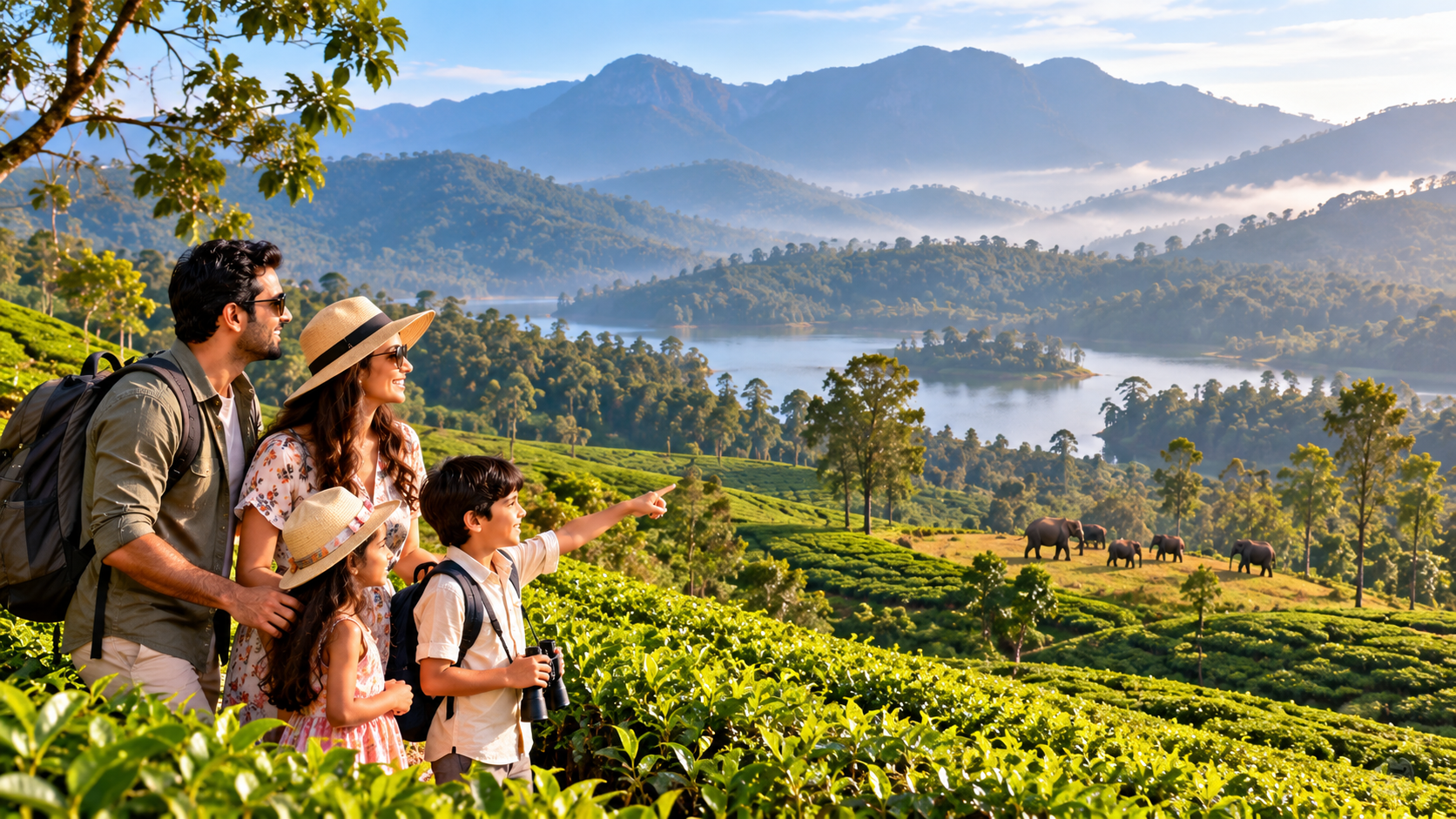
From Kochi, you climb into the Western Ghats for two nights in Munnar, with roadside waterfalls, a spice garden, Eravikulam National Park and its rare Nilgiri tahr, the Tea Museum and the lakes along the Mattupetty road. Then you drive through the cardamom hills to Thekkady for a boat ride on Periyar Lake, watching for elephants, gaur and sambar deer at the water's edge, and an evening of Kathakali or Kalaripayattu. In Alleppey, you slow right down: a night at a lakeside resort, then a night on your own private houseboat, drifting through the backwaters past paddy fields and villages with meals cooked on board.

It's 7 days, round trip from Kochi, with a private car and driver throughout, and time for Fort Kochi before you fly home. It's a lovely choice for families and senior travellers who want a pilgrimage and a holiday in one.

Compare all our Kerala tour packages, see our Kerala family tour packages, or check the best time to visit Kerala.

From Ashok's travels

I first travelled through Kerala in the 1990s, by train to Kochi and bus to Kanyakumari, and I keep going back. It is even greener than Goa. Give Kochi a full day, walk the Munnar tea gardens, try a Kerala massage in Thekkady, and don't miss a night on a houseboat in Alappuzha.

Ashok Saini, Founder, Dreamland Vacations

Good to know

Package typeStandard Package
Planning supportSmall changes by enquiry
Best forFamilies, couples & seniors
Get a free quote
Trip highlights
✦ Guruvayur Darshan from Kochi
✦ Kochi to Munnar – Into the Western Ghats
✦ Munnar – Tea Country
✦ Munnar to Thekkady – Periyar Wildlife
✦ Thekkady to Alleppey – Lakeside Resort
✦ A Night on an Alleppey Houseboat
Day-wise plan

Kerala itinerary: day by day

Day 1
Guruvayur Darshan from Kochi

Guruvayur Darshan from Kochi

⌖ Kochi

Your Kerala journey begins with a blessing. Your driver meets you at Kochi airport or Ernakulam railway station and drives you north to Guruvayur, about two and a half hours away, through the green countryside of central Kerala: coconut groves, paddy fields, small towns with tiled-roof houses and busy markets, and temples, churches and mosques side by side along the road. As you approach Guruvayur, the roads fill with pilgrims, many of them families who have travelled from across India, and stalls selling flowers, lamps, sandalwood paste and devotional pictures line the streets.

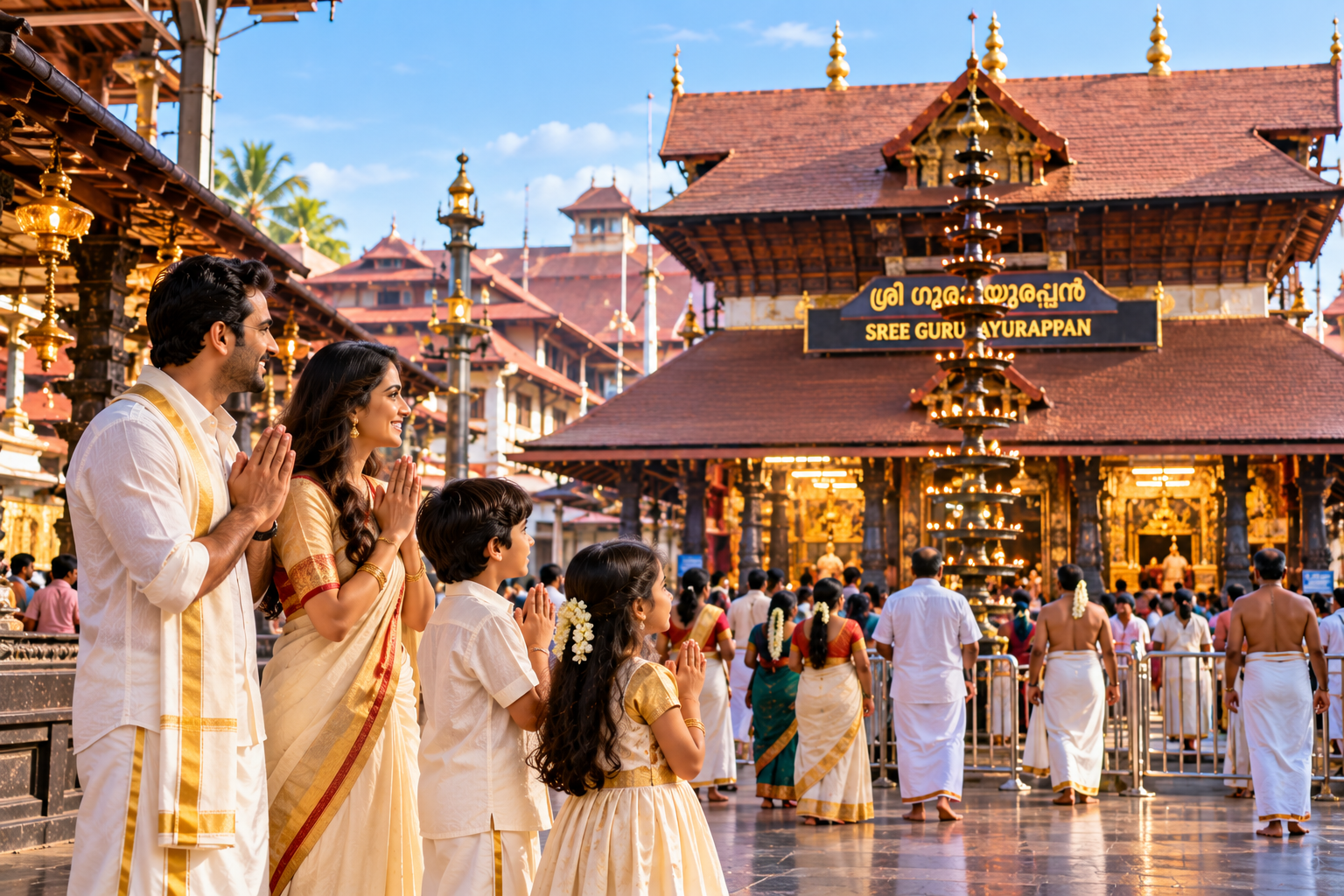
The Sri Krishna Temple, often called the Dwarka of the South, draws pilgrims from across India, and the temple town buzzes with devotion from early morning. It's one of the most important Krishna temples in the country, also known as Bhuloka Vaikuntham, the abode of Vishnu on earth. According to tradition, the idol of Guruvayurappan, Krishna in his four-armed form, was worshipped by Krishna himself in Dwarka, and after Dwarka was swallowed by the sea, it was carried here by Guru, the teacher of the gods, and Vayu, the god of the wind, which is how the town got its name. The temple's rituals follow traditions laid down centuries ago by the great teacher Adi Shankaracharya, and the day begins long before dawn, at 3 AM, with the first darshan of the deity.

Join the darshan in the traditional dress the temple requires: for men, a mundu, the white Kerala wrap, without a shirt, and for women, a saree, or a salwar kameez with a long skirt-like dupatta, depending on current rules. Entry to the temple is for Hindus only. Inside, the atmosphere is deeply devotional: the sound of conch shells and drums, the glow of hundreds of oil lamps on the great lamp tower, the scent of sandalwood and jasmine, and the chanting of thousands of devotees. Many families come here to perform a thulabharam, a traditional offering in which a devotee is weighed on a great scale against bananas, sugar, coconuts or other goods, which are then given to the temple. Guruvayur is also one of the most popular wedding venues in Kerala, and on auspicious days, hundreds of couples are married in quick succession in front of the temple, a joyful, colourful sight.

The temple is also closely linked to Kerala's arts and literature. In the 16th century, the poet Melpathur Narayana Bhattathiri composed the Narayaneeyam, a famous Sanskrit hymn to Krishna, here, and the classical dance-drama Krishnanattam was created for the temple. During the festival of Guruvayur Ekadasi in November or December, the town fills with music, with great Carnatic music concerts held in honour of Krishna.

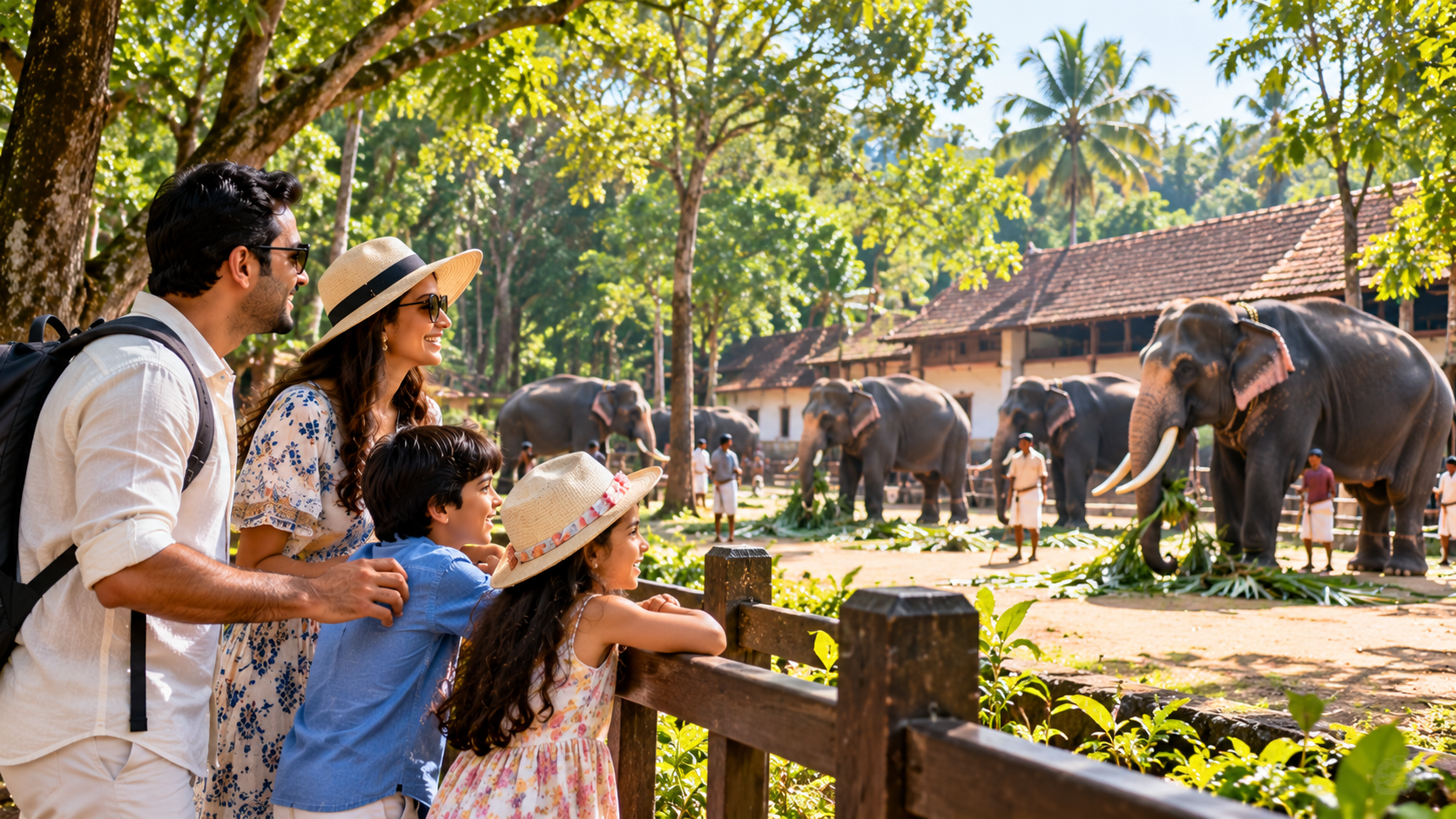
Afterwards, visit Punnathur Kotta, an old palace compound that is home to dozens of temple elephants, which you can watch from a distance. Elephants have been offered to Guruvayur temple by devotees for generations, and the temple now looks after one of the largest herds of captive elephants in the world. At Punnathur Kotta, also known as Anakotta, the elephant fort, you can see the great animals being bathed, fed and cared for by their mahouts under the shade of tall trees. The most famous of them, Guruvayur Keshavan, was so loved by devotees that a statue was raised in his memory.

Before leaving Guruvayur, many pilgrims also visit the Mammiyur Mahadeva Temple, a short walk away. Tradition holds that a visit to Guruvayur is complete only after praying at Mammiyur, where Shiva is worshipped, and the smaller, quieter temple is a peaceful contrast to the crowds at the main shrine. For lunch, try a simple vegetarian meal at one of the restaurants near the temple, served on a banana leaf: rice, sambar, rasam, avial (mixed vegetables in coconut and yogurt), thoran (vegetables stir-fried with grated coconut), crisp pappadam, pickles and a sweet payasam to finish. It's a good introduction to the food you'll enjoy all week.

Drive back to Kochi in the afternoon for the night. As the light softens over the paddy fields and palms, you'll reach your hotel in time to relax. If you have energy, take a stroll along Marine Drive, Ernakulam's waterfront promenade, as the lights of the harbour come on.

On the way back, the road passes through Thrissur district, the cultural heart of Kerala, home to the great Vadakkunnathan Temple and the spectacular Thrissur Pooram festival in April or May, when caparisoned elephants and hundreds of drummers fill the temple grounds. Even if you don't stop, your driver will happily point out the landmarks and tell you about life in this part of Kerala.

Included today: pick-up at Kochi airport or railway station, private car to Guruvayur and back to Kochi, hotel in Kochi.

Good to know: about 5 hours of driving in total. Entry to the Sri Krishna Temple is for Hindus only, and the dress code is strictly followed. Queues can be long on weekends, holidays and auspicious days, and the temple closes for some hours in the afternoon. Mobile phones and cameras aren't allowed inside. Breakfast on arrival day isn't included.
Day 2
Kochi to Munnar – Into the Western Ghats

Kochi to Munnar – Into the Western Ghats

⌖ Munnar 🍽 Meals: Breakfast

After breakfast, head east into the hills, past rubber plantations and cardamom forest. Today you travel from the coast to the cool, misty tea country of Munnar, about four hours away, and the journey shows you how quickly Kerala's landscapes change.

Leaving Kochi, you pass through the green farmland of Ernakulam district, with its paddy fields, coconut groves and small towns, and then cross the Periyar, Kerala's longest river, at Neriamangalam on a graceful old stone bridge built in the 1930s. From here, the road winds up into the Western Ghats, the great mountain range that runs down the western side of India and is one of the richest areas of biodiversity on earth. Rubber plantations give way to cardamom and pepper, grown in the shade of tall forest trees, and the air becomes cool and fresh.

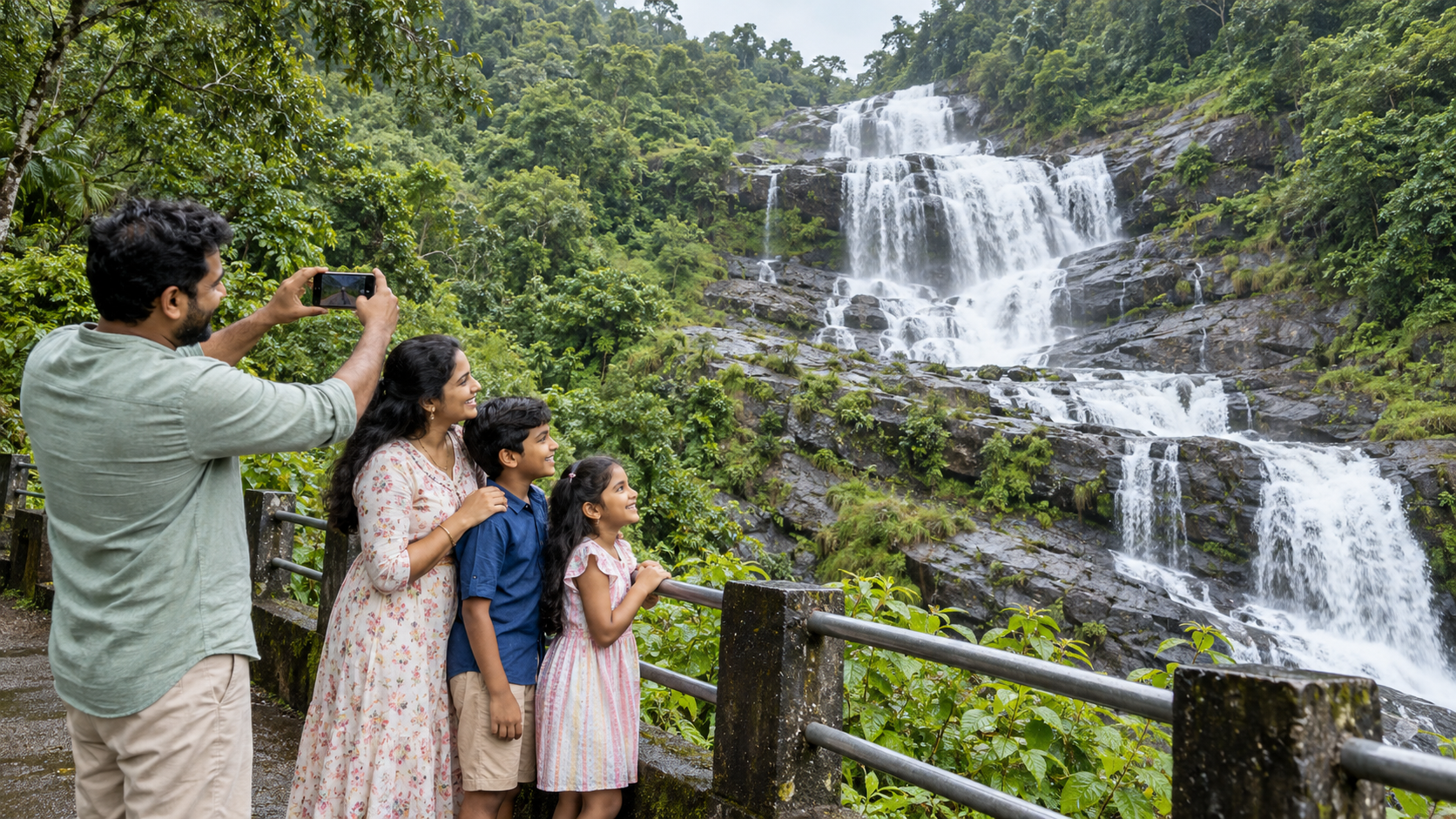
Stop at the Cheeyappara and Valara waterfalls beside the road. Cheeyappara tumbles down a rocky hillside in seven steps, white water against dark stone and green forest, and Valara, a few kilometres further on, plunges into a deep, wooded gorge. Both are at their fullest after the monsoon, and stalls nearby sell tea, roasted corn and fresh fruit. Then stop at a spice garden to see pepper, cardamom and cinnamon growing, along with cloves, nutmeg, vanilla and coffee. Your guide will explain how Kerala's spices drew traders from Rome, Arabia, China and Europe to this coast for more than two thousand years.

Along the way, the road passes through Adimali, a busy market town at the meeting point of several hill roads, where you can stop for lunch. Try a Kerala meal of rice with fish curry or chicken, or a plate of porotta, the layered flaky bread, with spicy beef or vegetable curry, and a glass of strong, sweet tea. After Adimali, the road climbs steadily, and the first tea estates appear on the slopes above you, the bushes trimmed into neat, flat-topped rows that follow every curve of the hills.

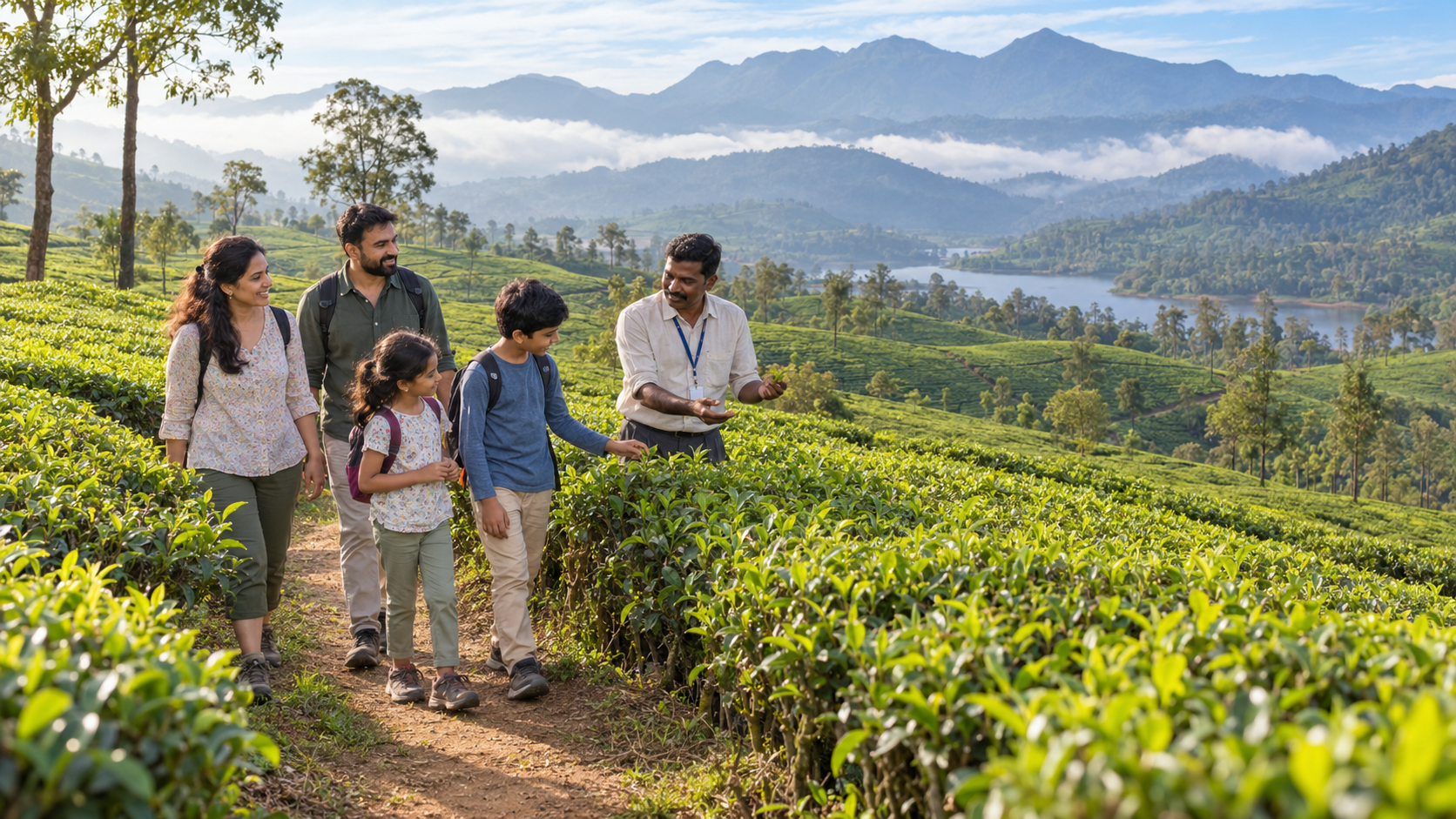
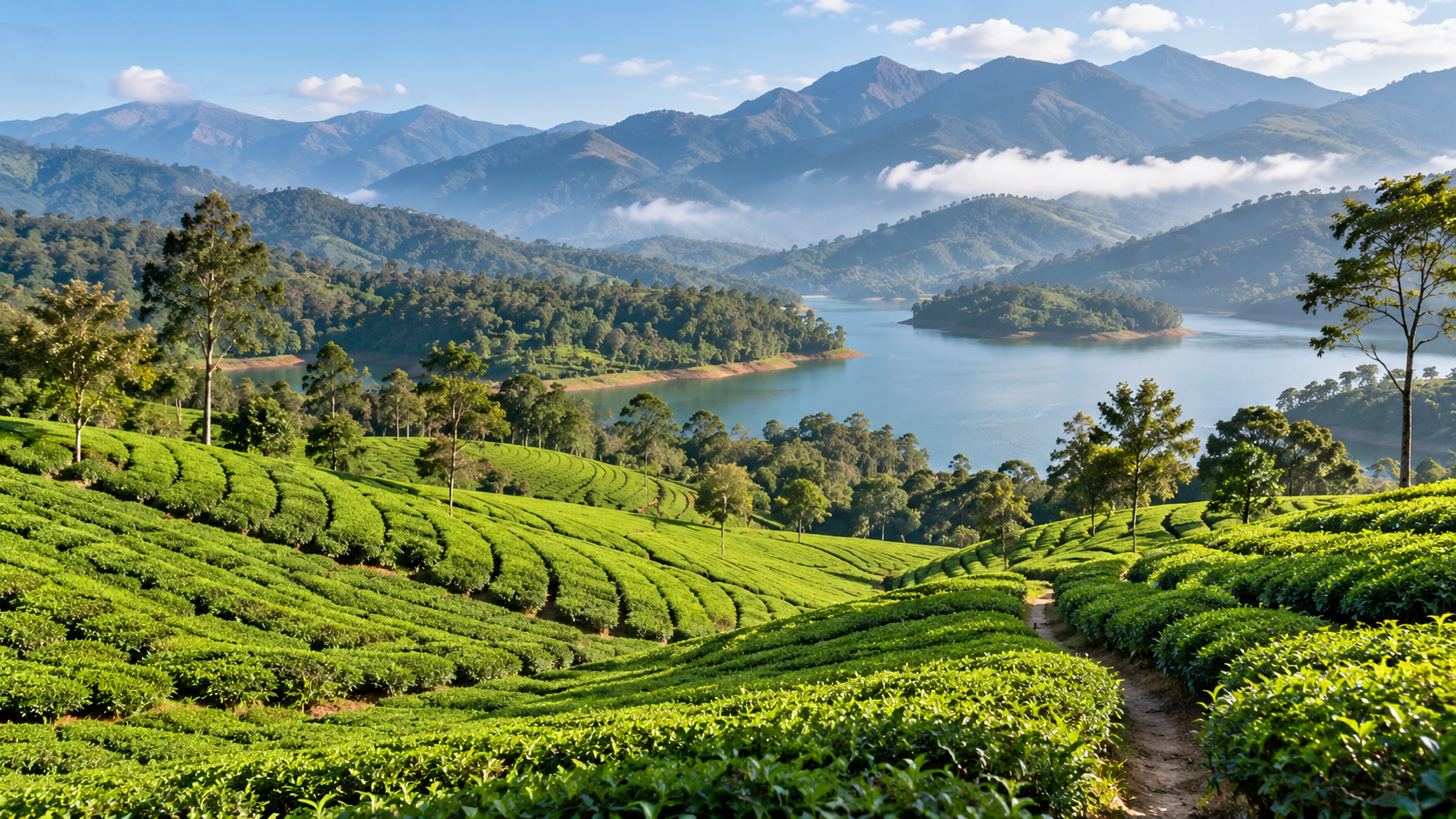
Tea estates cover the slopes as you near Munnar, where you check in by mid-afternoon and enjoy the cool evening air. The tea gardens are one of the most beautiful sights in India: soft, rounded rows of tea bushes covering every slope, with narrow paths winding between them, silver oaks standing above, and tea pickers moving slowly along the rows with baskets on their backs. Munnar sits about 1,600 metres above sea level, where three mountain streams meet, and its name means "three rivers" in Malayalam. British planters developed it in the late 19th century as the heart of a great tea-growing region, and it's been a favourite hill station ever since.

The tea pickers, mostly women, work their way through the bushes plucking the top two leaves and a bud by hand, the finest part of the plant, and drop them into the baskets on their backs. Many of their families came from Tamil Nadu generations ago to work on the estates, and you'll hear Tamil spoken alongside Malayalam in the estate villages, with their neat rows of workers' houses, small temples and schools. Ask your driver to stop at one of the viewpoints near Munnar, where you can walk a few steps into the estate and take photos of the patchwork of tea, forest and mist.

Your hotel in Munnar will be set among the hills, and many rooms look out over tea estates or forested valleys. Munnar's weather is the reason it became a hill station: while the coast is warm and humid, the hills stay pleasantly cool through the year, with daytime temperatures of around 15 to 25°C, and colder nights in December and January, when mornings can drop close to freezing on the highest estates. The monsoon, from June to September, brings heavy rain and thick mist, and the hills turn an even deeper green, with waterfalls pouring down every slope.

As evening falls, wrap up in a jacket, enjoy a cup of fresh Munnar tea on your balcony and watch the mist settle into the valleys. If you'd like to go out, Munnar town has a small market, shops selling tea, spices, homemade chocolates and warm shawls, and simple restaurants serving Kerala and North Indian food.

Munnar's air is fresh and clean, the evenings are quiet, and the silence of the hills, broken only by birdsong and the wind in the eucalyptus trees, is a welcome change after the bustle of the plains. Dinner tonight is at your hotel or in town. It's a good night for an early rest, as you'll want to be up early tomorrow for Eravikulam.

Included today: private car from Kochi to Munnar with stops at Cheeyappara and Valara waterfalls and a spice garden, hotel in Munnar, breakfast.

Good to know: drive about 4 hours. Lunch is at your own cost. Evenings in Munnar can be cold from November to February, so pack a warm layer.

Day 3
Munnar – Tea Country

Munnar – Tea Country

⌖ Munnar 🍽 Meals: Breakfast

Start the day with an early breakfast at your hotel and a cup of fresh tea, then drive about 15 kilometres to the entrance of Eravikulam at Fifth Mile. Get there before 9 AM to beat the queues, as the park is very popular, especially on weekends and holidays, and the number of visitors each day is limited. From the ticket counter, a forest department bus takes you up a narrow, winding road through the tea estates to Rajamala, where the walking path begins. Walk slowly along the path as it climbs gently along the hillside, with sheer rock faces above you and the valleys below. Mist often drifts across the slopes in the morning, and when it lifts, the views are breathtaking.

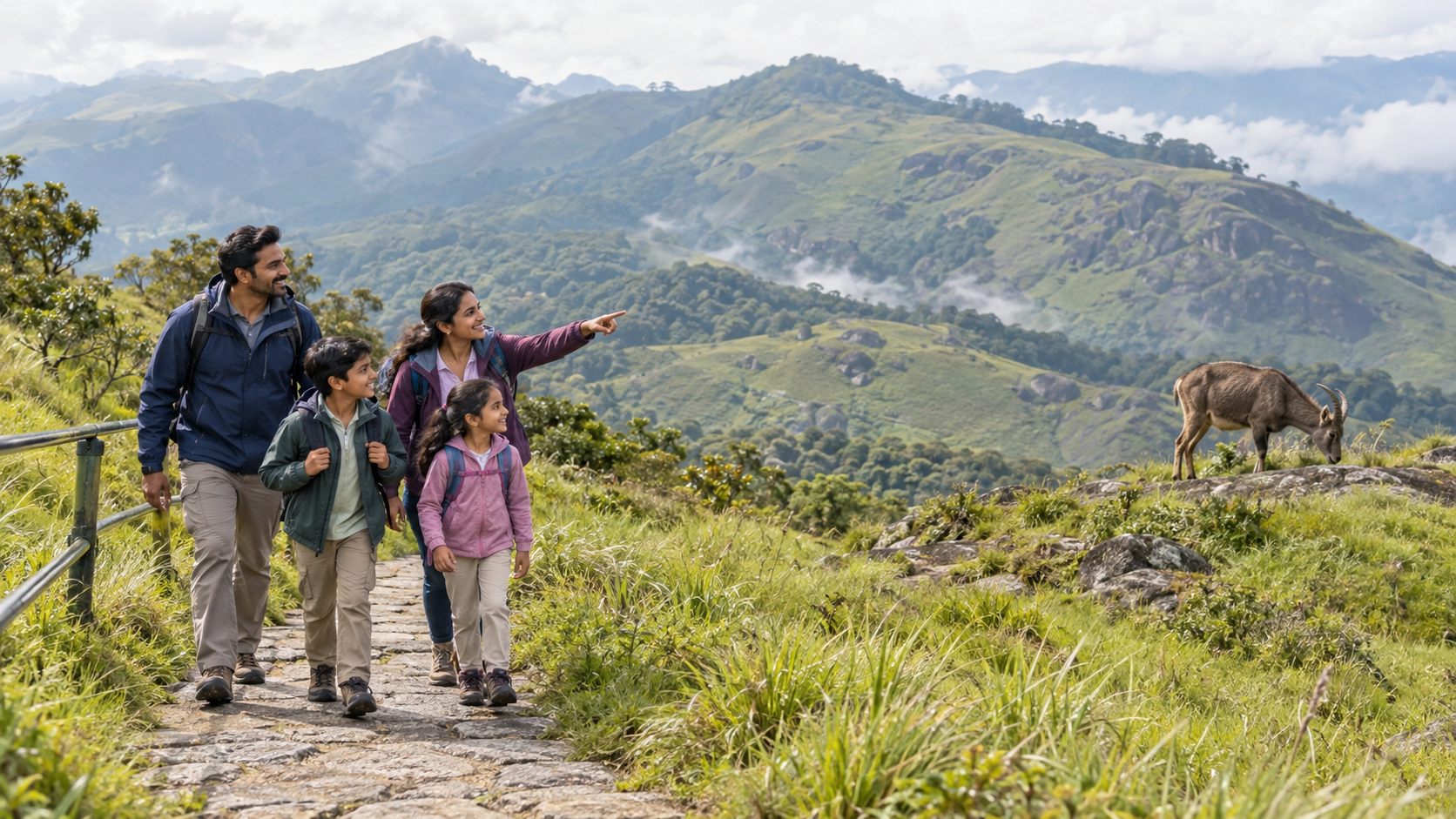
Visit Eravikulam National Park when it opens at 9 AM and take the park bus up to the grasslands, home of the Nilgiri tahr, a mountain goat found only in these hills. The park protects a high plateau of rolling grassland and shola forest around Anamudi, at about 2,695 metres the highest peak in South India. The tahr, sturdy and short-horned, with thick brown coats, were once hunted almost to extinction, but under protection they've recovered, and today they graze calmly beside the walking path, often just a few metres away. The views across the valleys and tea estates far below are some of the finest in Kerala, and on clear mornings, they stretch for miles. The park is also famous for the Neelakurinji, a shrub that flowers only once every twelve years, turning the hills a soft blue-purple; the next great flowering is expected around 2030.

Next, the Tea Museum shows how tea is made, with a tasting to finish. Set in an old factory, it tells the story of Munnar's tea from the 1880s, when the first planters cleared the forests, through old photographs, documents and machines. You'll see fresh green leaves being withered, rolled, oxidised, dried and graded, and then taste the finished tea, bright and brisk from the high slopes.

After the Tea Museum, have lunch in Munnar town, and if you have time, visit the CSI Christ Church, built by British planters in 1910 with grey stone walls and stained-glass windows, which still holds services today, and the Mount Carmel Church, built in 1898, the first Catholic church in the High Ranges. Both are reminders of the planters' era, when Munnar was a small, close-knit community of British families on the estates.

In the afternoon, drive along the Mattupetty road to Mattupetty Dam, Echo Point and Kundala Lake, stopping at viewpoints over the estates. Mattupetty Dam holds back a long, calm lake in a fold of the hills, where wild elephants sometimes come down to drink, and the Indo-Swiss dairy farm nearby keeps herds of cattle on the slopes. At Echo Point, shout across the water and hear your voice bounce back from the hills. Kundala Lake, ringed by eucalyptus and tea, is a peaceful place for a pedal-boat or bamboo-raft ride, and in spring, cherry trees bloom pink along its banks.

Along the way to Mattupetty, stop at the Photo Point, where the road curves around a hill covered with tea, with a small stream running below, one of the most photographed places in Munnar. If time allows, continue beyond Kundala to Top Station, about 32 kilometres from Munnar on the border of Tamil Nadu, where the land drops away suddenly and, on clear days, you can see far across the plains below. The name comes from the old ropeway that once carried tea down the mountain to the railway. Drive back to Munnar as the light softens and the mist rises again over the tea, and enjoy a quiet evening at your hotel.

Evenings in Munnar are for slowing down. Back at your hotel, wrap up warmly, order a pot of tea and watch the last light fade over the hills, as the lights of the estate villages begin to twinkle across the valley. If you'd like a souvenir, Munnar's shops sell packets of fresh tea straight from the local factories, from strong, everyday blends to delicate high-grown teas, as well as cardamom, pepper, homemade chocolates, eucalyptus oil and warm woollen shawls. It's worth tasting before you buy, and the shopkeepers are happy to brew a cup for you. For dinner, many hotels serve both Kerala dishes and North Indian favourites, and a bowl of hot soup or a spicy Kerala chicken curry with appam is just right on a cool hill evening. Take a few minutes on your balcony before bed: on clear nights, with little light pollution in the hills, the stars can be wonderful.

Included today: Munnar sightseeing by private car, breakfast.

Good to know: Eravikulam usually closes for a few weeks early in the year for the tahr's calving season; entry tickets are paid locally. The Tea Museum is closed on Mondays. See our Munnar tour packages for more ideas.

Day 4
Munnar to Thekkady – Periyar Wildlife

Munnar to Thekkady – Periyar Wildlife

⌖ Thekkady 🍽 Meals: Breakfast

Drive about three to four hours through cardamom plantations to Thekkady. The road winds south through the Cardamom Hills, past small towns, spice estates and patches of forest, with views across the ranges of the Western Ghats. You'll see farmers spreading green cardamom pods to dry on mats outside their homes; the Idukki district you're driving through grows most of India's cardamom.

The route runs via Pooppara and Nedumkandam, with views over the Cardamom Hills, and you'll arrive in Thekkady around lunchtime and check in to your hotel, often set among the trees on the edge of the forest. Kumily, the busy little town next to Thekkady, is the place to buy spices, with dozens of shops selling cardamom, pepper, cloves, cinnamon, nutmeg, vanilla, tea, coffee and homemade chocolates, along with Ayurvedic oils and handicrafts. Prices are usually fixed, but it's worth comparing a few shops.

Thekkady lies on the border of Kerala and Tamil Nadu, at the edge of the Periyar Tiger Reserve, one of the best-protected wildlife reserves in India, home to elephants, gaur, sambar deer, wild boar, otters, lion-tailed macaques, Nilgiri langurs, more than 300 species of birds and a small population of tigers.

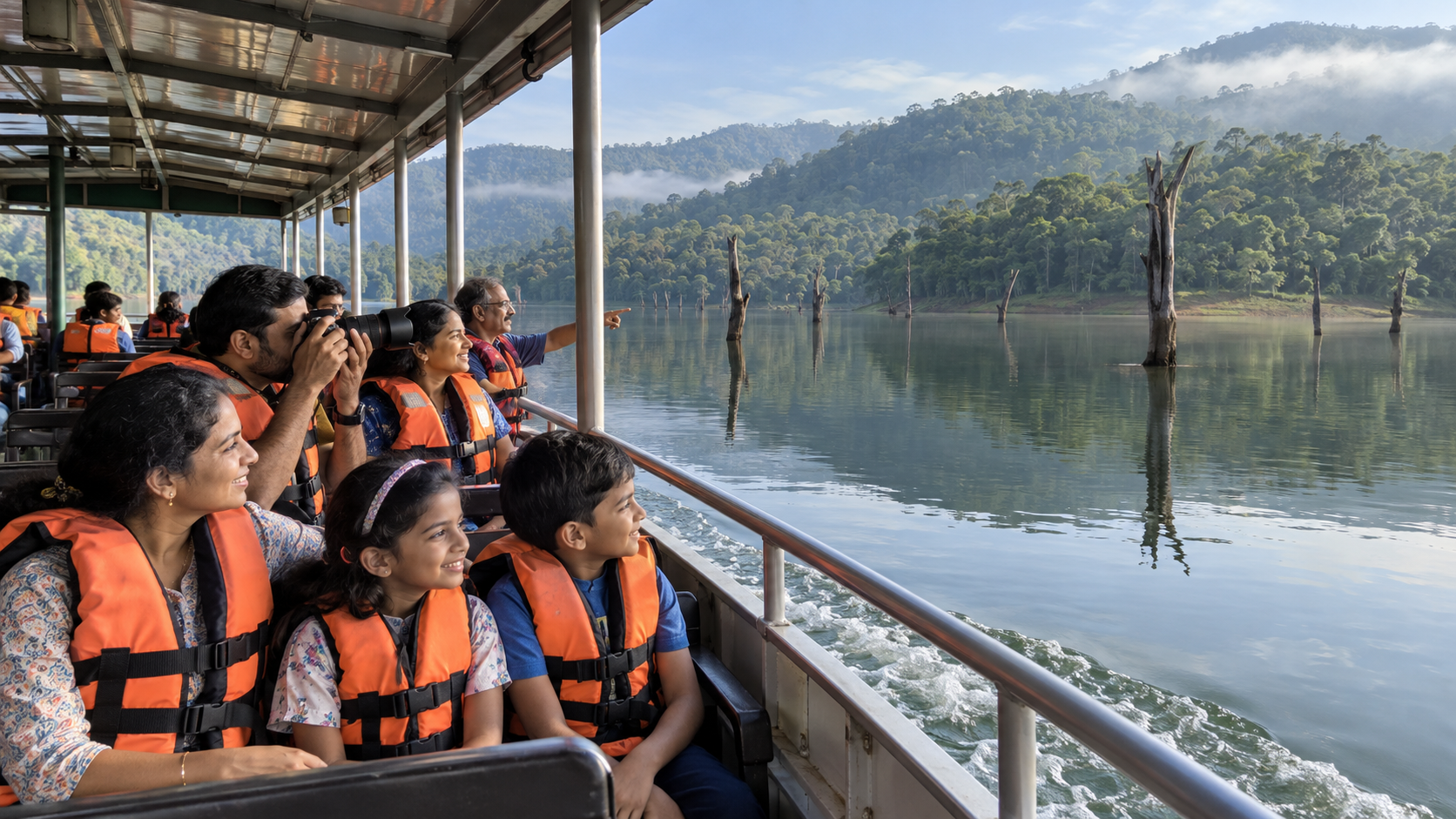
In the afternoon, take the boat ride on Periyar Lake inside the Periyar Tiger Reserve, looking for elephants, gaur and sambar deer along the shore. The lake was created in 1895, when the Mullaperiyar Dam was built across the Periyar River, and the bare trunks of trees drowned by the rising water still stand in the lake, where cormorants and darters perch to dry their wings. As the boat glides along, the forest rises on both sides, and herds of elephants often come down to wade and bathe at the water's edge.

The Mullaperiyar Dam was built by Colonel John Pennycuick, a British army engineer, to divert the waters of the Periyar River east to the dry plains of Tamil Nadu, and he's still remembered with great respect by farmers there. The boat rides on the lake are run by the Kerala Tourism Development Corporation and the forest department and leave at fixed times through the day, starting early in the morning. The early and late trips are usually the best for wildlife, and tickets can sell out on busy days, so it's worth booking in advance or getting to the boat landing early.

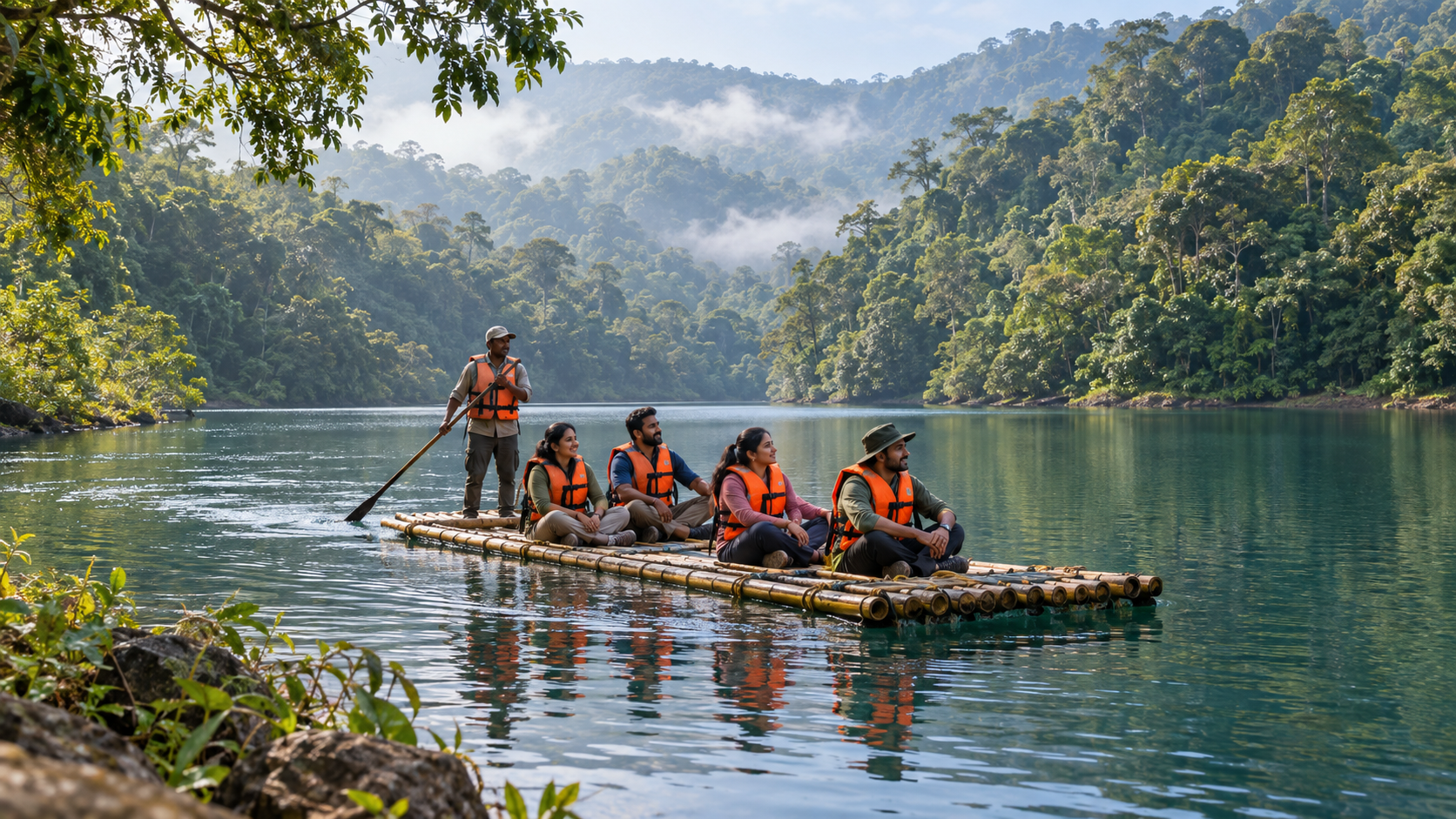
If you have time, there are other ways to explore the forest. The Kerala Forest Department runs a range of eco-tourism activities, including guided nature walks, bamboo rafting on the lake, jungle treks and border hikes, all led by local guides, many of whom once lived from the forest and now help protect it. These programmes need to be booked in advance and are usually full-day or half-day activities, so ask us if you'd like to add one.

In the evening, watch Kathakali or Kalaripayattu, or walk through a spice plantation. Kathakali, Kerala's classical dance-drama, tells stories from the great epics through expressive faces and hands, with performers in spectacular make-up and costumes. Kalaripayattu, one of the oldest martial arts in the world, is a thrilling display of leaps, kicks and sword fights by firelight. A plantation walk shows you cardamom, pepper, coffee and vanilla growing side by side.

After the evening show, enjoy dinner at your hotel. The nights in Thekkady are cool and quiet, filled with the sounds of the forest: the call of nightjars, the chirp of crickets and frogs, and sometimes the distant trumpet of an elephant.

Periyar has been protected since the days of the Maharajas of Travancore, who set aside the forests around the lake as a game reserve, and it became one of India's tiger reserves under Project Tiger in 1978. Today, it's known as one of the best-managed reserves in the country, and its eco-tourism programmes, which employ people from the local communities, including tribal families who once hunted in these forests, as guides and forest watchers, are often held up as a model for the rest of India. Tigers are rarely seen, as they're shy and the forest is dense, but elephants are common, especially in the dry months from February to May, when they come down to the lake to drink and bathe.

For the boat ride and the forest walks, wear comfortable clothes in muted colours and good walking shoes, and bring binoculars, a hat, sunscreen and water. On forest walks, the guides will give you leech socks after rain. Keep your voice low on the boat and on the trails, and you'll see far more.

Tomorrow, the road leads down from the hills to the backwaters, so enjoy a good night's sleep in the cool forest air.

Included today: private car from Munnar to Thekkady, hotel in Thekkady, breakfast.

Good to know: drive 3–4 hours. The boat ride, shows and plantation walk are optional and paid locally. More ideas in our guide to Thekkady tourist places.

Day 5
Thekkady to Alleppey – Lakeside Resort

Thekkady to Alleppey – Lakeside Resort

⌖ Alleppey 🍽 Meals: Breakfast

Drive down from the hills to Alleppey, now officially called Alappuzha, about four hours away, and check in to a resort on the backwaters. The road descends from the spice hills through rubber plantations and small towns to the green lowlands of Kuttanad, where paddy fields stretch to the horizon and canals run alongside the road.

Leaving after an unhurried breakfast, you drive down through the hills via Vandiperiyar and Peermade, a quiet hill town surrounded by tea estates, pine forests and grasslands, once the summer retreat of the Maharajas of Travancore. Beyond Kuttikkanam, the road winds steeply down through the forest, with views of the plains stretching away to the west, and the air becomes warmer and more humid as you descend. You'll pass through Mundakayam, surrounded by rubber plantations, where the tall, straight trees stand in neat rows with small cups tied to their trunks to collect the white latex.

Then the road continues to Kottayam, known as the land of letters, lakes and latex, Kerala's centre of publishing, education and the rubber trade, and the gateway to the backwaters. From Kottayam, the road runs west to Alleppey, through Kuttanad, often called the rice bowl of Kerala. Kuttanad is one of the few places in the world where farmers grow rice below sea level, on land reclaimed from the lakes and protected by earthen dykes. The paddy fields stretch to the horizon, bright green or golden depending on the season, with canals and narrow waterways running between them, and white egrets stalking through the fields.

Alleppey is often called the Venice of the East, a name that's said to have come from Lord Curzon, the British Viceroy of India, who admired its network of canals and waterways in the early 20th century. Once a busy port, the town is now the gateway to the backwaters, a vast network of lakes, rivers, canals and lagoons that stretches along the coast of Kerala. Every August, on the second Saturday, the town hosts the famous Nehru Trophy Boat Race on Punnamada Lake, when long snake boats, each rowed by more than a hundred oarsmen, race across the water to the beat of drums and songs, cheered on by huge crowds.

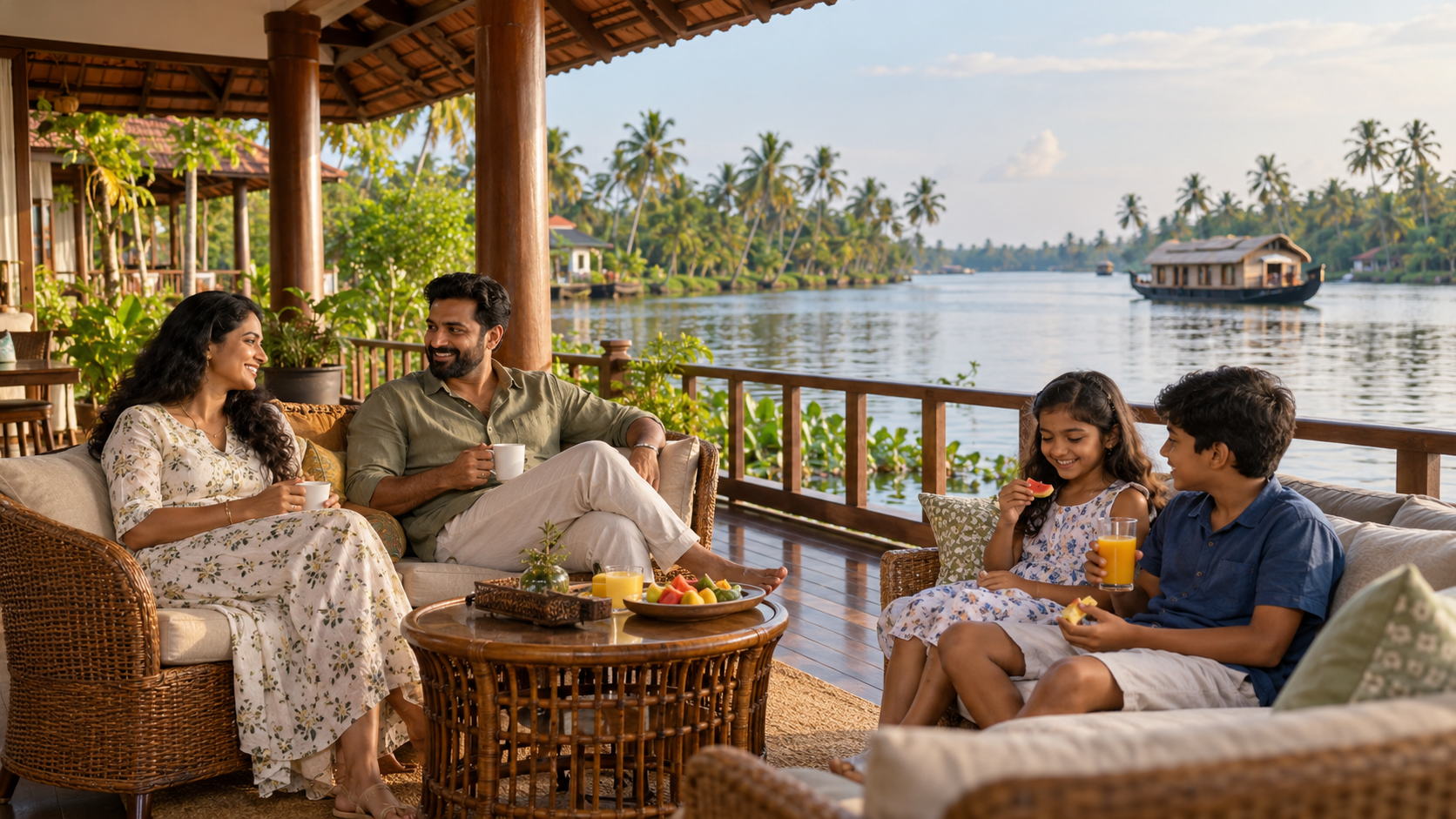
Spend the afternoon by the pool or the water. Alleppey's lakeside resorts are among the most relaxing places to stay in Kerala, with gardens of palms and hibiscus running down to the water's edge, hammocks strung between the trees and terraces where you can watch the houseboats drift past, village canoes loaded with coconuts and ducks paddling in long lines along the canals.

At the resort, you might like to book an Ayurvedic massage, a Kerala tradition, using warm herbal oils, or take a gentle walk along the canal bank to see village life up close: women washing clothes at the water's edge, children rowing to school, fishermen casting their nets and farmers tending the paddy. For dinner, try a Kerala specialty: karimeen pollichathu, pearl spot fish from the backwaters, marinated in spices, wrapped in a banana leaf and grilled, or a fragrant duck roast, a Kuttanad favourite, with appam, soft lacy rice pancakes.

Then watch the sunset from Alleppey Beach, a long, golden stretch of sand lined with palms, with the ruins of an old 19th-century pier reaching out into the sea and a red-and-white striped lighthouse nearby. Local families gather here in the evening, and the sun sinking into the Arabian Sea is a beautiful sight.

As darkness falls, return to your resort for a relaxed dinner by the water. Night in the backwaters is beautifully quiet: the lamps on the houseboats moored across the lake glow softly, the frogs and crickets begin their chorus, and now and then a canoe slides past in the dark. It's a good evening to sit on your terrace with a cool drink and enjoy the calm, the warm night air and the scent of the tropical gardens.

Alleppey's climate is warm and humid through the year, with temperatures of around 25 to 33°C, so light cotton clothes, sunglasses, a hat and sunscreen are essential, along with mosquito repellent for the evenings. The best months to visit are from October to March, when the days are pleasant and the skies clear, but the monsoon has its own beauty, when the paddy fields turn brilliant green, the rain falls in great curtains across the lake and the backwaters are at their most dramatic. Tomorrow, you'll move from the resort to your houseboat, so pack an overnight bag with what you'll need on board, and leave the rest of your luggage in the car with your driver, who will meet you again at the jetty the next morning.

Included today: private car from Thekkady to Alleppey, backwater resort in Alleppey, breakfast.

Good to know: drive about 4 hours. A shikara ride through the narrow canals can be added at extra cost.

Day 6
A Night on an Alleppey Houseboat

A Night on an Alleppey Houseboat

⌖ Alleppey 🍽 Meals: Breakfast, Lunch, Dinner

Check out of your resort after breakfast and relax by the water until it's time to head to the jetty, where your houseboat and crew will be waiting. The crew usually includes a captain, a cook and an assistant, and they'll welcome you aboard with a tender coconut or a fresh juice and show you around the boat. Then, as the engine starts, the houseboat slowly pulls away from the jetty and out into the wide, open waters of Vembanad Lake, the longest lake in India, with the green shoreline fringed with coconut palms stretching away into the distance.

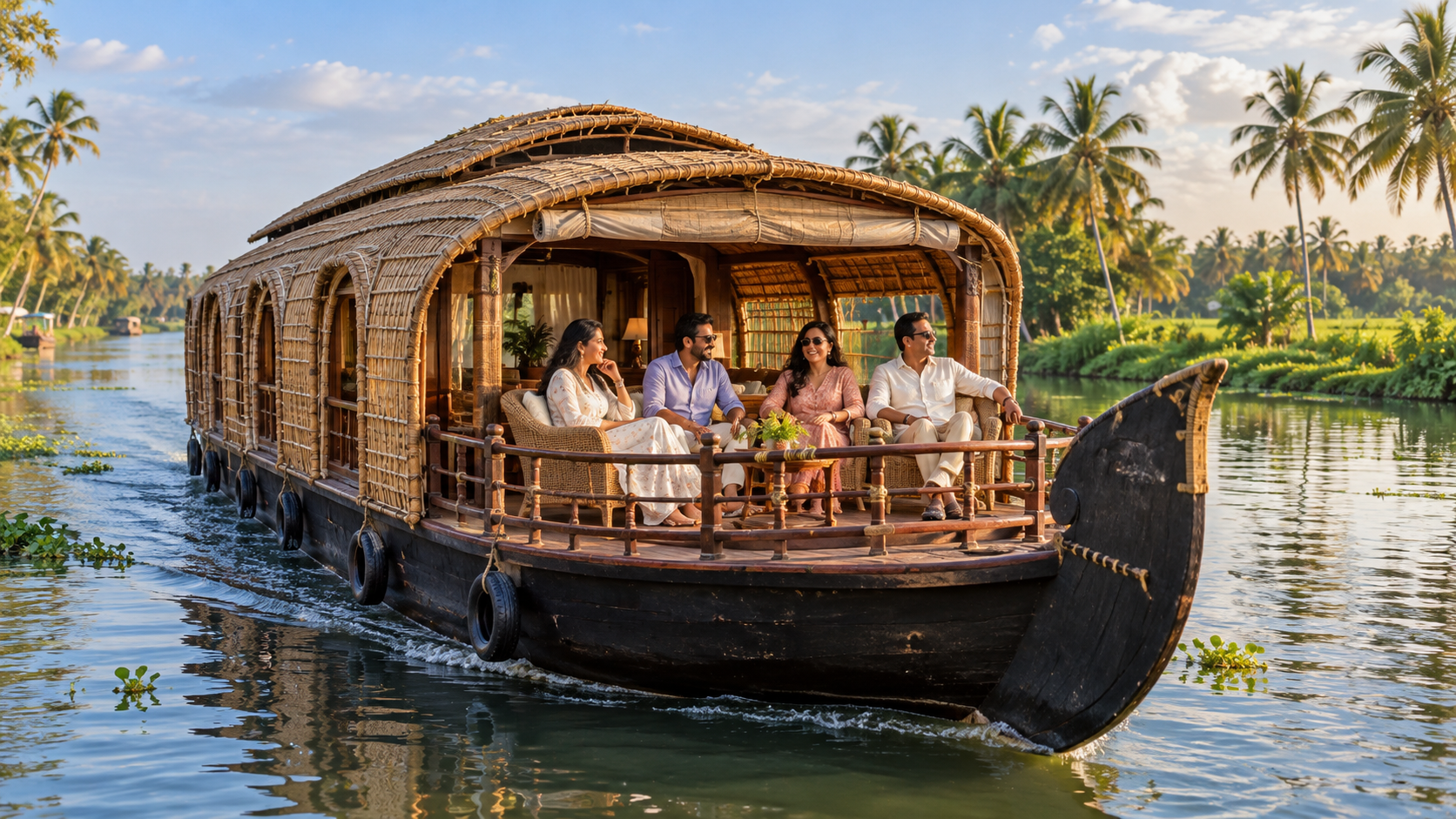
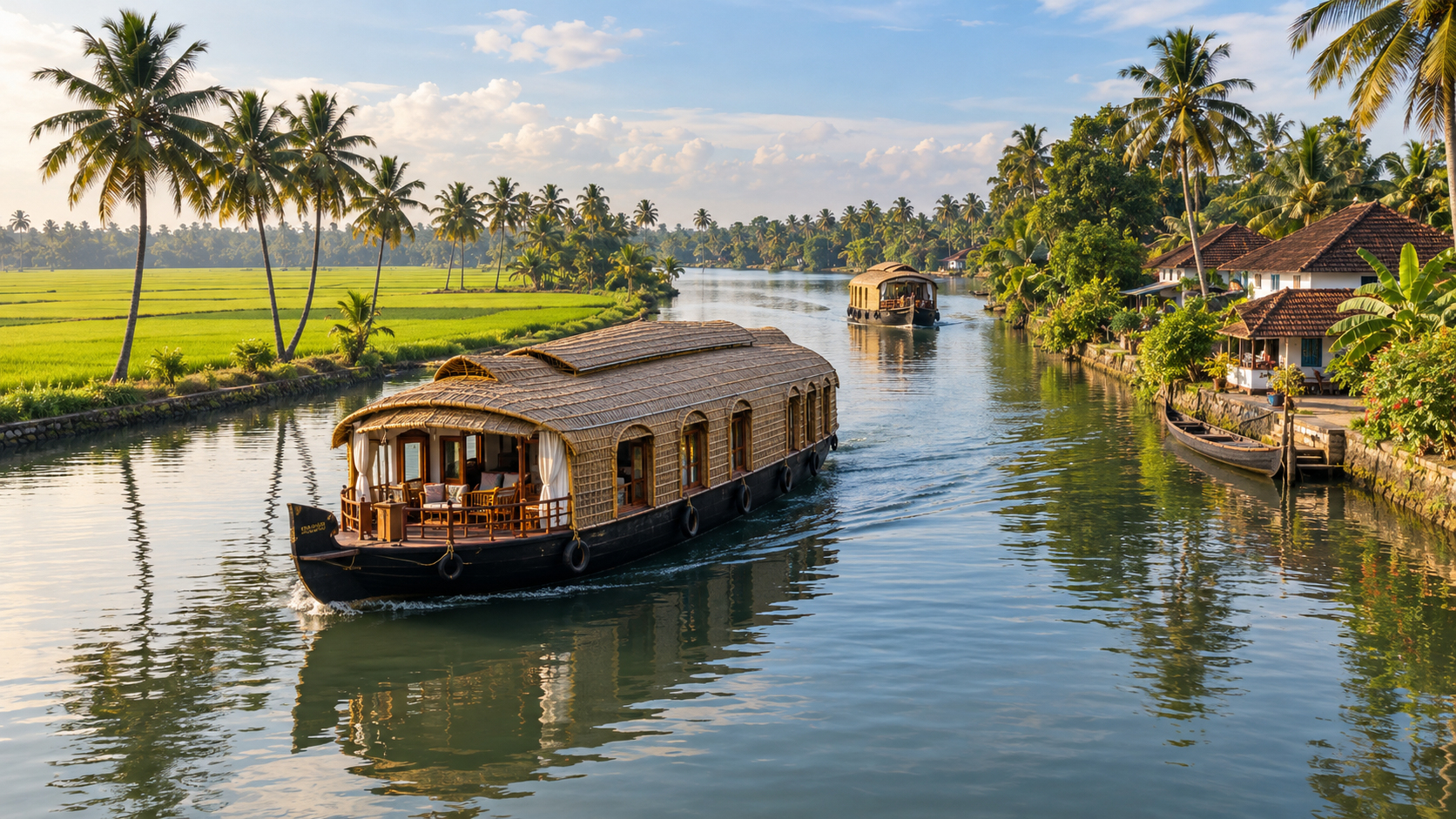
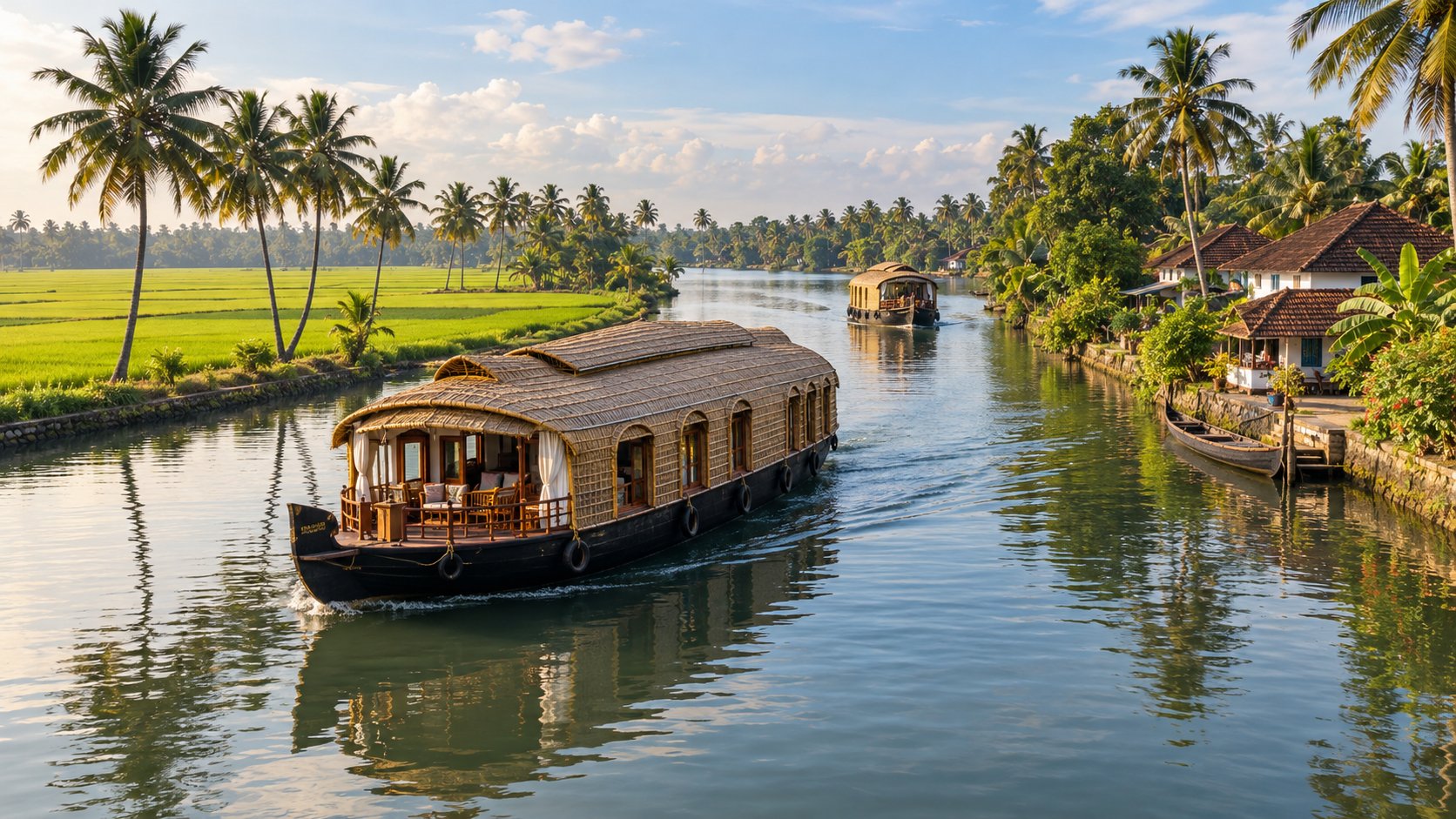
Around noon, board your private houseboat for a cruise along the backwaters, past paddy fields, coconut groves and lakeside villages. Your kettuvallam is a traditional Kerala rice barge transformed into a floating home, with a curved roof of woven bamboo and palm leaves, a bedroom with an attached bathroom, a sitting area and an open deck, and a crew who look after everything.

Lunch is served on board as the boat cruises along: rice, sambar, avial, thoran, a fish curry or fried fish, pappadam, pickle and fresh fruit, all cooked in the boat's small kitchen. The cooks on these boats are often excellent, and the food is one of the highlights of the trip. If you have any dietary needs, let us know in advance and the crew will happily adapt the menu.

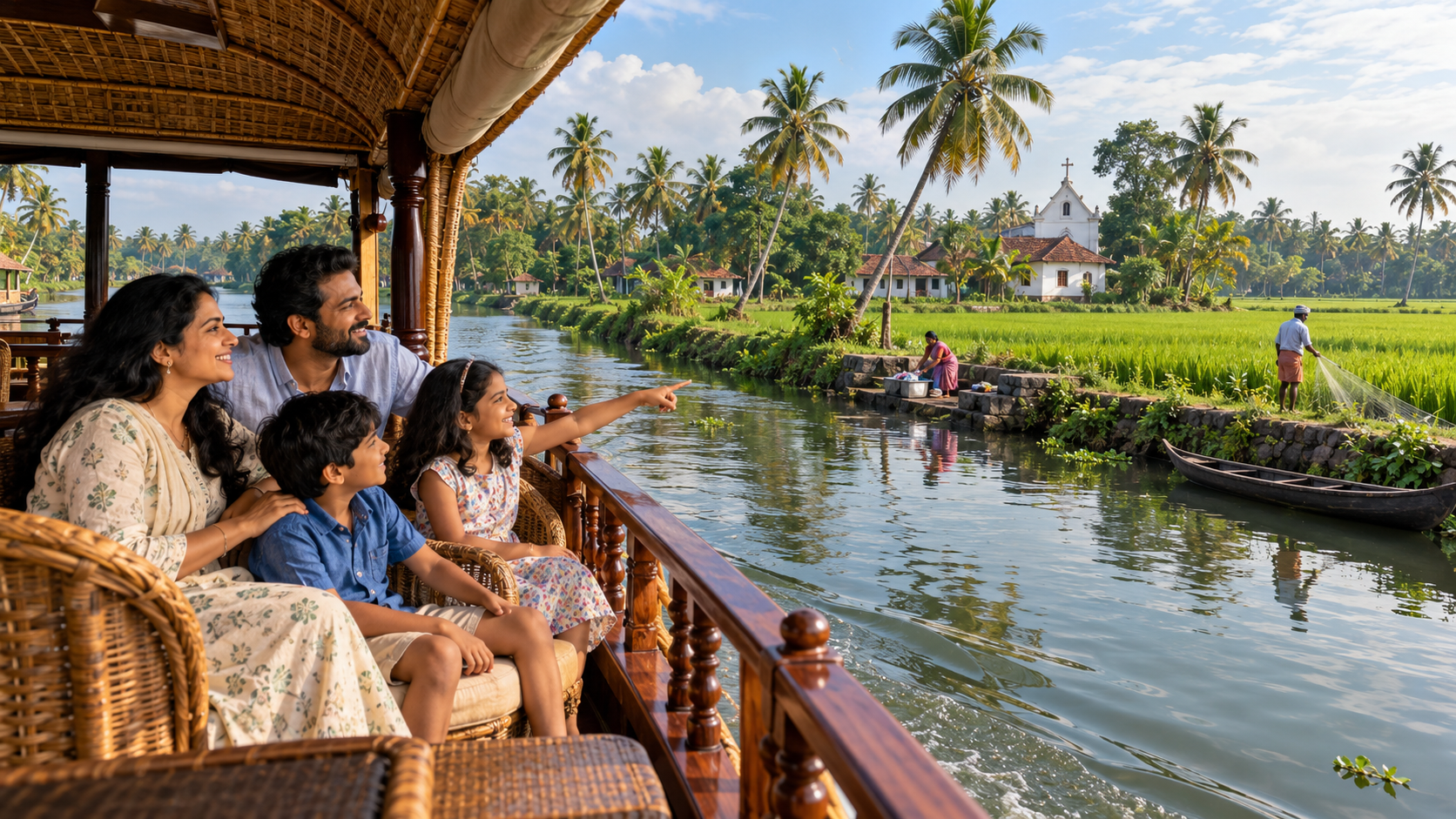
In the afternoon, settle into a chair on the open deck and watch the scenery slide by. The boat leaves the open lake and turns into narrower channels, where life goes on at the water's edge just a few metres away. You'll see village homes with small gardens running down to the water, churches and temples, women washing clothes and pots on the stone steps, children waving from the bank, men fishing from small dugout canoes, and toddy tappers climbing the tall coconut palms to collect sap. Kingfishers flash blue as they dive, egrets and herons stand patiently in the shallows, and cormorants spread their wings to dry in the sun.

Along the way, the crew may stop at a village shop or a fishermen's landing, where you can buy fresh prawns, crab or fish, which the cook will prepare for dinner for a small extra charge. Tea and snacks are served in the late afternoon, often pazham pori, sweet banana fritters, or spiced vadas, as the light turns golden over the water.

Lunch, dinner and breakfast are cooked on board by the crew. The boat moors for the night at about 5:30 PM, as local rules require.

Once you're moored at a quiet spot along the bank, the backwaters become peaceful and still, the sky glows orange and pink, and lamps begin to flicker in the houses along the bank. You'll hear the sound of frogs and crickets, the call of birds settling for the night and the gentle lapping of water against the hull. Dinner is served on deck by lamplight, and afterwards, you can sit outside under the stars, enjoying the stillness. The air conditioning in the bedroom usually runs on the boat's generator from about 9 PM to 6 AM.

A night on a houseboat is one of the most memorable experiences in Kerala, and for many travellers, it's the highlight of their trip, a chance to slow down and see a way of life that's been shaped by the water for centuries.

For your night on board, pack light, comfortable clothes, a hat, sunglasses, sunscreen, mosquito repellent, a torch, and a light layer for the evening breeze on the water. The bathrooms are compact, with running water, but it's worth bringing your own toiletries. Electricity on board comes from the boat's generator and batteries, so charge your phone and camera when it's running. Mobile coverage is usually good on the backwaters, but it can drop in the remoter channels, which many guests find a welcome break.

Houseboats on the Alleppey backwaters follow rules set by the local authorities to protect the lakes and the people who live and fish on them. Boats must stop sailing and moor for the night by early evening, so that fishermen can set their nets safely after dark, and only licensed boats with trained crews are allowed to operate. The crews are proud of their work and know these waters well, so don't hesitate to ask them about the villages, the birds, the fishing and the farming you see along the way. Their stories are one of the joys of the trip, and a small tip at the end of the cruise is always appreciated.

Whether you spend it reading, chatting with the crew, taking photographs or simply watching the water, the day passes gently, at the pace of the boat.

Included today: private houseboat with lunch, dinner and breakfast on board, breakfast at the resort.

Good to know: bedrooms are air-conditioned at night. Compare boats on our Alleppey houseboat packages page.

Day 7
Alleppey to Kochi – Departure

Alleppey to Kochi – Departure

⌖ Kochi 🍽 Meals: Breakfast

Wake early, step out onto the deck and watch the mist rising from the water as the backwaters come to life: fishermen paddling out in their canoes, ducks being herded along the canals, and the first ferries carrying villagers to work and school. Breakfast is served on board, perhaps appam with egg curry, or puttu, steamed rice cake with grated coconut, with kadala curry, made from black chickpeas, and hot tea or coffee, as the boat makes its way slowly back to the jetty.

After a short morning cruise and breakfast, leave the boat by 9 AM and drive about two hours to Kochi.

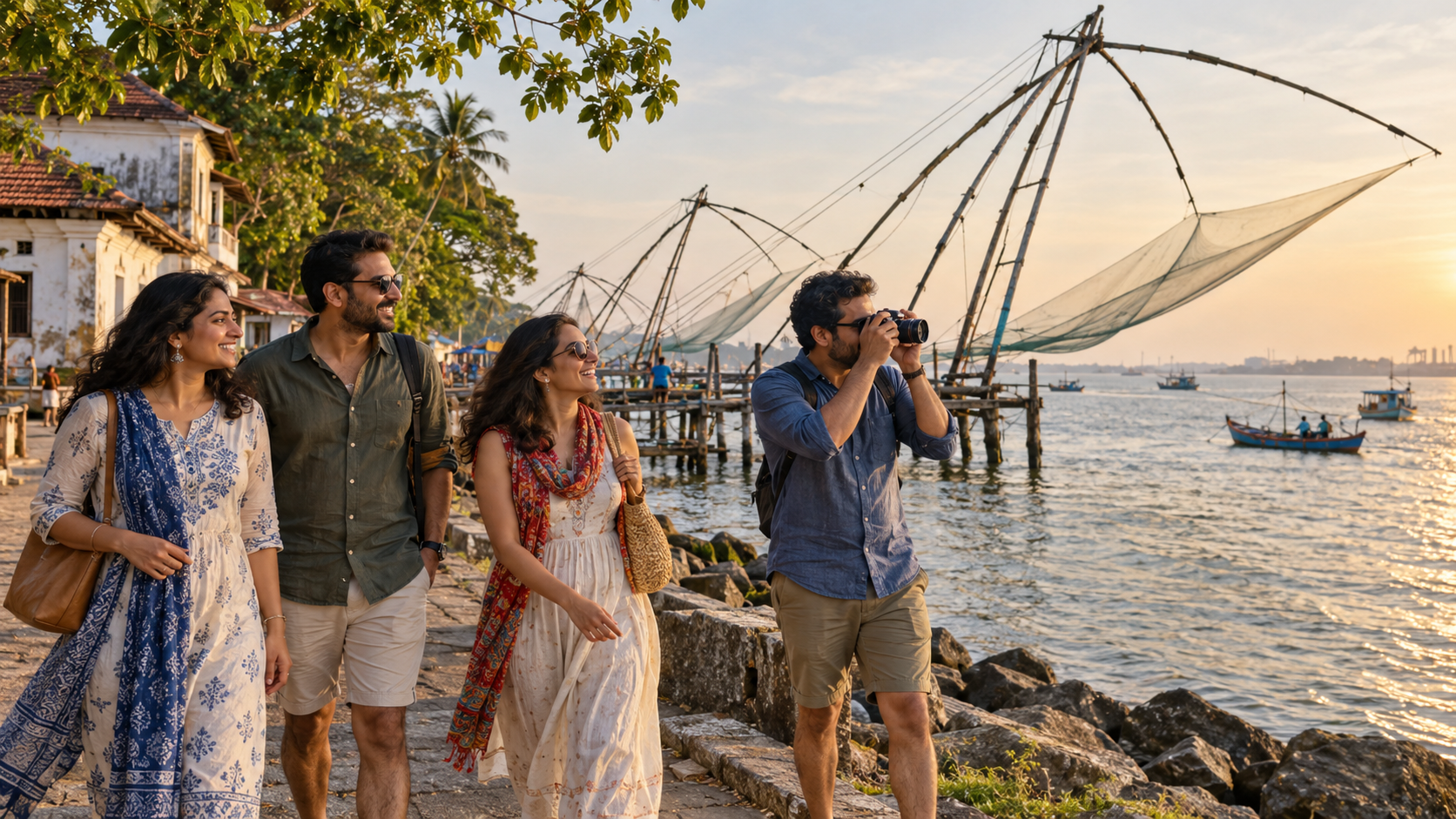
The drive to Kochi follows the coastal highway north through busy towns and villages. If you have time before your flight, spend a few hours exploring Fort Kochi, one of the most charming and historic towns in India. For centuries, it was a meeting point of cultures, as Arab, Chinese, Jewish, Portuguese, Dutch and British traders and settlers came here in search of spices, and their influence can still be seen in its streets, buildings and food.

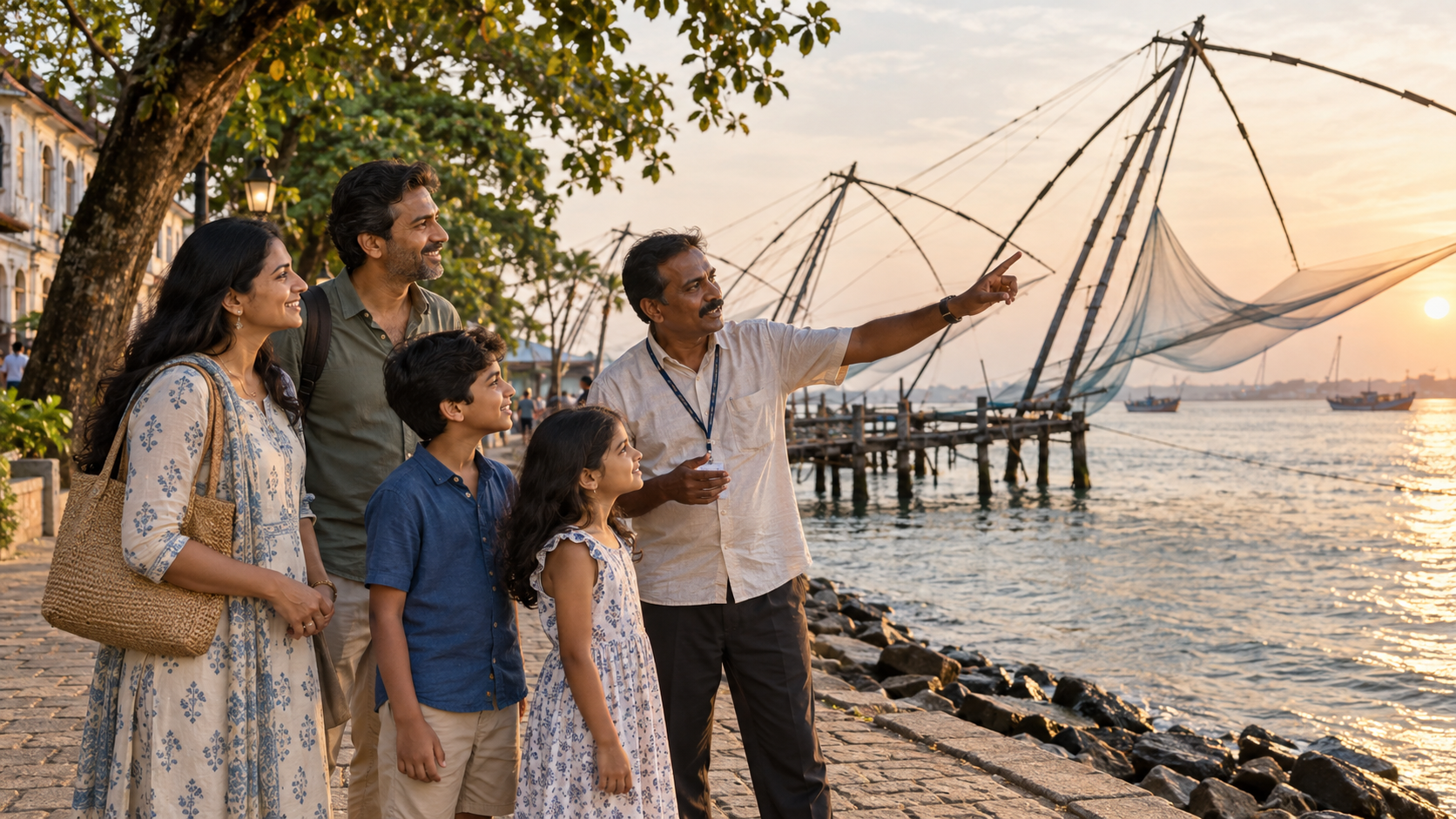
Start at the Chinese fishing nets on the shore, huge cantilevered nets of wood and rope, believed to have been introduced by Chinese traders centuries ago. Fishermen still operate them by hand, lowering them into the water and raising them with heavy stones as counterweights, and you can watch them at work and buy fresh fish from the stalls nearby. Nearby, St Francis Church, built by the Portuguese in 1503, is one of the oldest European churches in India. Vasco da Gama, the Portuguese explorer who first reached India by sea, died in Kochi in 1524 and was buried here, before his remains were taken back to Portugal some years later. His tombstone can still be seen inside. The Santa Cruz Basilica, a short walk away, is known for its pastel colours, Gothic design and painted ceilings.

Then drive a few minutes to Mattancherry to visit the Dutch Palace, built by the Portuguese in the 16th century and gifted to the Raja of Kochi, and later renovated by the Dutch. Inside, its walls are covered with beautiful murals depicting scenes from the Ramayana and other Hindu legends. Nearby is Jew Town, with its narrow streets lined with antique shops, spice warehouses, cafés and boutiques, and the Paradesi Synagogue, built in 1568, with its hand-painted Chinese tiles and Belgian chandeliers, one of the oldest active synagogues in the Commonwealth. Note that the Dutch Palace is closed on Fridays, and the synagogue is closed on Fridays, Saturdays and Jewish holidays.

Fort Kochi is also known for its street art, cafés and galleries, and it hosts the Kochi-Muziris Biennale, India's largest contemporary art festival, which takes place in some winters. Whatever time you have, it's a fitting end to a week that began with a blessing at Guruvayur and took you through the tea hills, spice forests and backwaters of Kerala, before your driver takes you to the airport or railway station for your journey home.

Fort Kochi is about 40 kilometres from Kochi's international airport at Nedumbassery, and the drive usually takes about an hour and a half, longer in heavy traffic, so leave plenty of time. For a relaxed departure, book a flight that leaves at least three hours after you're due to reach the airport. If you're leaving by train, Ernakulam Junction and Ernakulam Town stations are closer, about half an hour from Fort Kochi.

If you'd like to take a little of Kerala home with you, Fort Kochi and Mattancherry are good places to shop. Look for spices and tea from the warehouses of Jew Town, Kerala's famous kasavu sarees and mundus, woven in white or cream cotton with golden borders, brass oil lamps, handmade wooden and coconut-shell crafts, Kathakali masks, and Ayurvedic oils and soaps. Banana chips fried in coconut oil and halwa from the sweet shops make a good gift too, and the cafés of Fort Kochi are the perfect place for a last cup of filter coffee or a plate of fresh seafood before you go.

Looking back on your week, you'll have experienced a remarkable variety in a short time: the devotion of Guruvayur, the cool green tea country of Munnar, the forests and wildlife of Periyar, the peace of the backwaters and the layered history of Kochi.

Our team will be in touch until you're home, and we hope this is only your first visit to God's Own Country, as Kerala proudly calls itself. Safe travels.

Included today: morning cruise and breakfast on the houseboat, private car to Kochi, Fort Kochi if time allows, drop at Kochi airport or railway station.

Good to know: drive about 2 hours. Book a flight that leaves at least 3 hours after you reach the airport. See our Fort Kochi tourist places guide.

Hotel confirmation

Hotel names will be provided after booking, subject to availability and confirmation. We do not hold hotel confirmations before booking.

Inclusions

  1. 5 nights in hotels or resorts of your chosen category (1 in Kochi, 2 in Munnar, 1 in Thekkady, 1 in Alleppey), with daily breakfast
  2. 1 night on a private houseboat, with lunch, dinner and breakfast on board
  3. A private sedan, SUV or tempo traveller with an English- or Hindi-speaking driver for all 7 days, including fuel, tolls, parking and driver allowance
  4. Pickup and drop at Kochi airport or railway station
  5. All sightseeing and transfers listed in the itinerary

Exclusions

Not included: flights or trains, entry tickets (Eravikulam National Park, Tea Museum, Periyar boating), special darshan tickets or offerings at Guruvayur, cultural shows, meals other than breakfast and houseboat meals, and personal expenses.

Important Terms

These terms apply to every Kerala tour package booked with Dreamland Vacations LLP ("we", "us"). By paying the advance, you ("the guest") accept them on behalf of everyone named in the booking.

1. Quotes and availability

1.1 Quotes are valid for 3 days and are subject to availability until the booking is confirmed. Hotel and houseboat prices change often, especially for December and January travel.

1.2 Hotels named in a quote are our first choice. If one is unavailable when you book, we'll offer a hotel of the same category and tell you before confirming.

2. Booking and payment

2.1 Once we confirm availability, pay 30% of the total package cost to confirm your booking. Your booking is confirmed only when we have received this payment and sent you a written confirmation with hotel names.

2.2 Full payment is due 30 days before your travel date. If it is not received by then, we may treat the booking as cancelled by you, and the charges in section 4 apply.

2.3 For bookings made within 30 days of the travel date, pay 30% to book, and the balance as soon as your booking is confirmed.

2.4 We accept payment by bank transfer, UPI or our online payment link, with no extra charge for paying online.

3. Prices

3.1 Prices are per person, based on two adults sharing a room, unless the quote says otherwise. GST is charged extra at the rate applicable on the invoice date.

3.2 Child rates apply to children aged 5 to 11 sharing their parents' room. Children under 5 travel free without an extra bed, subject to hotel policy.

3.3 Hotels add compulsory gala-dinner charges for 24 and 31 December. These are not included unless the quote says so and are payable at the time of booking.

3.4 Once confirmed, the package price is fixed, except for changes in government taxes, park fees or fuel surcharges imposed after booking.

Cancellation by you

4.1 Cancellations must be sent by email to info@dreamlandvacations.com. The charges below are counted from the day we receive your email, in Indian time.

4.2 Bookings for travel between 20 December and 5 January, and any hotel, resort or houseboat we have told you is non-refundable, cannot be refunded once confirmed, whatever the cancellation date.

4.3 Flights and train tickets booked through us follow the airline's or railway's own cancellation rules, plus our service fee of Rs 500 per ticket.

4.4 GST already paid is not refundable.

4.5 We recommend travel insurance that covers cancellation, as these charges apply whatever the reason for cancelling, including illness.

5. Changes by you

5.1 One change of travel dates is free if requested 31 or more days before the original arrival date, provided the new dates are within the same season and the hotels are available. You pay any difference in price.

5.2 Date changes requested within 30 days of arrival are treated as a cancellation and a new booking.

5.3 Other changes, such as upgrading a hotel, adding a night or adding a houseboat, are possible at any time, subject to availability and the price difference.

5.4 Changing the name of a traveller is free up to 7 days before arrival.

6. Refunds

6.1 Refunds are made to the original payment method within 21 working days of the cancellation, after deducting the charges in section 4.

6.2 There is no refund for any service you don't use once the tour has started, including meals, sightseeing, a missed houseboat check-in or leaving early. If you leave early, we'll try to cancel later bookings and pass on whatever the hotels or suppliers refund to us.

7. Changes by us

7.1 If we must change a confirmed hotel, we'll replace it with one of the same or a higher category at no extra cost, and tell you as soon as we know.

7.2 If we have to cancel your tour for any reason other than those in section 8, you can choose a full refund of what you have paid or a different tour of equal value.

8. Events beyond our control

8.1 Heavy rain, landslides, floods, strikes and hartals, road closures, government orders, park closures and similar events can disrupt travel in Kerala, especially in the hills during the monsoon.

8.2 If such an event affects your tour, we'll arrange the best available alternative, such as a different route, hotel or sightseeing. Any extra costs are payable by you, and we'll refund only what the hotels and suppliers refund to us for services not used.

8.3 Houseboat cruising may be shortened or stopped in bad weather or under local regulations. Periyar boating and Eravikulam National Park can close without notice. These are not grounds for a refund of the package.

9. Our responsibility

9.1 We arrange hotels, houseboats, transport and sightseeing through independent suppliers. We take care to choose them well, but we are not responsible for loss, injury, damage, delay or illness caused by their acts or omissions, or by you.

9.2 Please look after your own belongings. We're not responsible for lost or stolen items.

9.3 Wildlife sightings, weather and views cannot be guaranteed.

10. Travel notes

10.1 Every guest must carry a valid government photo ID (Aadhaar, passport, driving licence or voter ID). Foreign nationals need a valid passport and Indian visa. Hotels may refuse check-in without ID.

10.2 Hotel check-in is usually 2 pm and check-out 11 am or 12 noon. Early check-in and late check-out depend on availability and may be charged.

10.3 The vehicle is for the itinerary as booked. Drives beyond it, or after 8 pm, may cost extra. Drivers may switch off the air-conditioning on steep hill roads.

10.4 Houseboats moor for the night at a fixed time under local rules. Air-conditioning on Deluxe boats usually runs at night only.

10.5 Behaviour that endangers others or breaks the law may lead to the tour being ended without refund.

Good to Know

  1. Arrive in Kochi early on Day 1. Guruvayur is about two and a half hours each way, and temple queues can be long, so a morning arrival gives you time for darshan without rushing. If you land late, we can move Guruvayur to the last day.
  2. Guruvayur Temple is open only to Hindus. Men wear a mundu (dhoti) with no shirt, and women traditional Indian dress. The temple closes for part of the afternoon, and weekends and festival days are the busiest.
  3. Eravikulam National Park closes for a few weeks each year between February and April for the Nilgiri tahr calving season. On those dates we replace it with Top Station or extra time at the tea estates.
  4. The Tea Museum is closed on Mondays. In Fort Kochi, Mattancherry Palace is closed on Fridays, and the Paradesi Synagogue on Fridays and Saturdays.
  5. Periyar boat tickets sell out in peak season. We book them for you in advance.

Best Time for This Tour

October to March is the best time, with pleasant weather in the hills and calm backwaters. December and January are the busiest months, and Guruvayur is especially crowded during temple festivals and on auspicious days for weddings, so plan darshan for a weekday if you can. See our guide to the best time to visit Kerala.

Make It Your Own

  1. Stay overnight in Guruvayur: our Kerala 8 Days Itinerary spends a night in Guruvayur and adds Athirapilly, Kerala's biggest waterfall.
  2. Skip the temple: our Kerala 7 Days Itinerary gives you a second night in Thekkady instead.
  3. Upgrade the hotels: choose 3-star, 4-star or 5-star, place by place, and a Premium or Luxury houseboat.
  4. Travelling with family? We'll choose hotels with family rooms and pools. See our Kerala family tour packages.

See all our Kerala tour packages.

Get a free quote for this tour

Guruvayur Tour Package with Munnar, Thekkady & Alleppey – 7 Days FAQs

How far is Guruvayur from Kochi?
Guruvayur is about 80 to 90 km north of Kochi, roughly two and a half hours by road, depending on traffic. This tour visits it as a day trip on Day 1 and returns to Kochi for the night.
What is the dress code at Guruvayur Temple?
Men must wear a mundu (dhoti) and enter without a shirt. Women should wear a saree or other traditional Indian dress. Mundus can be bought near the temple, and phones and footwear must be left outside.
Can non-Hindus visit Guruvayur?
Non-Hindus cannot enter the Sri Krishna Temple, but they can visit the temple town and watch the elephants at Punnathur Kotta. Mixed groups often split for an hour while others visit the elephant camp.
How long does darshan take at Guruvayur?
It depends on the day. On a quiet weekday it can take under an hour, while on weekends, holidays and festival days the queue can last several hours. Paid special darshan tickets can shorten the wait.
How is this different from your Kerala 8 Days Itinerary?
This 7-day tour visits Guruvayur as a day trip from Kochi. The 8-day itinerary stays a night in Guruvayur and adds a night at Athirapilly waterfall before Munnar, Thekkady and Alleppey.
Is this tour suitable for elderly parents?
Yes. Apart from the Guruvayur day trip, most drives are four hours or less, and there are two relaxing days at the end in Alleppey. We can choose hotels with lifts or ground-floor rooms, and shorten the walk at Eravikulam.
Gallery

Kerala photos: Guruvayur Tour Package with Munnar, Thekkady & Alleppey – 7 Days

Plan your Kerala holiday with Dreamland Vacations

Share your dates, travellers and comfort preference. Our team will guide you with the next best step.

Get a free quote
Itinerary Get a quote
WhatsApp