Spain & Portugal Tour – Spanish Fiesta, 10 Nights / 11 Days
Standard Package

Spain & Portugal Tour – Spanish Fiesta, 10 Nights / 11 Days

Spain and Portugal in 10 nights / 11 days: Madrid and Toledo, Salamanca, Porto, Lisbon with Sintra and Cabo da Roca, Seville with a flamenco show, Co…

⌖ Europe ✦ Family & senior friendly planning
Package snapshot
DestinationEurope
Travel styleStandard Package

Want to customize this package?

Share your dates and travellers. This enquiry is free. Small changes to a standard itinerary—such as a date change or an extra day—can be discussed with our team.

We’ll send verification codes to your WhatsApp number and email. Indian numbers can be entered without +91; for other countries, include the country code.
Verification required before submitting.
Your holiday

Spain & Portugal Tour – Spanish Fiesta, 10 Nights / 11 Days: overview

Palaces, flamenco and the edge of Europe

Imagine a warm summer evening in Seville, the air scented with orange blossom and jasmine, as a flamenco dancer stamps out a rhythm that seems to come from the earth itself. A few days later you're standing in the Alhambra, gazing at walls carved as finely as lace, and then wandering beneath the towers of Gaudí's Sagrada Família in Barcelona. This Spain and Portugal tour package is a complete journey around the Iberian Peninsula, and it's planned so all you have to do is soak it up.

You start in Madrid with a guided city tour and a day in medieval Toledo, then travel via the golden squares of Salamanca to Porto and its river, and on to Lisbon, with the palaces of Sintra and Cabo da Roca, the westernmost point of mainland Europe. Back in Spain, you enjoy a guided tour of Seville and an evening flamenco show, see the Mezquita in Cordoba, and visit the Alhambra and Generalife gardens in Granada. You end with the futuristic City of Arts and Sciences in Valencia and two nights in Barcelona for Gaudí's Sagrada Família, the Gothic Quarter and the mountain monastery of Montserrat.

A professional tour manager travels with you, local guides lead the city tours, you stay in 4-star hotels, and Indian lunches and dinners are included on most days. One Schengen visa covers both countries. See all our Europe tour packages.

Good to know

Package typeStandard Package
Planning supportSmall changes by enquiry
Best forFamilies, couples & seniors
Get a free quote
Trip highlights
✦ Arrive in Madrid | Welcome to the heart of Spain
✦ Madrid city tour, Las Ventas bullring, a sword workshop and Toledo | A royal capital and the city of three cultures
✦ Salamanca and on to Porto, with a Douro River cruise | A golden university city and a river into Portugal
✦ Porto city tour and on to Lisbon | Tiles, port wine and the road to the capital
✦ Lisbon city tour, Sintra and Cabo da Roca | Explorers, palaces and the edge of Europe
✦ Seville city tour and an evening flamenco show | The soul of Andalusia
Day-wise plan

Europe itinerary: day by day

Day 1
Arrive in Madrid | Welcome to the heart of Spain

Arrive in Madrid | Welcome to the heart of Spain

⌖ Madrid 🍽 Meals: Dinner

Your Iberian adventure begins in Madrid, the capital of Spain. As your plane descends over the high, sunbaked plateau of central Spain, look out of the window: golden fields and olive groves stretch to the horizon, broken by low hills and the dark lines of distant mountains, and then the city appears, spreading out under a vast blue sky. Madrid sits at around 650 metres above sea level, making it one of the highest capital cities in Europe, and its clear, bright light has inspired painters for centuries.

After you clear immigration at Madrid–Barajas Airport and collect your bags, walk out into the arrivals hall, where your tour manager is waiting to welcome you. From this moment, all the planning is done: coaches, hotels, guides, tickets and meals are arranged, and your tour manager will be with you throughout the eleven days.

The drive into the city gives you your first impressions of Spain. Wide avenues are lined with grand 19th-century buildings, their balconies trimmed with wrought iron and flowers. Fountains splash in the middle of busy roundabouts, and café terraces spill out onto every pavement. Spain is one of the most visited countries in the world, and it's easy to see why: the sunshine, the food, the music and the warmth of the people make visitors feel welcome from the very first moment.

Spain's history is one of the richest in Europe. The Romans ruled here for centuries, leaving roads, bridges and aqueducts. Then, from the year 711, much of the Iberian Peninsula was ruled by Muslim kingdoms for nearly eight hundred years, a period that gave Spain some of its most beautiful buildings, from the Mezquita in Cordoba to the Alhambra in Granada, both of which you'll see on this tour. In 1492 the Catholic monarchs Ferdinand and Isabella completed the conquest of Granada and, in the same year, sent Christopher Columbus across the Atlantic, beginning Spain's age of empire. You'll see traces of all these chapters over the coming days.

Madrid became the capital in 1561, chosen by King Philip II partly because it lies almost exactly in the centre of Spain. In the heart of the city, in the Puerta del Sol square, a small stone plaque in the pavement marks Kilometre Zero, the point from which all Spain's national roads are measured. Nearby stands the statue of a bear reaching up into a strawberry tree, the symbol of Madrid, which you'll see on everything from the city's coat of arms to its taxis.

Once you reach your hotel and check in, take time to rest after your journey. Madrid in summer is hot and sunny, often over 30°C in the afternoon, so many locals stay indoors during the hottest hours and come out again in the evening. The Spanish rhythm of life is different from what you may be used to: lunch is the main meal of the day and is eaten around two or three in the afternoon, and dinner is often not until nine or ten at night. In summer, the streets, squares and terraces are full of families, friends and children until well after midnight. Madrid is often said to be the city that never sleeps.

If you have energy later in the day, take a gentle walk around your neighbourhood as the heat fades. You'll find small bars serving tapas, little plates of food to share with a drink: olives, potato omelette, cheese, croquettes and grilled vegetables. Tapas are more than food; they're a way of life, a reason to meet friends and move from one bar to the next, chatting and nibbling as the evening goes on.

A few practical tips help you settle in. Spain uses the euro, and cards are accepted almost everywhere. Spanish power sockets take the same two round pins as much of Europe. A few words of Spanish go a long way: "hola" (hello), "gracias" (thank you), "por favor" (please) and "adiós" (goodbye). And keep a close eye on bags and phones in crowded places, as pickpockets work the busiest tourist areas.

In the evening the group meets for dinner, a chance to get to know your fellow travellers and to hear your tour manager outline the journey ahead, from Madrid and Toledo to Portugal and back through Andalusia to Barcelona. Then it's time for a good night's sleep. Tomorrow you'll explore Madrid and step back into the Middle Ages in Toledo.

You'll notice how warm and expressive the Spanish are. Friends greet each other with a kiss on each cheek, conversations are loud and lively, and nobody is ever in too much of a hurry to stop and chat. Football is a passion here too: Madrid is home to Real Madrid, one of the most successful clubs in the history of the game, and on match nights, the whole city seems to hold its breath.

Included today: arrival transfer, dinner.

Good to know: hotel check-in is usually mid-afternoon. Summer temperatures in Spain often reach 30–38°C, so carry water, a hat and sunscreen throughout the tour.
Day 2
Madrid city tour, Las Ventas bullring, a sword workshop and Toledo | A royal capital and the city of three cultures

Madrid city tour, Las Ventas bullring, a sword workshop and Toledo | A royal capital and the city of three cultures

⌖ Madrid 🍽 Meals: Breakfast, Lunch, Dinner

Today you explore Spain's elegant capital in the morning, and in the afternoon travel to Toledo, one of the most remarkable medieval cities in Europe. After breakfast, your local guide joins the coach for a tour of Madrid.

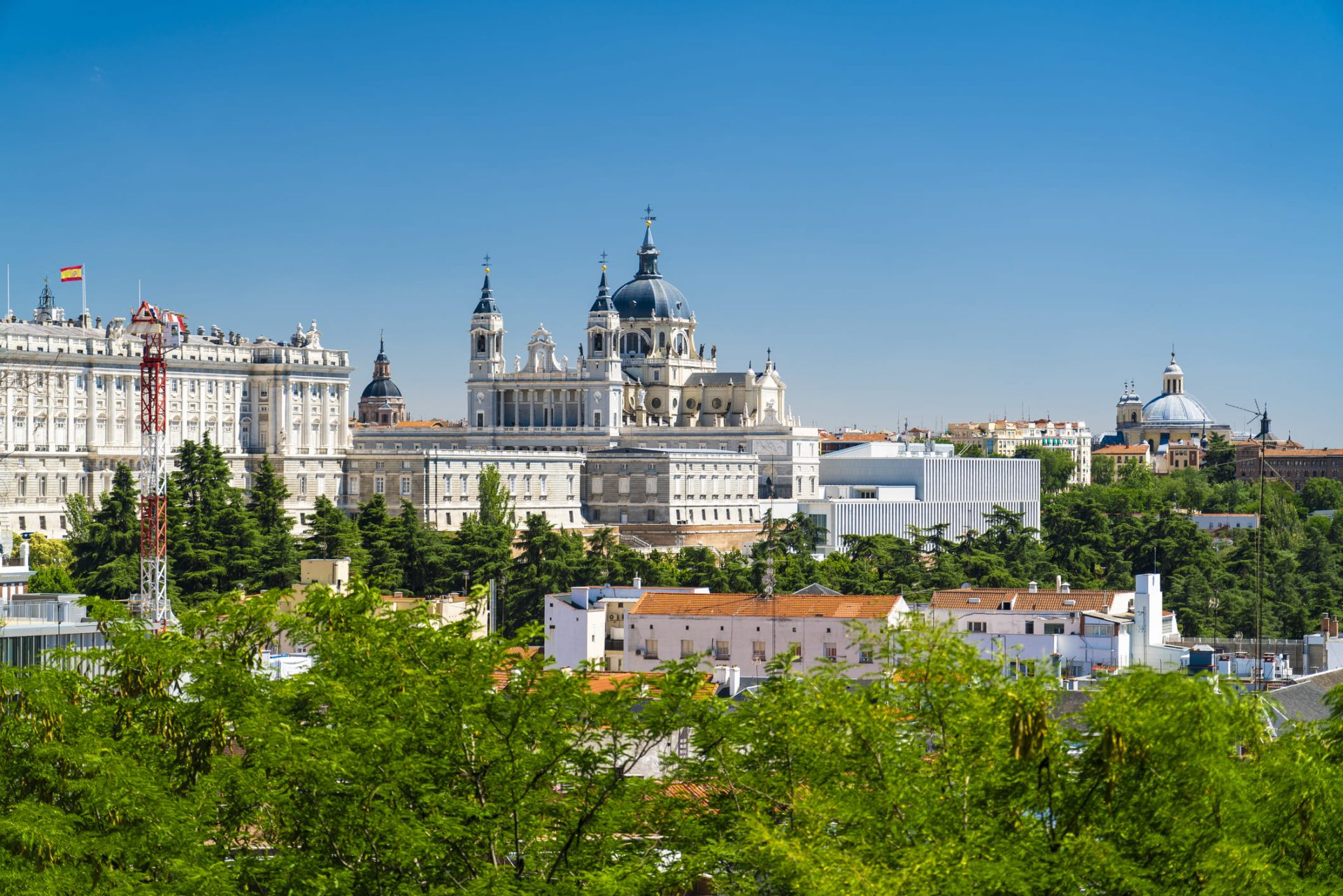
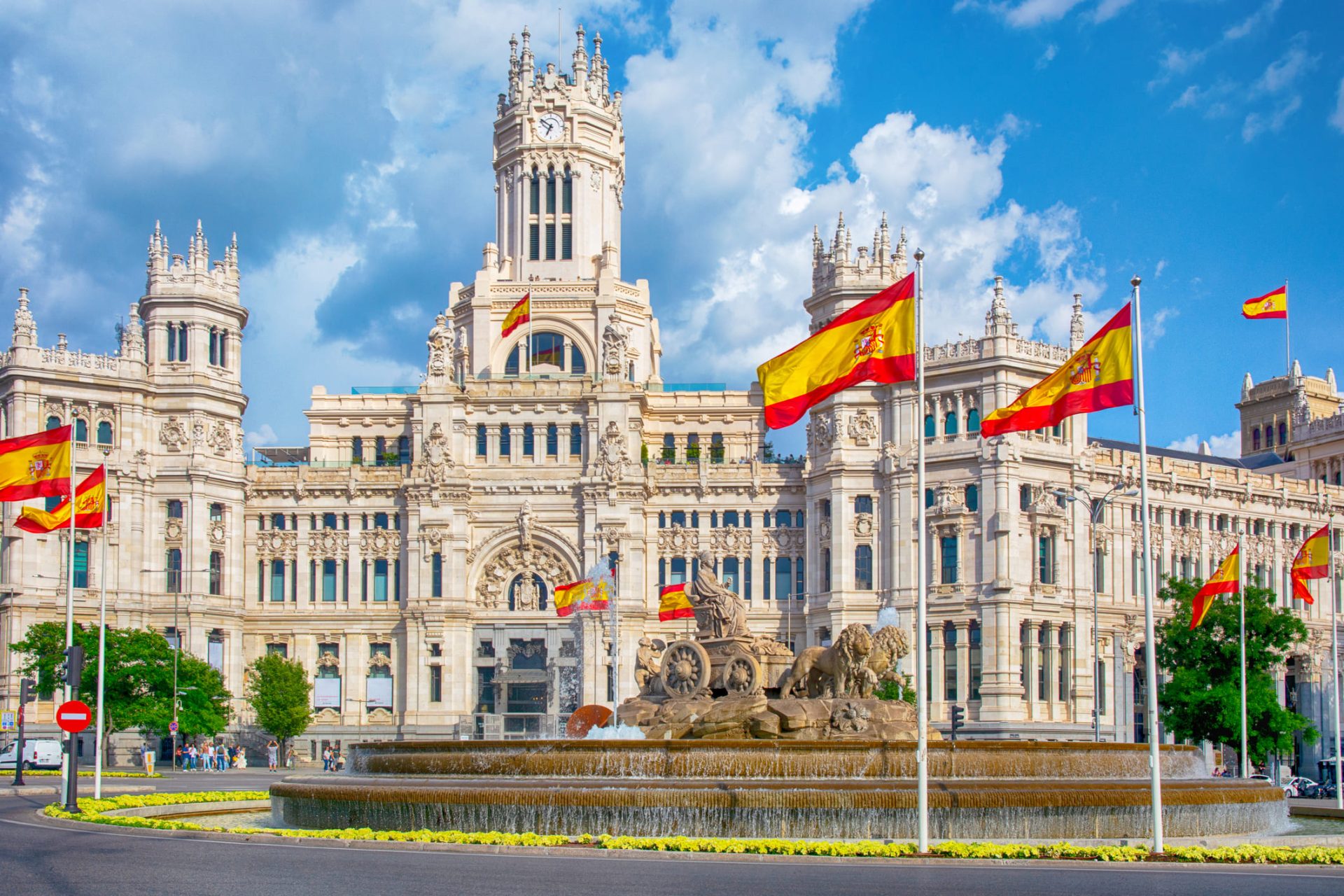
Your tour takes you past the Royal Palace, the official residence of the Spanish royal family, though they actually live in a smaller palace outside the city and use this one for state ceremonies. With more than 3,000 rooms, it's the largest royal palace in Western Europe by floor area, and its white stone facade looks out over formal gardens and the Almudena Cathedral. You'll see the Plaza Mayor, a grand square surrounded by arcades and red-painted buildings with hundreds of balconies, which has hosted markets, festivals, royal ceremonies and even bullfights since the 17th century. You'll drive along the Gran Vía, Madrid's grandest avenue, lined with early 20th-century buildings topped with domes and statues, and past the Cibeles Fountain, where the Roman goddess Cybele rides a chariot pulled by lions; it's also where fans of Real Madrid, one of the world's most famous football clubs, gather to celebrate their victories. You'll pass the Prado Museum, one of the greatest art museums in the world, home to masterpieces by Velázquez, Goya and El Greco, and the green expanse of the Retiro Park, with its lake and glass palace.

Then you visit Las Ventas, Madrid's famous bullring, built in 1931 in the neo-Mudéjar style, with red brick and colourful ceramic tiles inspired by Spain's Moorish architecture. It can hold around 23,000 spectators, and walking into the arena, you'll feel the drama of the place, with its sand ring and the rows of seats rising all around. Bullfighting is a centuries-old tradition in Spain, though it's increasingly debated today; the visit focuses on the building's architecture and history.

In the afternoon you drive south across the plains of La Mancha, the land of windmills and Don Quixote, to Toledo. As you approach, the city appears in one of the most spectacular settings in Europe: a hill crowded with churches, towers and houses of golden stone, wrapped on three sides by a deep gorge of the River Tagus. The view is so striking that the painter El Greco, who lived here in the 16th century, painted it again and again. The whole old city is a UNESCO World Heritage Site.

Toledo is known as the city of three cultures, because for centuries Christians, Muslims and Jews lived side by side here, and each left their mark on the city's streets, buildings and traditions. It was the capital of Spain until 1561, and for a time in the Middle Ages, it was one of the great centres of learning in Europe, where scholars translated ancient works from Arabic and Hebrew into Latin. Your guide leads you through the maze of narrow, winding lanes past the great Gothic cathedral, one of the most important in Spain, old synagogues, churches with Moorish-style brickwork and quiet courtyards.

Toledo has been famous for its swords for more than two thousand years. Roman soldiers prized blades made from Toledo steel, and medieval knights carried Toledo swords into battle. Today local workshops still make swords, many of them used as props in famous historical and fantasy films. At a traditional sword workshop, you see how the blades are forged and finished, and you'll also see damascene work, a delicate local craft in which fine gold and silver threads are hammered into blackened steel to create intricate patterns on jewellery, plates and boxes. Toledo is also famous for its marzipan, a sweet made from almonds and sugar that local nuns have been making for centuries, so look out for it in the bakeries.

In the evening you return to Madrid. As darkness falls, the city comes alive again, and you enjoy dinner with the group before a good night's rest.

Madrid is full of small pleasures. Near the Plaza Mayor stands Sobrino de Botín, which opened in 1725 and is recognised as the oldest restaurant in the world still in operation; the painter Goya is said to have worked there as a young man washing dishes. And no visit to Madrid is complete without churros con chocolate, crisp fried dough sticks dipped into thick, rich hot chocolate. The Chocolatería San Ginés, tucked in a lane near the Puerta del Sol, has been serving them since 1894, day and night, and Madrileños often stop there in the early hours after a late night out. If you love art, the Prado holds two of the most famous paintings in Spain: Velázquez's Las Meninas, a mysterious portrait of the young princess and her ladies-in-waiting in which the painter includes himself at his easel, and Goya's dark, haunting "Black Paintings", which he painted directly onto the walls of his house in his old age.

Included today: guided city tour of Madrid, Las Ventas bullring visit, sword workshop visit, guided tour of Toledo, breakfast, lunch, dinner.

Good to know: Toledo's streets are steep and cobbled, so wear comfortable shoes. Carry water and a hat, as summer afternoons are hot.

Day 3
Salamanca and on to Porto, with a Douro River cruise | A golden university city and a river into Portugal

Salamanca and on to Porto, with a Douro River cruise | A golden university city and a river into Portugal

⌖ Porto 🍽 Meals: Breakfast, Lunch, Dinner

Today you travel from the heart of Spain to the Atlantic coast of Portugal, stopping on the way in one of Spain's most beautiful cities. After breakfast, you check out of your hotel and the coach heads north-west across the plains of Castile, a vast landscape of golden wheat fields, sunflowers, vineyards and hilltop villages with castles and church towers.

By late morning you reach Salamanca, often called the Golden City because its buildings are made from a warm, honey-coloured sandstone that seems to glow in the sun, especially in the late afternoon. Your English-speaking guide shows you the highlights. You begin at the Plaza Mayor, built in the 18th century and often called the most beautiful square in Spain. It's surrounded on all four sides by elegant arcaded buildings, decorated with medallions carved with the faces of kings, queens and famous Spaniards, and it's the living room of the city, where students, families and visitors meet at café tables in the shade of the arcades.

Salamanca is above all a university city. The University of Salamanca, founded in 1218, is the oldest university in Spain and one of the oldest in Europe still in operation. Its scholars helped shape ideas about international law, economics and astronomy, and Christopher Columbus is said to have consulted its experts before his voyage across the Atlantic. Today thousands of students from around the world come here to study, and the city has a youthful, lively energy. The university's main facade is a masterpiece of Spanish Renaissance stone carving, so finely detailed that it looks like lace or silverwork, with portraits, coats of arms, mythological figures and plants. Hidden among the carvings is a tiny frog sitting on a skull, and tradition says that students who spot it will pass their exams and visitors who find it will have good luck. Your guide will help you look for it, but it's surprisingly hard to find.

Nearby stands the Casa de las Conchas, the House of Shells, a 15th-century mansion whose facade is decorated with around 300 carved scallop shells, the symbol of the Order of Santiago and of the pilgrims who walk the Camino de Santiago to the tomb of St. James in north-west Spain. Salamanca also has two cathedrals side by side, the old Romanesque one and the newer Gothic one.

After lunch, you continue west and cross the border into Portugal, the second country of your tour. Portugal is one hour behind Spain, so you'll gain an hour today. Portugal is one of the oldest nations in Europe, with borders that have barely changed since the 13th century, and despite its small size, it once ruled a vast empire stretching from Brazil to Africa and Asia. Its explorers changed the world: in 1498, the Portuguese navigator Vasco da Gama became the first European to reach India by sea, landing near Calicut on the Malabar coast, and for centuries the Portuguese ruled Goa. You'll see reminders of that shared history in Lisbon.

By late afternoon you reach Porto, Portugal's second city, built on steep hills above the River Douro, near where it flows into the Atlantic. Porto is so important to Portuguese history that it gave the country its name: in Roman times, the settlement here was called Portus Cale, which eventually became "Portugal". The city is famous worldwide for port, the sweet fortified wine made from grapes grown in the steep terraced vineyards of the Douro Valley, upstream.

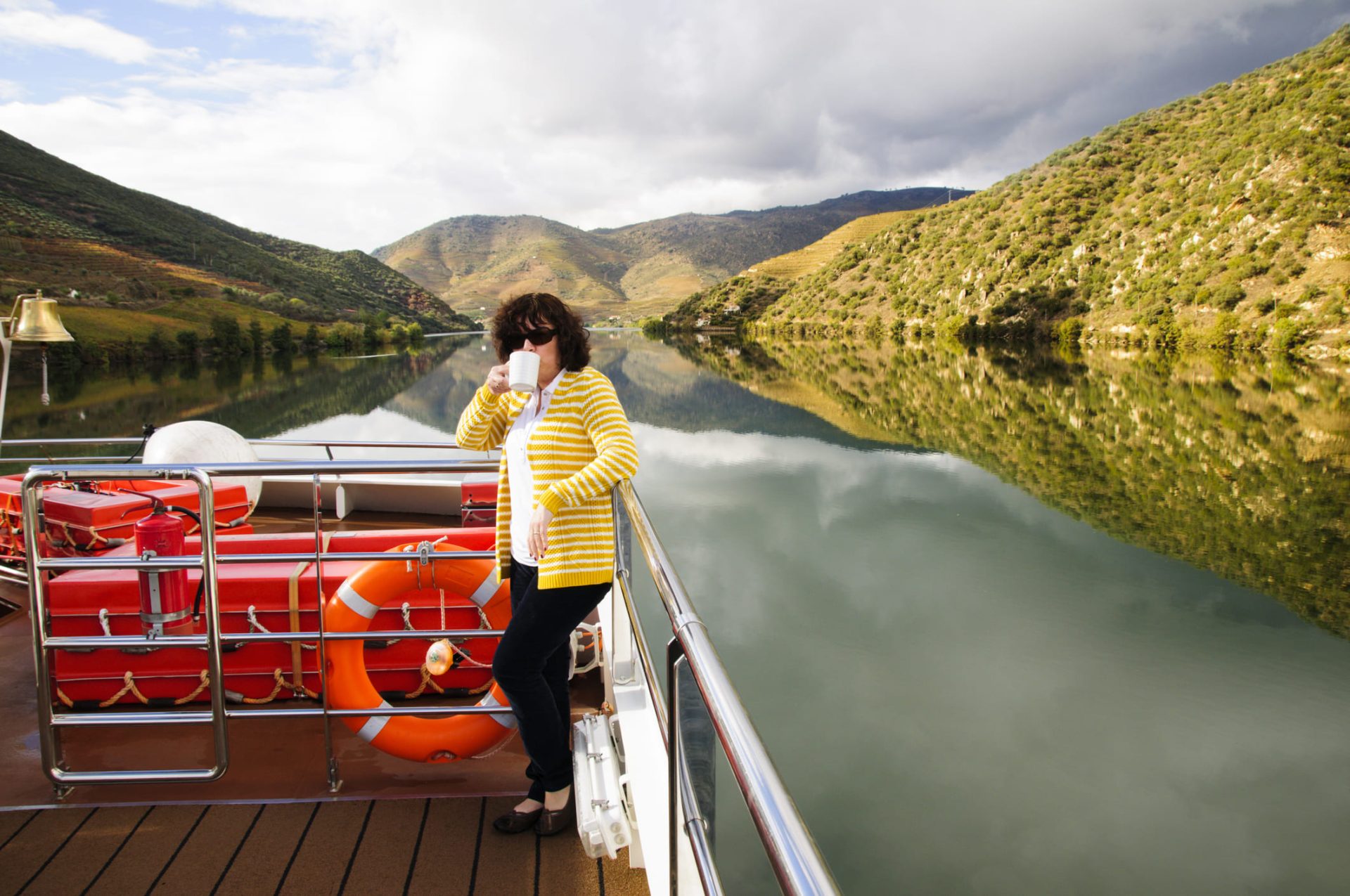
Then you board a boat for a cruise on the Douro River, and it's the perfect introduction to Porto. As the boat glides along, the city rises in tiers from the water: colourful houses stacked on top of each other, their facades covered in decorative tiles and their balconies hung with washing; church towers and domes; and the long riverside promenade of the Ribeira, lined with cafés. You'll pass under some of the six bridges that cross the river here, including the great double-decker iron arch of the Dom Luís I Bridge, designed by a partner of Gustave Eiffel and opened in 1886. On the opposite bank, in Vila Nova de Gaia, the names of famous port houses are painted in giant letters on the roofs of their wine cellars, and traditional wooden boats called rabelos, once used to carry barrels of port down the river from the vineyards, are moored along the quay. In the golden light of a summer evening, it's one of the loveliest sights in Europe.

After the cruise, you check in to your hotel in Porto and sit down to dinner with the group.

Included today: guided tour of Salamanca, coach to Porto, Douro River cruise, breakfast, lunch, dinner.

Good to know: remember to set your watch back one hour when you enter Portugal. Today has several hours of driving, so keep water and snacks on the coach.

Day 4

Porto city tour and on to Lisbon | Tiles, port wine and the road to the capital

⌖ Lisbon 🍽 Meals: Breakfast, Lunch, Dinner

Today you explore Porto with a local guide and then travel south to Lisbon, Portugal's capital. After breakfast, you check out of your hotel and the guided tour begins.

Porto's historic centre is a UNESCO World Heritage Site, a tangle of steep, narrow streets, staircases and alleys that tumble down the hill to the river. Your guide shows you the city's most famous sights. At São Bento railway station, step inside the grand entrance hall, whose walls are covered with around 20,000 blue-and-white painted tiles, called azulejos, showing scenes from Portuguese history and everyday life. Azulejos are one of Portugal's great art forms, and you'll see them everywhere, on churches, houses, shops and fountains, sometimes covering entire buildings. You'll also see the Clérigos Tower, a slender baroque bell tower that rises above the city's rooftops, the city's cathedral standing on a hill with views over the old town, and the grand Stock Exchange Palace.

Then you walk down to the Ribeira, the old riverside district, where brightly painted houses crowd together along the waterfront and café terraces look out across the river. Cross the lower deck of the Dom Luís I Bridge, or look up at its great iron arch, and you'll see why it has become the symbol of the city. Porto has a relaxed, friendly atmosphere, and its people are proud of their city; they're nicknamed "tripeiros", tripe-eaters, after a local legend that the people of Porto gave all their meat to the ships of an expedition in the 15th century and kept only the tripe for themselves.

Your guide also takes you across the river to the port wine cellars of Vila Nova de Gaia, where port has been aged in huge oak barrels for centuries. You'll learn how the wine is made from grapes grown in the steep terraces of the Douro Valley and why, in the days before roads and railways, it was carried down the river by boat to Porto to age in these cool, dark cellars. A tasting is usually offered at the end; it's optional, and you can enjoy the visit whether or not you drink.

Before you leave, look out for a Porto speciality: the francesinha, a hearty sandwich covered in melted cheese and sauce, which locals love, or more simply, a custard tart from a bakery.

In the afternoon you drive south to Lisbon, about three hours away. The motorway runs through the green, gentle countryside of central Portugal, past pine and eucalyptus forests, vineyards, olive groves and small whitewashed towns with red-tiled roofs. You'll pass near Coimbra, home to Portugal's oldest university, founded in 1290.

By evening you reach Lisbon, one of the oldest cities in Western Europe, spread across seven hills on the north bank of the Tagus River, where it widens into a vast estuary before meeting the Atlantic. As you approach, look out for the 25 de Abril Bridge, a long red suspension bridge that looks remarkably like San Francisco's Golden Gate Bridge, and for the giant statue of Christ the King on the far bank, with his arms outstretched over the river, inspired by the famous statue in Rio de Janeiro. You check in to your hotel and enjoy dinner with the group. If you have energy afterwards, Lisbon's warm summer evenings are perfect for a short stroll.

Porto has a surprising link with one of the most famous stories of our time. In the early 1990s, J.K. Rowling lived in Porto, teaching English, while she was working on the first Harry Potter book. Many fans believe that the city inspired details in the books: university students in Portugal still wear long black capes as part of their traditional academic dress, which look very much like the robes worn at Hogwarts. Fans also flock to the Livraria Lello, a bookshop opened in 1906, often called one of the most beautiful bookshops in the world, with a carved wooden ceiling, stained-glass skylight and a curving red staircase that seems to float in the middle of the room. Rowling herself has said she never visited it, but the legend has made it one of the most visited shops in Portugal, and there's often a queue outside.

On the road to Lisbon, the coach passes close to Coimbra, whose university, founded in 1290, has one of the most beautiful libraries in Europe, the Joanina Library, with gilded baroque bookcases. Remarkably, a small colony of bats lives in the library, and every night they come out to eat the insects that would otherwise damage the old books. Further south, the motorway passes near Fátima, one of the most important Catholic pilgrimage sites in the world, where three shepherd children reported seeing visions of the Virgin Mary in 1917. Millions of pilgrims visit every year, many of them walking for days to reach the vast square in front of the basilica.

Included today: guided city tour of Porto with a port wine cellar visit, coach to Lisbon, breakfast, lunch, dinner.

Good to know: Porto's streets are very steep, so wear comfortable shoes with good grip. The wine tasting is for adults only.

Day 5
Lisbon city tour, Sintra and Cabo da Roca | Explorers, palaces and the edge of Europe

Lisbon city tour, Sintra and Cabo da Roca | Explorers, palaces and the edge of Europe

⌖ Lisbon 🍽 Meals: Breakfast, Lunch, Dinner

Today you discover Lisbon, the city from which Portugal's explorers set sail to the world, then travel to the fairy-tale hills of Sintra and the westernmost point of mainland Europe. After breakfast, your local guide takes you on a tour of the capital.

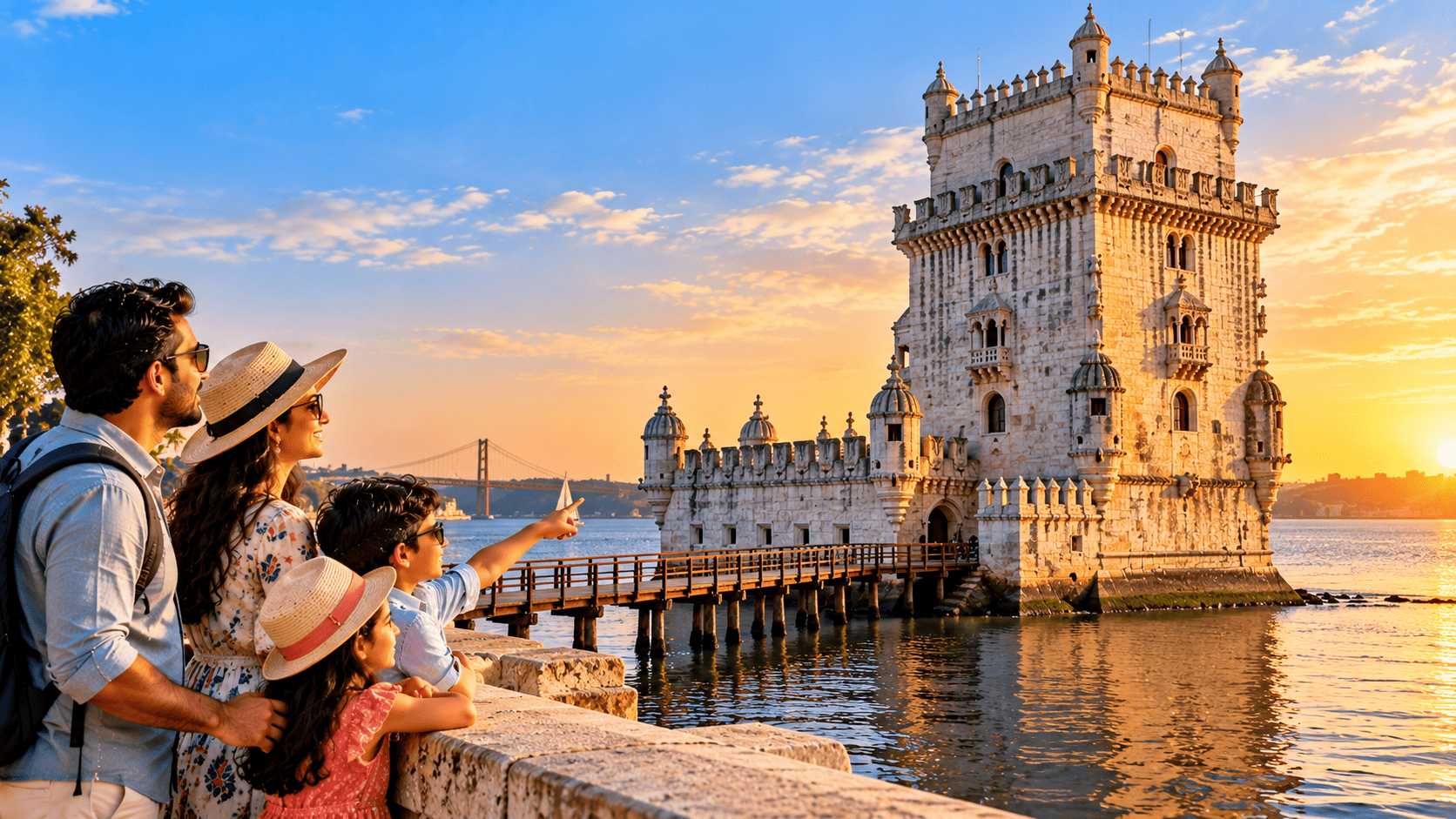
You begin in Belém, on the banks of the Tagus, where the story of Portugal's great Age of Discovery comes alive. It was from here, in 1497, that Vasco da Gama set sail on the voyage that took him around Africa to India, opening the sea route between Europe and Asia and changing the history of both continents. To celebrate the riches that followed, King Manuel I built the Jerónimos Monastery, a breathtaking building of pale limestone, carved with ropes, sea creatures, exotic plants and other symbols of the voyages of discovery, in a style that came to be called Manueline. Inside lies the tomb of Vasco da Gama himself. Nearby, standing at the water's edge, is the Belém Tower, a small, elegant fortress built in the early 16th century to guard the entrance to the harbour, with lacy stone balconies and watchtowers; it was the last sight of home for many sailors setting out to sea. Both are UNESCO World Heritage Sites. You'll also see the Monument to the Discoveries, a giant stone prow of a ship with figures of Portugal's explorers, navigators and princes gazing out towards the sea.

Belém is also home to one of Portugal's most famous treats: the pastéis de Belém, little custard tarts with crisp, flaky pastry and a creamy filling, baked from a secret recipe that has been used in a bakery here since 1837. Eat one warm, sprinkled with cinnamon and sugar.

Then your tour continues into the heart of the city to the Alfama, Lisbon's oldest district, a maze of steep, narrow lanes, stairways and tiny squares climbing the hill below St. George's Castle. It's one of the few parts of the city that survived the great earthquake of 1755, which destroyed much of Lisbon, so its layout still dates back to medieval and even Moorish times. Washing hangs between the houses, canaries sing in cages on the balconies, and the famous yellow trams squeal around impossibly tight corners. The Alfama is also the home of fado, Portugal's soulful traditional music, sung with deep emotion about longing, love and the sea, and recognised by UNESCO as part of the world's cultural heritage.

In the afternoon you drive west into the green, misty hills of Sintra, a place so beautiful that the poet Lord Byron called it a "glorious Eden". For centuries, Portuguese kings and nobles built summer palaces and romantic gardens here, in the cool forests above the hot plains, and the whole area is now a UNESCO World Heritage Site. Perched on a hilltop above the town stands the Pena Palace, a fantastical 19th-century castle painted in bright yellow and red, with domes, towers and battlements that look as if they've come straight from a fairy tale. Below it, the ruined walls of a Moorish castle snake along the ridge, and in the charming town centre, the white National Palace is crowned by two huge, conical chimneys. Wander the narrow lanes, browse the shops and try a travesseiro, Sintra's famous almond pastry.

Then you drive on to Cabo da Roca, the westernmost point of mainland Europe. Here, the land ends in high, windswept cliffs that drop more than a hundred metres into the crashing Atlantic waves. A stone monument carries a line from Portugal's greatest poet, Luís de Camões: "Where the land ends and the sea begins." Stand at the cliff's edge, feel the wind in your hair and look out across the endless ocean towards America, and you'll understand how this small country came to look outward to the world. In the evening you return to Lisbon for dinner.

Lisbon's city centre, the Baixa, tells the story of the great earthquake of 1755, which struck on the morning of All Saints' Day, followed by a tsunami and fires that destroyed much of the city. The king's chief minister, the Marquis of Pombal, rebuilt the centre with straight, wide streets in a neat grid and invented one of the first earthquake-resistant building systems in the world, with flexible wooden frames inside the walls. At its edge lies the Praça do Comércio, a vast square open to the river, framed by yellow arcades and a triumphal arch. Lisbon also has a deep link with Goa: it was from here, in 1541, that the missionary St. Francis Xavier sailed for India, and he is buried in the Basilica of Bom Jesus in Old Goa. For many Indian visitors, standing in the city from which these journeys began is a moving reminder of the long, complicated history the two countries share.

Included today: guided city tour of Lisbon including Belém and the Alfama, visit to Sintra, Cabo da Roca, breakfast, lunch, dinner.

Good to know: Cabo da Roca is often very windy, even on hot days, so keep a light jacket handy. Lisbon's hills and cobbled streets are steep and can be slippery, so wear shoes with good grip. Palace entries in Sintra are not included unless stated.

Day 6
Seville city tour and an evening flamenco show | The soul of Andalusia

Seville city tour and an evening flamenco show | The soul of Andalusia

⌖ Seville 🍽 Meals: Breakfast, Lunch, Dinner

Today you leave Portugal and travel to Seville, the passionate capital of Andalusia in southern Spain. After breakfast, you check out of your hotel in Lisbon and the coach heads south-east across the Alentejo, a vast, sun-drenched region of rolling plains, olive groves, vineyards and cork oak forests. Portugal produces about half of the world's cork, and you'll see the trees with their trunks stripped of bark in sections, a process that's done by hand every nine years without harming the tree. After a few hours you cross back into Spain, setting your watch forward an hour, and continue into Andalusia.

By early afternoon you reach Seville, the city of flamenco, bullfighting, orange trees and fiestas, and one of the most beautiful cities in Spain. In the 16th century, after Columbus's voyages, Seville became one of the richest cities in the world, because all the treasure ships from the Americas had to sail up the Guadalquivir River to unload here. That wealth shows in its grand buildings. Your local guide shows you the highlights.

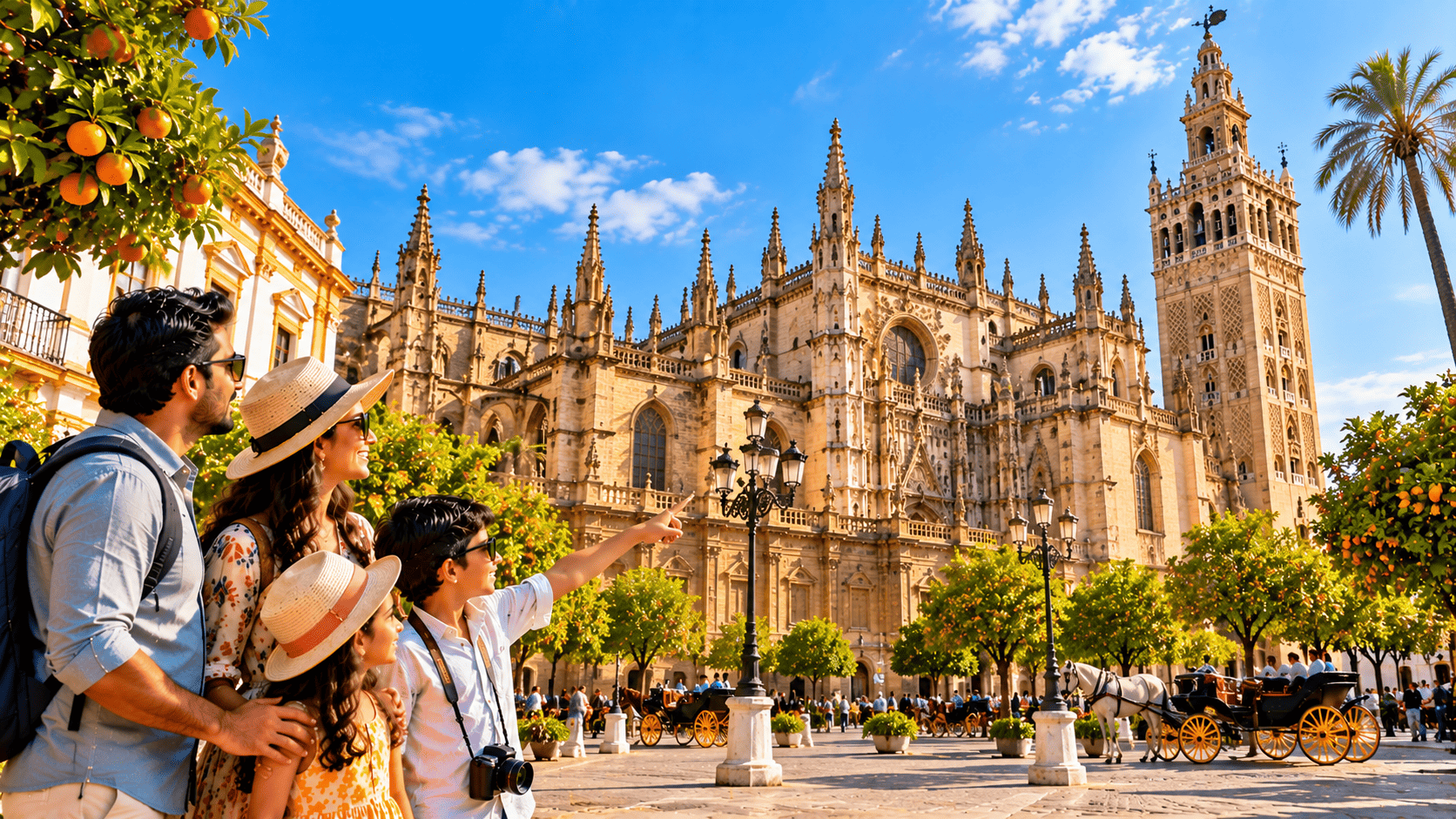
You begin with Seville Cathedral, the largest Gothic cathedral in the world. Its builders are said to have declared that they would build a church so large that future generations would think they were mad. Inside, the soaring stone vaults, the enormous golden altarpiece and the forest of columns are overwhelming. The tomb of Christopher Columbus stands here, his coffin carried on the shoulders of four larger-than-life figures representing the old kingdoms of Spain. Beside the cathedral rises the Giralda, its bell tower, which was originally the minaret of the great mosque that stood here in the 12th century; the upper part was added later by Christian builders, a perfect example of the way cultures have blended in Seville.

Then you visit the Real Alcázar, a magnificent royal palace that is still used by the Spanish royal family when they visit Seville, making it one of the oldest royal palaces in Europe still in use. Built and rebuilt over many centuries, much of it in the Mudéjar style, it's a dreamlike world of intricately carved arches, colourful tiles, painted wooden ceilings, quiet courtyards with pools and fountains, and lush gardens filled with orange trees, palms and peacocks. Fans of the television series Game of Thrones may recognise it: its gardens were used as the Water Gardens of Dorne.

Your tour then takes you through the Santa Cruz quarter, Seville's old Jewish neighbourhood, a romantic maze of whitewashed lanes, flower-filled balconies and little squares shaded by orange trees. You may also see the Plaza de España, a vast semicircular square built for an exhibition in 1929, lined with colourful tiled alcoves representing every province of Spain, and crossed by bridges over a small canal; it appeared in the Star Wars film Attack of the Clones.

In the evening, you experience one of the highlights of the whole trip: a flamenco show. Flamenco was born in Andalusia, and it's recognised by UNESCO as part of the world's cultural heritage. It grew out of the music and dance of the region's many communities, including the Roma, or gitanos, whose ancestors, as historians and linguists believe, travelled westward from northern India more than a thousand years ago. As the lights dim, the guitarist begins to play, the singer's voice rises with raw emotion, and the dancer begins to move, slowly at first, then faster and faster, heels drumming on the wooden floor, hands clapping, skirt swirling. The intensity, passion and skill are breathtaking, and many Indian travellers notice echoes of the rhythms and footwork of Indian classical dance. It's an unforgettable evening. Afterwards, you return to your hotel in Seville.

Seville has more surprises around every corner. Its streets are lined with thousands of orange trees, but their oranges are so bitter that nobody eats them fresh; instead, many are shipped to Britain, where they're made into marmalade. In the modern part of the old town, you'll see the Metropol Parasol, nicknamed "Las Setas", the mushrooms, a huge wavy wooden canopy that's one of the largest wooden structures in the world, with a walkway on top offering views over the rooftops. Sevillanos love a celebration: in spring, the city fills with candlelit processions during Holy Week, and then comes the April Fair, a week of flamenco dresses, horse-drawn carriages, dancing and music in hundreds of colourful tents. Even in summer, when the heat keeps people indoors in the afternoon, the city comes alive again after sunset, with families strolling, children playing in the squares and café terraces full until long after midnight.

Included today: coach Lisbon to Seville, guided city tour of Seville with the Cathedral and Alcázar, flamenco show, breakfast, lunch, dinner.

Good to know: Seville is one of the hottest cities in Europe in summer, often over 38°C in the afternoon, so carry water, a hat and sunscreen. Set your watch forward one hour when you return to Spain. Shoulders and knees should be covered in the cathedral.

Day 7
Cordoba and the Mezquita, then on to Granada | A forest of arches

Cordoba and the Mezquita, then on to Granada | A forest of arches

⌖ Granada 🍽 Meals: Breakfast, Lunch, Dinner

Today you travel through the heart of Andalusia to two cities that were once among the greatest in Europe. After breakfast, you check out of your hotel in Seville and the coach heads east along the valley of the Guadalquivir River. The landscape is pure southern Spain: endless rows of olive trees covering the rolling hills in silvery green, fields of sunflowers turning their faces to the sun, whitewashed villages clinging to hilltops and, here and there, a ruined castle watching over the plain. Andalusia produces a huge share of the world's olive oil, and you'll see olive groves almost all the way.

By late morning you reach Cordoba. A thousand years ago, Cordoba was one of the largest and most sophisticated cities in the world, the capital of a Muslim caliphate that ruled most of Spain. At its height, in the 10th century, it had paved and lit streets, hundreds of mosques, public baths, markets, and libraries containing hundreds of thousands of books, at a time when most of Europe's cities were small and poor. Scholars, poets, doctors and philosophers, Muslim, Jewish and Christian, made it a beacon of learning.

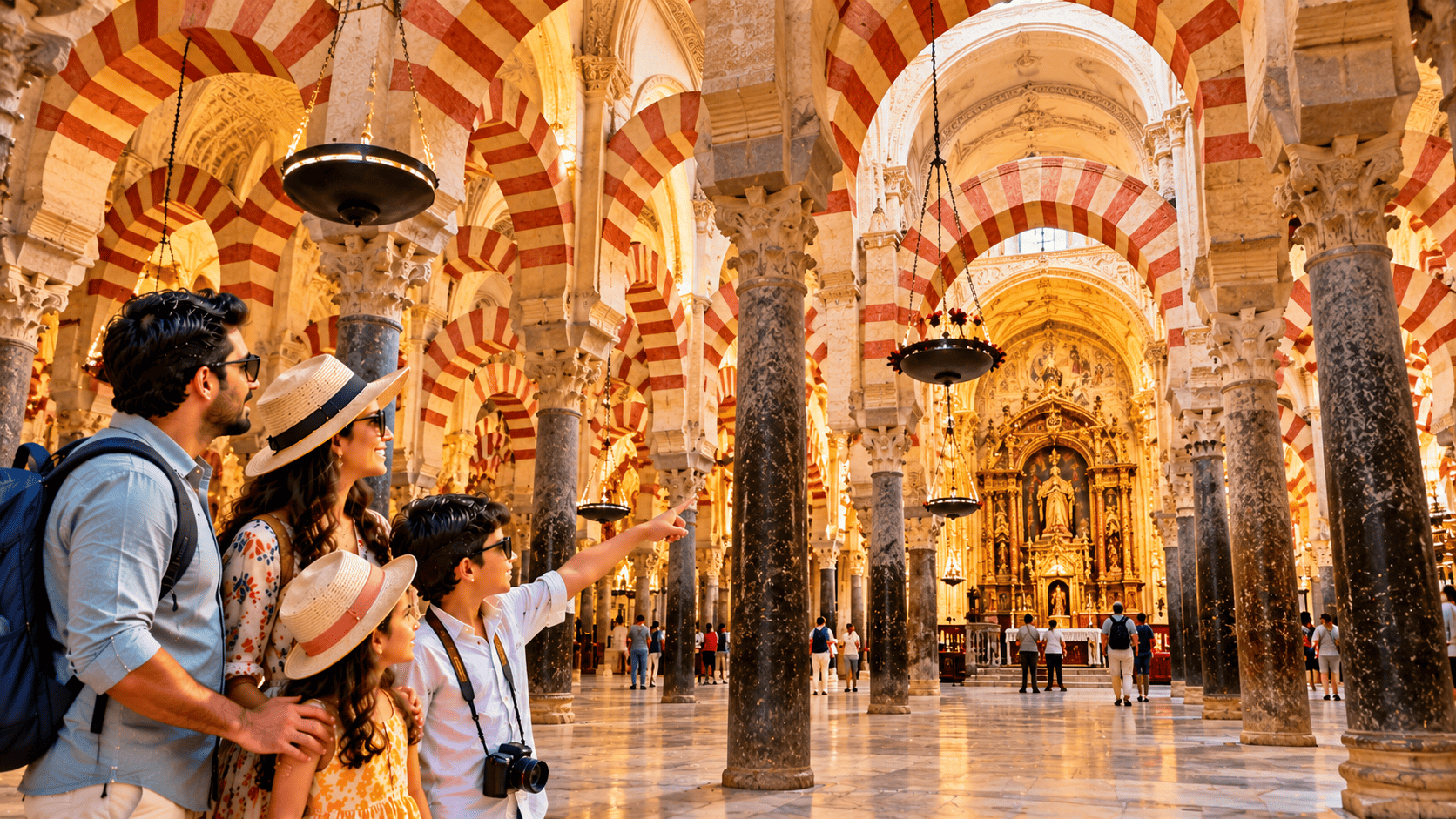
Your local guide leads you to the city's greatest treasure, the Mezquita-Catedral, the Mosque-Cathedral of Cordoba, and one of the most extraordinary buildings in the world. Construction of the great mosque began in 785, and over the next two centuries it was enlarged again and again until it became one of the largest mosques in the world. As you step inside, your eyes take a moment to adjust to the soft, dim light, and then you see it: a vast forest of more than 800 columns of jasper, onyx, marble and granite, many of them reused from older Roman and Visigothic buildings, stretching away in every direction. Above them rise double arches striped in red brick and white stone, row after row, creating endless shifting patterns as you walk. It feels peaceful, mysterious and almost infinite.

At the far end lies the mihrab, the prayer niche, decorated with dazzling golden mosaics and delicate carvings, a gift from the Byzantine emperor in the 10th century. Then comes the great surprise: in the middle of the mosque stands a soaring Renaissance cathedral, built inside it in the 16th century after the city had become Christian. The contrast between the low forest of arches and the tall, bright Christian nave is astonishing. According to a famous story, when the emperor Charles V saw the finished cathedral, he regretted it and said that they had built something that could be found anywhere and destroyed something that was unique in the world.

After the visit, wander through the Judería, Cordoba's old Jewish quarter, a maze of narrow white lanes, with flowerpots hanging on the walls and glimpses into cool courtyards filled with plants. Cordoba is famous for its patios, private courtyards decorated with hundreds of flowerpots, which families open to visitors each May during a much-loved festival. Look out, too, for the old Roman bridge spanning the river, with the Mezquita rising behind it.

In the afternoon you continue south-east through olive country towards Granada, set at the foot of the Sierra Nevada mountains. Granada was the last Muslim kingdom in Spain, and it fell to the Catholic monarchs Ferdinand and Isabella in 1492, the same year Columbus sailed for the Americas. As you approach the city, look up towards the hills: on a clear day, you may glimpse the red walls of the Alhambra on its hill above the city, with the peaks of the Sierra Nevada behind, often still streaked with snow in early summer. Granada is a lively university city, and in many of its bars, a free tapa still comes with every drink, a tradition that visitors love. In the evening you check in to your hotel and enjoy dinner with the group. Tomorrow, the Alhambra.

Cordoba was the birthplace of two of the greatest thinkers of the Middle Ages: the Muslim philosopher Averroes, whose writings on Aristotle shaped European thought for centuries, and the Jewish philosopher and doctor Maimonides, whose statue sits in a small square in the Judería. Their lives are a reminder of the time when Cordoba was one of the great centres of learning in the world.

In Granada, if you have a little energy this evening, ask your tour manager about the Mirador de San Nicolás, a small square at the top of the Albaicín quarter, which offers the most famous view of the Alhambra, glowing red and gold at sunset with the Sierra Nevada behind. Nearby is the Sacromonte, a hillside where families have lived for generations in whitewashed cave houses dug into the rock, and where some of the most passionate flamenco in Spain is performed.

Included today: coach Seville to Granada, guided tour of Cordoba with Mezquita-Catedral entry, breakfast, lunch, dinner.

Good to know: the Mezquita is an active church, so dress modestly, with shoulders and knees covered. Cordoba is very hot in summer, so carry water and a hat.

Day 8
The Alhambra and Generalife Gardens, then on to Valencia | A palace of lace and water

The Alhambra and Generalife Gardens, then on to Valencia | A palace of lace and water

⌖ Alicante / Valencia 🍽 Meals: Breakfast, Lunch, Dinner

Today you visit one of the most beautiful places on earth. After breakfast, you check out of your hotel and your local guide takes you up the hill to the Alhambra, the palace-city of the Nasrid sultans of Granada, a UNESCO World Heritage Site and Spain's most visited monument.

The Alhambra's name comes from the Arabic for "the red one", after the reddish colour of its walls. From the outside, it looks like a fortress: tall walls and towers rising from a wooded hill above the city. But inside lies a world of astonishing beauty. Most of what you see was built in the 13th and 14th centuries by the Nasrid dynasty, the last Muslim rulers in Spain, and it was designed as a paradise on earth.

You enter the Nasrid Palaces, the heart of the Alhambra, and walk through a sequence of halls and courtyards, each more beautiful than the last. The walls are covered with carved plaster so delicate that it looks like lace, with flowing patterns of leaves, geometric stars and Arabic calligraphy. One phrase is repeated thousands of times: "There is no victor but God", the motto of the Nasrid dynasty. Ceilings rise in honeycomb-like domes made of thousands of tiny carved pieces, called muqarnas, that seem to drip like stalactites. Colourful tiles in geometric patterns line the lower walls. In the Court of the Myrtles, a long, still pool reflects the arches and the tall Comares Tower like a mirror, and in the famous Court of the Lions, twelve marble lions support a fountain at the centre of a courtyard surrounded by a forest of slender columns. Water is everywhere: in pools, fountains and tiny channels that run through the floors, filling the palace with the soft sound of flowing water, which was precious in this hot, dry land.

From the palace windows, you look out over the old Albaicín quarter on the opposite hill, a jumble of white houses and gardens, and the green valley below. When the Catholic monarchs captured Granada in 1492, they were so impressed by the Alhambra that they decided to keep it rather than destroy it, and it was here that they met Christopher Columbus to agree to his voyage. Centuries later, the American writer Washington Irving lived in the palace for a time and wrote his Tales of the Alhambra, published in 1832, which made the palace famous around the world.

Then you walk to the Generalife, the summer palace and gardens of the sultans, on the hillside above the Alhambra. Here, the sultans came to escape the heat and the business of court. The gardens are a delight: terraces of roses, oleanders and cypress trees, clipped hedges, and the famous Patio de la Acequia, a long courtyard garden with a narrow pool down the middle, lined by arching jets of water and flowerbeds. In summer, the scent of jasmine and roses fills the air, and the views back over the Alhambra and the city are unforgettable.

After lunch, you leave Granada and drive east towards the Mediterranean coast. The road crosses dramatic, sun-baked landscapes of mountains and dry valleys, then descends to the fertile coastal plains, with orange and lemon groves, rice fields and palm trees. This is the region of Valencia, one of Spain's great agricultural gardens, famous for its oranges and for one of the world's best-known dishes: paella, which originated here, cooked in a wide, shallow pan over an open fire. By evening you reach your hotel in the Alicante or Valencia area, near the Mediterranean, and enjoy dinner with the group.

The Alhambra holds more treasures. Inside its walls stands the Palace of Charles V, built in the 16th century in the Renaissance style, with a surprising design: a perfect circular courtyard inside a square building. At the western tip of the hill rises the Alcazaba, the oldest part of the Alhambra, a fortress whose watchtower, the Torre de la Vela, gives panoramic views across the city and the plains. The Alhambra has inspired artists and musicians for centuries: one of the most famous pieces ever written for the Spanish guitar, "Recuerdos de la Alhambra" (Memories of the Alhambra), composed by Francisco Tárrega in 1896, imitates the sound of the palace's trickling fountains with a delicate, shimmering tremolo. Visitor numbers are strictly limited each day to protect the palaces, which is why tickets sell out weeks in advance, and why visiting with a group, with your entry already arranged, is such an advantage.

Included today: guided tour of the Alhambra with Nasrid Palaces and Generalife Gardens entry, coach to Valencia / Alicante, breakfast, lunch, dinner.

Good to know: entry to the Nasrid Palaces is at a fixed, timed slot, so please be punctual with the group. There is a lot of walking on uneven paths and slopes at the Alhambra; wear comfortable shoes and carry water. The drive to Valencia takes around five hours.

Day 9
Valencia city tour and on to Barcelona | A city of the future and a city of the past

Valencia city tour and on to Barcelona | A city of the future and a city of the past

⌖ Barcelona 🍽 Meals: Breakfast, Lunch, Dinner

Today you discover Valencia, Spain's third-largest city, and then travel up the Mediterranean coast to Barcelona. After breakfast, your local guide takes you on a tour of the city.

Valencia has one of the most remarkable stories of any city in Spain. For centuries, the River Turia ran through the city centre, but after a devastating flood in 1957, the river was diverted around the city. The old riverbed was turned into a park, the Turia Gardens, a nine-kilometre ribbon of green that winds through the heart of the city, with paths, playgrounds, sports fields, fountains and gardens, crossed by the old stone bridges that once spanned the river.

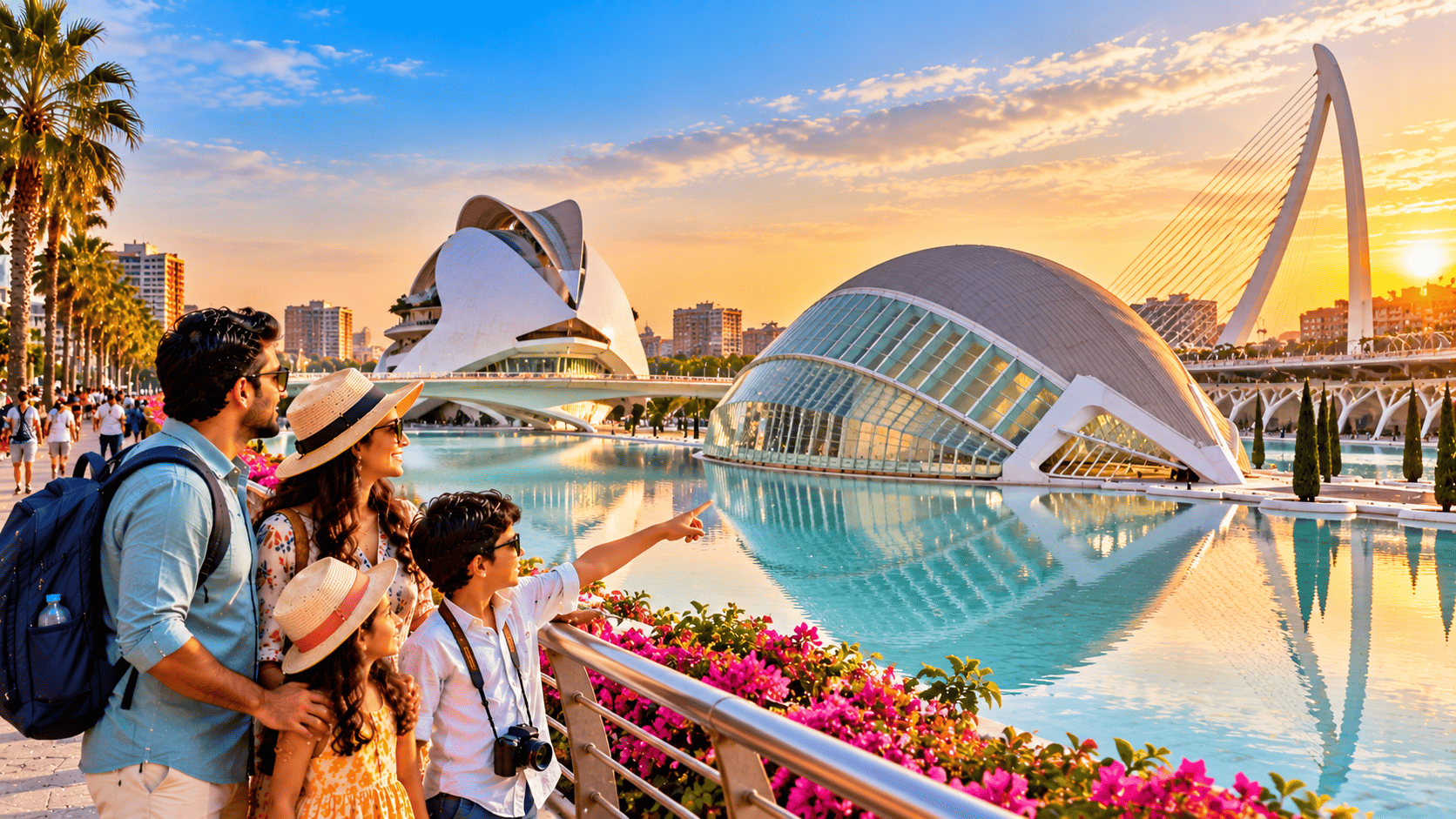
At one end of the park stands the City of Arts and Sciences, one of the most spectacular modern architectural complexes in Europe. Designed mostly by the Valencian architect Santiago Calatrava, its gleaming white buildings look like giant skeletons, eyes, shells and sails, rising from shallow turquoise pools. There's an opera house shaped like a helmet, a science museum like the skeleton of a whale, a planetarium shaped like a giant eye that opens and closes, and L'Oceanogràfic, the largest aquarium in Europe. Walking among these futuristic shapes, reflected in the water under the summer sun, feels like stepping into a science-fiction film.

Then you head into the old town. Valencia Cathedral combines Romanesque, Gothic and baroque styles, and in one of its chapels, it keeps a cup of agate that tradition says is the Holy Grail, the cup used by Jesus at the Last Supper. Its bell tower, the Miguelete, rises above the old town's rooftops. Nearby, the Central Market is one of the largest and most beautiful food markets in Europe, built in the early 20th century with a soaring iron and glass roof and colourful tiles; inside, hundreds of stalls overflow with oranges, vegetables, olives, cheeses, spices and fresh seafood. Across the street stands La Lonja, the old silk exchange, a Gothic masterpiece whose great hall is held up by twisting stone columns like palm trees; it's a UNESCO World Heritage Site and a reminder of Valencia's wealth as a trading city in the 15th century.

Valencia is famous for its festivals, above all Las Fallas, held every March, when giant, colourful sculptures, some taller than a house, are built all over the city and then burned in a single night of fire and fireworks. And on a hot day, try a glass of horchata, a cool, sweet, milky drink made from tiger nuts, a Valencian speciality, perfect with a long, thin pastry called a farton.

In the afternoon you drive north along the Mediterranean coast to Barcelona. The road passes orange groves, rice fields, holiday towns and long sandy beaches, with the blue sea sparkling on your right. After about three and a half hours, you reach Barcelona, the capital of Catalonia, set between the mountains and the sea. Catalonia has its own language, Catalan, which you'll see on signs everywhere alongside Spanish, and a proud culture of its own. You check in to your hotel for two nights and enjoy dinner with the group.

Valencia is the birthplace of paella, and the Valencians are very particular about it. The traditional Valencian paella is made with rice, saffron, green beans, butter beans, and chicken and rabbit, cooked in a wide, shallow pan over a wood fire until a thin, crispy, caramelised layer, called the socarrat, forms at the bottom of the pan; that crust is considered the best part. For vegetarians, paella de verduras, made with seasonal vegetables, is just as delicious. The region's rice grows in the paddy fields of the Albufera, a large freshwater lagoon just south of the city, where you'll see herons and egrets wading among the rice.

The city also has one of the oldest courts in the world. Every Thursday at noon, for around a thousand years, the Water Tribunal has met outside the cathedral door to settle disputes between farmers about irrigation water from the canals. The judges are farmers themselves, dressed in black smocks; the hearings are held in the Valencian language, with no written records, and the decisions are final. UNESCO recognises it as part of the world's intangible heritage. Not far from Valencia, the town of Buñol holds La Tomatina every August, when thousands of people pelt each other with tonnes of ripe tomatoes in the world's biggest food fight, a festival made famous for Indian audiences by the film Zindagi Na Milegi Dobara.

On the road north to Barcelona, the coast is dotted with old fishing towns and castles. Look out for Peñíscola, a white walled town on a rocky peninsula jutting into the sea, crowned by a castle once home to a medieval pope, and used as a filming location for the television series Game of Thrones.

Included today: guided tour of Valencia with the City of Arts and Sciences (exterior), cathedral and old town, coach to Barcelona, breakfast, lunch, dinner.

Good to know: entry to the museums and aquarium inside the City of Arts and Sciences is not included. Valencia is hot in summer, so carry water and sunscreen.

Day 10
Barcelona city tour, Sagrada Família and Montserrat | Gaudí's city and the sacred mountain

Barcelona city tour, Sagrada Família and Montserrat | Gaudí's city and the sacred mountain

⌖ Barcelona 🍽 Meals: Breakfast, Lunch, Dinner

Your last full day is in Barcelona, one of the most exciting cities in Europe, a city of extraordinary architecture, Mediterranean beaches, lively streets and Catalan pride. After breakfast, your English-speaking guide takes you on a tour of the city.

You begin with a walking tour of the Gothic Quarter, the oldest part of Barcelona, where the Romans founded a town more than 2,000 years ago; you can still see sections of the Roman walls. Its narrow, winding lanes open onto quiet squares and lead to medieval palaces and churches. In the Plaça del Rei, the King's Square, stands the old royal palace with its great hall, the Saló del Tinell, the Royal Chapel of Santa Àgata and the Palau del Lloctinent, the viceroy's palace. Tradition says that it was here, on the palace steps, that King Ferdinand and Queen Isabella received Christopher Columbus on his return from his first voyage to the Americas. Nearby rises Barcelona Cathedral, with its Gothic spires and a cloister where thirteen white geese live, one for each year of the life of the city's patron saint, Eulàlia.

Then you see Plaça de Catalunya, the great central square of the city, and walk along La Rambla, Barcelona's most famous street, a wide, tree-lined promenade running down to the sea, full of flower stalls, street performers and cafés. Halfway down, peek into La Boqueria, a colourful food market piled high with fruit, sweets and spices. At the bottom, near the port, the Columbus Monument rises high above the waterfront, with the explorer's statue pointing out to sea. Your tour also takes you up to Montjuïc, the hill overlooking the city and the harbour, where you'll see the Olympic Stadium, the main stadium of the 1992 Olympic Games, which transformed Barcelona into one of the world's favourite cities, and the Olympic Village by the sea.

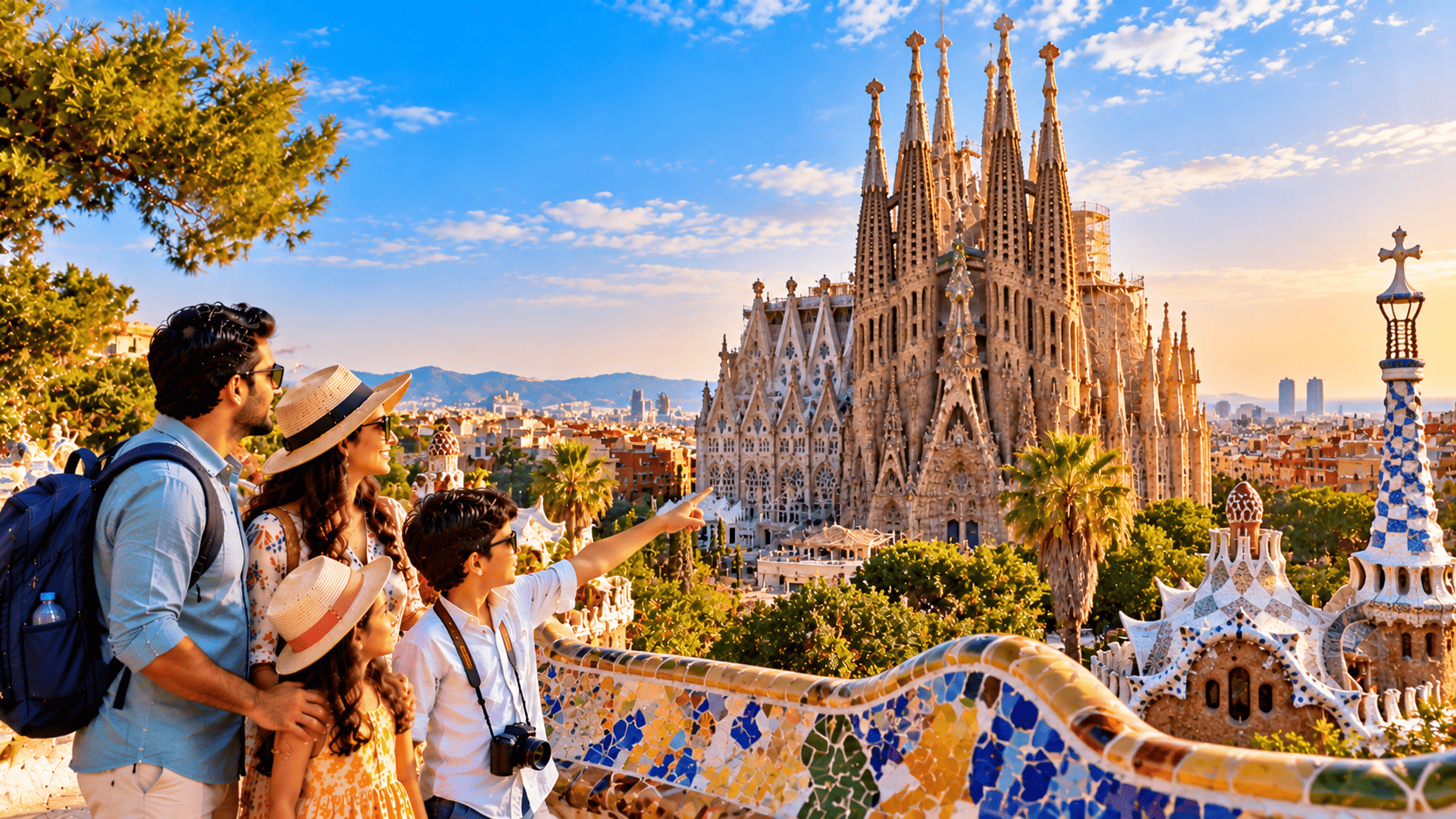
Then comes the Sagrada Família, the masterpiece of Antoni Gaudí, Barcelona's most famous architect, and one of the most extraordinary buildings in the world. Construction began in 1882, and Gaudí devoted more than forty years of his life to it, until his death in 1926; it's still being built today, funded entirely by donations and visitors' tickets. Its towers rise like giant sandcastles or stalagmites above the city, and its facades are covered with sculptures of people, animals and plants, telling the story of Christ's birth, death and resurrection. Gaudí took his inspiration from nature: the columns inside branch like trees, and the stained-glass windows fill the space with a forest of coloured light. When the central tower, dedicated to Jesus Christ, is complete, it will make the Sagrada Família the tallest church in the world, at 172.5 metres, deliberately just lower than the nearby hill of Montjuïc, because Gaudí believed his work should not rise above the work of God. As you drive around the city, look out for Gaudí's other fantastical buildings, like the wavy Casa Milà and the colourful, bone-like Casa Batlló on the elegant Passeig de Gràcia.

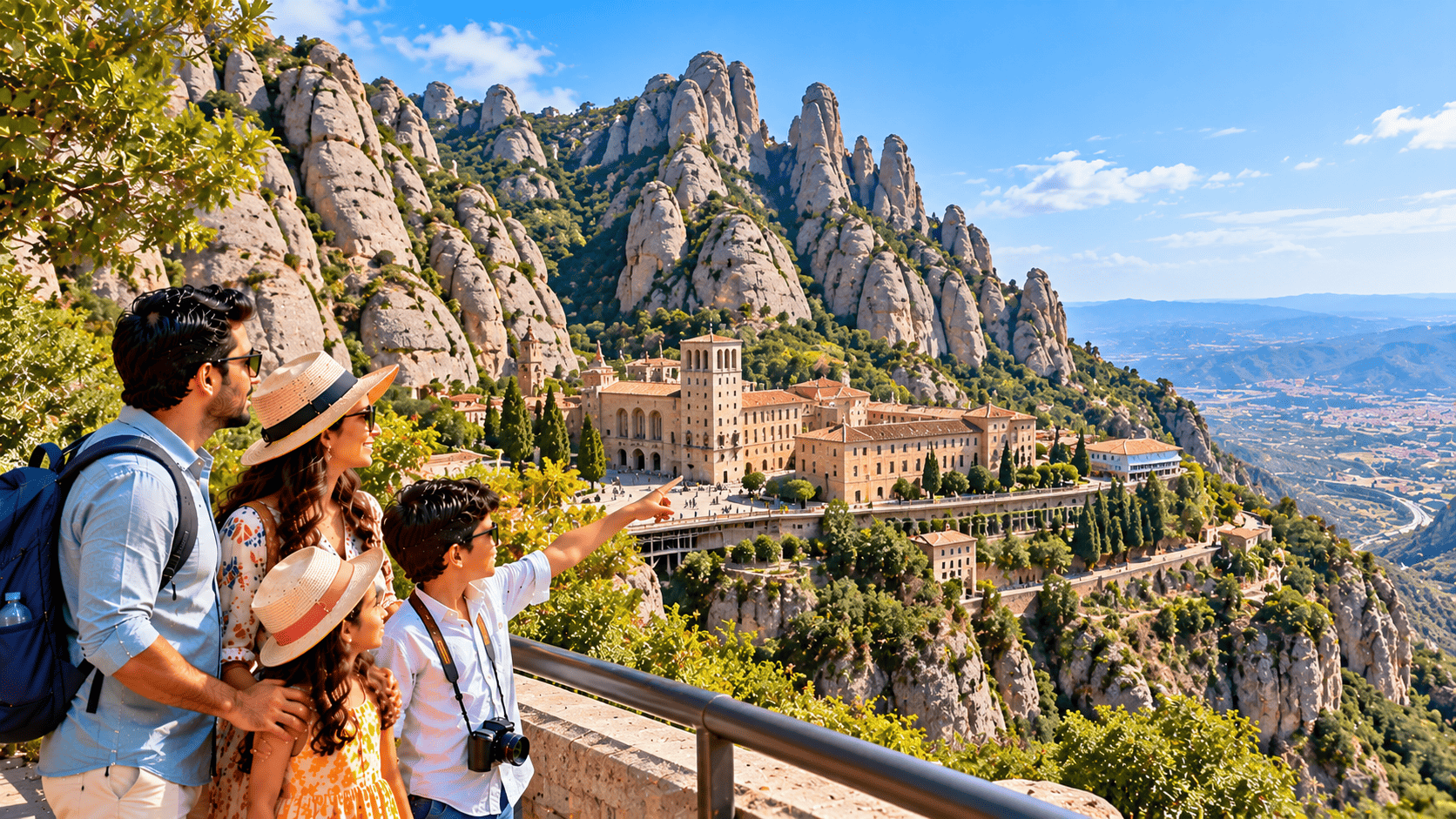
In the afternoon you leave the city for an excursion to Montserrat, about an hour inland. Montserrat means "serrated mountain", and as you approach, you'll see why: a jagged ridge of pink rock pinnacles rises abruptly from the plains, like the teeth of a giant saw. Clinging to the mountainside, about 700 metres up, is the Benedictine monastery of Montserrat, founded almost a thousand years ago and still home to a community of monks. It's Catalonia's most sacred place, and pilgrims come from all over to visit the Black Madonna, La Moreneta, a dark wooden statue of the Virgin Mary and Child, the patron saint of Catalonia. The monastery also has one of the oldest boys' choirs in Europe, the Escolania, whose pure voices fill the basilica during services. There's free time to explore the basilica, the museum, the market stalls selling local cheese, honey and sweets, and the viewpoints, where the views across Catalonia, all the way to the Pyrenees on a clear day, are breathtaking. In the evening you return to Barcelona for your farewell dinner with the group.

Catalan culture has its own wonderful traditions. At festivals, teams of people climb on each other's shoulders to build castells, human towers up to ten levels high, with a small child scrambling to the very top to raise a hand before the tower is carefully dismantled; UNESCO recognises them as part of the world's intangible heritage. And every year on 23 April, Sant Jordi's Day, the streets of Barcelona fill with stalls, as people give each other books and red roses. Barcelona is also home to FC Barcelona, whose motto is "Més que un club", more than a club, and whose stadium, Camp Nou, is one of the largest in Europe.

Included today: guided walking tour of the Gothic Quarter, Barcelona city tour with Montjuïc, Sagrada Família (exterior), excursion to Montserrat, breakfast, lunch, dinner.

Good to know: entry inside the Sagrada Família is not included unless stated. The Escolania choir sings at set times and not every day. Keep a close eye on bags and phones on La Rambla and in crowded areas.

Day 11
Departure from Barcelona | Home with Iberia in your heart

Departure from Barcelona | Home with Iberia in your heart

⌖ Barcelona 🍽 Meals: Breakfast

Your journey around Spain and Portugal comes to an end today. Before you leave, take a quiet moment over breakfast to look back on everything you've seen in the past eleven days. You began in Madrid, with its royal palace and grand avenues, and walked the ancient lanes of Toledo, the city of three cultures. You searched for the lucky frog on the university facade in Salamanca, cruised the Douro in Porto past its colourful riverfront, and stood in Belém, where Vasco da Gama set sail for India. You wandered through the fairy-tale palaces of Sintra and stood at Cabo da Roca, where the land ends and the sea begins. In Seville, you saw the tomb of Columbus and felt the passion of flamenco. In Cordoba, you walked through the forest of arches of the Mezquita, and in Granada, you marvelled at the lacework walls of the Alhambra. Then came the futuristic white buildings of Valencia and, finally, Gaudí's Barcelona and the sacred mountain of Montserrat. That's two countries, eleven days and a thousand years of history, all in one unforgettable journey.

If you have a little time this morning, take a last walk in Barcelona. In summer, the city's long sandy beaches, such as Barceloneta, come alive early with joggers, swimmers and sunbathers, and the promenade along the sea is perfect for a final stroll in the Mediterranean sunshine. Or simply sit at a café, order a café con leche or a cool drink, and watch the city go by.

Then it's time to pack. Over the past days you may have collected souvenirs: Portuguese azulejo tiles, a cork bag or wallet from Portugal, a bottle of port, olive oil from Andalusia, a Toledo damascene brooch, a flamenco fan, saffron from La Mancha, a Real Madrid or Barcelona football shirt, or Gaudí-inspired ceramics. Wrap fragile items, such as tiles, ceramics and bottles, carefully in clothes and place them in the middle of your suitcase. Liquids over 100 ml, including olive oil, wine and port, must go in your checked baggage. Keep your passport, tickets, medicines and a light jacket in your hand luggage. If you made a large purchase and the shop gave you a tax-free form, keep it with your receipt and the goods, as it may need to be checked at the airport before you check in.

After breakfast, you check out and the coach takes you to Barcelona's El Prat Airport, a short drive from the city near the coast. As you drive, look back at the city: the mountains behind, the sea in front, and Gaudí's towers rising above the rooftops.

This is also the moment to say goodbye to your tour manager, who has guided you across two countries and thousands of kilometres, and to the friends you've made along the way. Over eleven days of palaces, cathedrals, flamenco and long sunny lunches, many travellers find that their fellow passengers have become friends for life. Exchange contact details and promise to share photographs; you'll have plenty to remember.

At the airport there's time for a final coffee and some last-minute shopping, perhaps a box of turrón, the Spanish almond nougat, for the family at home. Then it's time to board your flight, carrying the colours, flavours and sounds of Spain and Portugal with you. ¡Hasta pronto! See you soon.

As you fly home, you may notice how much of Portugal and Spain is already part of India. The Portuguese, who arrived on India's west coast more than 500 years ago, left behind many words that are still used in Hindi, Marathi, Konkani and other Indian languages: chaabi, the key, comes from the Portuguese chave; almari, the cupboard, from armário; baalti, the bucket, from balde; pav, the bread of Mumbai's vada pav, from pão; girja, the church, from igreja; and ananas, the pineapple, from ananás. Many everyday foods also came to India with the Portuguese, including chillies, potatoes, tomatoes, cashew nuts and papayas. It's hard to imagine Indian food without them today, yet they first arrived on Portuguese ships.

So when you're back home, eating a spicy curry or a plate of vada pav, you may just remember this journey, and smile. And with all the places you haven't yet seen, from the beaches of the Algarve to the islands of Mallorca and the Canary Islands, Spain and Portugal will always have a reason to welcome you back.

One last thought: the Spanish and Portuguese have a gift for enjoying life slowly, lingering over long lunches, strolling in the evening and talking late into the night. If you carry home a little of that unhurried spirit, it may be the best souvenir of all.

Included today: breakfast, departure transfer to Barcelona airport.

Good to know: book a flight that leaves at least 3 hours after the transfer reaches the airport; we'll confirm the transfer time when you book.

Hotel confirmation

Hotel names will be provided after booking, subject to availability and confirmation. We do not hold hotel confirmations before booking.

Inclusions

Hotels: Guaranteed 04 Star

Meals: All Meals Included

Sightseeing: All Tours included

Exclusions

Flights

Visa

Insurance

GST

TCS

Important Terms

Booking and payment

  • At booking: 30% of the tour cost per person.
  • 30 days before departure: the full balance.
  • Booking within 30 days of departure: 30% to book, and the balance as soon as your booking is confirmed.

Cancellation charges

From booking until 36 days before departure₹30,000 per person35 to 29 days before departure₹60,000 per person28 to 15 days before departure50% of the tour cost14 to 8 days before departure75% of the tour cost7 days or less before departure, or no-show100% of the tour cost


When to visit Spain and Portugal

Spring (April–June) and autumn (September–October) are ideal, with 20–28°C days. July and August are hot in Seville and Granada, often above 35°C, so carry a hat, sunscreen and water. Alhambra tickets are timed and sell out early, which is why booking a tour with entrances included helps.

Spain & Portugal Tour – Spanish Fiesta, 10 Nights / 11 Days FAQs

Is the Alhambra entrance included?
Yes. You visit the Alhambra Palace and Generalife Gardens in Granada with a local guide.
Which cities does this Spain tour cover?
Madrid, Toledo, Salamanca, Porto, Lisbon, Sintra, Seville, Cordoba, Granada, Valencia, Barcelona and Montserrat.
How much does a Spain trip cost from India?
It depends on the departure, room sharing and flights. Send us an enquiry for an exact quote.
Are flights included?
No. This is a land tour that starts in Madrid and ends in Barcelona. We can add return flights from Delhi, Mumbai or your city, timed to match the group transfers.
Is Jain or vegetarian food available?
Yes. Most lunches and dinners are Indian meals with Jain, vegetarian and non-vegetarian options, and breakfast is a continental buffet at the hotel.
Gallery

Europe photos: Spain & Portugal Tour – Spanish Fiesta, 10 Nights / 11 Days

Plan your Europe holiday with Dreamland Vacations

Share your dates, travellers and comfort preference. Our team will guide you with the next best step.

Get a free quote
Itinerary Get a quote
WhatsApp