London, Paris & Switzerland Tour – Grand Fascinating Europe, 9 Nights / 10 Days
Standard Package

London, Paris & Switzerland Tour – Grand Fascinating Europe, 9 Nights / 10 Days

London, Paris and Switzerland in 9 nights / 10 days: London with Madame Tussauds, the London Eye and Lord's, the Eurostar to Paris, Versailles, the E…

⌖ Europe ✦ Family & senior friendly planning
Package snapshot
DestinationEurope
Travel styleStandard Package

Want to customize this package?

Share your dates and travellers. This enquiry is free. Small changes to a standard itinerary—such as a date change or an extra day—can be discussed with our team.

We’ll send verification codes to your WhatsApp number and email. Indian numbers can be entered without +91; for other countries, include the country code.
Verification required before submitting.
Your holiday

London, Paris & Switzerland Tour – Grand Fascinating Europe, 9 Nights / 10 Days: overview

Three dream destinations in ten days

Imagine watching the guards march outside Buckingham Palace in their scarlet tunics, then speeding under the sea to Paris on the Eurostar, and a few days later standing in the snow at the Top of Europe with glaciers glittering all around you. This London Paris Switzerland tour package combines Europe's three most requested destinations in one smooth journey, planned so all you have to do is enjoy it.

You spend two nights in London, with a guided city tour, the Changing of the Guard, Lord's Cricket Ground, the London Eye and Madame Tussauds, then cross the Channel by Eurostar to Paris. Three nights in Paris include a guided city tour, the Eiffel Tower top level, Versailles, a Seine cruise and a full day at Disneyland® Paris. After Geneva and the Jet d'Eau, three nights in Switzerland bring Jungfraujoch, Mt. Titlis, a Lake Lucerne cruise, Bern, the Lindt Home of Chocolate and a Rhine Falls boat ride.

A professional tour manager travels with the group, you stay in superior 4-star hotels, and Indian lunches and dinners are included on most days. You need both a UK visa and a Schengen visa, and our team helps you with both applications. See all our Europe tour packages.

Good to know

Package typeStandard Package
Planning supportSmall changes by enquiry
Best forFamilies, couples & seniors
Get a free quote
Trip highlights
✦ Arrive in London | Welcome to the capital of the United Kingdom
✦ London city tour, Changing of the Guard, Lord's Cricket Ground and the London Eye | Royal London and the Home of Cricket
✦ Madame Tussauds and the Eurostar to Paris | From London to Paris under the sea
✦ Paris city tour, Eiffel Tower top level, Versailles and a Seine cruise | Paris from the top
✦ Full day at Disneyland® Paris | A day of magic, thrills and characters
✦ Paris to Geneva and Geneva orientation tour | Into Switzerland, on the shores of Lake Geneva
Day-wise plan

Europe itinerary: day by day

Day 1
Arrive in London | Welcome to the capital of the United Kingdom

Arrive in London | Welcome to the capital of the United Kingdom

⌖ London 🍽 Meals: Dinner

Your journey through three of Europe's most famous destinations begins in London, one of the great cities of the world. As your plane descends, look out of the window: the River Thames winds through the city in great loops, past the towers of the City of London and Canary Wharf, the green expanses of the royal parks, and rows upon rows of red-brick houses stretching to the horizon. If the sky is clear, you may even spot the London Eye turning slowly beside the river, or the dome of St. Paul's Cathedral rising above the rooftops.

After you clear immigration and collect your bags, walk out into the arrivals hall, where your tour manager is waiting to welcome you. From this moment on, everything is arranged: the coach, the hotels, the Eurostar, the guides, the tickets and the meals. All you need to do is enjoy ten days in London, Paris and Switzerland.

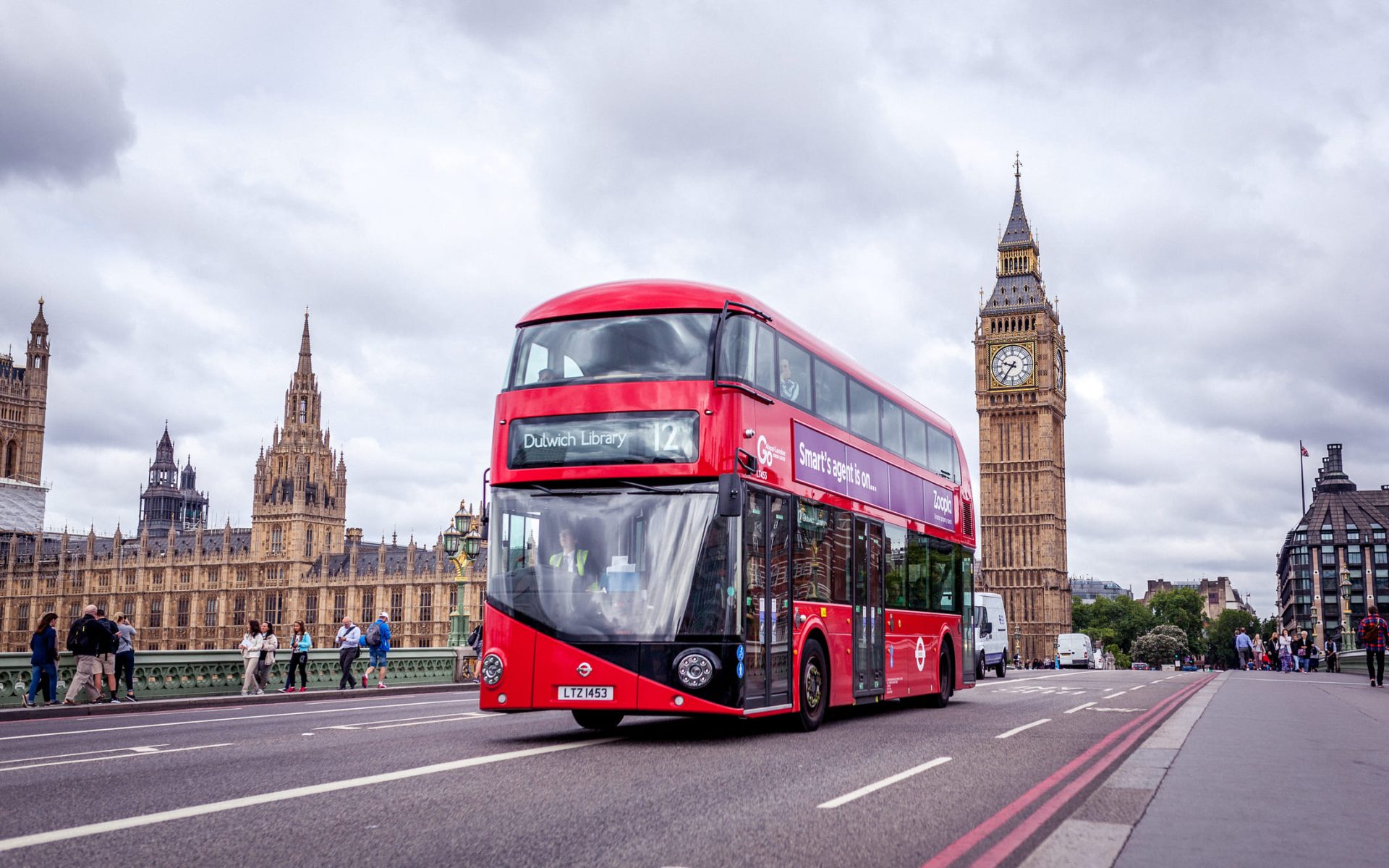
The drive into the city is your first taste of London. You'll see the famous red double-decker buses, black taxis and red post boxes, terraces of Victorian houses with painted front doors, and leafy squares hidden behind iron railings. London has been a great city for nearly two thousand years: the Romans founded it as Londinium around the year 50, and since then it has grown into a global capital of around nine million people. It's said that more than 300 languages are spoken in its homes and schools, making it one of the most diverse cities on earth.

London is a city of contrasts, where history and modern life sit side by side. Standing beside the Thames, you can see the medieval Tower of London, built by William the Conqueror nearly a thousand years ago, and right next to it the gleaming glass towers of the modern financial district, including the Shard, the tallest building in the United Kingdom, a slender glass pyramid more than 300 metres high. You can see Wren's great dome of St. Paul's Cathedral, which famously survived the bombing of the Second World War, when the city around it was in flames, and became a symbol of London's courage.

For Indian travellers, London often feels surprisingly familiar. Britain and India share a long, complex history, and today well over a million people of Indian origin live in the United Kingdom. Indian food is everywhere, from neighbourhood curry houses to fine restaurants, and areas such as Southall in west London, with its sari shops, sweet shops and gurdwaras, and Wembley, with its temples and Gujarati restaurants, feel like a home away from home. Every year, Diwali is celebrated with music, dance and food in Trafalgar Square, and the whole city joins in.

Once you reach your hotel and check in, take some time to rest after your long journey. In summer, London's days are wonderfully long: in June and July, the sun doesn't set until after nine in the evening, and the long twilight makes the city glow. If you have energy, take a gentle walk around your neighbourhood. You'll see Londoners relaxing in parks and squares, picnicking on the grass, sitting outside traditional pubs with their hanging flower baskets, or simply enjoying the sunshine, which they never take for granted.

A few practical tips will help you settle in. In Britain, cars drive on the left, just like in India, so look right first when you cross the road; many crossings in central London even have "LOOK RIGHT" painted on the street. The currency is the pound sterling, and cards and contactless payments are accepted almost everywhere. British power sockets have three rectangular pins, so you'll need the right adapter, which is different from the one you'll need in Paris and Switzerland later in the tour. And the weather is famously changeable: even on a sunny summer morning, it's wise to carry a light jacket or a small umbrella.

In the evening the group gathers for dinner, a chance to meet your fellow travellers and to hear your tour manager outline the journey ahead: London's royal sights and cricket tomorrow, then the Eurostar to Paris, and finally the Swiss Alps. After dinner, head back to the hotel for a good night's sleep. Tomorrow, London's greatest landmarks await.

London's famous black taxis come with a remarkable story. To earn a licence, every London cab driver must pass an exam known as "The Knowledge", memorising around 25,000 streets and thousands of landmarks within six miles of the city centre. It usually takes three or four years of study, often riding around the city on a scooter with a map, so a London cabbie can take you anywhere without a satnav. And if you take the Tube, listen for the famous announcement, "Mind the gap", reminding passengers to watch the space between the train and the platform; it's become one of London's most recognisable phrases.

Included today: arrival transfer, dinner.

Good to know: hotel check-in is usually mid-afternoon. London's summer temperatures are usually 18–26°C, but showers can come at any time. You'll need two types of plug adapter on this tour: UK (three rectangular pins) and European (two round pins).
Day 2
London city tour, Changing of the Guard, Lord's Cricket Ground and the London Eye | Royal London and the Home of Cricket

London city tour, Changing of the Guard, Lord's Cricket Ground and the London Eye | Royal London and the Home of Cricket

⌖ London 🍽 Meals: Breakfast, Lunch, Dinner

Today you see the very best of London. After breakfast, your expert local guide joins the coach for a tour of the city's most famous landmarks.

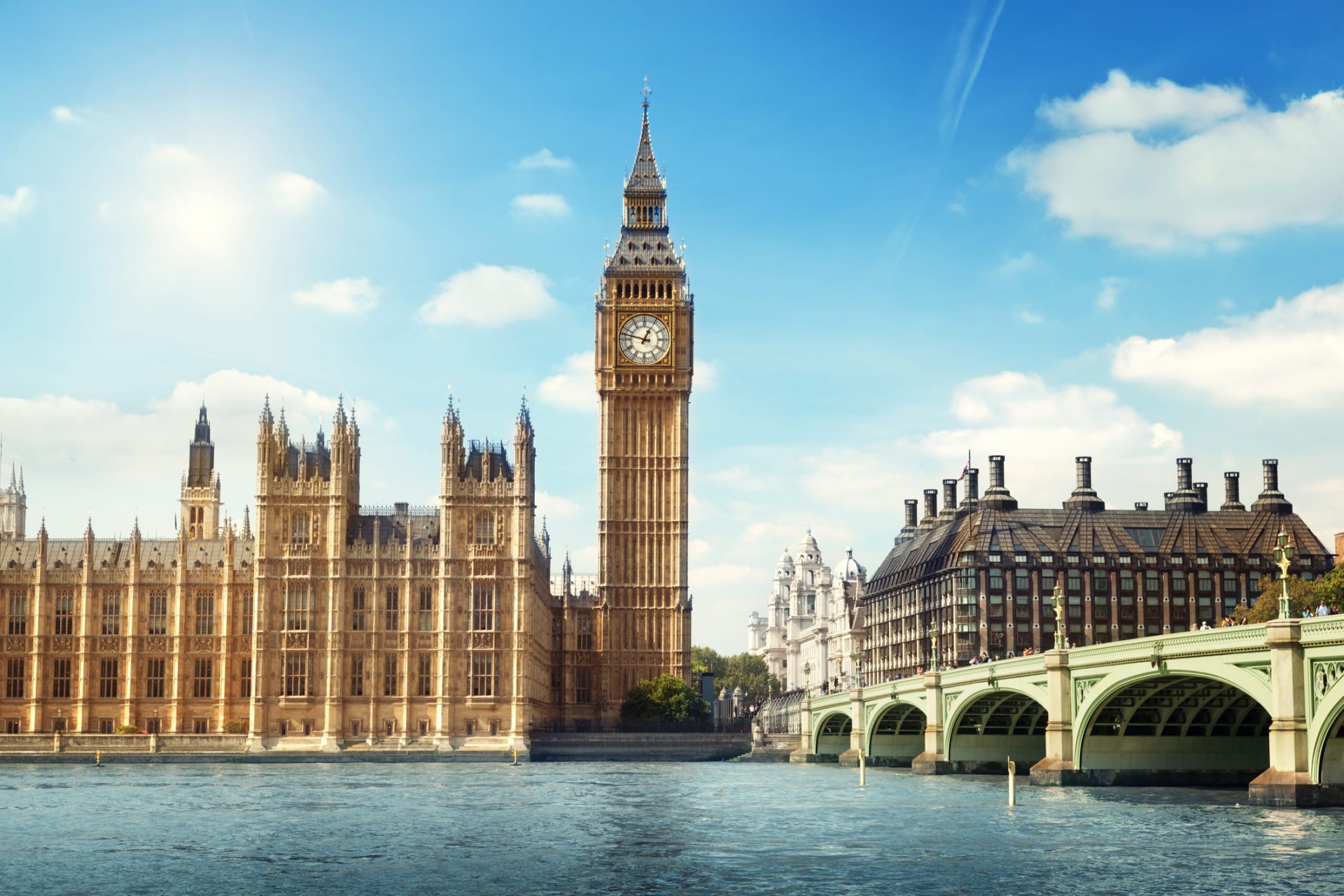
You begin at Westminster, the heart of British government. The Houses of Parliament, officially the Palace of Westminster, stretch along the bank of the Thames, a vast Gothic building with more than a thousand rooms, rebuilt in the 19th century after a great fire destroyed the old palace. At one end rises the famous clock tower, known all over the world as Big Ben, though strictly that's the name of the great bell inside, which weighs more than 13 tonnes; the tower itself was renamed the Elizabeth Tower in 2012. Across the street stands Westminster Abbey, where English and British kings and queens have been crowned for nearly a thousand years. Inside, Poets' Corner holds memorials to many of the greatest writers in the English language, from Chaucer to Charles Dickens.

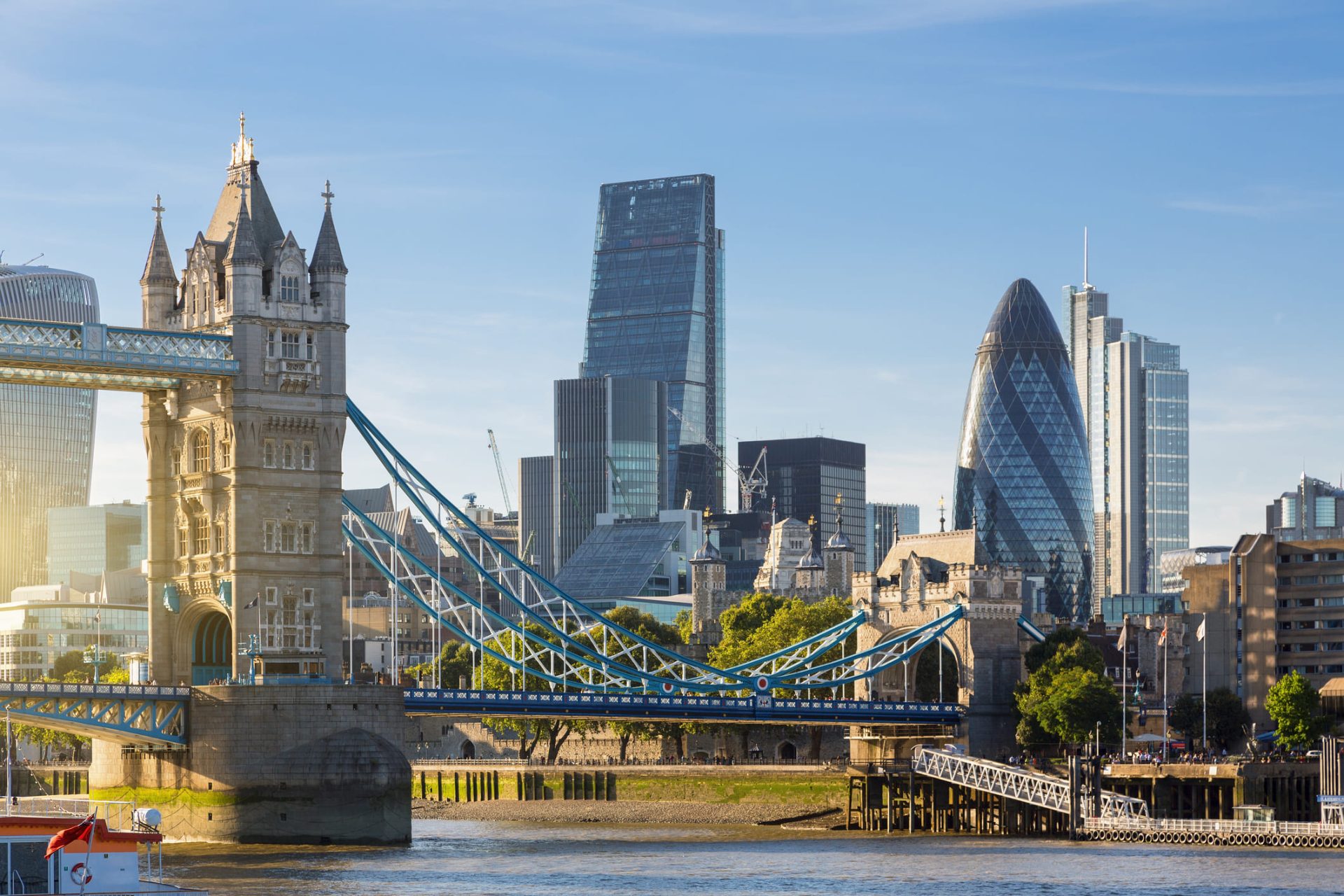
The tour continues to Trafalgar Square, with Nelson's Column rising above four giant bronze lions and fountains. In one corner of the square stands the "Fourth Plinth", which was built for a statue that was never made; today it displays a changing series of modern artworks, so it looks different every couple of years. You'll pass the bright lights and giant screens of Piccadilly Circus, drive through the green expanse of Hyde Park, and cross the river to see Tower Bridge, with its two great Gothic towers and blue suspension chains, opened in 1894, whose roadway still lifts to let tall ships pass beneath it.

Then you watch the Changing of the Guard at Buckingham Palace, the London home of the King. The palace has around 775 rooms, including 19 state rooms, 52 royal and guest bedrooms and 78 bathrooms, and when the King is in residence, the Royal Standard flies from the roof. The ceremony is one of the most famous in the world: the soldiers of the King's Guard, in scarlet tunics and tall black bearskin hats, march to the music of a military band as the new guard takes over from the old. The precision, the colours and the music are unforgettable, and the crowds that gather along the railings show how much it still means to people from all over the world.

In the afternoon you visit Lord's Cricket Ground, the Home of Cricket. For any cricket lover from India, this is a pilgrimage. Lord's has been at its present site in St. John's Wood since 1814, and it's the home of the Marylebone Cricket Club, which wrote the laws of cricket. On the tour, you go behind the scenes: the grand Victorian Pavilion; the famous Long Room, lined with portraits of cricketing legends, through which players walk on their way to the pitch; and the players' dressing rooms, where you can see the honours boards listing every batsman who has scored a Test century at Lord's and every bowler who has taken five wickets in an innings. Look for the Indian names, including Dilip Vengsarkar, who scored three Test centuries here. You'll also see the futuristic white media centre that looks like a spaceship hovering over the stands, and you'll learn that the famous pitch slopes by about two and a half metres from one side to the other, a feature that has puzzled bowlers for generations. In the MCC Museum, you'll see the tiny Ashes urn, cricket's most famous trophy, and remember that it was here at Lord's, in 1983, that Kapil Dev's India won the World Cup for the first time.

The day ends with a ride on the London Eye, the giant observation wheel on the South Bank of the Thames, 135 metres tall. It has 32 glass capsules, one for each of London's boroughs, though, for luck, they're numbered from 1 to 33, skipping number 13. A full rotation takes about half an hour, moving so slowly that you barely notice, and as you rise, London unfolds below you: the Houses of Parliament, the river curving away under its bridges, the dome of St. Paul's, the Shard and the towers of the City, and on a clear summer evening, the green hills beyond. In the evening you return to your hotel for dinner.

Buckingham Palace hasn't always been a royal home. It began as a large townhouse built for the Duke of Buckingham in 1703 and was bought by King George III for his wife. Queen Victoria was the first monarch to live there, from 1837, and since then the famous balcony at the front has been the place where the royal family appears to the crowds on great national occasions.

Included today: guided London city tour, Changing of the Guard (subject to schedule), Lord's Cricket Ground tour, London Eye ride, breakfast, lunch, dinner.

Good to know: the Changing of the Guard doesn't take place every day and can be cancelled in bad weather or for state events; if it doesn't take place, you still see Buckingham Palace. Lord's tours may be changed on match days.

Day 3
Madame Tussauds and the Eurostar to Paris | From London to Paris under the sea

Madame Tussauds and the Eurostar to Paris | From London to Paris under the sea

⌖ Paris 🍽 Meals: Breakfast, Lunch, Dinner

Today you meet the stars in London and then travel to Paris on one of the most famous train journeys in the world. After breakfast, you check out of your hotel and drive to Marylebone Road, just around the corner from Baker Street, where the fictional detective Sherlock Holmes lived at number 221B.

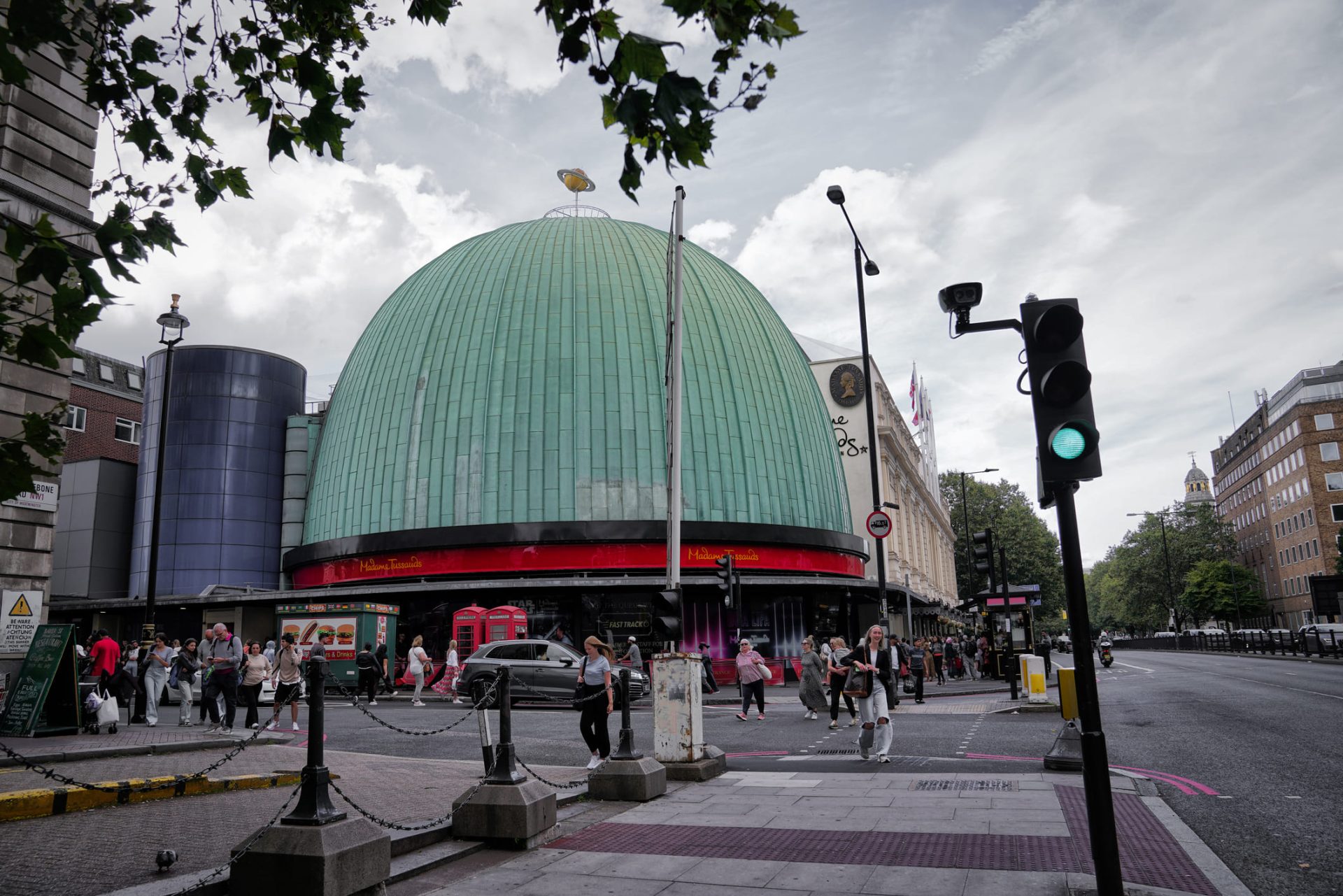
Here you visit Madame Tussauds, the world-famous wax museum. Its story begins in Paris in the 18th century, when a young woman named Marie Grosholtz learned the art of wax modelling from her mentor, Philippe Curtius. During the French Revolution, she was asked to make death masks of famous victims of the guillotine. She later married and became Marie Tussaud, and in 1802 she brought her collection to Britain, touring the country for more than thirty years before opening a permanent exhibition on Baker Street in 1835. Today Madame Tussauds has museums all over the world, but London is where it all began.

Inside, you walk among astonishingly lifelike figures of the most famous people on earth: kings and queens of the British royal family, world leaders, sports stars, music legends and Hollywood actors. Each figure takes a team of sculptors months to make, with every hair inserted by hand and the skin painted in many layers to look real. For Indian visitors, the Bollywood section is a highlight: Amitabh Bachchan became the first Indian actor to be immortalised in wax here in 2000, and he's been joined over the years by other Indian stars of film and sport. You can stand right beside them, put your arm around their shoulders and take a photograph, and many visitors find themselves leaning in close, half expecting the figures to blink. There are also interactive zones, from a Marvel superheroes experience to a ride through London's history in a black taxi.

In the afternoon you head to St Pancras International station to board the Eurostar to Paris. St Pancras is one of the most beautiful railway stations in the world: a magnificent red-brick Victorian Gothic building with towers, spires and pinnacles, opened in 1868. Inside, a vast arched roof of iron and glass soars over the platforms, and a giant bronze statue of a couple embracing, called The Meeting Place, stands beneath the great clock. Right next door is King's Cross station, where Harry Potter fans can find Platform 9¾, with a luggage trolley disappearing into the wall.

The Eurostar is a high-speed train that runs between London and Paris through the Channel Tunnel. The tunnel, opened in 1994, is one of the great engineering achievements of the 20th century: it runs for about 50 kilometres between England and France, nearly 38 of them beneath the sea, making it the longest undersea railway tunnel in the world. Before it was built, the only way across the Channel was by ferry or plane; now you can travel from the centre of London to the centre of Paris in around two and a quarter hours.

As the train speeds out of London, you'll see the green countryside of Kent, the "Garden of England", with its orchards, hop gardens and oast houses with their pointed white tops. Then, quite suddenly, the train enters the tunnel, and for around twenty minutes you're travelling beneath the seabed of the English Channel. Most passengers barely notice; it's only when the train emerges into the daylight of northern France that you realise you've crossed from one country to another. The landscape changes: wide, open farmland, golden with wheat in summer, and villages gathered around their church spires. The train reaches speeds of around 300 kilometres an hour, and the countryside flashes past.

You arrive at the Gare du Nord in Paris, one of the busiest railway stations in Europe, and step out into the City of Light, known for its haute couture, its great museums, its beautiful monuments and its sensational cabarets. The coach takes you through the streets to your hotel, past elegant cream-stone buildings, café terraces and tree-lined boulevards. After check-in, you enjoy dinner with the group. Three days in Paris lie ahead.

The Channel Tunnel took around six years to build, with around 13,000 workers digging from both the English and French sides at the same time. In December 1990, the British and French tunnellers finally broke through to meet each other deep beneath the sea, and they shook hands through the gap, a moment celebrated in both countries. People had dreamed of a tunnel under the Channel since the time of Napoleon, nearly two hundred years earlier; you're riding through a dream that took centuries to come true.

Included today: Madame Tussauds entry, Eurostar from London to Paris, breakfast, lunch, dinner.

Good to know: passport and security checks for the Eurostar take place at St Pancras before boarding, including French border control, so keep your passport handy. Luggage on the Eurostar is limited to what you can carry, so pack sensibly. Remember to switch to your European plug adapter in Paris.

Day 4
Paris city tour, Eiffel Tower top level, Versailles and a Seine cruise | Paris from the top

Paris city tour, Eiffel Tower top level, Versailles and a Seine cruise | Paris from the top

⌖ Paris

Today you discover Paris in all its glory. After breakfast, your local guide joins the coach for a tour of the city's finest sights.

You begin at the elegant Place Vendôme, an octagonal square of matching 17th-century mansions, where the windows of the world's great jewellers sparkle around a bronze column topped by a statue of Napoleon. Then the Opéra Garnier, the grand opera house whose facade glows with gold statues; a little-known fact is that beehives are kept on its roof, and the honey made by its bees is sold in the opera's shop. You'll pass the Musée d'Orsay, a former railway station filled with Impressionist masterpieces by Monet, Renoir, Degas and Van Gogh, and the vast Place de la Concorde, where the guillotine once stood during the Revolution and where an ancient Egyptian obelisk now rises between two fountains.

From the square, you drive up the Champs-Élysées, nearly two kilometres of grand avenue lined with plane trees, shops, cinemas and cafés, one of the most famous streets in the world. At the top stands the Arc de Triomphe, commissioned by Napoleon in 1806 to celebrate his armies' victories. It's about 50 metres tall, and in 1919, a daring French pilot flew his small plane right through the middle of the arch, a stunt that has never been repeated. Twelve avenues radiate out from the arch like the points of a star, and the traffic swirling around it, with no lanes at all, is a spectacle of its own. You'll cross the Pont Alexandre III, decorated with golden winged horses, and pass Les Invalides, where Napoleon lies in a magnificent red stone tomb beneath a golden dome.

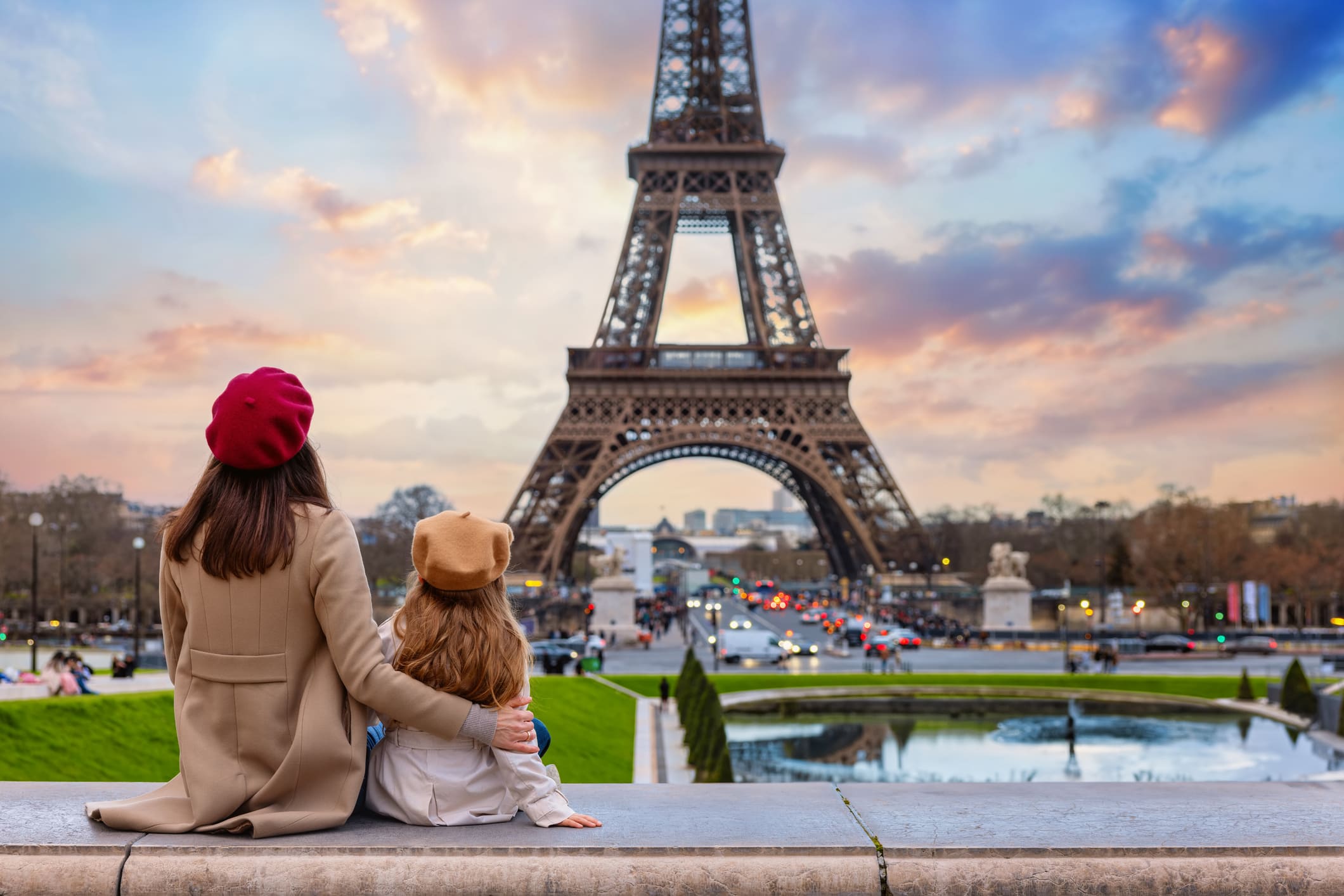
Then you go up the Eiffel Tower, all the way to the top level, 276 metres above the city. Built for the World's Fair of 1889, the tower was supposed to be taken down after twenty years. It was saved because it proved so useful as a giant radio antenna, and today it's one of the most visited monuments in the world. Lifts carry you up through the latticework to the second level and then, in a glass lift, up the narrowing tip to the top. Up here, the wind is fresh and all of Paris is spread beneath you: the Seine winding through the city under its bridges, the grey rooftops and green parks, the white domes of Sacré-Cœur on Montmartre and the skyscrapers of La Défense on the horizon. It's a view you'll never forget.

In the afternoon you drive to Versailles, the most magnificent royal palace in Europe. Louis XIV, the Sun King, transformed a hunting lodge into a palace fit to dazzle the world, and moved the entire royal court here in 1682. You walk through the State Apartments, with their marble walls, painted ceilings and gilded furniture, and into the Hall of Mirrors, where 357 mirrors reflect the light from tall windows overlooking the gardens and crystal chandeliers glitter overhead. It was here, in 1919, that the Treaty of Versailles was signed, ending the First World War. In summer, the gardens are glorious, with fountains, statues, flowerbeds and the long Grand Canal shimmering in the sun.

In the evening you return to Paris for a cruise on the Seine. As the boat glides under bridge after bridge, you'll pass the Louvre, once a royal palace and now the most visited museum in the world, with its glass pyramid; the Musée d'Orsay with its giant station clocks; the island of the Île de la Cité with Notre-Dame Cathedral, beautifully restored after the fire of 2019; and, near the end of the cruise, a small copy of the Statue of Liberty on a narrow island in the river, a reminder that the original in New York was a gift from France to America. In the summer twilight, with Parisians picnicking on the riverbanks and the Eiffel Tower glowing gold ahead, it's one of the most romantic moments of the whole trip.

As you travel around the city, notice the entrances to the Paris Métro, the underground railway that opened in 1900 for the World's Fair. Some of the original entrances still stand, with curling green iron frames shaped like plant stems and amber lamps, designed in the Art Nouveau style by Hector Guimard, and they've become symbols of Paris in their own right. Even the Louvre has a hidden history: before it became a royal palace and then a museum, it began around 1190 as a fortress protecting the city, and the remains of its medieval walls can still be seen deep beneath the museum today.

Included today: guided city tour of Paris, Eiffel Tower top (3rd) level, Palace of Versailles visit, Seine cruise, breakfast, lunch, dinner.

Good to know: access to the Eiffel Tower's top level depends on its operating status, and queues average one to two hours in summer; if the top is closed, the group visits the 2nd level instead. Wear comfortable shoes, as today involves a lot of walking.

Day 5
Full day at Disneyland® Paris | A day of magic, thrills and characters

Full day at Disneyland® Paris | A day of magic, thrills and characters

⌖ Paris 🍽 Meals: Breakfast, Packed Lunch, Dinner

Today is all about fun. After breakfast, the coach takes you about forty minutes east of Paris to Disneyland® Paris, and you have the whole day to enjoy it, with a packed lunch so you don't need to waste time in restaurant queues.

Your ticket gives you a full day in one of the two parks. Disneyland® Park is the classic fairy-tale park, with five lands filled with famous rides, shows and parades with the Disney characters. The second park next door brings the world of films to life, with stunt shows, movie sets and rides inspired by Disney, Pixar and Marvel, including Avengers Campus, where you can team up with Spider-Man and the Avengers, and the Ratatouille ride, where you shrink to the size of a rat and race through a Parisian restaurant kitchen. Your tour manager will help you choose the park that suits your family best.

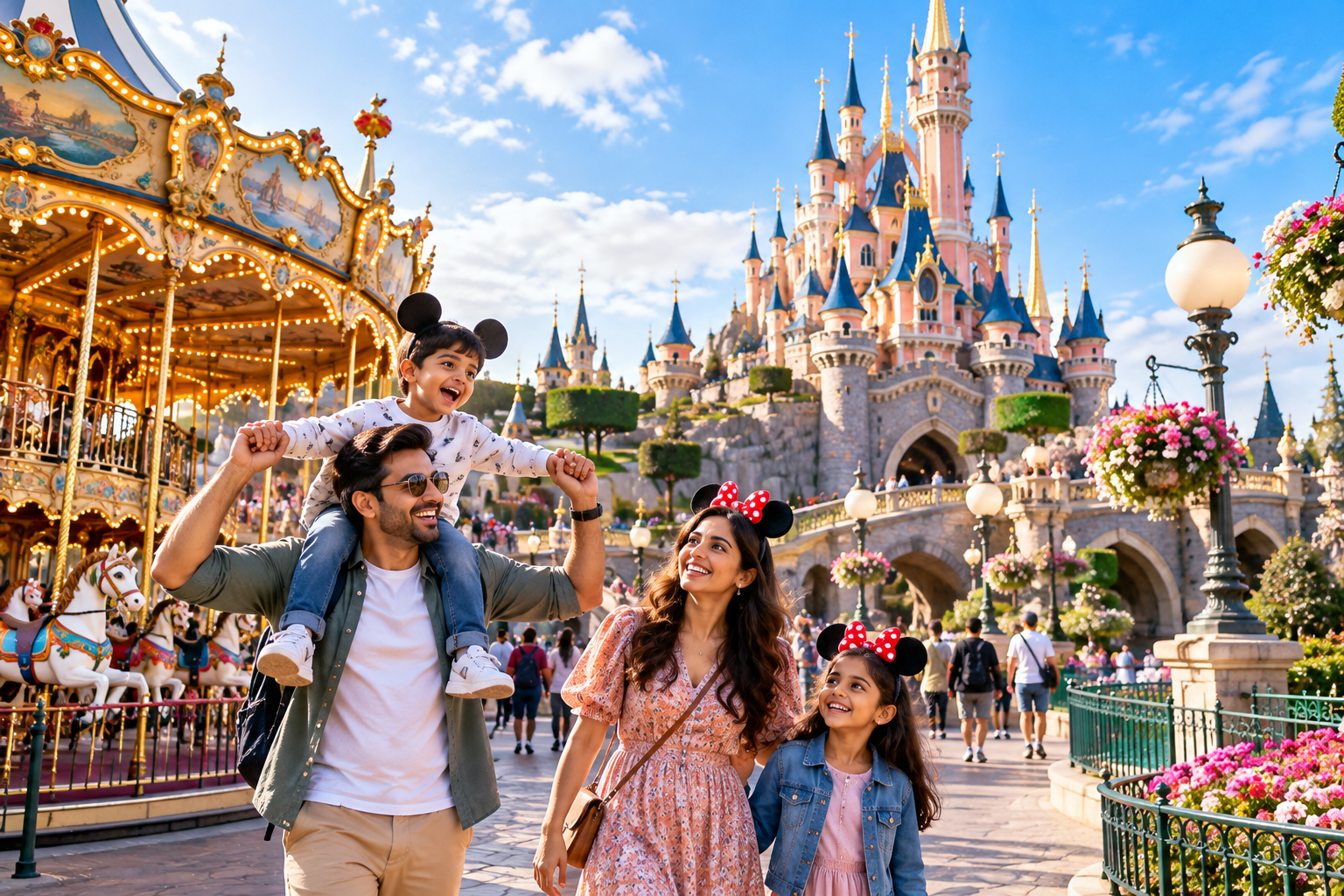
As you walk through the gates of Disneyland® Park, you step onto Main Street, U.S.A., an old-fashioned American small town with colourful shopfronts, ice-cream parlours, a horse-drawn tram and music playing in the air. At the end of the street stands Sleeping Beauty Castle, its pink walls and blue turrets rising against the sky. Climb up into the castle to see its stained-glass windows and tapestries telling the story of Sleeping Beauty, and then go down into the dungeon below, where a huge animated dragon sleeps, breathing smoke and roaring at anyone who comes too close.

The park is divided into five lands, each a different world. In Fantasyland, the youngest visitors can fly over moonlit London with Peter Pan, ride the flying elephants of Dumbo, spin in the giant teacups of the Mad Hatter, and sail through "it's a small world" with its singing dolls from every corner of the globe. Adventureland is full of jungles, treehouses and pirates, with the swashbuckling Pirates of the Caribbean boat ride and the twists and loops of the Indiana Jones roller coaster. In Frontierland, the Wild West comes alive, with a runaway mine train racing around Big Thunder Mountain on its island in the lake, and the haunted Phantom Manor on the hill. And in Discoveryland, you can battle the evil Zurg with Buzz Lightyear or blast into hyperspace on a Star Wars roller coaster.

In summer, the park stays open late into the evening, and the long, warm days give you plenty of time to enjoy everything. Watch the parade wind down Main Street, with dancers, music and floats carrying Mickey, Minnie and the princesses, and look out for character meet-and-greets, where children can meet their heroes and take photographs. Many families say the evening finale is the most magical part of the day: as darkness falls, the castle lights up with a spectacular show of projections, music and fireworks, and thousands of people watch together in wonder.

A few tips: download the official Disneyland® Paris app to check ride waiting times and show schedules; head for the most popular rides early in the day, before the queues build up; carry water and sunscreen, and take breaks in the shade during the hottest hours. In the evening, the coach brings you back to Paris for dinner, with tired, happy faces all around.

Disney fans love to hunt for "hidden Mickeys", small three-circle shapes of Mickey Mouse's head hidden by the designers in rides, buildings, fences, paintings and even the patterns on the pavement. Once you start looking, you'll find them everywhere, and it's a wonderful game for children while waiting in queues. Families with small children should also ask about the Rider Switch service on the bigger rides: if your child is too small to ride, one parent can ride while the other waits with the child, and then they swap without having to queue again. Many rides have height limits for safety, so check them in the app before you join a queue. And if you'd like professional photos, the park's photographers are stationed at the best spots, including in front of the castle, ready to capture your family's picture.

The park itself is full of wonderful details. Main Street, U.S.A. was designed to look like a small American town at the beginning of the 20th century, inspired by the town where Walt Disney grew up, and the buildings are built using a trick called forced perspective: their upper floors are smaller than the lower ones, which makes them look taller than they really are. The same trick makes Sleeping Beauty Castle seem to rise high into the sky. In the evenings, music fills the streets, the lights twinkle, and the castle glows in changing colours. Whatever your age, it's hard not to feel a little like a child again.

Included today: full-day Disneyland® Paris ticket (one park), coach transfers, breakfast, packed lunch, dinner.

Good to know: summer is a busy season at the park, so expect queues at popular rides. Parades, shows and opening hours are set by the park and may change on the day.

Day 6
Paris to Geneva and Geneva orientation tour | Into Switzerland, on the shores of Lake Geneva

Paris to Geneva and Geneva orientation tour | Into Switzerland, on the shores of Lake Geneva

⌖ Geneva 🍽 Meals: Breakfast, Packed Lunch, Dinner

Today you leave Paris and travel south-east into Switzerland. After breakfast, you check out of your hotel and settle into the coach for a scenic journey across France. A packed lunch is provided, so you can enjoy the scenery with fewer stops.

The motorway leads south through the green and gold heart of France. In summer, the countryside is at its most beautiful: fields of wheat and sunflowers, white Charolais cattle grazing in green pastures, old farmhouses with red-tiled roofs, and small towns with church spires. You pass through Burgundy, one of the world's great wine regions, where vineyards cover the gentle hillsides in neat rows. The road then climbs into the Jura mountains, a range of forested ridges and green meadows along the border between France and Switzerland, famous for cheese-making and watchmaking; for centuries, farming families in these valleys spent their long winters making tiny, precise watch parts by hand.

In the afternoon you cross the border into Switzerland, the third country of your tour, and arrive in Geneva, at the western tip of Lake Geneva, one of the largest lakes in Western Europe. Geneva is a French-speaking city with a truly global character. It's home to the European headquarters of the United Nations and the headquarters of the International Red Cross, founded here in 1863, as well as dozens of other international organisations, so you'll hear people speaking languages from every corner of the world.

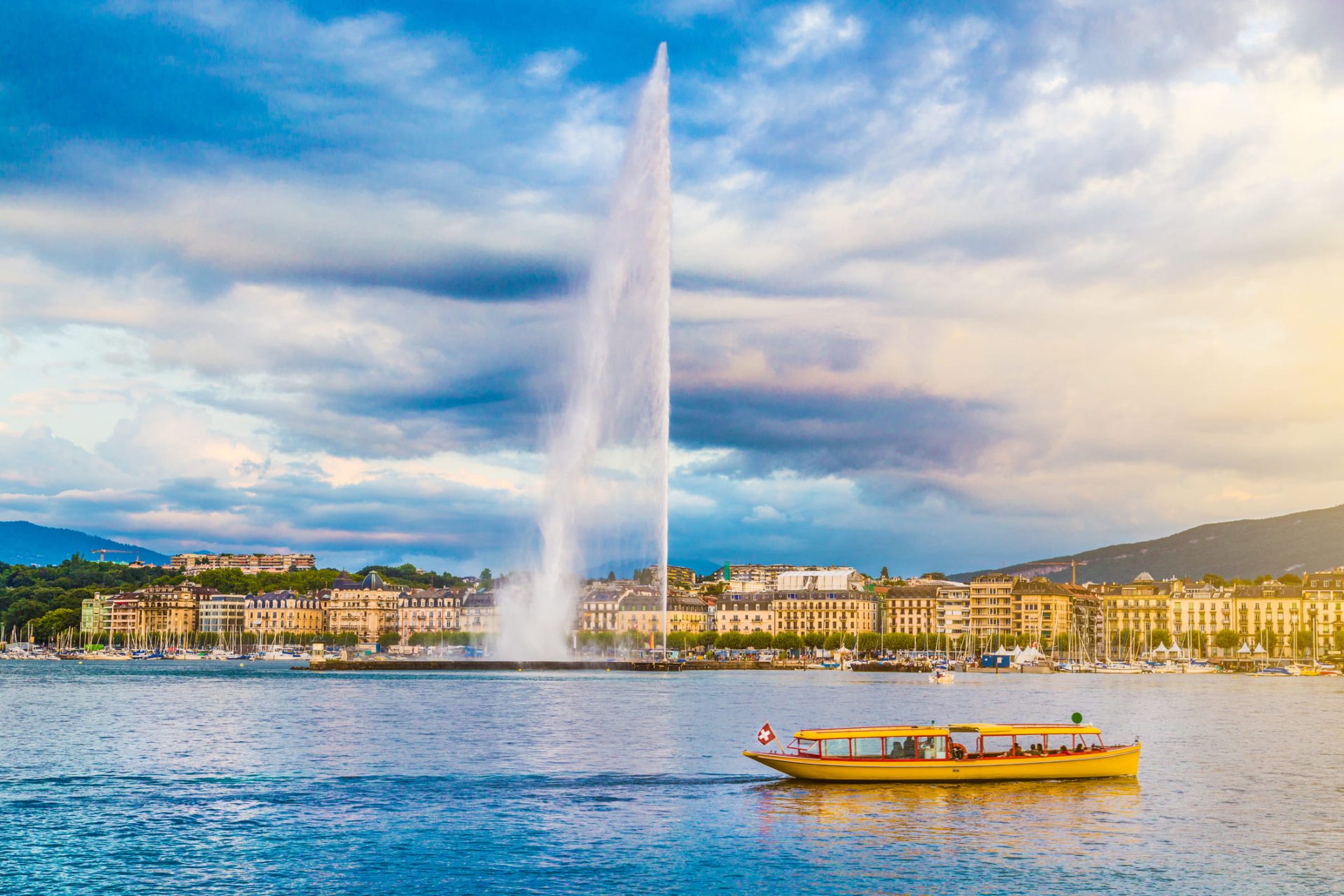
Your orientation tour shows you the city's most famous sights. On the lakefront, the Jet d'Eau, Geneva's famous fountain, shoots a white column of water 140 metres into the air at around 200 kilometres an hour. It began life in 1886 as a safety valve for a hydraulic power plant, releasing excess pressure in the evenings, and people loved it so much that it became a permanent fountain. On a sunny summer day, rainbows shimmer in its spray, and it can be seen from far across the lake. You'll also see the Palais des Nations, the United Nations office in Geneva, with the flags of its member states lining the approach, and across the square, the Broken Chair, a giant wooden chair with one leg shattered, a powerful monument against landmines and cluster bombs. In the English Garden on the lakeshore, the famous Flower Clock, made of thousands of plants, keeps perfect time, a tribute to Geneva's long tradition of watchmaking.

In summer, Geneva lives by the lake. Locals swim from public bathing places, sail across the blue water and cycle along the promenades, and on clear days the snowy summit of Mont Blanc, the highest mountain in Western Europe, shines in the distance. Just outside the city lies CERN, the world's largest particle physics laboratory, where scientists study the smallest building blocks of the universe, and where, in 1989, the World Wide Web was invented.

After the tour, you check in to your hotel in Geneva and enjoy dinner with the group. If you have energy, take an evening walk along the lake as the sun sets and the lights of the city reflect in the water.

Geneva is often called the capital of peace. In 1864, the first Geneva Convention was signed here, setting out rules to protect wounded soldiers in wartime, and the Geneva Conventions are still the foundation of international humanitarian law today. After the First World War, Geneva became the home of the League of Nations, the first organisation that tried to keep peace between nations, and its grand headquarters, the Palais des Nations, was later taken over by the United Nations. Geneva also has a special link with India: in December 1931, after the Round Table Conference in London, Mahatma Gandhi travelled to Switzerland and stayed with the French writer Romain Rolland at his villa in Villeneuve, on the eastern shore of Lake Geneva, where the two great thinkers spent days discussing peace and non-violence.

The Jura mountains you crossed this afternoon are the home of Comté cheese, made from the milk of cows grazing on the high pastures; it takes around 400 litres of milk to make a single large wheel, which is then aged for months in cool cellars. The Swiss side of the Jura is the heartland of Swiss watchmaking, sometimes called Watch Valley, where famous brands still have their workshops in small mountain towns. The towns of La Chaux-de-Fonds and Le Locle were even laid out by the watchmakers themselves, with straight streets designed so that workshops would get as much daylight as possible, and today they're a UNESCO World Heritage Site.

Included today: coach Paris to Geneva, Geneva orientation tour, breakfast, packed lunch, dinner.

Good to know: the drive from Paris to Geneva takes most of the day, with comfort stops on the way. Switzerland uses the Swiss franc, but cards are accepted almost everywhere.

Day 7
Jungfraujoch – Top of Europe and Interlaken | Standing among the glaciers

Jungfraujoch – Top of Europe and Interlaken | Standing among the glaciers

⌖ Central Switzerland 🍽 Meals: Breakfast, Lunch, Dinner

Today you travel to the highest point of your journey: Jungfraujoch, the Top of Europe, high in the Swiss Alps. After an early breakfast, you check out of your hotel in Geneva, and the coach follows the shore of Lake Geneva, then heads inland across the rolling green hills of western Switzerland, past Bern, and into the Bernese Oberland, the Highlands of Bern.

In summer, the Bernese Oberland is a scene from a picture book. The valleys are lush and green, wildflowers carpet the meadows in yellow, purple and white, and brown-and-white cows graze on the slopes with big bells around their necks, their gentle clanging echoing across the valley. Wooden chalets with deep eaves and flower-filled balconies dot the hillsides, waterfalls tumble from the cliffs, and above it all rise three of the most famous mountains in the Alps: the Eiger, the Mönch and the Jungfrau, which means "the maiden", their peaks still covered in snow even in midsummer. Bollywood fans may recognise the landscape: many famous Hindi films, including the classic Dilwale Dulhania Le Jayenge, were filmed in these mountains, and for many Indian families, a trip here feels like stepping into a favourite movie.

At the Grindelwald Terminal, you board the Eiger Express, a modern gondola that whisks you up from the valley to the Eigergletscher station in just 15 minutes. As the cabin climbs, look out at the north face of the Eiger, a sheer wall of dark rock and ice nearly 1,800 metres high, one of the most famous and dangerous climbing routes in the world. The mountain itself was first climbed in 1858, but its north face wasn't conquered until 1938, after many climbers lost their lives trying.

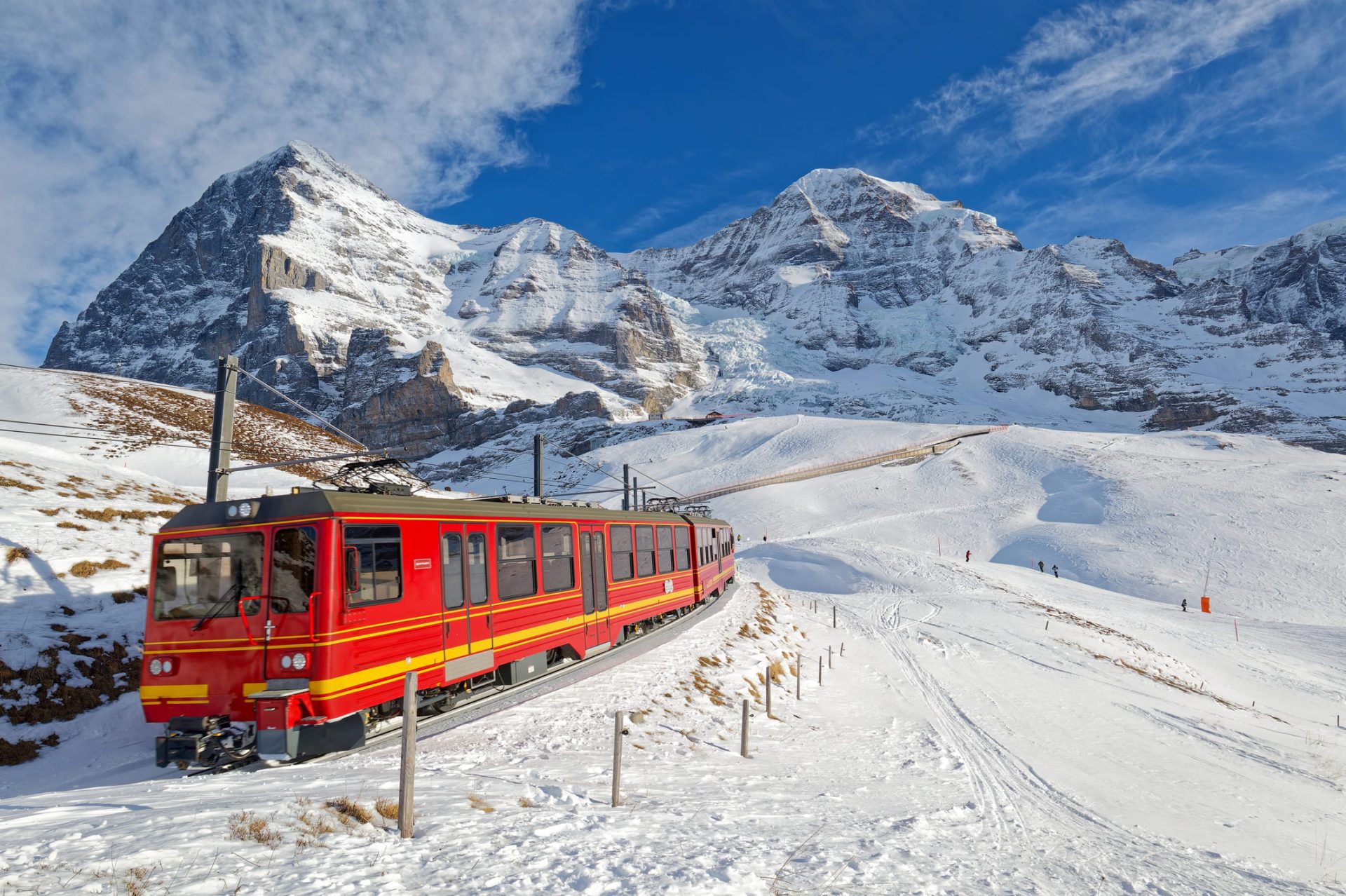
At Eigergletscher, you board the cogwheel train of the Jungfrau Railway, which climbs steadily through a tunnel carved inside the Eiger and the Mönch, a marvel of engineering that took sixteen years to build and opened in 1912. Then you arrive at Jungfraujoch, at 3,454 metres the highest railway station in Europe, a world of eternal ice and snow.

Take your time, move slowly, and let your body adjust to the thin mountain air. Then explore. In the Ice Palace, a maze of corridors carved deep inside the glacier, you walk between gleaming walls of blue ice, admiring sculptures of animals carved by artists from the glacier itself. A fast lift then carries you up to the Sphinx observation deck, perched on a rocky peak, and the view is breathtaking. Below you stretches the Great Aletsch Glacier, the longest glacier in the Alps, a vast river of ice around 20 kilometres long, holding billions of tonnes of ice, curving away between the snowy peaks. On a clear day, the panorama reaches as far as France, Germany and Italy. Since the 1930s, the Sphinx has also been home to a scientific research station, where scientists study the atmosphere and the climate in this clean, high air.

Out on the glacier plateau, you can walk on the snow, throw snowballs and pose for photographs with the Swiss flag against the white peaks. In summer, there's even a Snow Fun Park on the glacier, with activities like sledging and a zip line, an amazing experience in the middle of July or August. And before you leave, you can send a postcard home from one of the highest post offices in Europe.

After descending, you visit Interlaken, a charming resort town on a strip of land between two turquoise lakes, Lake Thun and Lake Brienz. Its name means "between the lakes". In summer, Interlaken buzzes with life: paragliders drift down from the mountains to land on the great open meadow in the centre of town, people stroll along the main street lined with grand hotels and shops, and the snowy Jungfrau glows above the rooftops. There's time to wander, shop for Swiss watches and chocolates, and enjoy a coffee or an ice cream with mountain views.

In the evening you continue to your hotel in Central Switzerland for dinner, full of memories of the Top of Europe.

Look out in Interlaken for the bronze statue of Yash Chopra, the Indian film director who did more than anyone to make Switzerland famous in India, in the town's Kursaal gardens. Switzerland honoured him for his films, which brought generations of Indian travellers to these mountains. And if you're hungry at the Top of Europe, there's even an Indian restaurant at Jungfraujoch, a very welcome sight on a cold mountain day.

Included today: Jungfraujoch – Top of Europe excursion with the Eiger Express and Jungfrau Railway, Ice Palace, Sphinx observation deck, Interlaken visit, breakfast, lunch, dinner.

Good to know: it's cold at the top even in summer, often around freezing, so bring a warm jacket, gloves, sunglasses and sunscreen. Walk slowly at altitude. Travellers with heart or breathing conditions should check with their doctor before going. The Snow Fun Park depends on the weather and may cost extra.

Day 8
Mt. Titlis, Lucerne and a Lake Lucerne cruise | Snow, a storybook town and a sparkling lake

Mt. Titlis, Lucerne and a Lake Lucerne cruise | Snow, a storybook town and a sparkling lake

⌖ Central Switzerland 🍽 Meals: Breakfast, Lunch, Dinner

Today combines a glacier summit, one of Switzerland's prettiest towns and a peaceful lake cruise. After breakfast, the coach drives through the green countryside of Central Switzerland to Engelberg, a mountain village at the foot of Mt. Titlis, with a great white Benedictine monastery at its heart, founded nearly 900 years ago.

The ride to the top of Titlis is an adventure in itself. Gondolas lift you over pine forests and meadows dotted with wildflowers to the mountain lake of Trübsee, then a cable car carries you higher, into the world of rock and ice. For the last stretch, you board the Rotair, the world's first revolving cable car, introduced in 1992. As it climbs the steep final cliff, its floor slowly rotates a full 360 degrees, so everyone enjoys the complete view: the dazzling snow-capped peak, the deep blue crevasses of the glacier, pristine white snowfields dotted with massive ice boulders, and the green valley far below.

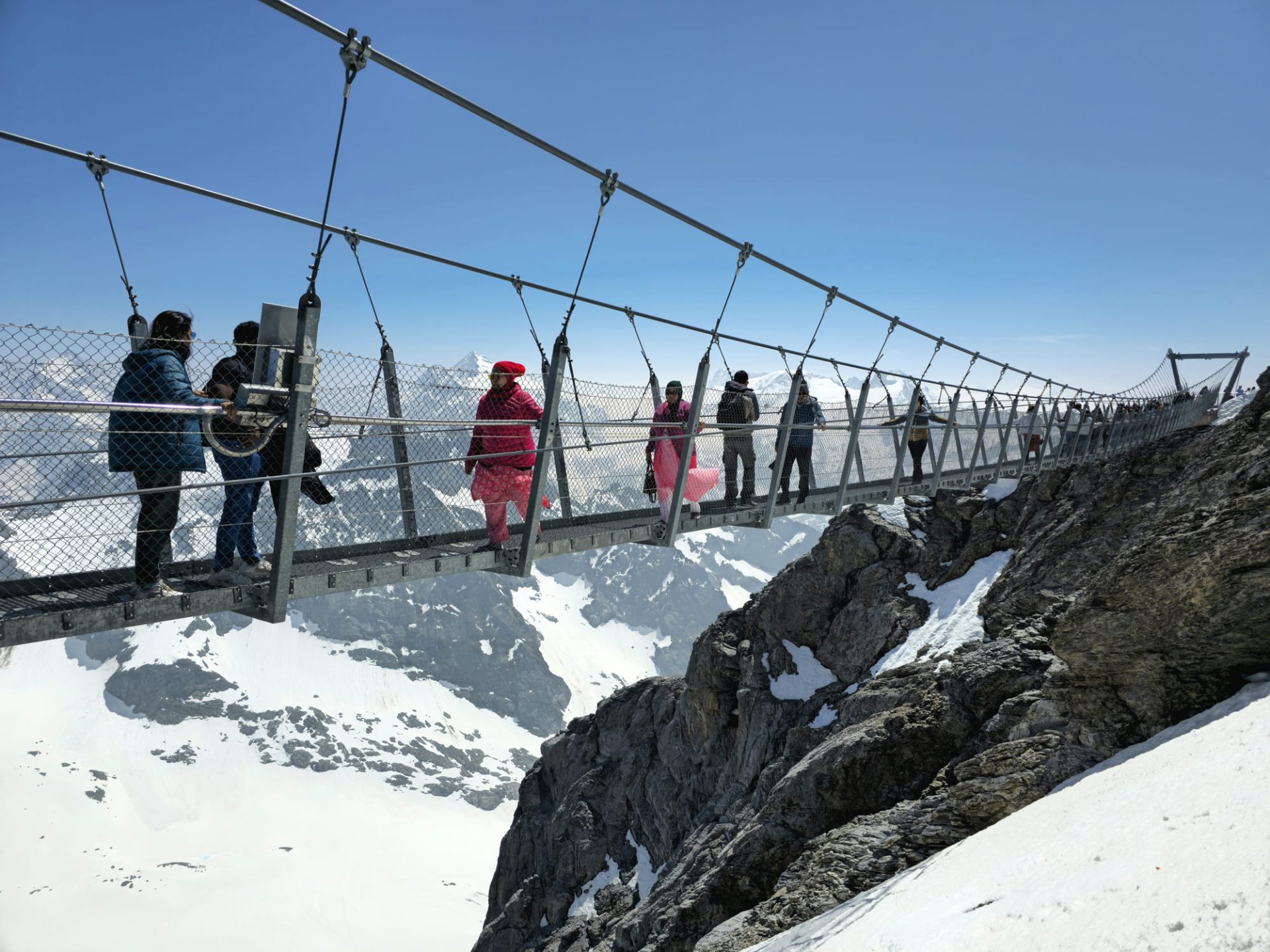
At the top station, at 3,020 metres, you step out into a white world, even in the middle of summer. The adventurous head straight for the Titlis Cliff Walk, Europe's highest suspension bridge, which stretches about 100 metres along the cliff face, with a drop of around 500 metres beneath your feet. It sways slightly in the wind, and walking across it is a thrill you'll remember. Then go inside the glacier to the Glacier Cave, a tunnel carved into the ice, where the frozen walls glow blue. Outside, you can play in the snow, and if the weather allows, ride the Ice Flyer, an open chairlift that glides low over the glacier and its crevasses.

After coming down, you drive to Lucerne for an orientation tour of one of the most beautiful cities in Switzerland. You'll visit the Lion Monument, a huge dying lion carved into a sandstone cliff to honour the Swiss Guards who died in Paris in 1792 defending the French king; the American writer Mark Twain called it "the most mournful and moving piece of stone in the world". Then you walk across the Kapellbrücke, the Chapel Bridge, a covered wooden footbridge built in the 14th century, with flower boxes along its sides and triangular paintings under its roof showing scenes from the city's history. In 1993, a fire destroyed much of the bridge and many of its paintings, and it was carefully rebuilt; look closely and you'll still see some panels blackened by the flames. Beside it, the octagonal stone Water Tower rises from the river. There's free time to shop in the old town for famous Swiss watches, Swiss Army knives and chocolates.

Later, you board a boat for a scenic, relaxing cruise on Lake Lucerne. The lake is shaped like a cross, with long arms stretching between steep, forested mountains, so that around every bend a new view appears: lakeside villages with old hotels and gardens, church towers, waterfalls and green meadows, with snowy peaks rising behind. Look out for Mt. Pilatus, whose cogwheel railway, with a gradient of up to 48 percent, is the steepest in the world, and Mt. Rigi, the "Queen of the Mountains", where Europe's first mountain railway opened in 1871. In the golden light of a summer afternoon, with the breeze on your face and the water sparkling around you, it's a moment of perfect peace. In the evening you return to your hotel for dinner.

Lucerne has long attracted famous visitors. Queen Victoria came in 1868 and stayed for weeks, travelling up into the surrounding mountains, and her visit made Lucerne fashionable among wealthy travellers from all over Europe. The composer Richard Wagner lived for six years in a villa on the lakeshore at Tribschen, just outside the town, where he wrote some of his greatest music; the house is now a museum. Above the old town, the Musegg Wall, part of the medieval town walls, stretches along the hill with nine towers. One of them, the Zyt Tower, has the oldest clock in Lucerne, and by an ancient privilege, it's allowed to strike each hour one minute before all the other clocks in the town.

On the shores of the lake, near the village of Brunnen, lies the Rütli meadow, where, according to tradition, representatives of three mountain communities met in 1291 and swore to defend each other, the beginning of the Swiss Confederation. Every year on 1 August, Swiss National Day, the meadow is the scene of a special celebration, and bonfires are lit on the mountains around the lake.

Included today: Mt. Titlis with the Rotair revolving cable car and Cliff Walk, Lucerne orientation tour, Lake Lucerne cruise, breakfast, lunch, dinner.

Good to know: it can be cold and windy at the top of Titlis, so carry a warm layer, sunglasses and sunscreen. The Ice Flyer and other summit activities depend on the weather.

Day 9
Bern, the Rhine Falls by boat and the Lindt Home of Chocolate | A capital, a waterfall and a world of chocolate

Bern, the Rhine Falls by boat and the Lindt Home of Chocolate | A capital, a waterfall and a world of chocolate

⌖ Central Switzerland 🍽 Meals: Breakfast, Lunch, Dinner

Your last full day in Switzerland brings together history, nature and chocolate. After breakfast, the coach drives west to Bern, the capital of Switzerland.

Bern is a small, relaxed capital with a big history. Its medieval old town, a UNESCO World Heritage Site, sits on a narrow rocky peninsula surrounded on three sides by a loop of the River Aare, whose water is a startling shade of turquoise. Your orientation tour leads you along streets lined with about six kilometres of covered stone arcades, which let people shop in any weather, past colourful 16th-century fountains, each crowned with a painted figure. One of them, the Kindlifresser, shows a giant ogre eating small children, and nobody is quite sure why it was made; it's one of Bern's strangest and most photographed sights.

At the heart of the old town stands the Zytglogge, Bern's famous clock tower, the city's most recognisable symbol. Once the city's western gate and later a prison, it has carried an astronomical clock since the 16th century, showing the time, the day, the month, the signs of the zodiac and the phases of the moon. A few minutes before each hour, a little mechanical show begins, with a rooster crowing, a jester ringing bells and a parade of bears. Just a few steps away is the flat where Albert Einstein lived in 1905, when, working as a young clerk at the Swiss patent office, he published his theory of special relativity. You'll also see the Federal Palace, the grand domed home of the Swiss parliament and government, overlooking the Aare and the distant Alps. Bern is named, according to legend, after a bear, and real brown bears still live in the Bear Park beside the river.

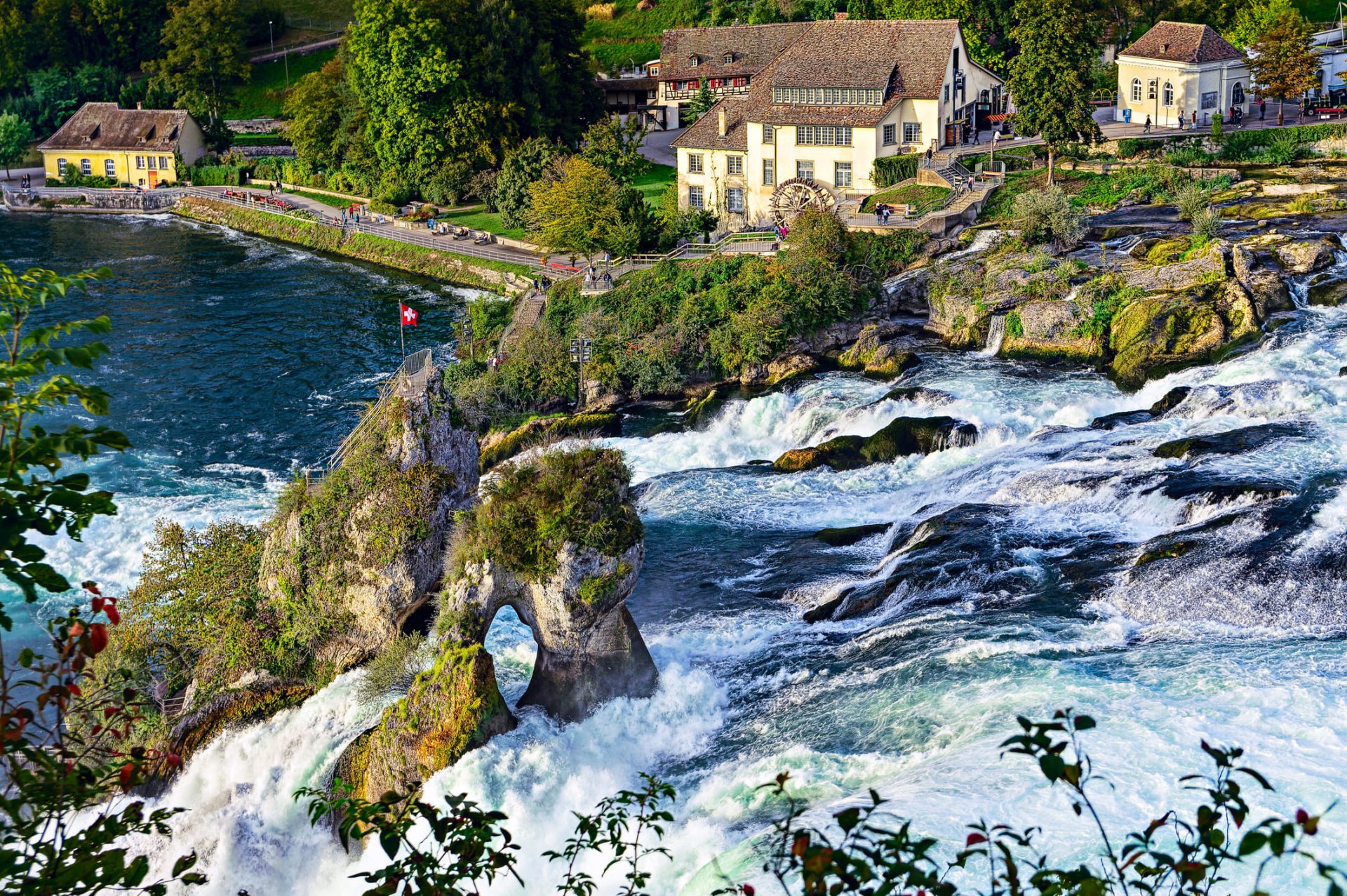
Then you drive north to Schaffhausen and the Rhine Falls, the largest waterfall in Europe, about 150 metres wide and 23 metres high. In summer, the Rhine is at its fullest, and an enormous volume of water thunders over the rocks every second in a wall of white foam and spray. Today you experience it from a boat. The little boat sets off across the churning basin below the falls, rocking on the waves, and heads right into the spray, with the roar so loud that you have to shout to be heard. Depending on the water level, the boat may land at the great rock in the middle of the falls, where you can climb a staircase to a small platform at the top and stand with the river crashing past on both sides. It's an unforgettable experience, and a perfect photo opportunity.

The day ends at the Lindt Home of Chocolate in Kilchberg, on the shores of Lake Zurich. As you enter, you're greeted by the world's largest chocolate fountain, more than nine metres tall, with around 1,500 litres of warm, liquid chocolate flowing down from a giant golden whisk into a huge bowl. The interactive exhibition tells the story of chocolate, from the cocoa plantations of the tropics to the Swiss pioneers of the 19th century, who turned a bitter drink into the smooth, melting chocolate we love today. Along the way, there are tastings, and at the end, the enormous Lindt shop offers chocolates of every flavour to take home.

In the evening you return to your hotel in Central Switzerland for your farewell dinner with the group, full of stories from London, Paris and the Alps.

For one of the best views of Bern, walk up to the Rose Garden on the hillside across the river, where more than 200 varieties of roses bloom in summer, and the whole old town, its rooftops, towers and the curve of the Aare, is spread out below you. The Swiss parliament in the Federal Palace is remarkably open: when parliament is in session, visitors can watch the debates from the public galleries, and Swiss ministers are often seen walking or taking the tram around the city like ordinary citizens. Switzerland has no single head of government; instead, it's led by a council of seven ministers, and each year one of them takes a turn as president.

At Lindt, look out for the story of Lindor, the famous chocolate balls with a hard shell and a soft, melting centre, first created in 1949. The company's roots go back to 1845, when the confectioner David Sprüngli and his son began making chocolate in Zurich, and to Rodolphe Lindt, whose invention in 1879, a process called conching, made chocolate smooth and melting for the first time. Before that, chocolate was gritty and hard; after it, the world fell in love with Swiss chocolate.

Included today: Bern orientation tour, Rhine Falls boat ride, Lindt Home of Chocolate entry with tasting, breakfast, lunch, dinner.

Good to know: you may get a little wet on the Rhine Falls boat, so protect your phone and camera. Landing at the central rock depends on the water level. Keep chocolates in a cool place.

Day 10
Departure from Zurich | Home with three countries in your heart

Departure from Zurich | Home with three countries in your heart

⌖ Zurich 🍽 Meals: Breakfast

Your journey through London, Paris and Switzerland comes to an end today. Before the bustle of checking out begins, take a quiet moment over breakfast to enjoy your last Swiss morning: the green hills, the fresh mountain air, perhaps the sound of cowbells or church bells drifting across the valley. In summer, the sun rises early, and the morning light on the hills is soft and golden.

It's been a remarkable ten days. You arrived in London and saw Westminster, Big Ben and Tower Bridge, watched the Changing of the Guard at Buckingham Palace, walked through the Long Room at Lord's, where India lifted the World Cup in 1983, and watched London unfold beneath you from the London Eye. You met the stars at Madame Tussauds and sped under the sea on the Eurostar to Paris. There, you rode to the very top of the Eiffel Tower, walked through the Hall of Mirrors at Versailles, cruised the Seine at sunset and spent a magical day at Disneyland® Paris. Then you crossed into Switzerland, saw Geneva's great fountain, stood in the snow at Jungfraujoch, rode the revolving cable car on Mt. Titlis, cruised Lake Lucerne, walked the arcades of Bern, felt the spray of the Rhine Falls and tasted chocolate at Lindt. That's three of the world's dream destinations in a single journey.

Now it's time to pack. You may have collected British tea and shortbread, cricket souvenirs from Lord's, French perfume and macarons, Disney souvenirs, and Swiss watches, chocolate and knives. Wrap anything fragile in clothes and place it in the middle of your suitcase. Keep chocolates away from heat. Remember that Swiss Army knives and liquids over 100 ml must go in your checked baggage. Keep your passport, tickets, medicines and a light jacket in your hand luggage. If you made a large purchase with a tax-free form in Switzerland, keep the form, receipt and goods together, as they may need to be stamped by customs at the airport before you check in.

After breakfast, you check out and the coach takes you to Zurich Airport. The drive crosses the green Swiss Plateau, with neat farms, orchards, forests and villages, and perhaps a red Swiss train gliding past exactly on time. This is also the moment to say goodbye to your tour manager, who has guided you through three countries, from the streets of London to the glaciers of the Alps, and to the friends you've made along the way. Exchange phone numbers and promise to share your photographs; you'll have plenty to compare, from Big Ben to the Matterhorn chocolate in your bag.

At the airport, there's time for a last coffee or hot chocolate and some final shopping. Then it's time to board your flight home. As the plane climbs, look out of the window for one last glimpse of the Alps shining on the horizon, and take with you the memories of a journey that brought together the royal pageantry of London, the romance of Paris and the majesty of the Swiss mountains.

Over the past ten days, you've travelled through three very different countries, each with its own language, money, food and way of life: the pound in Britain, the euro in France, and the Swiss franc in Switzerland; tea and biscuits in London, croissants and café au lait in Paris, and fondue and chocolate in the Alps. Switzerland alone has four national languages, and you've heard two of them: French in Geneva, and German in Lucerne, Bern and Zurich. You've also seen how well these neighbours connect, from the Eurostar racing under the sea to the Swiss trains and cable cars running exactly to the minute.

If you'd like a reminder of Swiss precision, look out at the station for the famous Swiss railway clock, with its plain white face and red second hand shaped like a railway signal. Designed in the 1940s, it's so admired that it has become a design classic, and its second hand has a special trick: it sweeps round the dial in about 58 seconds, then pauses at the top until the master clock sends its signal, so that every station clock in the country is perfectly in step.

And if this journey has given you a taste for Europe, there's much more waiting: the canals of Venice, the art of Florence and the ruins of Rome; the lakes and castles of Austria; the fjords of Norway; or the Scottish Highlands. Many of our travellers come back again and again, each time discovering something new. Perhaps this is only the first of many journeys, and the next one is already waiting.

Included today: breakfast, departure transfer to Zurich Airport.

Good to know: book a flight that leaves at least 3 hours after the transfer reaches the airport; we'll confirm the transfer time when you book.

Hotel confirmation

Hotel names will be provided after booking, subject to availability and confirmation. We do not hold hotel confirmations before booking.

Inclusions

Hotels: Guaranteed 04 Star

Meals: All Meals Included

Sightseeing: All Tours included

Exclusions

Flights

Visa

Insurance

GST

TCS

Important Terms

Booking and payment

  • At booking: 30% of the tour cost per person.
  • 30 days before departure: the full balance.
  • Booking within 30 days of departure: 30% to book, and the balance as soon as your booking is confirmed.

Cancellation charges

From booking until 36 days before departure₹42,000 per person35 to 29 days before departure₹60,000 per person28 to 15 days before departure50% of the tour cost14 to 8 days before departure75% of the tour cost7 days or less before departure, or no-show100% of the tour cost


Two visas, one trip

This tour visits the UK and the Schengen area, so you need a UK visitor visa and a Schengen visa. Apply for the UK visa first, then the Schengen visa through France or Switzerland. Our team guides you through both.

London, Paris & Switzerland Tour – Grand Fascinating Europe, 9 Nights / 10 Days FAQs

How do we travel from London to Paris?
By the Eurostar high-speed train through the Channel Tunnel, which takes about two and a half hours.
Do I need two visas?
Yes, a UK Standard Visitor visa and a Schengen visa. We help you with both applications.
Is Jungfraujoch included?
Yes, along with Mt. Titlis, a Lake Lucerne cruise and the Rhine Falls with a boat ride.
Are flights included?
No. This is a land tour that starts in London and ends in Zurich. We can add return flights from Delhi, Mumbai or your city, timed to match the group transfers.
Is Jain or vegetarian food available?
Yes. Most lunches and dinners are Indian meals with Jain, vegetarian and non-vegetarian options, and breakfast is a continental buffet at the hotel.
Gallery

Europe photos: London, Paris & Switzerland Tour – Grand Fascinating Europe, 9 Nights / 10 Days

Plan your Europe holiday with Dreamland Vacations

Share your dates, travellers and comfort preference. Our team will guide you with the next best step.

Get a free quote
Itinerary Get a quote
WhatsApp