Scandinavia Tour – Finland, Sweden, Norway & Denmark, 9 Nights / 10 Days
Standard Package

Scandinavia Tour – Finland, Sweden, Norway & Denmark, 9 Nights / 10 Days

Four Nordic capitals and Norway's fjords in 9 nights / 10 days: Helsinki, an overnight Baltic cruise to Stockholm, Oslo, the Norway in a Nutshell jou…

⌖ Europe ✦ Family & senior friendly planning
Package snapshot
DestinationEurope
Travel styleStandard Package

Want to customize this package?

Share your dates and travellers. This enquiry is free. Small changes to a standard itinerary—such as a date change or an extra day—can be discussed with our team.

We’ll send verification codes to your WhatsApp number and email. Indian numbers can be entered without +91; for other countries, include the country code.
Verification required before submitting.
Your holiday

Scandinavia Tour – Finland, Sweden, Norway & Denmark, 9 Nights / 10 Days: overview

Four Nordic capitals, two nights at sea and the fjords of Norway

Imagine a summer evening in the far north of Europe, when the sun barely sets and the sky glows pink and gold until midnight. You're standing on the deck of a great ship, gliding between thousands of rocky islands towards Stockholm. A few days later you're on a little mountain train winding down past roaring waterfalls to a fjord so deep and narrow it takes your breath away. This Scandinavia tour package shows you Finland, Sweden, Norway and Denmark in ten days, and it's planned so all you have to do is look and enjoy.

You begin in Helsinki with a guided city tour and the remarkable Rock Church, then sail overnight on a Silja Line cruise to Stockholm for its Old Town, City Hall and the Vasa Museum. You drive through the Swedish lakelands to Oslo for the Vigeland sculpture park and the Holmenkollen ski jump, then ride Norway in a Nutshell, with scenic mountain trains and a fjord cruise, the highlight of the tour. After a guided tour of Bergen and the Fløyen funicular, a second overnight cruise takes you to Denmark, with Aarhus and Odense on the way to Copenhagen, the Nyhavn canals, a Carlsberg brewery visit and Tivoli Gardens.

A professional tour manager travels with the group, you stay in 4-star hotels with inside cabins on the two cruises, and Indian lunches and dinners are included on most days. One Schengen visa covers all four countries. See all our Europe tour packages.

Good to know

Package typeStandard Package
Planning supportSmall changes by enquiry
Best forFamilies, couples & seniors
Get a free quote
Trip highlights
✦ Arrive in Helsinki | Welcome to the happiest country in the world
✦ Helsinki city tour, Rock Church and overnight Silja Line cruise | A city of design and a night at sea
✦ Stockholm city tour, City Hall, Vasa Museum and SkyView | The beauty on the water
✦ Karlstad and on to Oslo | Through the Swedish lakelands to Norway
✦ Oslo city tour, Vigeland Sculpture Park and Holmenkollen Ski Jump | Art, sport and the road into the mountains
✦ Norway in a Nutshell – mountain railways and a fjord cruise, then Bergen | The highlight of your tour
Day-wise plan

Europe itinerary: day by day

Day 1
Arrive in Helsinki | Welcome to the happiest country in the world

Arrive in Helsinki | Welcome to the happiest country in the world

⌖ Helsinki 🍽 Meals: Dinner

Your Scandinavian adventure begins in Helsinki, the capital of Finland. As your plane comes in to land, look out of the window: dark green forests stretch in every direction, dotted with thousands of lakes that shine like mirrors in the summer sun, and along the coast, a scatter of rocky islands lies in the blue waters of the Baltic Sea. Finland has so many lakes that it's often called the land of a thousand lakes, though in fact it has more than 180,000.

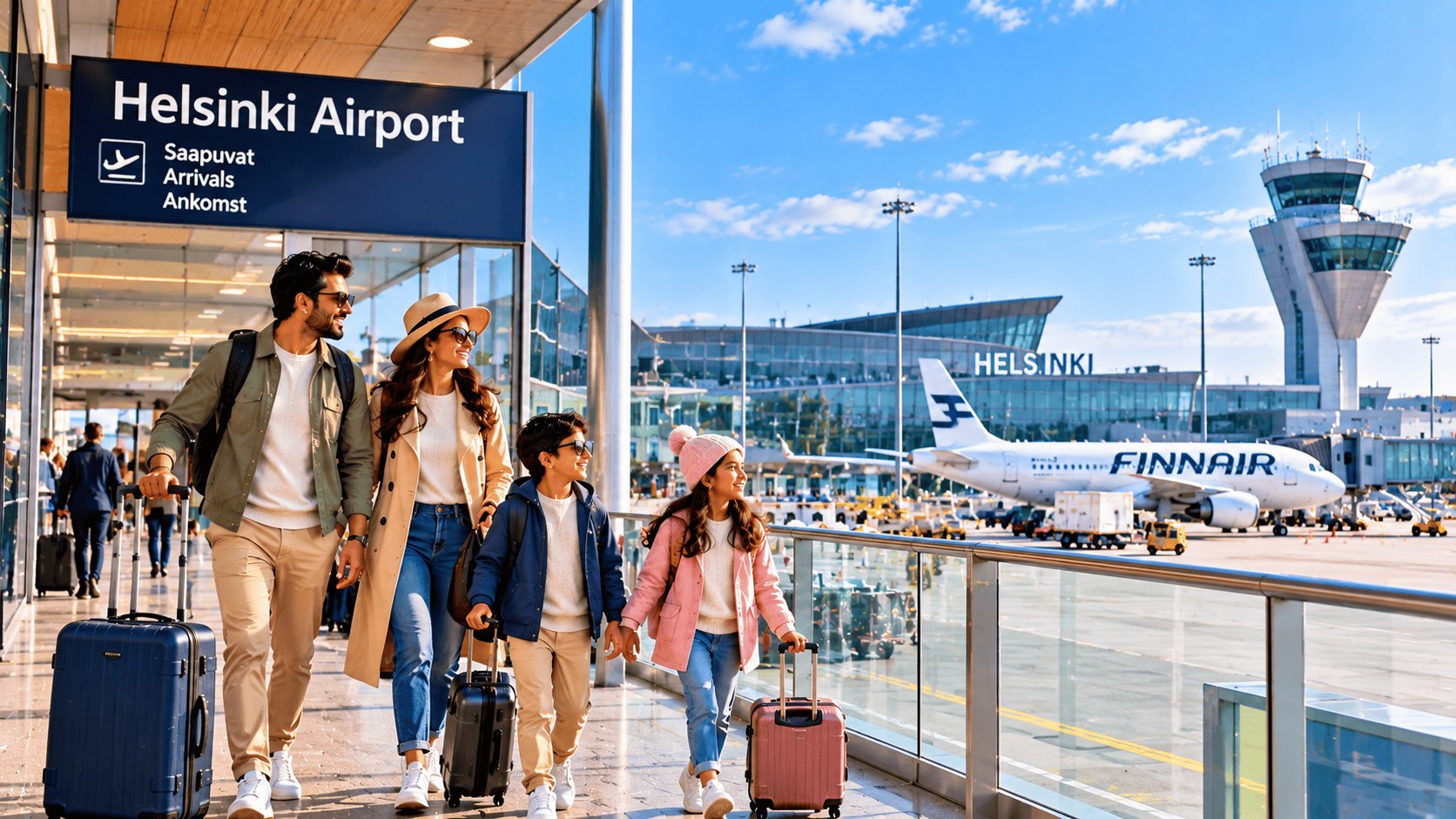
After you clear immigration and collect your bags, walk out into the arrivals hall, where your tour manager is waiting to greet you. From this moment, everything is arranged: coaches, hotels, cruises, trains, guides and meals. All you have to do is enjoy ten days in one of the most beautiful corners of the world.

Finland has been named the happiest country in the world in the World Happiness Report year after year, and within a few hours you'll begin to understand why. Life here feels calm and balanced. Cities are clean and safe, nature is never far away, and people value simple pleasures: time outdoors, good design, a cup of coffee with friends and, above all, the sauna. Finland has around three million saunas for a population of about five and a half million people, and for the Finns, the sauna isn't a luxury but a way of life, a place to relax, clear the mind and spend time with family and friends.

The drive into the city takes you through green suburbs and forests to Helsinki, a city by the sea. Helsinki was founded in 1550 by the Swedish king Gustav Vasa, at a time when Finland was part of the kingdom of Sweden. In 1809 Finland came under the rule of the Russian Empire, and in 1812 the Russian tsar made Helsinki the capital. Finland finally became independent in 1917. You'll see the traces of this history all over the city: grand neoclassical buildings from the Russian era, Lutheran churches from the Swedish tradition, and modern Finnish architecture and design that have made Helsinki famous around the world. The Finnish language itself is quite unlike Swedish or Russian; its closest relatives are Estonian and, more distantly, Hungarian.

Helsinki is known as a city of design. It was named World Design Capital in 2012, and Finnish brands like Marimekko, with its bold, colourful printed fabrics, and Iittala, with its elegant glassware, are loved around the world. The city's Design District is a neighbourhood of small boutiques, galleries and workshops where you can see Finnish creativity up close.

Once you reach your hotel and check in, the rest of the day is yours. If you've arrived after an overnight flight, rest and freshen up. Then, if you have the energy, step outside and enjoy the light. In June and July, Helsinki has around nineteen hours of daylight, and even at midnight the sky is never fully dark, only a deep, glowing twilight. Finns make the most of these long summer days: they sit at outdoor café terraces, swim in the sea, picnic in the parks and stroll along the waterfront late into the evening. It's a magical time to visit, and it can make it hard to sleep, so many travellers keep an eye mask handy.

A few practical tips help you settle in. Finland uses the euro, and cards are accepted almost everywhere, even for very small purchases. Tap water is clean and delicious. Finnish people are friendly but reserved; they value personal space and quiet, and nobody minds a comfortable silence. English is widely spoken, but a simple "kiitos" (thank you) always brings a smile.

In the evening the group meets for dinner. It's your first chance to get to know your fellow travellers and to hear your tour manager explain the plan for the coming days: a guided tour of Helsinki tomorrow, then your first overnight cruise to Stockholm. After dinner, return to your hotel and get some rest. Your Nordic adventure has begun.

The Finns have a word you'll hear often if you ask them about their character: sisu. It means a kind of quiet courage, determination and resilience in the face of hardship, and Finns believe it helped them survive long, dark winters and difficult chapters of history. You'll also see the cheerful, round, white Moomin trolls everywhere, on mugs, books and souvenirs. They were created by the Finnish writer and artist Tove Jansson, and they're as loved in Finland as any national hero. If your tour is in late June, you may catch Midsummer, called Juhannus, when Finns head to their lakeside summer cottages, light bonfires by the water and celebrate the longest day of the year. Many Finns spend their summer holidays at a simple wooden cottage on a lake, with a sauna by the shore, swimming in the cool water between sauna sessions. For them, it's the very definition of happiness.

Included today: arrival transfer, dinner.

Good to know: hotel check-in is usually mid-afternoon. Helsinki summer days are usually mild, around 18–24°C, but evenings by the sea can be cool, so pack a light jacket. Bring an eye mask if you're sensitive to light at night.
Day 2
Helsinki city tour, Rock Church and overnight Silja Line cruise | A city of design and a night at sea

Helsinki city tour, Rock Church and overnight Silja Line cruise | A city of design and a night at sea

⌖ Silja Line Cruise 🍽 Meals: Breakfast, Lunch, Western Dinner

Today you explore Helsinki with a local guide and then set sail across the Baltic Sea on your first overnight cruise. After breakfast, you check out of your hotel and the guided tour begins.

The tour takes you along the waterfront past the busy harbour, where the great white cruise ferries to Stockholm and Tallinn are moored, and the shipyards where some of the world's largest cruise ships and icebreakers have been built. You'll drive along the coastal road past Embassy Park, a quiet area of elegant villas and embassies by the sea, and stop at the Market Square, where colourful stalls sell fresh berries, smoked fish, vegetables, handicrafts and souvenirs in summer. Nearby stands the Havis Amanda fountain, a bronze statue of a mermaid rising from the sea, one of Helsinki's best-loved symbols.

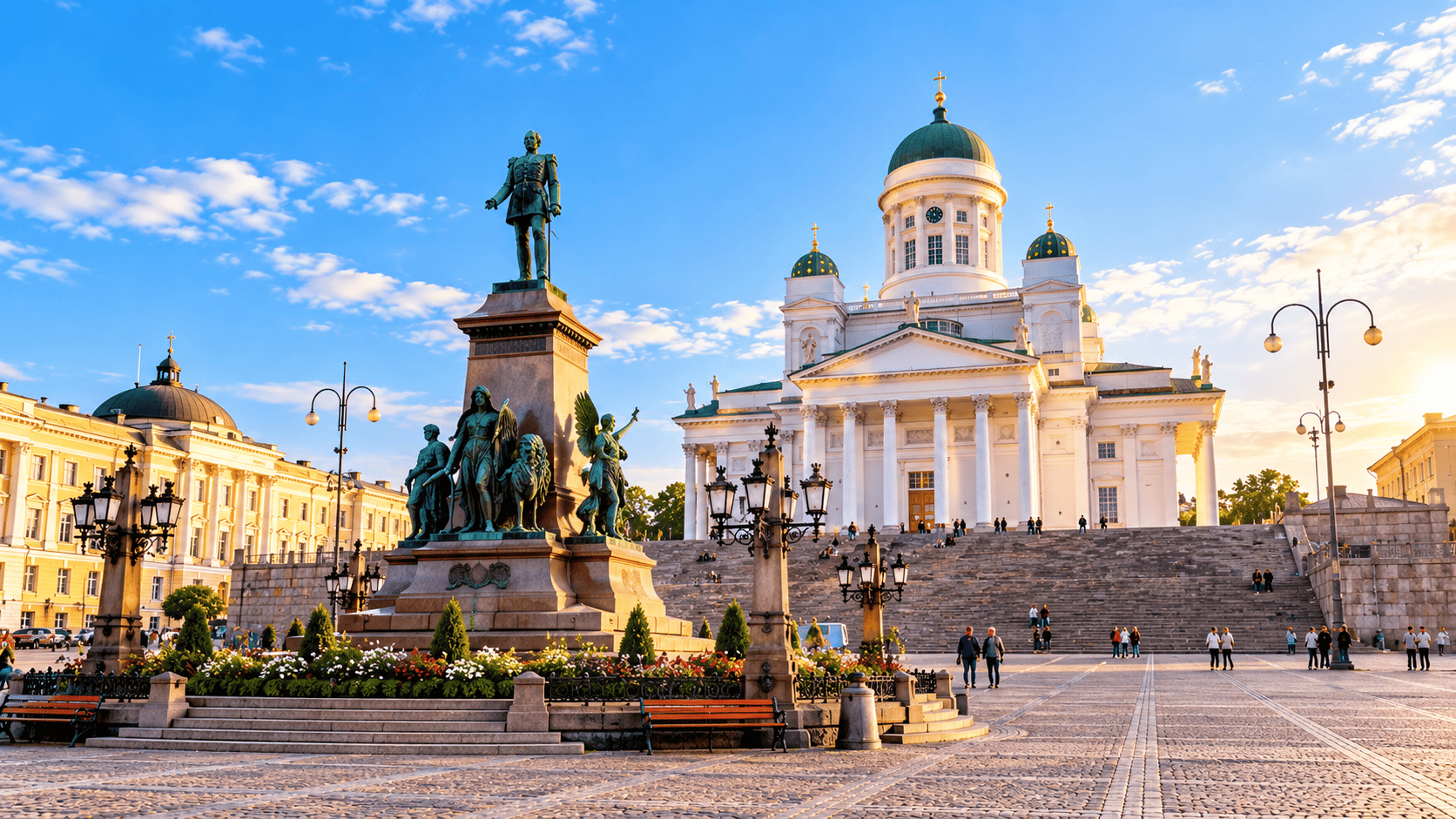
Then you come to Senate Square, the heart of the old city, designed in the early 19th century in grand neoclassical style. At the top of a wide flight of steps stands the brilliant white Helsinki Cathedral, a Lutheran church crowned with green domes, which has become the city's landmark. In the middle of the square stands a statue of the Russian tsar Alexander II, who was remembered fondly in Finland for giving the country greater freedom. Not far away, on a hill overlooking the harbour, rises the red-brick Uspenski Cathedral, with golden onion domes, the largest Orthodox church in Western Europe, a reminder of Finland's years under Russian rule. You'll also walk along the Esplanadi, a leafy boulevard lined with designer shops, cafés and an outdoor stage where concerts are held in summer.

Next you visit the Sibelius Monument, dedicated to Jean Sibelius, Finland's greatest composer, whose music helped inspire the Finnish people in their struggle for independence. The monument, unveiled in 1967, is made of more than 600 welded steel pipes, arranged like the pipes of a great organ, and seems to ripple like a wave. When the wind blows, it sometimes makes a soft, whistling sound.

The tour continues along Mannerheimintie, Helsinki's main street, past the Parliament building, the National Museum and Finlandia Hall, a gleaming white concert hall designed by the great Finnish architect Alvar Aalto. You'll also see the Olympic Stadium, built for the 1952 Summer Olympics, with its tall white tower.

Then comes one of Helsinki's most extraordinary sights: the Temppeliaukio Church, better known as the Rock Church. Completed in 1969, it was built directly into a huge outcrop of solid granite, and its walls are the raw, rough rock itself. A great copper dome rests on the rock, separated from it by a ring of windows that lets daylight flood in. Inside, the space is warm, calm and surprisingly beautiful, and the natural rock walls give it such excellent acoustics that it's often used for concerts. Many visitors find it one of the most moving places in the city.

In the late afternoon, you head to the port and board the Silja Line cruise ship for your overnight voyage to Stockholm. These ships are like floating hotels, with cabins, restaurants, shops, lounges and entertainment over several decks. As the ship leaves the harbour, go out on deck: you'll sail past Suomenlinna, a sea fortress built in the 18th century on a group of islands guarding the entrance to Helsinki, now a UNESCO World Heritage Site. Then the ship heads out across the Baltic, threading its way between hundreds of small rocky islands with red wooden summer cottages, saunas and boathouses by the water. In summer the sun sets late, and the evening light on the sea and the islands is unforgettable. Dinner tonight is a Western buffet on board, after which you can watch the sunset from the deck, enjoy the onboard shows or simply relax in your cabin as the ship sails through the night.

Before you leave Helsinki, look out for a few Finnish treats in the market halls and cafés. Karelian pies are small, oval pastries with a thin rye crust and a filling of creamy rice porridge, traditionally eaten warm with egg butter, and they're vegetarian. Korvapuusti, which translates as "slapped ears", are fragrant cinnamon and cardamom buns, perfect with a cup of coffee; the Finns drink more coffee per person than almost any other nation in the world. In summer, the markets are piled high with fresh strawberries, blueberries and cloudberries, a golden berry that grows wild in the northern marshes.

During the night, the ship sails through the Åland Islands, a group of thousands of islands between Finland and Sweden. Åland belongs to Finland but is self-governing, Swedish-speaking and demilitarised, with its own flag and even its own stamps. If you're awake as the ship passes through, you may see the dark silhouettes of the islands against the pale northern night sky.

Included today: guided city tour of Helsinki, Rock Church visit, overnight Silja Line cruise to Stockholm in an inside cabin, breakfast, lunch, Western dinner on board.

Good to know: pack a small overnight bag for the cruise with your night clothes, medicines and toiletries, as your main suitcase may be less easy to reach. The Rock Church sometimes closes for services or concerts.

Day 3
Stockholm city tour, City Hall, Vasa Museum and SkyView | The beauty on the water

Stockholm city tour, City Hall, Vasa Museum and SkyView | The beauty on the water

⌖ Stockholm 🍽 Meals: Breakfast, Lunch, Dinner

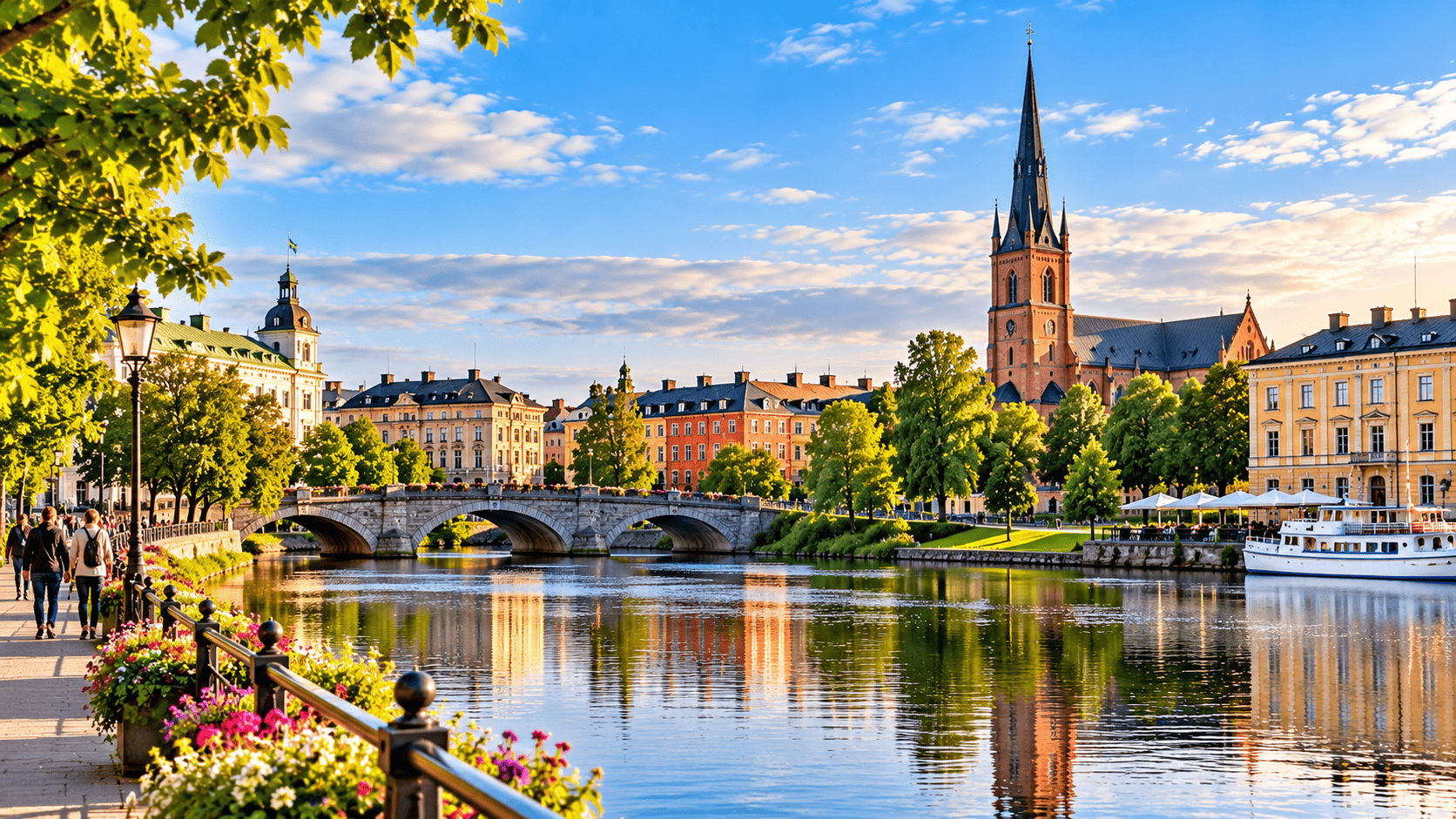
Wake up early if you can and go out on deck, because the ship's arrival into Stockholm is one of the most beautiful sea journeys in Europe. For the last few hours, the ship sails through the Stockholm archipelago, a maze of around 30,000 islands, islets and rocks. Some are bare granite, smoothed by ancient glaciers; others are covered in pine forest, with little red cottages, jetties and sailing boats by the water. In the soft morning light, with the sea calm and glassy, it's a magical sight.

Stockholm, the capital of Sweden, is built on 14 islands where Lake Mälaren meets the Baltic Sea, linked by more than 50 bridges, which is why it's often called the Venice of the North. It's a city of water, light and space, where you're never far from a waterfront, a park or a view. It's also a city of ideas: Sweden has given the world everything from the Nobel Prize to IKEA, ABBA, Spotify and the safety belt in cars.

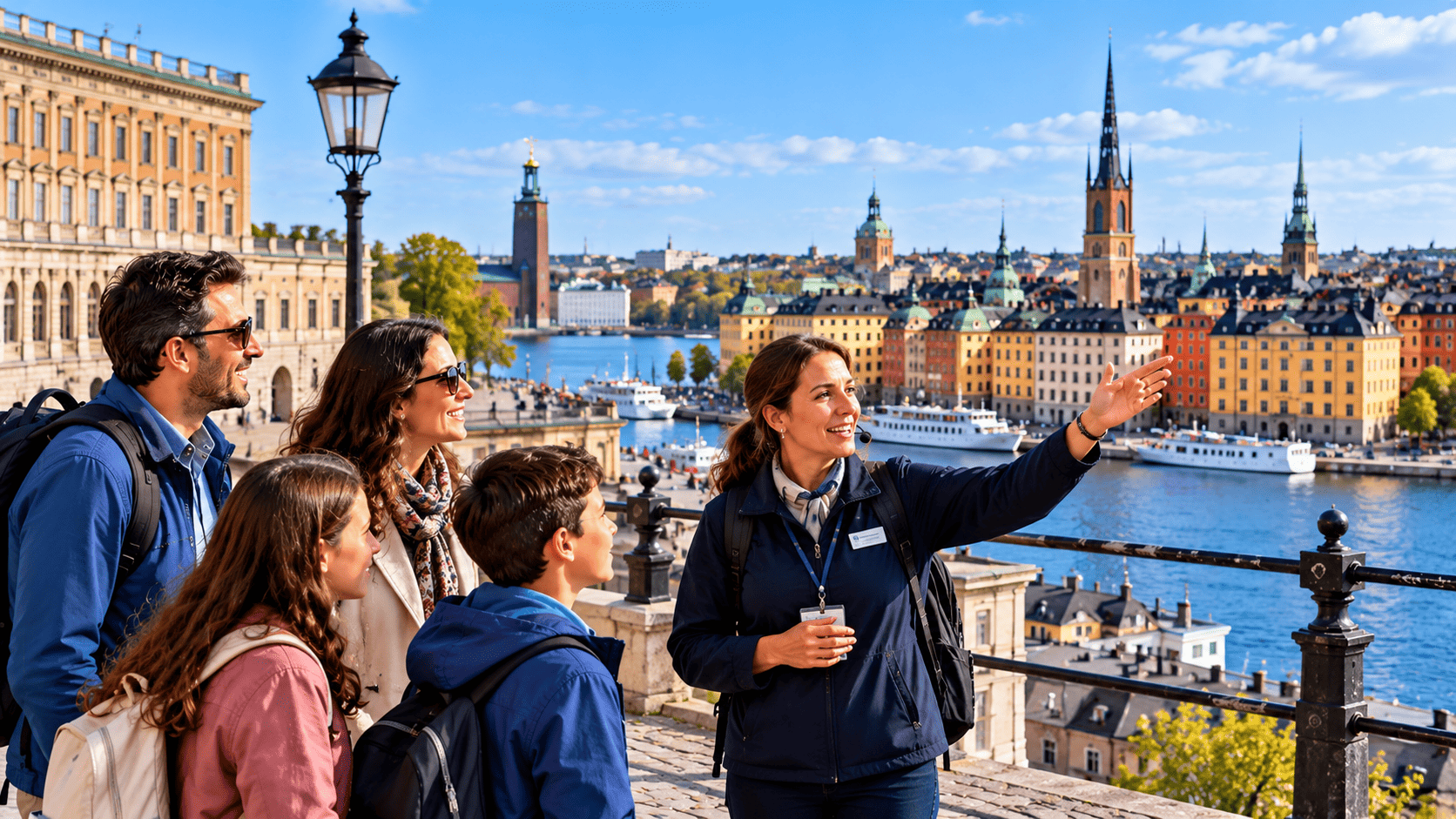
After you disembark, your local guide takes you on a city tour. You begin at Fjällgatan, a street on a cliff on the island of Södermalm, which offers one of the best views of the city: the islands, bridges, church spires and the water sparkling between them. Then you head into Gamla Stan, the Old Town, where Stockholm began in the 13th century. Its narrow, cobblestoned alleys are lined with tall, colourful buildings in shades of ochre, red and yellow, and lead to Stortorget, the old main square. Here you'll see the Royal Palace, the official residence of the Swedish king, with more than 600 rooms, making it one of the largest palaces in Europe, and Stockholm Cathedral, the city's oldest church. If you're lucky, you may see the changing of the guard at the palace.

Then you visit Stockholm City Hall, one of Sweden's most famous buildings, with its tall red-brick tower topped by three golden crowns, standing on the water's edge. Every December, the Nobel Prize banquet is held in its Blue Hall, which, to most visitors' surprise, isn't blue at all; the architect planned to paint it but loved the red brick so much that he left it as it was, though the name stuck. Upstairs, the Golden Hall dazzles with walls covered in around 18 million tiny gold and glass mosaic tiles, telling the story of Sweden's history.

Next comes the Vasa Museum, the most visited museum in Scandinavia. Inside stands the Vasa, a magnificent warship built for the Swedish king in the 1620s. On her maiden voyage in 1628, in front of crowds of onlookers, she sailed barely a kilometre and a half before tipping over and sinking in the harbour; she was too tall and top-heavy. She lay on the seabed for 333 years until she was raised in 1961, and because the cold, brackish water of the Baltic preserved her so well, about 98 percent of the ship you see is original. Standing beneath her towering hull, decorated with hundreds of carved sculptures of lions, warriors and gods, is an astonishing experience.

The day ends with a ride on the SkyView gondolas, which climb up the outside of the Avicii Arena, a giant white ball-shaped building that is the largest spherical building in the world. From the top, you get a panoramic view across Stockholm and its islands.

In between the sights, do as the Swedes do and take a "fika", the Swedish coffee break, with a cup of coffee and a cinnamon bun. For Swedes, fika is a cherished daily ritual, a moment to pause and chat with friends or colleagues, and it's one of the nicest habits you can pick up on your travels. In the evening you check in to your hotel in Stockholm for dinner.

Stockholm has a special link with India through the Nobel Prize. The prizes were created by Alfred Nobel, the Swedish chemist who invented dynamite and left most of his fortune in his will to reward those who "conferred the greatest benefit to humankind". The first prizes were awarded in 1901. In 1913, the poet Rabindranath Tagore became the first person from Asia to win a Nobel Prize, for literature, and in 1930 the physicist C.V. Raman won the Nobel Prize for physics for his discovery about the scattering of light, now known as the Raman effect. Standing in the City Hall where the Nobel banquet is held, it's a proud thought.

If you have time on another visit, Stockholm's island of Djurgården is home to more famous museums, including Skansen, the world's oldest open-air museum, opened in 1891, where historic farmhouses and workshops from all over Sweden have been rebuilt, and the ABBA Museum, where fans can sing along with the band that put Sweden on the world's musical map.

Included today: arrival by cruise into Stockholm, guided city tour of Stockholm, City Hall visit, Vasa Museum entry, SkyView gondola ride, breakfast, lunch, dinner.

Good to know: City Hall visits depend on official events, and SkyView operates subject to weather and maintenance; if either is unavailable, an alternative is arranged. Stockholm's Old Town is cobbled, so wear comfortable shoes.

Day 4
Karlstad and on to Oslo | Through the Swedish lakelands to Norway

Karlstad and on to Oslo | Through the Swedish lakelands to Norway

⌖ Oslo 🍽 Meals: Breakfast, Lunch, Dinner

Today you cross from Sweden into Norway on a scenic road journey through the heart of Scandinavia. After breakfast, you check out of your hotel in Stockholm, sit back in the coach and watch the Swedish countryside unfold.

The road heads west through central Sweden, a landscape of endless forests of pine, spruce and birch, broken by sparkling lakes, rolling farmland and small villages. You'll notice that many of the wooden houses and barns are painted a deep, rich red with white trim around the windows and corners. This colour, known as Falu red, comes from a paint made with minerals from the old copper mine at Falun, and it has protected Swedish wooden buildings from the weather for centuries. Today a red cottage beside a lake, surrounded by trees, is the picture almost every Swede dreams of for their summer holidays.

Swedes love their countryside, and they have a special right that allows them to enjoy it. It's called allemansrätten, the right of public access, and it means that anyone can walk, cycle, camp for a night, pick berries and mushrooms, and swim almost anywhere in nature, even on private land, as long as they respect the land and the people who live there. It's one reason why outdoor life is so important to Swedes, and why you'll see so many people hiking, cycling and canoeing in summer.

Around midday you reach Karlstad, a charming town in the province of Värmland, roughly halfway between Stockholm and Oslo. Karlstad lies where the Klarälven River flows into Lake Vänern, the largest lake in Sweden and in the whole European Union, so big that it feels like an inland sea. The town is known as one of the sunniest places in Sweden, and its symbol is a smiling sun, which you'll see on signs, flags and souvenirs around town. It's said to come from an old tradition of locals telling visitors that the sun always shines in Karlstad. With its riverside promenades, parks, bridges and cafés, it's a relaxed and friendly place to stretch your legs and have lunch.

In the afternoon you continue west and cross the border into Norway. The landscape gradually becomes hillier and more rugged, with deeper valleys, steeper forests and rocky outcrops, a hint of the mountains and fjords to come. Norway is a long, narrow country stretching far into the Arctic, with a coastline so indented by fjords that if you straightened it out, it would reach around the world more than twice. It's one of the wealthiest countries in the world, thanks partly to the oil and gas discovered in the North Sea in the 1960s, and the Norwegians have saved much of that wealth in a giant fund for future generations.

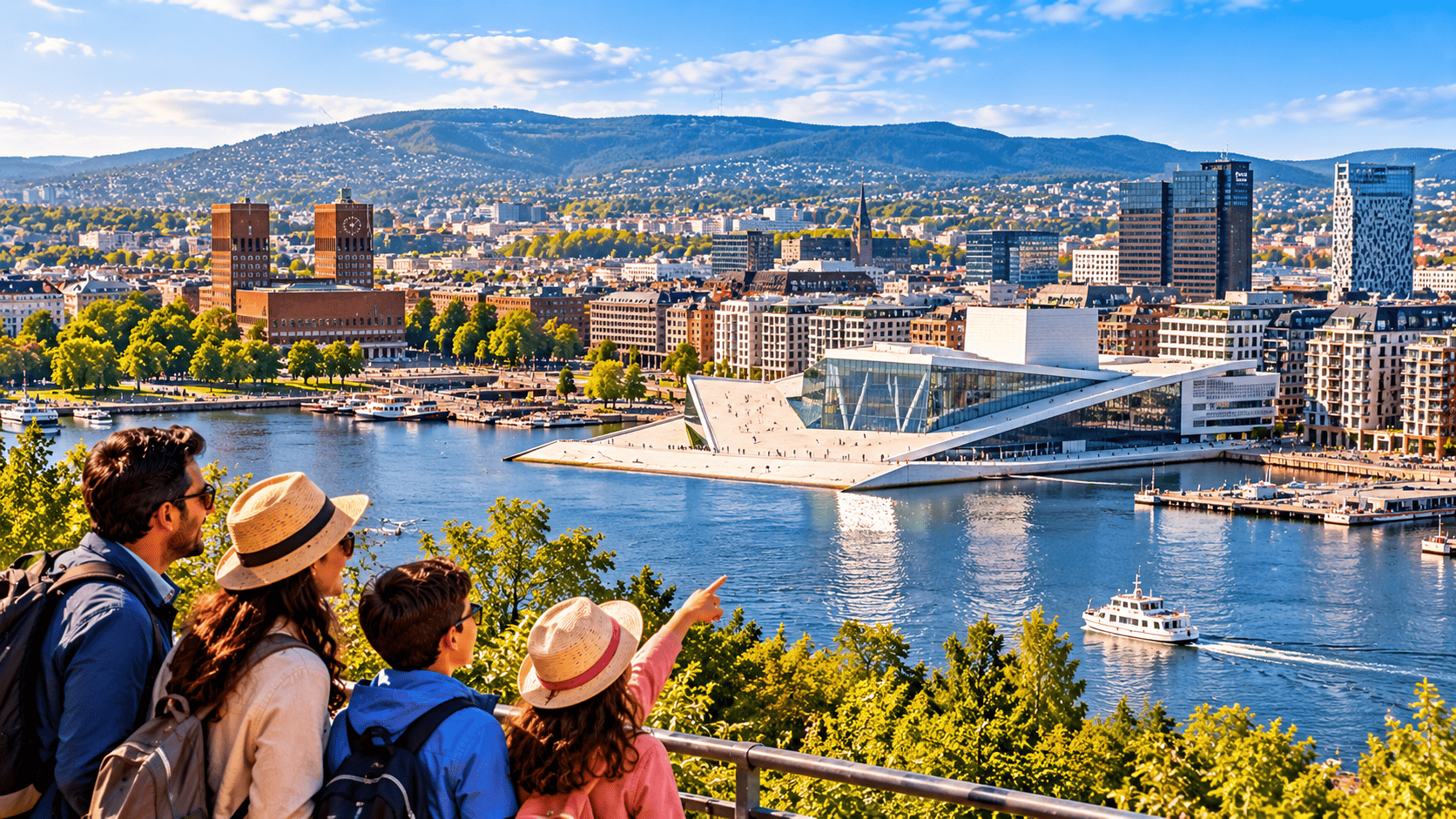
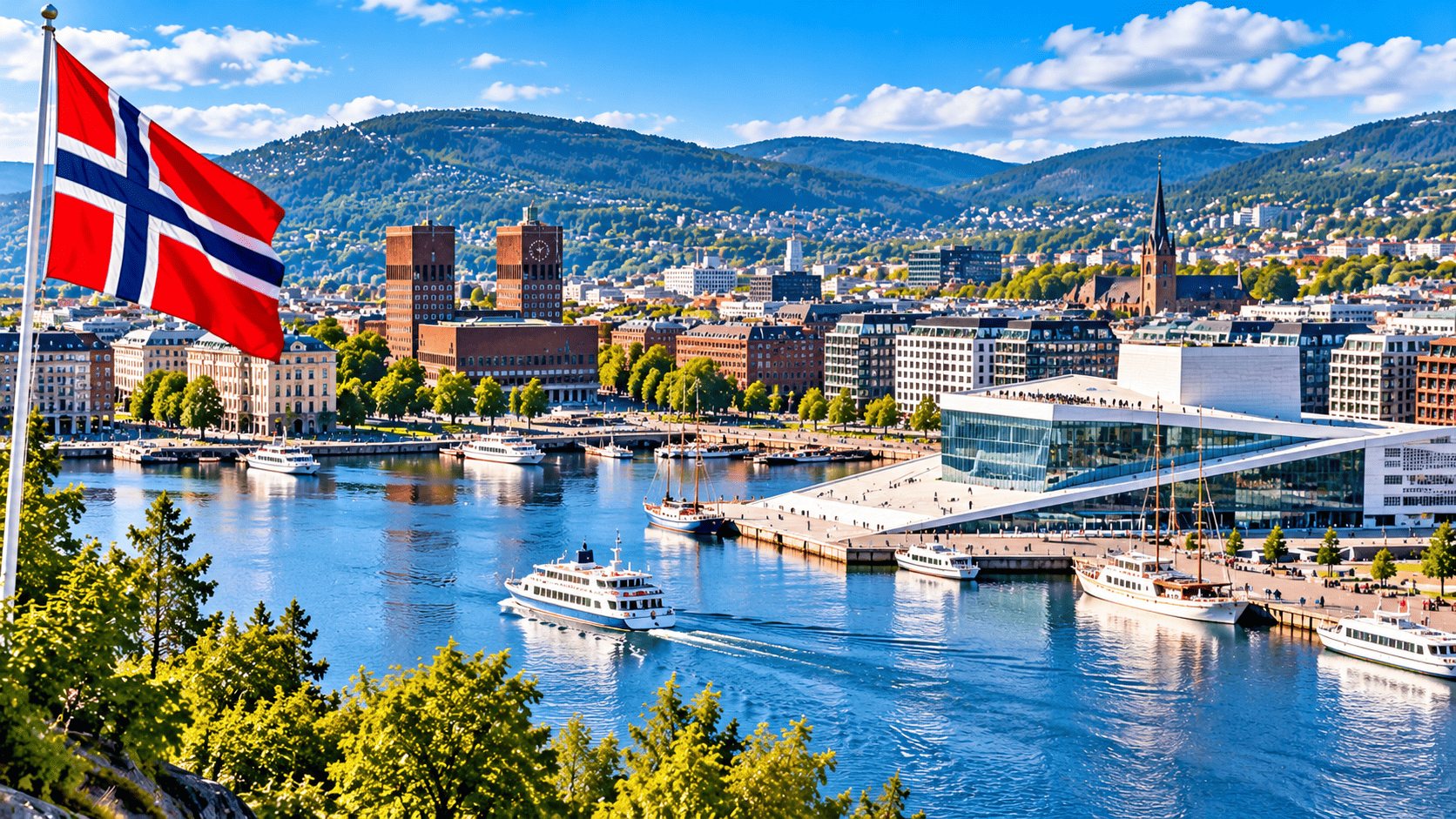
By evening you reach Oslo, the capital of Norway, set at the head of the long Oslofjord and surrounded by forested hills. Oslo is one of the oldest capitals in Scandinavia, founded around a thousand years ago. After a great fire in 1624, the Danish-Norwegian king Christian IV rebuilt the city and renamed it Christiania after himself; it only got its old name, Oslo, back in 1925. Today it's a green, modern and relaxed city, with a beautiful waterfront. As you drive in, look out for the Oslo Opera House, a gleaming white building that seems to rise out of the water like a glacier. Its sloping marble roof runs right down to the fjord, and visitors are allowed to walk up onto it for views over the city and the water. You may also spot Oslo City Hall, the big twin-towered brick building on the harbour where the Nobel Peace Prize is awarded every year, and the medieval Akershus Fortress, standing guard over the harbour.

You check in to your hotel in Oslo, where dinner is waiting. In summer, the evenings here are long and light, so if you have the energy, take a walk along the harbour at Aker Brygge, a lively waterfront area of restaurants and cafés, where locals gather on warm evenings to enjoy the sunshine by the fjord.

Värmland, the province around Karlstad, is a land of storytellers. The writer Selma Lagerlöf grew up here, and in 1909 she became the first woman ever to win the Nobel Prize for literature. Her most famous book, The Wonderful Adventures of Nils, tells of a boy who shrinks to the size of a thumb and travels across Sweden on the back of a goose, and generations of Swedish children learned their country's geography from it. If your tour is in late June, you may also see Swedes celebrating Midsummer, the most beloved festival of the year, when families dance around a tall maypole decorated with leaves and flowers, wear wreaths of flowers in their hair, and eat herring, new potatoes and strawberries late into the bright summer night.

Included today: coach Stockholm to Oslo via Karlstad, breakfast, lunch, dinner.

Good to know: today is mostly a travel day, with about eight hours of driving including stops. Norway uses the Norwegian krone rather than the euro, but cards are accepted almost everywhere.

Day 5
Oslo city tour, Vigeland Sculpture Park and Holmenkollen Ski Jump | Art, sport and the road into the mountains

Oslo city tour, Vigeland Sculpture Park and Holmenkollen Ski Jump | Art, sport and the road into the mountains

⌖ Geilo 🍽 Meals: Breakfast, Lunch, Western Dinner

Today you explore Oslo with a local guide, then travel up into the mountains of central Norway. After breakfast, the guided city tour begins.

Your guide shows you the highlights of the Norwegian capital. You'll drive along Karl Johans gate, Oslo's main street, which runs from the central station up to the Royal Palace, past the Storting, Norway's parliament, the National Theatre and the old university buildings. At the top stands the Royal Palace, the residence of the Norwegian king, surrounded by a park that is open to everyone, a sign of how informal and close to the people the Norwegian monarchy is. You'll also see the waterfront, with the Opera House, City Hall and Akershus Fortress.

Then you visit the Vigeland Sculpture Park, one of Norway's most popular attractions, set in the green expanse of Frogner Park. It's the life's work of one artist, Gustav Vigeland, who created more than 200 sculptures in bronze, granite and wrought iron, all showing human beings at every stage of life, from babies to the very old. Walk across the bridge lined with bronze figures of people running, playing, embracing and quarrelling, and look out for Sinnataggen, "the Angry Boy", a small bronze toddler stamping his foot in a tantrum, so famous that his hand has been polished bright by visitors. At the heart of the park rises the Monolith, a column more than 14 metres tall carved from a single block of granite, covered with 121 human figures climbing and clinging to one another as they reach towards the sky. The park is free and open to all, and on summer days it's full of families, joggers and picnickers.

After lunch you drive up into the hills above the city to Holmenkollen, the home of Norwegian skiing. Skiing is part of the Norwegian soul: there's even a saying that Norwegians are born with skis on their feet. The Holmenkollen Ski Jump has hosted ski-jumping competitions since 1892, and the dramatic modern jump you see today, rebuilt in 2010, rises like a giant curving ramp above the forest. You take a lift up the tower to the top of the jump, where you can look down the steep run that the jumpers race down before flying through the air, and out across Oslo, the fjord and its islands far below. It's an exhilarating view, and it gives you a whole new respect for the athletes. At the base of the jump is the Ski Museum, said to be the oldest ski museum in the world, telling the story of 4,000 years of skiing, including the polar expeditions of Norwegian explorers like Roald Amundsen, the first man to reach the South Pole.

In the afternoon you leave Oslo and drive north-west into the mountains. The road follows the long Hallingdal valley, a green, deep valley with a river running through it, old wooden farms, traditional stave churches and pine forests rising up the slopes. As you climb, the landscape becomes wilder and more open.

By evening you reach Geilo, a mountain resort village in the heart of Norway, set at around 800 metres above sea level, roughly halfway between Oslo and Bergen. In winter Geilo is a popular ski resort, but in summer it's surrounded by green hillsides, lakes and walking trails. Just to the south lies the Hardangervidda, the largest mountain plateau in Northern Europe, a vast, open landscape of lakes, moorland and rocks, home to wild reindeer. The air here is crisp and pure, and the silence is deep. You check in to your hotel and enjoy a hearty Western dinner, then perhaps step outside to admire the mountains in the long summer twilight.

Oslo has many more stories to tell. The Nobel Peace Prize, unlike the other Nobel Prizes, is awarded here, not in Stockholm, because Alfred Nobel's will left the choice of the peace prize to a committee of the Norwegian parliament. It's presented every year in Oslo City Hall, whose walls are covered with huge, colourful murals of Norwegian life. On the Bygdøy peninsula, across the harbour, are museums devoted to Norway's great explorers: the Fram Museum, which holds the polar ship Fram, sailed by the explorers Fridtjof Nansen and Roald Amundsen into the icy waters of the Arctic and Antarctic, and the Kon-Tiki Museum, which displays the balsa-wood raft on which the adventurer Thor Heyerdahl sailed across the Pacific Ocean in 1947. And the city's waterfront MUNCH museum holds hundreds of works by Edvard Munch, including versions of his world-famous painting The Scream.

Norwegian food is simple and hearty. Look out for brunost, a sweet, caramel-coloured brown cheese that Norwegians slice thinly onto bread or waffles at breakfast. Visitors either love it or are puzzled by it, but you should try it at least once.

Included today: guided city tour of Oslo, Vigeland Sculpture Park, Holmenkollen Ski Jump tower, breakfast, lunch, Western dinner.

Good to know: the drive from Oslo to Geilo takes about four hours. It's cooler in the mountains, so keep a warm layer handy for the evening.

Day 6
Norway in a Nutshell – mountain railways and a fjord cruise, then Bergen | The highlight of your tour

Norway in a Nutshell – mountain railways and a fjord cruise, then Bergen | The highlight of your tour

⌖ Bergen 🍽 Meals: Breakfast, Lunch, Dinner

Today is the day you'll remember long after you get home. Norway in a Nutshell is one of the most famous scenic journeys in the world, combining spectacular train rides and a fjord cruise through some of Norway's most dramatic landscapes. After breakfast, you check out and head to the station.

The journey begins on the Bergen Railway, which crosses the mountains between Oslo and Bergen and is considered one of the most beautiful train routes in Europe. From Geilo, the train climbs onto the high mountain plateau, a bare, wild landscape above the tree line, where lakes and patches of snow lie among the rocks even in summer, and the sky feels close. It passes Finse, at more than 1,200 metres the highest station on the line; scenes of the planet Hoth in the Star Wars film The Empire Strikes Back were filmed on the glacier nearby. Then you reach Myrdal, a small mountain station perched high above a deep valley.

At Myrdal you change to the Flåm Railway, one of the steepest standard-gauge railways in the world and a marvel of engineering. Over about 20 kilometres, it descends more than 860 metres from the mountains to the fjord, winding down the valley through tunnels cut into the rock, around hairpin bends and along ledges above deep gorges. Waterfalls tumble down the mountainsides all around, and in summer the valley is lush and green. The train stops at the Kjosfossen waterfall, where the water thunders down beside the track and a cool mist drifts over the platform. In summer, a mysterious woman in a red dress sometimes appears on the rocks by the falls, singing and dancing; she represents the huldra, a forest spirit from Norwegian folklore who was said to lure men into the mountains. It's a memorable moment.

The train arrives at Flåm, a tiny village at the end of the Aurlandsfjord, surrounded by steep mountains. Here you board a boat for the fjord cruise. The boat glides out along the Aurlandsfjord and into the Nærøyfjord, one of the narrowest fjords in the world and a UNESCO World Heritage Site. Fjords were carved by enormous glaciers during the ice ages, and when the ice melted, the sea flooded in. The result is breathtaking: mountains rise straight out of the water to well over a thousand metres, their slopes so steep that it's hard to believe anyone could live here, yet tiny farms cling to ledges high above the water. Waterfalls pour down the cliffs, sometimes from such a height that they turn to spray before reaching the bottom. At its narrowest, the Nærøyfjord is only about 250 metres wide, and with the cliffs towering above you, the scale is overwhelming. Stand on the deck, feel the cool, clean air on your face, and simply take it in. Look out for seals, goats on the shore and tiny villages with wooden churches.

The cruise ends at Gudvangen, and from there you continue by road to Bergen, passing through the green countryside around Voss, with its lakes, farms and waterfalls. By evening you arrive in Bergen, Norway's second city and the gateway to the fjords, set between seven mountains on the west coast. You check in to your hotel, enjoy dinner, and perhaps take an evening walk along the harbour, where colourful wooden buildings line the waterfront and the mountains rise behind the town.

The Flåm Railway is a story of patience and hard work. It took around twenty years to build, and it finally opened in 1940. Most of its 20 tunnels were dug by hand, with workers chipping away at the rock metre by metre. Today it's one of Norway's most popular attractions, carrying hundreds of thousands of passengers a year.

The fjords you sail through today are arms of the Sognefjord, the longest and deepest fjord in Norway. It stretches more than 200 kilometres inland from the sea, and in places its water is more than 1,300 metres deep, so the cliffs you see above the water continue far down below the surface. All the waterfalls you see are also part of Norway's wealth: Norway produces almost all of its electricity from hydropower, using the water that rushes down from the mountains. Many of the sightseeing boats on these fjords are now electric or hybrid, so they glide almost silently through the water, leaving the peace of the fjord undisturbed. On a calm day, the only sounds are the waterfalls and the cries of seabirds.

Included today: Norway in a Nutshell journey with the Bergen Railway, Flåm Railway and fjord cruise on the Nærøyfjord, coach to Bergen, breakfast, lunch, dinner.

Good to know: keep a small day bag with water, snacks, a warm layer and a rain jacket, as you'll change between trains, boat and coach. Weather in the fjords changes quickly, but the scenery is beautiful in sun, mist or rain. The huldra performance at Kjosfossen runs only in summer.

Day 7
Bergen city tour, Bryggen and the Fløibanen funicular, then overnight Fjord Line cruise | The gateway to the fjords

Bergen city tour, Bryggen and the Fløibanen funicular, then overnight Fjord Line cruise | The gateway to the fjords

⌖ Fjordline Cruise 🍽 Meals: Breakfast, Lunch, Western Dinner

Today you discover Bergen, one of the most charming cities in Scandinavia, and then set sail across the North Sea to Denmark. After breakfast, you check out of your hotel and your local guide takes you on a tour of the city.

Bergen was founded around 1070, and for centuries it was the most important city in Norway and even its capital. It sits on the west coast, surrounded by seven mountains, at the edge of a world of fjords and islands. Bergen is also famous for its rain: it's often called one of the rainiest cities in Europe, with rain falling on more than 200 days a year. Locals joke that children in Bergen are born with umbrellas, and that if you don't like the weather, you just wait fifteen minutes. But when the sun shines, as it often does in summer, there's no lovelier city in the north.

Your tour begins at Bryggen, the old wharf on the harbour, one of the most photographed places in Norway and a UNESCO World Heritage Site. From the 14th to the 18th centuries, Bergen was part of the Hanseatic League, a powerful trading network of German merchants, and they ran their business from these wooden buildings by the water. The main trade was in stockfish, dried cod from northern Norway, which was shipped all over Europe. Today the long row of narrow wooden houses, painted in red, ochre, yellow and white, with steep gabled roofs, is Bergen's symbol. Behind the facades, wander into the narrow wooden passageways between the old warehouses, where the timber floors creak, the walls lean, and you can almost smell the history. Many of the buildings now house craft shops, galleries and cafés.

Nearby is Bergen's famous fish market, where stalls by the harbour sell fresh salmon, shrimp, crab and fish cakes, and further along the waterfront stand the medieval Bergenhus Fortress and the stone Rosenkrantz Tower. Bergen is also the hometown of Edvard Grieg, Norway's greatest composer, whose music, such as "In the Hall of the Mountain King", you may recognise from films and advertisements.

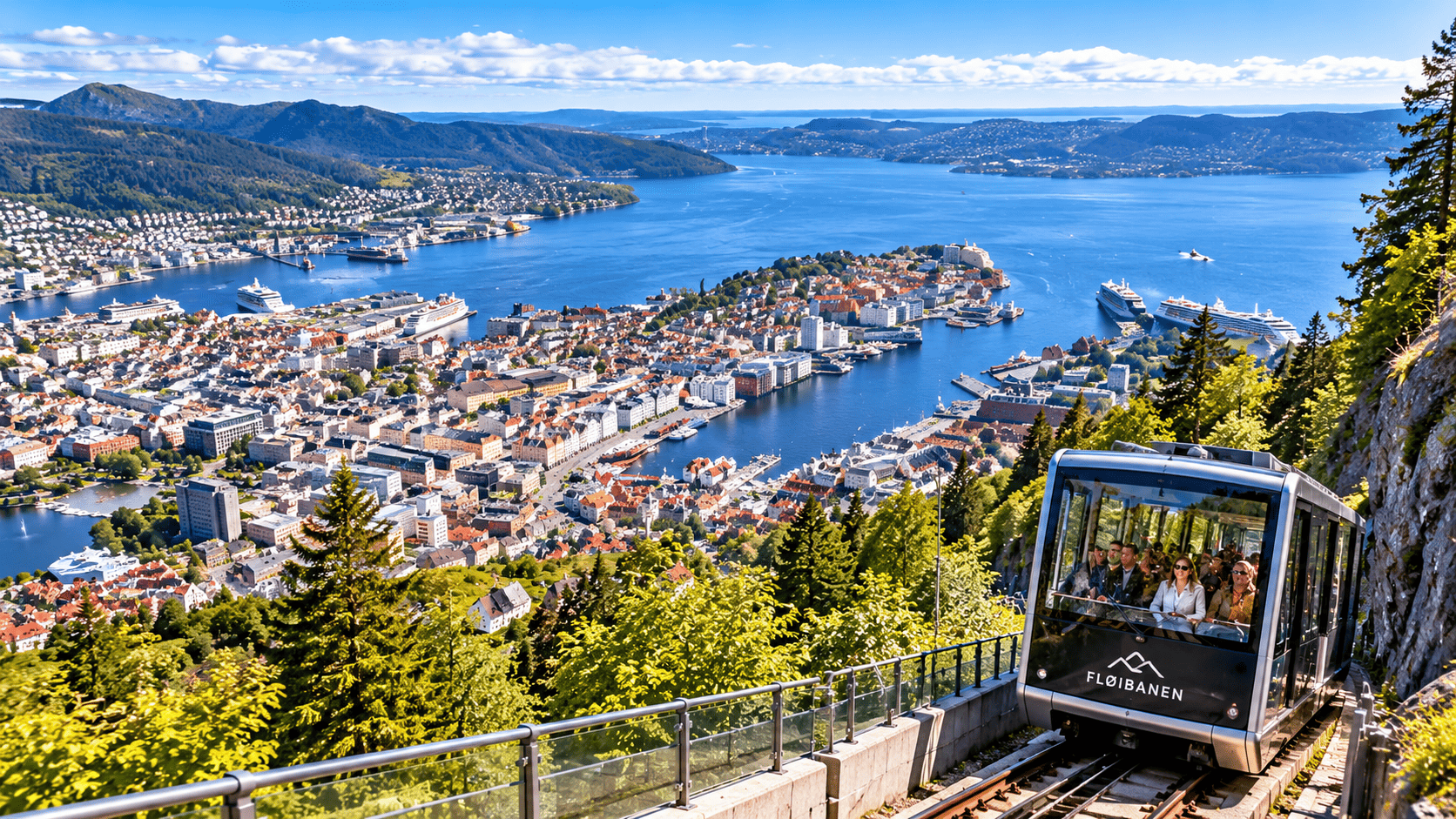
Then you ride the Fløibanen, a funicular railway that has been carrying passengers up Mount Fløyen since 1918. In just a few minutes, it climbs steeply from the city centre through the trees to a viewpoint more than 300 metres above the sea. From the top, the whole of Bergen is laid out below you: the harbour full of boats, the colourful houses of Bryggen, the church spires, the surrounding mountains and the islands and fjords stretching out towards the open sea. On a clear day it's one of the finest city views in Norway. There are walking trails, a lake and a playground at the top, and you may even meet the friendly goats that graze the hillside to keep the vegetation in check.

After lunch, you head to the harbour and board the Fjord Line ship for your second overnight cruise, from Bergen to Hirtshals at the northern tip of Denmark. As the ship sails out of Bergen, go out on deck to watch the city and its mountains slowly disappear, and to enjoy the views of the islands and skerries along the Norwegian coast. The ship has restaurants, shops, lounges and entertainment, and your inside cabin is a comfortable place to rest. Dinner tonight is a Western meal on board. As the evening goes on, the ship heads out into the open North Sea, and you can relax, watch the long summer sunset over the water, and drift off to sleep as you sail towards Denmark, the last country of your tour.

Bergen's trade in stockfish created a surprising link with the cuisines of Southern Europe. For centuries, dried cod from Norway was shipped to Italy, Spain and Portugal, where it became a key ingredient in famous dishes such as Italian baccalà and Portuguese bacalhau. Bergen is also the home port of the Hurtigruten, the coastal ships that have sailed up and down the Norwegian coast since 1893, calling at dozens of small ports on the way north into the Arctic. For many travellers, a voyage on these ships to see the midnight sun or the northern lights is a lifelong dream.

Just outside the city stands Troldhaugen, the lovely wooden villa where Edvard Grieg lived and composed with his wife Nina, overlooking a lake. Grieg's music captured the spirit of Norway's mountains, fjords and folk tales so perfectly that, after a few days in Norway, you may find yourself humming it.

Included today: guided city tour of Bergen with Bryggen, Fløibanen funicular, overnight Fjord Line cruise to Hirtshals in an inside cabin, breakfast, lunch, Western dinner on board.

Good to know: carry a light rain jacket or umbrella in Bergen, even in summer. Pack an overnight bag for the cruise. If you're prone to seasickness, bring motion-sickness tablets, as the North Sea can be choppy.

Day 8
Aarhus and the Infinite Bridge, Odense and the H.C. Andersen Museum, then Copenhagen | Denmark, land of fairy tales

Aarhus and the Infinite Bridge, Odense and the H.C. Andersen Museum, then Copenhagen | Denmark, land of fairy tales

⌖ Copenhagen 🍽 Meals: Breakfast, Lunch, Dinner

Good morning, Denmark! Your ship arrives in Hirtshals, a fishing port on the northern tip of Jutland, the long peninsula that forms most of mainland Denmark. After disembarking, the coach drives south through the Danish countryside. Denmark is very different from Norway: instead of mountains and fjords, you'll see gently rolling farmland, golden fields of grain, neat farms with whitewashed walls, windmills, both old and modern, and long sandy beaches. Denmark is a small, flat country of islands and peninsulas, and wherever you are, you're never more than about 50 kilometres from the sea.

Denmark is also one of the happiest countries in the world, and the Danes have a word for the secret of their contentment: hygge. It's hard to translate, but it means a feeling of cosiness, warmth and togetherness: candles on the table, good food, friends and family, and time to enjoy simple pleasures. The Danes are also famous for cycling; in many cities, there are more bicycles than cars, and you'll see people of all ages cycling to work, to school and to the shops in every kind of weather.

By late morning you reach Aarhus, Denmark's second-largest city, a lively university town on the east coast of Jutland. Your orientation tour shows you its cathedral, the old Latin Quarter with its colourful houses and cafés, and the modern harbourfront with its striking new architecture. Rising above the city skyline is the ARoS art museum, crowned with a circular rainbow-coloured glass walkway on its roof, from which visitors see the city through every colour of the rainbow.

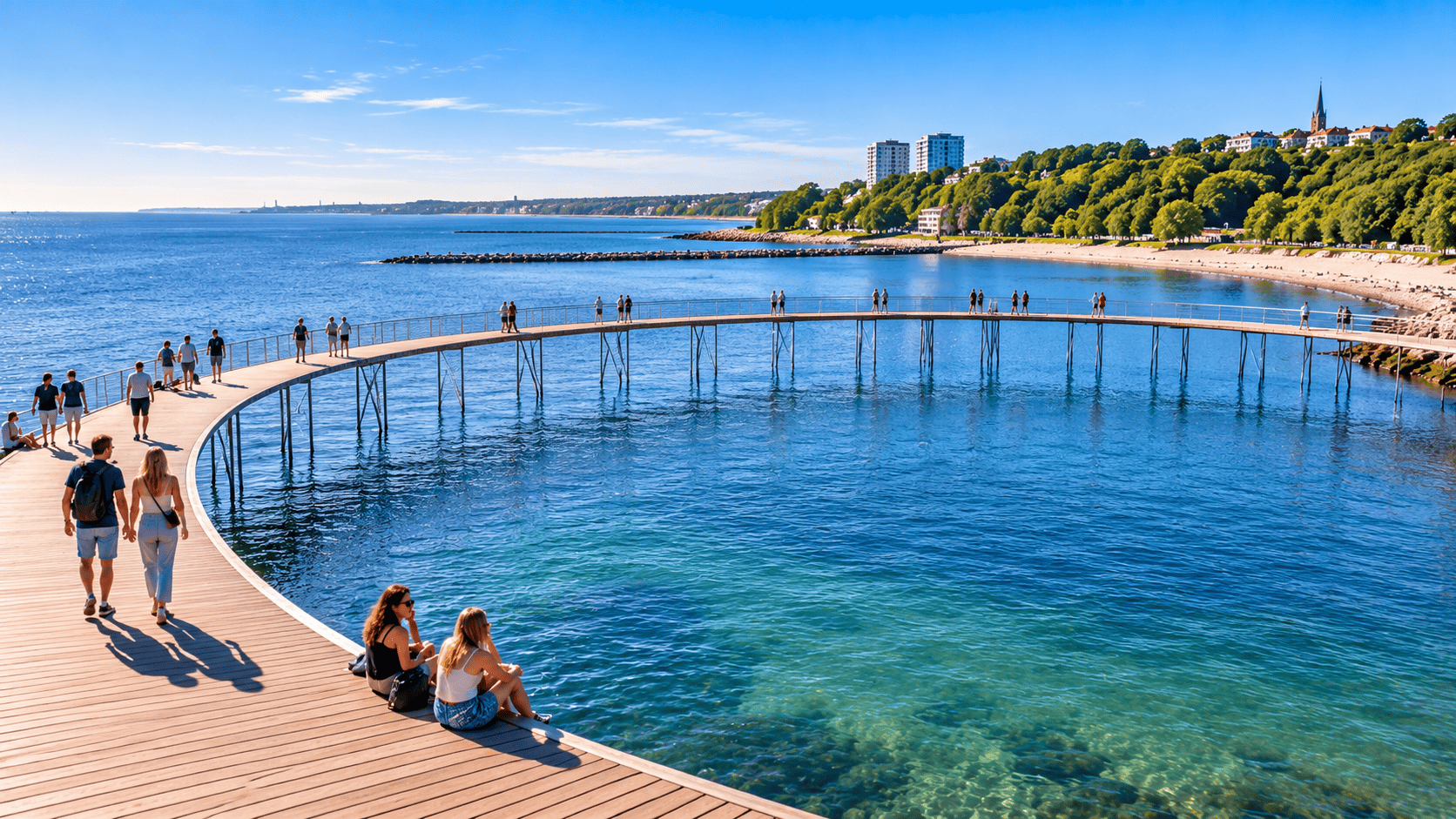
Then you stop for photos at the Infinite Bridge, a circular wooden pier about 60 metres across, standing in the sea just off the beach south of the city. It was built in 2015 as a work of art, and walking around its endless circle, you look out across the bay, back at the forested coast and then towards the city, a different view with every step. It's a peaceful, beautiful spot, especially on a sunny summer day, when the water sparkles all around.

After lunch in Aarhus, you continue south and then east across the island of Funen to Odense, Denmark's third city and the birthplace of Hans Christian Andersen, the world's most famous writer of fairy tales. Andersen was born here in 1805 into a poor family; his father was a shoemaker. Against all odds, he became a writer, and his stories, including The Little Mermaid, The Ugly Duckling, The Emperor's New Clothes, The Princess and the Pea and The Snow Queen, which inspired the Disney film Frozen, have been translated into more than 120 languages and are loved by children everywhere, including in India.

You visit the H.C. Andersen Museum, which reopened in 2021 in a beautiful new building designed by the Japanese architect Kengo Kuma, surrounded by gardens. It's not an ordinary museum: rather than simply telling the story of his life, it invites you to step inside Andersen's fairy-tale world, with magical rooms, sounds, lights and installations that bring his stories to life. Next to it stands the small yellow house where he is believed to have been born. Walking through Odense's old streets, with their colourful, low houses and cobbled lanes, it's easy to imagine the young Andersen dreaming up his stories.

In the afternoon you drive on towards Copenhagen, crossing the Great Belt Bridge, which links the islands of Funen and Zealand. At around 18 kilometres, it's one of the longest bridge connections in Europe, and its East Bridge is one of the longest suspension bridges in the world, with towers rising high above the sea. Crossing it, with water stretching away on both sides, is an experience in itself. By evening you reach Copenhagen, the capital of Denmark, where you check in to your hotel and enjoy dinner.

Jutland also gave the world one of its best-loved toys. In 1932, in the small town of Billund, a carpenter named Ole Kirk Christiansen began making wooden toys. He named his company Lego, from the Danish words "leg godt", meaning "play well". The famous plastic bricks came later, and today Lego bricks are found in homes all over the world. If you have children with you, they'll be thrilled to know they're in the home country of Lego.

At lunch or in a café, look out for smørrebrød, Denmark's famous open sandwiches: a slice of dark rye bread topped with anything from egg and cress to cheese, vegetables, herring or roast beef, arranged so beautifully that they look like works of art. And look up at the flagpoles: Danes love to fly their red and white flag, the Dannebrog, which is often said to be the oldest national flag in continuous use in the world. According to legend, it fell from the sky during a battle in 1219.

Included today: disembarkation in Hirtshals, Aarhus orientation tour, photo stop at the Infinite Bridge, H.C. Andersen Museum entry in Odense, coach to Copenhagen, breakfast, lunch, dinner.

Good to know: today has several hours of driving with stops along the way. Denmark uses the Danish krone, but cards are accepted almost everywhere.

Day 9
Copenhagen city tour, Nyhavn canal cruise, Carlsberg and Tivoli Gardens | The city of fairy tales and bicycles

Copenhagen city tour, Nyhavn canal cruise, Carlsberg and Tivoli Gardens | The city of fairy tales and bicycles

⌖ Copenhagen 🍽 Meals: Breakfast, Lunch, Dinner

Your last full day is in Copenhagen, one of the most liveable, stylish and cheerful cities in the world. After breakfast, your local guide takes you on a tour of the city's highlights.

Copenhagen began as a small fishing village and grew into the capital of a powerful kingdom that once ruled over Norway, Iceland and parts of Sweden. Its name means "merchants' harbour". Today it's famous for its design, its food, its clean harbour, where people swim in summer, and its cycling culture: more people cycle to work here than drive, and bicycle lanes are as wide as roads.

Your tour takes you to the Little Mermaid, the small bronze statue sitting on a rock by the harbour, inspired by Hans Christian Andersen's fairy tale. Unveiled in 1913, she's one of the most famous statues in the world, and many visitors are surprised at how small she is. You'll see Amalienborg Palace, the home of the Danish royal family, made up of four identical palaces around an octagonal square, where the Royal Guard, in their bearskin hats and blue uniforms, change guard every day at noon. You'll also pass Christiansborg Palace, home to the Danish parliament, the Prime Minister's office and the Supreme Court, and the elegant Renaissance Rosenborg Castle, where the Danish crown jewels are kept.

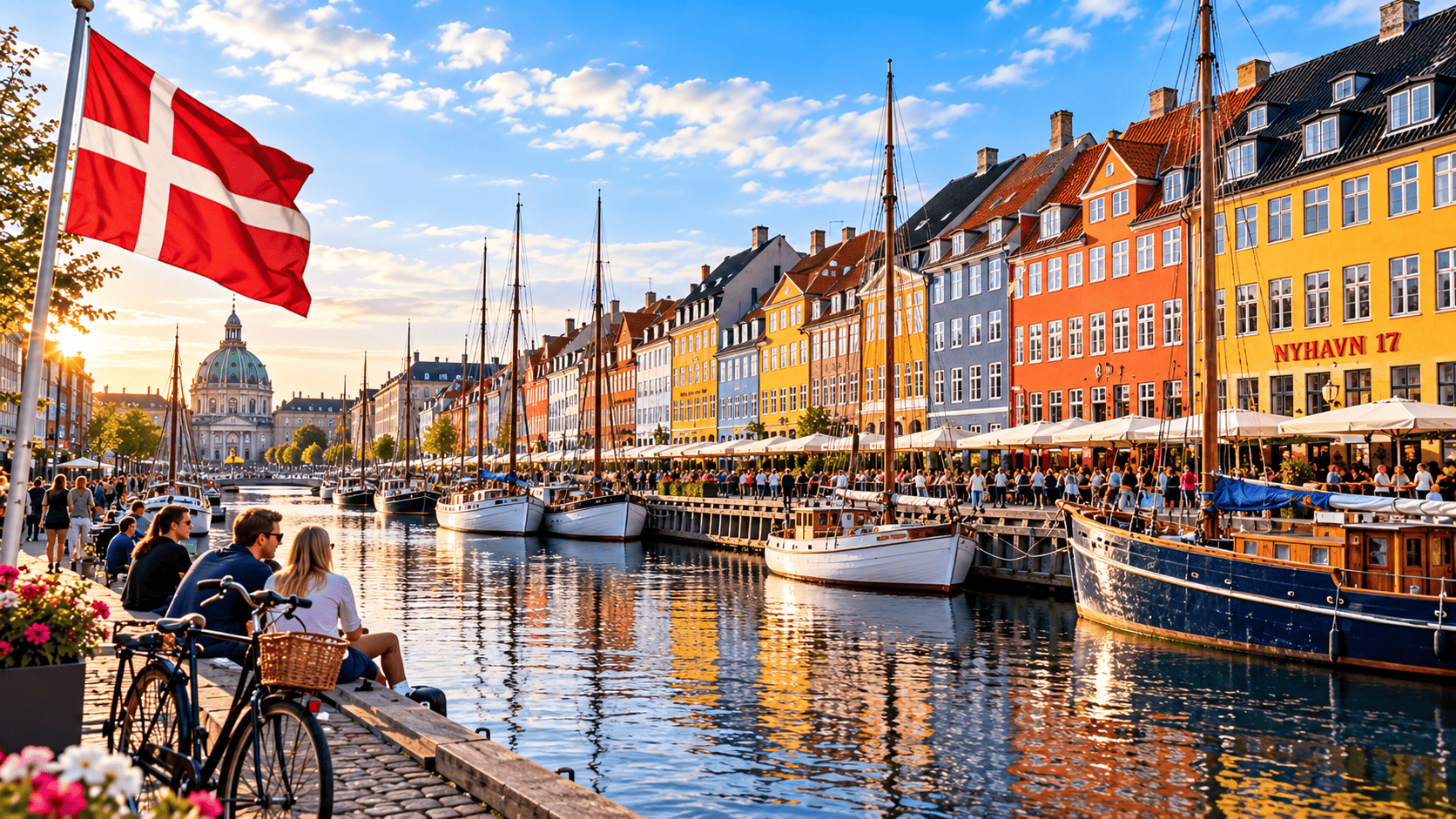
Then comes a cruise from Nyhavn, the most famous and photographed spot in Copenhagen. Nyhavn, which means "new harbour", is a 17th-century canal lined with tall, narrow houses painted in bright reds, yellows, blues and oranges, with old wooden sailing ships moored along the quay and café tables spilling onto the cobbles. Hans Christian Andersen lived in three different houses along this canal. Your boat glides out through the canals and into the harbour, past palaces, the Opera House, the modern Royal Library, nicknamed the "Black Diamond" for its gleaming black glass, and the colourful houses of Christianshavn, giving you a whole new view of the city from the water.

Next you visit Carlsberg, one of the most famous breweries in the world, founded in Copenhagen in 1847 by J.C. Jacobsen, who named it after his son Carl. Carlsberg is about more than beer: its laboratory made scientific discoveries that changed the world. In 1883 a scientist there found a way to produce pure yeast, which transformed brewing, and Carlsberg shared the method freely. In 1909, another Carlsberg chemist, Søren Sørensen, invented the pH scale, which is still used in every science laboratory in the world. Much of Carlsberg's profit goes to a foundation that funds science and the arts. At the brewery, you'll see the famous Elephant Gate, with four giant granite elephants, the historic brewery buildings, and a collection of bottles from around the world, and you'll learn how beer is made. The tour ends with a tasting; soft drinks are available for those who don't drink alcohol.

In the evening you visit Tivoli Gardens, the magical amusement park in the heart of the city. Opened in 1843, it's one of the oldest amusement parks in the world, and it's said that Walt Disney visited and was inspired by it when he dreamed up Disneyland. Tivoli is a fairy-tale world of beautiful gardens, flowerbeds, lakes, Chinese-style pagodas, theatres and restaurants, along with rides old and new, including a wooden roller coaster that has been running since 1914. As darkness falls, thousands of lights come on across the gardens, reflecting in the lake, and the whole park glows like a fairy tale. It's the perfect place to spend your final evening in Scandinavia.

Copenhagen has many more corners to discover. The Round Tower, a 17th-century observatory in the old city, has no stairs inside; instead, a wide spiral ramp winds up to the top, and legend says that the Russian tsar Peter the Great once rode up it on horseback. Strøget, one of the longest pedestrian shopping streets in Europe, runs through the heart of the city, lined with shops, street performers and cafés. Copenhagen is also a world capital of design: Danish chairs, lamps and furniture by designers like Arne Jacobsen are found in homes and offices all over the world, and you'll see their clean, simple style in shops and hotels everywhere. In summer, the harbour water is so clean that locals swim in it at public harbour baths in the middle of the city, diving off the wooden decks between office blocks and apartment buildings. It's a perfect picture of the relaxed Danish way of life.

Included today: guided city tour of Copenhagen, Nyhavn canal cruise, Carlsberg brewery visit with tasting, Tivoli Gardens entry, breakfast, lunch, dinner.

Good to know: the Tivoli entry ticket does not include rides; ride tickets can be bought inside the park. The Little Mermaid is often surrounded by visitors, so be patient for a photo. The brewery tasting is for adults only.

Day 10
Departure from Copenhagen | Home with four countries in your heart

Departure from Copenhagen | Home with four countries in your heart

⌖ Copenhagen 🍽 Meals: Breakfast

Your Scandinavian journey comes to an end today. If you're an early riser, step outside for a last morning walk in Copenhagen. In summer the sun rises before five o'clock, and the city at dawn is wonderfully peaceful: the harbour is calm and glassy, cyclists glide silently along the empty streets, and the first cafés are opening their doors, filling the air with the smell of fresh coffee and Danish pastries. Try a real Danish pastry, a wienerbrød, flaky, buttery and often filled with custard or almond paste, which the Danes, curiously, call "Viennese bread", because the recipe was brought to Denmark by Austrian bakers in the 19th century.

Over breakfast, take a moment to look back on an extraordinary ten days. You began in Helsinki, the capital of the happiest country in the world, and stood inside the Rock Church. You sailed overnight through the islands of the Baltic, arrived by sea in Stockholm, saw the City Hall where the Nobel banquet is held, and marvelled at the 17th-century warship in the Vasa Museum. You drove through the Swedish lakelands to Oslo, walked among Vigeland's sculptures and looked down from the Holmenkollen ski jump. You rode the Norway in a Nutshell trains through the mountains, past roaring waterfalls, and sailed along one of the narrowest fjords in the world. You explored Bergen's colourful Bryggen and rode the funicular up Mount Fløyen, crossed the North Sea by night, walked the Infinite Bridge in Aarhus, stepped into the fairy-tale world of Hans Christian Andersen in Odense, and ended in Copenhagen with Nyhavn, the Little Mermaid and Tivoli Gardens. That's four countries, four capitals and a lifetime of memories in ten days.

Now it's time to pack. Over the past ten days, you may have collected Finnish design pieces, Swedish glass or a wooden Dala horse, Norwegian woollen sweaters or trolls, Danish design, Lego, or chocolate. Wrap anything fragile, such as glass or ceramics, carefully in clothes and place it in the middle of your suitcase. Liquids over 100 ml must go in your checked baggage. Keep your passport, tickets, medicines and a light jacket in your hand luggage. If you made a large purchase and the shop gave you a tax-free form, keep it with the receipt and the goods, as it may need to be checked at the airport before you check in.

After breakfast, you check out and the coach takes you to Copenhagen Airport, on the island of Amager, just a short drive from the city centre. As you approach the airport, look out over the water: you may glimpse the Øresund Bridge, the great bridge and tunnel that links Denmark to Sweden across the strait, made famous around the world by the television series The Bridge. It's a fitting final image of a journey that has carried you across the seas and borders of the Nordic world.

This is also the moment to say goodbye to your tour manager, who has guided you across four countries, two seas and countless miles of mountains, lakes and fjords, and to the friends you've made along the way. Exchange contact details and promise to share your photographs: you'll have plenty of fjords, sunsets and midnight skies to compare.

At the airport there's time for some last-minute shopping and a final Danish pastry or coffee. Then it's time to board your flight home, carrying the memories of the Nordic summer with you.

Over the past ten days, you've also seen how much these four small countries have given the world: Nokia from Finland; IKEA, Volvo and Spotify from Sweden; the Nobel Prizes; Lego and Danish design; and the Norwegian explorers who first reached the South Pole. The Nordic countries are known for their clean environment, their trust in each other, their equality and their care for nature, and you've seen it in their quiet, orderly cities, their spotless public spaces and their love of the outdoors. You may also have noticed that Swedish, Norwegian and Danish are so close that speakers can usually understand each other, while Finnish is a completely different language.

If you've fallen in love with the north, there's much more to discover. In the far north of Norway, Sweden and Finland, above the Arctic Circle, the sun never sets in midsummer, and in winter the sky dances with the green and violet lights of the aurora borealis, the northern lights. Lapland, the home of the Sami people and, according to the Finns, of Santa Claus himself, is a magical place to visit in the snowy season. Perhaps that will be your next adventure.

Included today: breakfast, departure transfer to Copenhagen Airport.

Good to know: book a flight that leaves at least 3 hours after the transfer reaches the airport; we'll confirm the transfer time when you book.

Hotel confirmation

Hotel names will be provided after booking, subject to availability and confirmation. We do not hold hotel confirmations before booking.

Inclusions

Hotels: Guaranteed 04 Star

Meals: All Meals Included

Sightseeing: All Tours included

Exclusions

Flights

Visa

Insurance

GST

TCS

Important Terms

Booking and payment

  • At booking: 30% of the tour cost per person.
  • 30 days before departure: the full balance.
  • Booking within 30 days of departure: 30% to book, and the balance as soon as your booking is confirmed.

Cancellation charges

From booking until 36 days before departure₹30,000 per person35 to 29 days before departure₹60,000 per person28 to 15 days before departure50% of the tour cost14 to 8 days before departure75% of the tour cost7 days or less before departure, or no-show100% of the tour cost


Best time for Scandinavia

Our Scandinavia tours run in late spring and summer, when the fjords are green, the days are long (around 18 hours of daylight in June) and the ferries and mountain railways run their full timetables. Temperatures are usually 15–22°C, so pack layers and a rain jacket.

Scandinavia Tour – Finland, Sweden, Norway & Denmark, 9 Nights / 10 Days FAQs

Does this Scandinavia tour include a Norway fjord cruise?
Yes. The Norway in a Nutshell day includes scenic train rides and a fjord cruise, and you also take two overnight cruises on the Baltic and North Sea.
Which countries does this tour cover?
Finland, Sweden, Norway and Denmark: Helsinki, Stockholm, Oslo, Geilo, Bergen, Aarhus, Odense and Copenhagen.
Can I see the Northern Lights on this tour?
No. This is a summer tour with very long days. For the Northern Lights, see our winter Murmansk tours.
How much does a Norway trip cost from India?
It depends on the departure, cabin and room sharing, and flights. Send us an enquiry for an exact quote.
Are flights included?
No. This is a land tour that starts in Helsinki and ends in Copenhagen. We can add return flights from Delhi, Mumbai or your city, timed to match the group transfers.
Is Jain or vegetarian food available?
Yes. Most lunches and dinners are Indian meals with Jain, vegetarian and non-vegetarian options, and breakfast is a continental buffet at the hotel.
Gallery

Europe photos: Scandinavia Tour – Finland, Sweden, Norway & Denmark, 9 Nights / 10 Days

Plan your Europe holiday with Dreamland Vacations

Share your dates, travellers and comfort preference. Our team will guide you with the next best step.

Get a free quote
Itinerary Get a quote
WhatsApp